So, I'll be up front with you: I've had a really busy week, and thus haven't been able to settle down and do the extensive reading and/or research required for a recommended reading this week. But I want to put up a post every Friday this year, so I went and sat back and tried to think of something to write about or recommend. And then it hit me: Podcasts! I spend much of my day listening to podcasts, and while I don't listen to a lot of directly comics related podcasts, I listen to a lot of great ones that I think you, the reader, might enjoy, and so I'm going to write about a few of them, and since most aren't directly comics related, I'll toss in a comic that shares something with each podcast, so if you're already a fan of that show, you might check out the comic.
The Thrilling Adventure Hour- The Thrilling Adventure Hour (TAH for short) is the show that got me into podcasts aside from listening to NPR that way. I've written about it before, both the recommended reading that is linked there and reviews of the tie-in comics, but if you haven't read those, TAH is, "a new style podcast done in the style of old time radio." A live show, recorded in front of an audience, most episodes are one short segment, featuring a comedic mash-up of classic radio drama tropes. The two regular features were, "Sparks Nevada, Marshal on Mars," a cowboy in space yarn, and the other, my personal favorite, was "Beyond Belief," featuring Frank and Sadie Doyle, a pair of drunken high society mediums, sort of The Thin Man meets Buffy the Vampire Slayer. Various other segments recurred throughout the show's run, and they were all witty, hilarious, and clever. The show also featured a wildly talented cast of regulars, and amazing guest stars. Read the recommended reading for way for detail. Thrilling Adventure Hour stopped regularly releasing episodes over the summer, but there are over 200 available in the shows archives. If you like TAH, you can check out the TAH graphic novel, the Sparks Nevada and Beyond Belief series from Image, and the upcoming Deadpool Vs. Gambit mini-series from TAH creators Ben Acker and Ben Blacker.
Welcome to Night Vale- I was introduced to Welcome to Night Vale through a crossover with TAH, and while it shares a tongue in cheek sense of humor with TAH at times, it is a completely different animal. Welcome to Night Vale, created and written by Joseph Fink and Jeffrey Cranor, is a community radio show from the odd little desert town of Night Vale, a town that has everything you'd expect from a small town: a bowling alley, an old lady, a store, a five-headed dragon, a faceless old woman who lives in your house. You know, the usual. OK, so Night Vale isn't a normal town. One description I read of the show described it as "Garrison Keillor's News from Lake Wobegon by way of Stephen King," and that's a decent, if a bit narrow, elevator pitch for the show. Each episode is narrated by local radio host Cecil Palmer (played by Cecil Baldwin), and while many episodes feature guests, the series really is Cecil's story, about his relationship with his boyfriend Carlos, the scientist, his brother-in-law Steve Carlsberg (don't get him started on Steve), his friend Dana, and all the other people on Night Vale. Cecil's a good guy, and the show develops a deep emotional life for him. But aside from the funny and weird townsfolk and Cecil's day to day life, Night Vale can be honestly very scary, and the horror is used sparingly and to good effect. Welcome to Night Vale is released biweekly on Mondays. If you enjoy Night Vale, check out the Welcome to Night Vale novel, and while I can't think of any comic with the same mix of horror, small town life, and humor, if you want a great small town horror, check out Dark Horse's Harrow County.
You Must Remember This- I love the movies, and I love knowing more about the people who make them. You Must Remember This is the story of, "the secret and forgotten history of Hollywood's first century." Loving researched, written, and narrated by Karina Longworth,You Must Remember This features themed seasons, some of which include stories of stars at war in World War II, Charles Manson's relationship with Hollywood, and the current season, long anticipated by me, about the Hollywood Communist Black List, which has certain terrifying echoes of America as it is now. The history is fascinating, and Longworth's writing and narration are sharp, crisp, and a pleasure to listen to. There are certain episodes that have very direct ties to comic books and Hollywood, such as episodes about Bruce and Brandon Lee, both of whom played comics and pulp characters, Warren Beatty and Madonna's relationship while making the (in my opinion anyway) under-rated comic strip adaptation, Dick Tracy, and Eddie Mannix, MGM's "fixer" who may or may not have been involved in the death of TV's Superman, George Reeves. New You Must Remember This episodes are released weekly on Mondays. One of my favorite comics of the past year has been Ed Brubaker and Sean Phillips's The Fade Out, a Hollywood noir set in the late '40s, and if you enjoyed that, you should definitely check out the current season of You Must Remember This, and vice versa.
Rachel and Miles X-Plain the X-Men- This is the only purely comic podcast on this list, and there's a reason for that. Jay Rachel Edidin and Miles Stokes are lifelong comics fans, specifically X-Fans, and their whole goal with their podcast is to untie the seemingly impossible knot of X-Men continuity. They have a great rapport, great authorial voice to their writing, and know their stuff. They clearly do a lot of research to keep up with the X-Titles. They started at the beginning, with the early Stan Lee stuff, but quickly moved froward into the Claremont era, and are now cycling between three titles, Uncanny X-Men, X-Factor, and New Mutants, in the run up to the mid-80s X-crossover "Inferno." Their excitement about the material is so contagious, listening has gotten me to go out and purchase a complete run of New Mutants (up to the Liefeld stuff. I already have all that in trade) and I plan to start reading it soon. New episodes come out weekly on Sunday. Important note if you're about to start listening: as of this Sunday's new episode, the series name will change to Jay and Miles X-Plain the X-Men, but all existing links should probably redirect. It's harder to pick a particular comic to say to read to get into this show, but a fourth comic is about to enter the rotation, the original run of Excalibur, and both Jay and Miles seem pretty excited about it, so you might want to track that down.
Talkin' Toons with Rob Paulsen- You might not know the name Rob Paulsen, but if you're a fan of animation, you know his voice. Rob Paulsen is one of those great voice actors who has a tremendous catalog of work, from Pinky in Pinky and the Brain, Yakko Warner in Animaniacs, and specifically comics related Raphael in the original Teenage Mutant Ninja Turtles animated series, and Donatello in the current one. And because he's been in the voice actor for the better part of thirty years, he has a lot of friends who do the same work. So, what Rob likes to do is sit down with his friends (some at their home, some in front of a live audience) and talk about their experience as voice actors, their process, and their favorite voices. Some of my favorite episodes include one with the creators of Rick and Morty, one with the cast of Adventure Time, and ones with various members of the classic DC animated universe cast members, including Clancy Brown (Lex Luthor), Jeffrey Combs (The Question), and Mark Hamill (The Joker). Talkin' Toons has had a less regular release schedule recently, but there are plenty of episodes on the archive and new episodes appear when Rob can fit them into his busy schedule. If you love cartoons of any kind, Talkin' Toons is a must listen, and many of the guests have comics that tie into their work, so just check out that list and pick a comic.
These are just five of the numerous podcasts I listen to regularly, and it's an amazing time where there's such a variety of different options to listen to. So I ask you readers: Do you have a favorite podcast? I'd love some new recommendations. Comment here, on Facebook, or Twitter, where I'm @mattlaz1013.
Showing posts with label x-men. Show all posts
Showing posts with label x-men. Show all posts
Friday, March 4, 2016

Thursday, February 18, 2016
Matt and Dan Go to the Movies- Deadpool

Dan Grote: Guys, I’m biased. You know
that. Of the 119 posts I’ve written for the Matt Signal since February 2014,
nearly 38 percent have been about Deadpool. This is a fan’s review.
That said,
this movie nails it. Is it the best comic book movie ever? No. Is it the best
Marvel movie? Also no. Is it the best possible filmic representation of my
favorite character? Yes.
Ryan
Reynolds, director Tim Miller and screenwriters Rhett Reese and Paul Wernick
gave us a Wade Wilson who was funny, filthy, F’d up, violent and as much a
thorn in the side of his enemies as his allies, all key ingredients in a
Deadpool stew. If this movie were created purely as fan service, then sir or
madam, I have been serviced.
And it’s a
love story. Morena Baccarin (Gotham, Firefly) plays Vanessa as Wade’s equal
in tragic backstory and sexual depravity. Trailers appeared to give her a
little more to do than be damseled, which turns out not to be the case, but the
strength of their relationship is still the movie’s emotional linchpin.
Matt Lazorwitz: And because the love
story is important to the plot, the love story works! Since I only write about
things I like on here, I’ve never discussed how love stories in superhero
movies often feel tacked on, and lack chemistry between the leads. There are
exceptions clearly (Chris Evans and Haley Atwell as Cap and Agent Carter jump
immediately to mind), but often the standard romantic subplot in a superhero
movie leaves me cold. Here though, because it’s important and it underlines so
much of Wade’s motivation, it makes sense.
And aside from
plot elements, Reynolds and Baccarin play off each other wonderfully. As Dan
said, Baccarin plays her part as Wade’s equal, but she also is tough as nails
and has a life her own. When Wade leaves, she goes on with her life; she’s not
pining for him when he decides to come back. Morena Baccarin is becoming an actress
with a ton of comic book acting credits, between Leslie Thompkins on Gotham, the voice of GIDEON on The Flash, and voicing Talia al Ghul in
recent DC Direct-to-DVD films, but I have to say Vanessa is my favorite of her
roles in a comic book property (Firefly/Serenity
doesn’t count as a comic book property, so no angry comments).
DG: If there was one character I would
have loved to have seen more of, it was Leslie Uggams’ Blind Al. I could have
watched another five minutes of her and Wade arguing about Ikea furniture or
Wade stroking her face with his regenerating baby hand. More of her in the
sequel, please.
Deadpool
works best when someone is trying to realign him from chaotic neutral to
chaotic good. For the purposes of the film, that realigner is Colossus, a CGI
character voiced by Stefan Kapicic, inheriting the role from Daniel Cudmore.
Kapicic’s Colossus is a cartoon. His accent is ripped straight from the ’90s
animated series (I kept waiting for him to yell “Illyana, my sister!”), and his
personality is something out of a G.I.
Joe public service announcement, whether he’s encouraging his trainee,
Negasonic Teenage Warhead, to eat a healthy breakfast or lecturing Deadpool
about how killing is wrong. I’m not saying that’s a bad thing. To the contrary,
it was just another thing that kept me laughing.
ML: Negasonic Teenage Warhead is a
really deep cut, an obscure Grant Morrison character, played wonderfully by
relative newcomer Brianna Hildebrand. Her quiet, sullen, surly teenage girl
could easily have been eye-rollingly over played, but she keeps the right balance
to it, and I liked that she and Wade wound up being friendly, if not friends.
Also, it was great to see that under her Goth clothes she’s wearing an X-Men training
uniform similar to those in the comics and in X-Men: First Class; little nods to the existing continuity make me
smile.
DG: So can we all agree the final fight
scene was staged at one of the three SHIELD helicarriers that blew up at the
end of Captain America: The Winter Soldier? Obviously, nobody
involved with the movie is ever going to confirm this, but I’m pretty sure a
lot of people’s head canons are synchronized on this one.
ML: And little nods like that are part
of Deadpool. There are a lot of references to Ryan Reynolds somewhat checkered
past with superhero movies, like comments about green CG costumes and a mouthless
X-Men Origins: Wolverine Weapon XI
action figure. Also, while there is no Wolverine cameo, Deadpool makes a few
barbed references to Fox’s previous mutant cashcow. And the fourth wall is
completely shattered when Colossus says he’s bringing Wade to see Professor X,
and not only does Wade ask “Stewart or McAvoy” but makes a continuity joke.
These aren’t the jokes for every viewer, there are plenty of those, but the
writers didn’t forget to lay out their fanboy Easter eggs.
Also, from a
strictly movie making standpoint, the film had some great fight choreography.
Sure, there are the standard bullet-time shots, but Wade’s pure brutality is
spot on, and the fights are stylish. Also, credit for one of the best super
strength fights I’ve seen between Colossus and Angel Dust. And while the
soundtrack isn’t Guardians of the Galaxy’s
“Awesome Mix,” the schizophrenia of bouncing from Juice Newton’s cover of “Angel
of the Morning” to DMX’s “X Gon’ Give it to Ya” to Neil Sedaka’s “Calendar Girl”
(used in a way I bet he never imagined) to Team Headkick’s “Deadpool Rap” seems
to speak perfectly to the spirit of the character and film.
DG: The closing credits thank Rob
Liefeld and Fabian Nicieza, who co-created the character 25 years ago, but so
much of this movie’s DNA comes from writer Joe Kelly and artists like Ed
McGuinness and Walter McDaniel who worked on the early issues of Deadpool’s first
solo series. Ajax, Blind Al, Sister Margaret’s Home for Wayward Girls, Wade’s
self-loathing and aversion to/infatuation with becoming a hero, the origin of
his name and the already-dated-no-matter-how-topical cultural references are
all Kelly’s brainchildren. And while we’re doling out credit, the fourth-wall
breaking comes from Christopher Priest, the pansexual winks come from the
Internet, and Nicieza is responsible for Weasel, Vanessa and Bob. Dopinder the
cab driver is an original character.
Yes, the
post-credits scene was anticlimactic, but that was part of the movie’s
metatextual commentary. And, hey, I’m still pretty excited that we’re getting
[redacted] in the sequel.
Wednesday, December 23, 2015
The Matt Signal Advent Calendar 2015 Day 23: Wolverine & the X-Men "Greetings from Genosha"

Wolverine and the X-Men
Season 1, Episode 10, "Greetings from Genosha," 2009
Matt Says:
Bet you thought I'd go for another Cyclops-centric episode, huh? Nope, for Wolverine and the X-Men I went with an episode about my second favorite X-Man, Nightcrawler. Nightcrawler is as criminally miswritten as Cyclops in so many modern stories, but this animated series got him pitch perfect: swashbuckling, fun, but still with a sort of inner sadness from being treated as an outsider because of his looks.
But this episode, where he arrives on Magneto's mutant haven of Genosha, sees Kurt in a place where he doesn't have to hide or get sidelong glances from everyone he passes. He gets a tour guide in Scarlet Witch, and gets to go to a concert with her. But when things look to good to be true, they probably are, and Kurt finds the underbelly of Magneto's order, and what's great about Kurt is he doesn't think twice: he does what's right immediately, even though it means he has to give up his burgeoning romance with Wanda and the place where he finally fits in. That nobility is one of the many reasons Nightcrawler is such a great character.
One of the best things about Wolverine and the X-Men was the vast well of characters that the series drew from. X-Men stuck to '90s characters mostly, and X-Men: Evolution didn't stray too far from its core cast. This episode, set on Genosha, allows the animators and team to go wild with mutants. Dazzler appears in her original '70s costume.'90s Acolytes Senyaka, Scanner, and Mellancamp appear. Sauron is shown in Magneto's prison. And '00s characters Mercury, Pixie, Squid Boy, and Dust (a phenomenal character animated beautifully here) all have speaking parts. And sharp-eyed viewers even get to see Wolfsbane run across screen. It's an X-Men Easter egg hunt of epic proportions.
Sunday, December 13, 2015
The Matt Signal Advent Calendar 2015 Day 13: "Pryde of the X-Men"

“Pryde of the X-Men”
X-Men cartoon pilot, 1989
Dan Says:
Seems hard to fathom today, but Marvel tried twice in the
1980s to launch an X-Men cartoon but couldn’t get past a pilot (or a backdoor
pilot, in the case of the “X-Men Adventure” episode of Spider-Man and His Amazing Friends).
“Pryde
of the X-Men” featured a classic team lineup – Professor X, Cyclops, Storm,
Wolverine, Nightcrawler, Colossus, Dazzler, Kitty Pryde – and went on to
inspire a 1992 arcade game memorable for its great multiplayer action and bad
English dubbing (“X-chickens, welcome to die!”).
In the cartoon, Magneto is freed from a military prison by
the White Queen and leads the Brotherhood of Evil Mutants – Juggernaut, Pyro,
Blob and Toad – on a mission to steal the magical orb that powers Cerebro so he
can enhance his powers and take control of a comet hurtling toward Earth
because magnets.
The animation style is reminiscent of G.I. Joe, my favorite cartoon from that decade. And for a 20-minute+
pilot, there are some pretty spot-on X-moments. Kitty, the POV character, is
afraid of Nightcrawler at first because of his demonic appearance, but she
comes to adore the fuzzy elf fairly quickly. Magneto is his classic Silver Age
self, right down to verbally abusing Toad. One could even argue that, while
underused, the “Pryde” version of Storm is superior to her ’90s cartoon
counterpart, in that she doesn’t make a histrionic speech every time she uses
her powers. No one’s gonna meet this goddess AT THE MONORAAAAAAAIIIL!!!!
Is it a perfect toon? Oh, heavens, no. There’s plenty to
nitpick, which I won’t do here, but it’d be weird if we didn’t point out that Wolverine,
whose Canadian-ness is essential to his character, is voiced with an Australian
accent. He even calls Toad a dingo at one point. I might appreciate this more
if, through some sort of script mix-up, Pyro, who is actually Australian, had
been voiced with a Canadian accent. “Ooh, soory I singed you there, eh? Put a
Molson on that, it’ll cool right off.”
Financial troubles allegedly kept this version of X-Men from
becoming a series, but just three years later, we got what was for many the
definitive X-Men cartoon. “Pryde of the X-Men,” however, was nothing if not
valiant in the attempt.
Saturday, December 12, 2015
The Matt Signal Advent Calendar 2015 Day 12: Spider-Man and His Amazing Friends "The X-Men Adventure"

Spider-Man and His Amazing Friends
“The X-Men Adventure,” Season 3, Episode 7, 1983
Dan Says:
This one’s pretty silly, so I’m including it mainly for
nostalgic purposes.
Spider-Man and His
Amazing Friends, which ran from 1981 to 1983 Saturday mornings on NBC, was
an odd mix of pulling characters from all over the Marvel Universe and making
stuff up as it went along. “The X-Men Adventure” is the perfect example of
that.
For starters, Spidey’s Amazing Friends, Iceman and Firestar,
were graduates of the Xavier School for Gifted Youngsters, but Firestar – whom
we now know as a former New Warrior, Avenger and X-Man – was created for the TV
show and for some reason in her civilian identity looked exactly like a more
conservatively dressed Mary Jane.
The X-Men, for the purposes of this episode, are Professor
X, Cyclops, Storm, Nightcrawler, Colossus, Sprite aka Kitty Pryde and …
Thunderbird. You know, the X-Man who died on his first mission? Oh, and he can
transform into a grizzly bear apparently.
Notice anyone missing? Someone with adamantium claws,
berserker rage and a penchant for cigars and samurai swords?
In this episode, Spidey and his pals visit the X-Mansion and
play around in the Danger Room. Until the mansion is invaded by that classic
X-Man villain Cyberiad, who only ever appears in this single cartoon.
Cyberiad is half-man, half-machine, literally, right down
the middle of his body. At one point, he gets into an actual fight with
himself. In a past life, he was a noted physicist, and apparently he and
Firestar used to date.
Firestar is a college student.
Cyberiad tricks and traps the X-Men one by one, then creates
holograms of the kidnapped mutants to trick the other members of the team. Why
not just use Arcade? Good question, I’ve no idea. Eventually, the X-Men corner
Cyberiad, and Firestar kills him with a radiation blast.
Kills him. On a Saturday morning cartoon meant for younger
viewers.
It sounds like I picked this episode just to mock it, but
fun fact: Legend
has it “The X-Men Adventure” was supposed to be a backdoor pilot for an
actual X-Men cartoon. Obviously, that did not pan out, but eventually we got “Pryde
of the X-Men,” and not long after that we got the ’90s X-Men cartoon we all
know and love. So let’s respect this episode for the wacky cartoon forefather that
it is.
Monday, December 7, 2015
The Matt Signal Advent Calendar 2015 Day 7: X-Men "Time Fugitives"

X-Men
Season 2, Episodes 7 and 8: “Time Fugitives,” 1993
Dan Says:
What’s better than one time traveler with a big gun, facial
scarring and distinctive theme music? TWO time travelers with big guns, facial
scarring and distinctive theme music!
The 1990s X-Men
cartoon introduced both Cable and Bishop during the first season, but a
two-parter during season two saw them fighting each other in the present to
correct terrible things that were happening in their respective futures. At the
heart of those terrible things was Apocalypse, who was plotting to wipe out
humans and weaker mutants with a techno-organic virus while disguised as a
scientist working for Graydon Creed and the Friends of Humanity.
To 13-year-old me, who was just getting into comics and
loved the X-Men, this two-parter was crazy-town banana pants. Apocalypse was
empirically the show’s best villain. He was big, menacing and given the biggest
bad-guy rants, saying things like “I am as far beyond mutant as they are beyond
you.” He literally got to identify himself as the end of the world. That’s
gangsta. And Cable and Bishop both represented the attitude of comics in
general at the time, each having been co-created by the then-future founders of
Image Comics (Cable: Rob Liefeld and Bishop: Jim Lee/Whilce Portacio). And they
were all shooting lasers at each other. That’s probably the 1993 equivalent of
the Cap-Tony-Bucky fight in the Civil War
trailer.
Also there were certain characters on the cartoon who got
their own cool theme music. Bishop’s blues-y harmonica and Cable’s paramilitary
synths were two of my favorites. Mr. Sinister’s menacing four-note theme was a
close third.
Friday, December 4, 2015
The Matt Signal Advent Calendar 2015 Day 4: X-Men: Evolution "Blind Alley"

X-Men: Evolution
Season 3, Episode 5: “Blind Alley” 2002
Matt Says:
X-Men: Evolution was the excellent animated series that treated most of the classic X-Men as if they were actually kids going to school, splitting their time between mutant classes at the Xavier school and regular classes at a regular high school. It was a great show that played with its own alternate version of X-Men history and built some great versions of classic X-characters.
If you've read anything I've written about the X-Men, you know I'm a Cyclops fanboy and apologist. And while I grew up with the decidedly less impressive version from the classic X-Men animated series, the version of Evolution is phenomenal, a clean cut leader and good kid who isn't either whiny or white bread, and his spotlight episode, "Blind Alley," is a favorite of mine. In it, Mystique, seeking revenge for Scott leaving her trapped for human authorities to find, tricks him into coming to Mexico and then strands him in the desert without his ruby quartz visor or glasses, and Scott has to survive without them.
The episode shows Scott fighting coyotes in the wild, accidentally blowing the roof off the hospital when he's brought into Mexico City, fighting off a street gang, and eventually fighting off Mystique, all using his wits and a minimum of optic blasts. The final fight with Mystique, where they fall into a dark basement where they both can't see and Scott uses this to his advantage, is brilliant. With no background music, you listen with Scott as he waits for Mystique to brush against something or grunt so he can make his move. It spotlights his tactical mind in a way most other Cyclops stories don't.
Also, this episode forwards the relationship between Scott and Jean Grey. They had been sort of dancing around each other for a few episodes, but here, the psychic bond that was forged earlier in the series really blossoms. It's fun to watch the X-Men repairing the school after yet another cataclysm, and Cyclops and Wolverine working on the roof together, having shirtless bro time (it's really the only way to describe it), where Scott asks Logan, who is older and a teacher here, for advice about Jean (it's important to know that in this version, Wolverine does not have the hots for Jean). It's a nice character moment for both characters.
As with The Tick from yesterday, the DVD release of X-Men: Evolution was incomplete. The first two seasons were released in single four episode discs, the third as a complete season, and the fourth was never released at all. Between continued interest in the X-Men and recent attention brought by episode recaps and a special podcast by Jay Rachel Edidin of the wonderful Rachel and Miles X-Plain the X-Men podcast, it would be a good time to get this whole series out there.
Wednesday, July 8, 2015
All-New Marvel WOW and Image Excitement: Titles We’re Excited About This Fall
Last week saw the announcement of a ton of new series from both Marvel and Image, and there are a bunch of those that have both Dan and me really excited. Here's a rundown of those series.
Totally Awesome Hulk (Matt): Greg Pak is second only to Peter David as my favorite Hulk writer, so it's exciting to see him back. And Frank Cho draws an awesome giant monster, so he's a great choice for the book. And if my supposition on the identity of the new Hulk is correct, (c'mon Amadeus Cho!) I'll be even more excited.
All-New All-Different Avengers (Dan): The old order
changeth! For real this time! Writer Mark Waid, hot off a great run on
Daredevil and currently rebooting Archie, and artist Adam Kubert roll out a new
Avengers lineup featuring Original Recipe Iron Man, Captain America (Sam
Wilson), Thor (Jane Foster), the Vision, Ms. Marvel (Kamala Khan), Spider-Man
(Miles Morales), and Nova (Sam Alexander). And, despite the fact that Tony Stark
is in the picture, they apparently have no money. The best part of this is
seeing all the new faces on the team. Considering Kamala’s penchant for writing
Avengers fan fiction, I’m especially interested to see how she reacts to getting
called up to the big leagues.


Daredevil (Matt): I've loved Mark Waid's run on Daredevil, which is evident to anyone who has read any of my reviews of the title, of which there have been many. And while I'm sad to see it go, I can't think of a better writer to take over than Charles Soule, who just happens to be a lawyer, and who wrote my favorite short-lived Marvel series since Captain Britain and MI-13 closed up shop, last year's She-Hulk series. I'm hooping he can bring that same wit and legal sense to Marvel's premiere superhero lawyer. Ron Garney is a great choice for penciler, as his work on Wolverine showed a sense of dynamism and how well he draws ninjas, a plus with DD.
Deadpool (Dan): YAY! DEADPOOL’S NOT DEAD ANYMORE! Not that I ever thought that was going to stick. Homeboy’s got a movie coming out next year! Writer Gerry Duggan and artist Mike Hawthorne return to keep being awesome.


Doctor Strange (Dan): It’s a bit of shame that Doctor
Strange hasn’t been able to carry a series in recent years, especially
considering how important he’s been to big stories like the Infinity Gauntlet and Secret Wars. But I have faith in this
new title, both because Marvel needs to give the doctor a big push with a movie
coming out next year and because of the creative team assigned to him. Jason
Aaron has done amazing work for Marvel in recent years on Wolverine & the X-Men and Thor,
and few artists do dark and trippy as well as Chris Bachalo. Plus check out
that sweet ax Doc’s been wielding in the promo art.
Extraordinary X-Men (Dan): I haven’t read X-Men on the regular since the days of Grant Morrison, but I’m intrigued by this title, which features a classic lineup: Storm (Mohawk), (Old Man) Logan, Nightcrawler, Colossus, Iceman, (young) Jean Grey, and Magik. It’s almost as if Marvel realized the X-Men needed a flagship book! Best of luck to new X-writer Jeff Lemire (Sweet Tooth, All-New Hawkeye) and artist Humbero Ramos (The Amazing Spider-Man).
Howling Commandos of S.H.I.E.L.D. (Matt): I love Marvel monsters. I think Werewolf by Night is seriously underrated as a character. And so a book of monster heroes working for S.H.I.E.L.D. lead by Dum-Dum Dugan, a favorite agent of S.H.I.E.L.D. and the only guy I know who can rock a bowler hat and a walrus 'stache, sounds like a great book. Frank Barbiere's Five Ghosts from image has had some great supernatural twists and turns, and while I'm not familiar with artist Brent Schoonover, a little internet research has show some great work, so I'm pleased to see where this goes.


Karnak (Dan): Of all the new Marvel titles, this one, about the Inhuman whose power is to see the fatal flaw in every scenario, is the one I never thought would ever exist. But given it’s being written by Warren Ellis, whose bitter British wit I’ve loved since he wrote Excalibur 20 years ago, I’m willing to give it a shot.
Sam Wilson, Captain America (Dan): I’m on record about my
love of the Steve Rogers-Sam Wilson dynamic, and I’m happy to see Sam’s still
wearing the colors, as much as I found myself burned out by previous writer
Rick Remender’s kitchen-sink approach dating to Uncanny X-Force. The new series by
writer Nick Spencer (Morning Glories,
Ant-Man) and artist Daniel Acuna (Uncanny Avengers) appears to show a rift
between Steve and Sam, and I’m hoping it injects some new life into Cap’s
adventures.
Spider-Man 2009 (Matt): Despite ending on something of a cliffhanger before Secret Wars, I wasn't sure we'd see this title return. But here it is! Peter David and Will Sliney return, giving Miguel O'Hara a new costume and hopefully keeping up the same fun and action that the first volume had.
And from last week’s Image Expo:


Black Magick (Matt): Ok, Greg Rucka could write anything and I'd read it. Nicola Scott could draw anything and I'd look at it. Combine the two with the words "supernatural" and "police procedural" and I might have my new favorite book of 2015 staring back at me sight unseen.
Camp Midnight (Matt): Steven T. Seagle has written a lot of very smart comics, and is best known for his work for Vertigo. But outside of comics, he's best known as part of the Man of Action studio, that created the hugely popular Ben 10 franchise. With artist Jason Katzenstein, he's combining his comics background with his all-ages work to give us Camp Midnight, the story of one of only two human campers at a summer camp for monsters. Sounds like a fun OGN to me.
Crosswind (Matt): Gail Simone is writing a creator owned book for Image? Sign me up. Add in strong art from the talented Cat Staggs and the concept of a no-nonsense hitman swapping minds with a frazzled housewife, and this looks like another home run from Simone, whose early Killer Princesses is a lost gem of hitwoman hilarity.
Private Eye (Dan): Brian K. Vaughn and Marcos Martin’s
formerly digital-only series, about a future in which personal privacy is so
guarded that everyone wears a mask, is finally being printed through Image. If
Vaughn (Y the Last Man, Ex Machina, Saga) has written a bad story, I haven’t read it.

Snotgirl (Dan): Color me intrigued by this series about a
fashion blogger with severe allergies, written by Bryan Lee O’Malley (Scott Pilgrim) with art by Leslie Hung.
The promo art for this series features a traditionally beautiful woman with
green snot running down her face.
Wednesday, June 24, 2015
Does a Mall Babe Eat Chili Fries? 10 Best Episodes/Stories of the 1990s X-Men Cartoon

This week marks the print debut of X-Men ’92, a digital-first Secret
Wars series by writers Chris Sims and Chad Bowers and artist Scott Koblish
based on the Fox Saturday morning cartoon that ran from 1992-97. I’ve written
about the
glory that is that cartoon before, as has Sims, but
as I’ll never pass up an opportunity to talk about one of the seminal shows of
my teen years, here’s a look at some of its best work:
A caveat before we begin: I have a soft spot in my heart for
the kitchen sink episodes that feature multiple guest stars. And time travel.
And Apocalypse. Also I’m going to cheat and write up multiparters as one
episode each.


“Night of the Sentinels” (two-parter, Season 1, episodes
1-2): Seriously, does a mall babe eat chili fries? When X-fans of a Certain Age
remember Jubilee, this is the Jubilee they remember, the one with the yellow
trench coat and the past-its-prime Valley Girl speak, getting chased down by
Sentinels. The two-parter that opens the series is also notable for introducing
a brand-new X-man, Morph, just to kill him off immediately (he gets better),
imprisoning Beast for an entire season, Cyclops making a “not” joke and a scene
in which the president of the United States power-walks on a treadmill in the
Oval Office while dressing down Henry Peter Gyrich.


“Slave Island” (Season 1, episode 7): “Who are you?” “The Wild
Man of Borneo.” The time-traveling, gun-toting, shoulder pad-embiggening Cable
introduces himself on the island of Genosha by making a reference I was too
young to get at 12. Not to mention, if Cable’s from the far future, should HE
even get that reference?

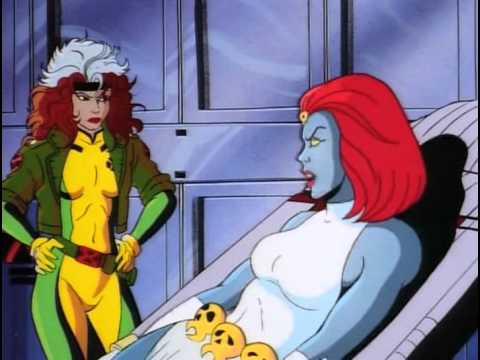
“The Cure” (Season 1, episode 9): This episode introduces
several major X-villains, including Apocalypse, Mystique, Pyro and Avalanche.
The latter two, who will return along with Blob as Mystique’s Brotherhood of
Evil Mutants, get a lot of play as a pair of violent but somewhat bumbling
henchmen, and their comedic timing is made evident from jump.


“Days of Future Past” (two-parter, Season 1, episodes
11-12): This two-piece kills two birds with one stone, adapting a Chris
Claremont/John Byrne classic (not the first time they’ll go to that refreshing
well) and introducing the best mullet in time travel, Bishop, who comes
complete with his own harmonica music. In this version, Bish comes back in time
to stop the assassination of Sen. Robert Kelly by the traitor Gambit (attempted
assassin not actually Gambit).


“Time Fugitives” (2-parter, Season 2, episodes 7 and 8):
What’s better than one overly muscled time traveler with a ridiculous laser
gun? TWO overly muscled time travelers with ridiculous laser guns! Bishop and
Cable come to the present from two different points in the future to wrestle
over Apocalypse and a virus that wracks mankind. Craziest thing that happens: A
change in the timestream creates lightning tornadoes in Cable’s future and
makes his son, Tyler, disappear.
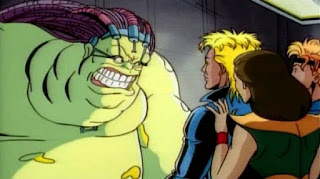

“Mojovision” (Season 2, episode 11): No X-Men series would
be complete without a visit to the Mojoverse. Because a morbidly obese,
spineless extradimensional being obsessed with television is the perfect baddie
for a Saturday morning cartoon.

“The Phoenix Saga” (5-parter, Season 3, episodes 3-7): Most
of the Season 3 is dedicated to revisiting the Golden Age of the Claremont run,
which means lots and lots of Phoenix stuff. These five episodes re-create
classic moments with the Phoenix Force, the Shi’ar, Erik the Red, Juggernaut
and Black Tom Cassidy, Banshee, the Starjammers and, best of all, Super
Doctor Astronaut Peter Corbeau.


“The Dark Phoenix Saga” (4-parter, Season 3, episodes 11 to
14): The show peaked with this mostly faithful retelling of the classic 1980
Claremont/Byrne story, hitting all the major points, from the Hellfire Club to
Jason Wyngarde’s mental manipulations of Jean Grey to the first appearances of
Dazzler and Kitty Pryde. While the arc concludes in a way that is more network BS&P-friendly
than the original (Jean is saved by sharing the “life forces” of the other
X-Men as opposed to, you know, dying), it still laid the groundwork for future
adaptations of X-stories outside the comics (and was better than X-Men: The Last Stand).


“One Man’s Worth” (2-parter, Season 4, episodes 1-2): That’s
right, kids, more time travel! In a story that could have only been told in the
’90s and after Back to the Future II,
Trevor Fitzroy travels back to 1959 to kill Professor Xavier, creating an
alternate dystopian timeline in which Magneto leads the X-Men and Wolverine and
Storm are married. Bishop, his sister Shard, Storm and Wolverine then go to the
future to convince Forge to let them use his time machine so they can go back
and stop Fitzroy in the past. Then Marty goes to the Old West to rescue Doc
Brown, only to find out he doesn’t want to be saved because he’s fallen in love
with Mary Steenburgen. And another Tannen falls for the old manure trap.


“Beyond Good and Evil” (4-parter, Season 4, episodes 8-11): Because
this cartoon made Apocalypse my favorite X-Men villain, I might have been more
excited about this arc than I was about the Dark Phoenix retelling, despite my
earlier statement about the show having peaked in Season 3. Apoc kidnaps a
number of psychics, including Professor X, Jean Grey and Psylocke, as part of
his latest quest for global domination. His actions are undone by the X-Men and
Cable, as well as Bishop, who finds himself stuck in a place called the Axis of
Time with a quirky janitor who turns out to be the Avengers villain Immortus. “Beyond
Good and Evil” was originally supposed to be the end of the series, until Fox
ordered more episodes. And so after this, the animation style changes and we
got wrong-sounding Gambit.


In addition to writing
for The Matt Signal, Dan Grote is now the official comics blogger for The Press
of Atlantic City. New posts appear Wednesday mornings at PressofAC.com/Life. His
new novel, Magic Pier, is available however you get your books online. He and Matt have been
friends since the days when Onslaught was just a glimmer in Charles Xavier's
eye. Follow @danielpgrote on Twitter.
Wednesday, April 22, 2015
Fit to Be Tied In: A History of Marvel Crossovers and Events- Part 5: Onslaught to Second Coming: Even More X-overs
So you guys remember when Charles Xavier turned Magneto into
a vegetable in X-Men #25 during “Fatal
Attractions?” Well, apparently a small part of Magneto had burrowed into
Xavier’s head as a result and was corrupting him from the inside, causing him
to do things like rocket-punch the Juggernaut into Hoboken and create Post. These
events led to the big companywide crossover of summer 1996, Onslaught, named for the hot mess that
was supposed to be the combined personalities of Xavier and Magneto. Onslaught encompassed all the X-books,
the Avengers, the Fantastic Four and the Incredible Hulk, and featured cameos by
Dr. Doom, Apocalypse and the Watcher. In defeating Onslaught, the Avengers, FF
and Doom end up getting sucked into a pocket dimension created by Franklin
Richards that led to a yearlong series of books under the banner Heroes Reborn, featuring the return to
Marvel of Image ex-pats Jim Lee and Rob Liefeld. In their absence, Xavier was
arrested for being Onslaught, a new character named Bastion fed the flames of
anti-mutant hysteria, fellow mutant-hater (and mutant supervillain progeny)
Graydon Creed ran for president and a new team of superheroes showed up called
the Thunderbolts.
The events of Onslaught would later inspire Rick Remender’s work on Uncanny Avengers and a recent, equally
messy crossover called Axis.

Bastion is the focus of the next year’s crossover, Operation: Zero Tolerance. The Master
Mold-Nimrod hybrid uses an army of human-sentinel hybrids called Prime
Sentinels to capture key members of the X-Men under the aegis of the U.S.
government. He is apprehended by SHIELD in a scene in which he gets a stern
talking-to by, of all people, Iceman, who is in revenge mode after his father
was beaten to death by Graydon Creed’s lackeys before Creed was assassinated.
OZT marks the addition of two new X-Men: the Morlock-Gene Nation member Marrow,
whose body produces weapons made of bone, and Dr. Cecilia Reyes, a reluctant member
who has force-field powers.
Next came the “Hunt for Xavier,” a tight crossover of the
two main X-books in which the X-Men fight a Cerebro that has gained sentience –
apparently all the X-Men’s tech has to Pinocchio at some point (see also the
Danger Room) – and the professor is found to be working with the Brotherhood of
(Evil?) Mutants.
The next two X-overs center on heavy-hitter villains. “Magneto
War” restores the master of magnetism from bearded vegetable to top-dog baddie
and gets rid of Joseph, the young Magneto clone who had ingratiated himself
among the X-Men for the past few years. The story ends with the United Nations
ceding to Magneto the island of Genosha, which hadn't been messed with in a
while, so it was ripe for the picking.

The dawn of the new millennium brought the long-promised
reveal of “The Twelve,” a group of mutants who were predicted to … do
something. It turns out that something is power a machine that would help
Apocalypse take over the body of Nate Grey, the refugee from the Age of
Apocalypse. Sadly, nearly 15 years of build-up (The Twelve were first mentioned
in an early issue of X-Factor) didn’t
quite deliver the story some were hoping for. Nevertheless, the Twelve were
revealed to be Magneto, Polaris, Storm, Sunfire, Iceman, Cyclops, Jean Grey,
Cable, Bishop, Professor X, Mikhail Rasputin (?) and the Living Monolith (???).
Apocalypse fails to possess Nate Grey but ends up possessing Cyclops instead.
After a series of reality-warping stories called Ages of Apocalypse, Chris Claremont returns to the X-books and
jumps them forward six months for some ill-explained power swaps, couple swaps
and guys-named-Thunderbird swaps.
Then for a while, nothing happened … well, not really, but
the early 00s saw a series of writers rotate through the X-books. Chris
Claremont came and went, followed by Scott Lobdell, then Grant Morrison and Joe
Casey, then Chuck Austen, then Joss Whedon and Claremont yet again, et al.
Brian Michael Bendis wrote an X-Men/Avengers crossover called House of M, which we’ll touch on in the
next post.
At this point, all but 198 of Earth’s mutants have been
depowered, and the X-Men are super bummed about it. Then, for the first time in
a long time, Cerebra (the sequel to Cerebro, which met its demise in the “Hunt for
Xavier”), picks up a blip in Alaska, a state crawling with Summers family
blood.

Which brings us to 2007-08’s “Messiah Complex,” the first of
three crossovers that will center on Hope, the first baby born after M-Day. Complex
finds the X-Men in a race against Mr. Sinister’s Marauders and the Rev. William
Stryker’s Purifiers to find Hope. Among its significant events, Xavier is
rendered comatose, Mystique kills Sinister, Cyclops sanctions Wolverine to form
a new X-Force that will serve as the X-Men’s secret kill squad, Bishop loses
his crap and suddenly remembers Hope is the Antichrist of his timeline, and
Cable takes Hope into the future to raise her, because if the future was good
enough for Cable, then goshdarnit, it’s good enough for his adopted daughter.
Cable and Hope return from the future in 2010’s “Second
Coming,” which is largely a battle of military wits between Cyclops – who by
now has turned the remaining mutants into a paramilitary strike team all living
on the same island off San Francisco – and Bastion – who has resurrected all
your favorite mutant-haters, from Cameron Hodge to Graydon Creed. The good guys
win, but at a pretty hefty price: Both Cable and Nightcrawler are killed (obviously
they've both since gotten better). The story ends with Cerebra registering five
new blips, launching a series called Generation
Hope that would last 17 issues.
Internecine strife (lowercase, with an i) among the X-Men
reaches a boiling point in 2011’s Schism
miniseries by Jason Aaron, which saw Cyclops and Wolverine break the X-Men into
two different camps, one of which stayed on the island off San Fran and the
other of which rebuilt the Xavier Institute and renamed it the Jean Grey School,
in a split that remains to this day.

For more good guys fighting good guys, stop by later this
week for a look at the Bendis age of Avengers crossovers, from Disassembled to
A vs. X.
Dan Grote’s new novel,
Magic Pier, is available however you get your books online. He has been writing
for The Matt Signal since 2014. He and Matt have been friends since the days
when making it to issue 25 guaranteed you a foil cover.
Thursday, April 9, 2015
Fit to Be Tied In: A History of Marvel Crossovers and Events Part 2- Mutant Massacre to Muir Island Saga- The Crossovers of Chris Claremont
These days, a month that goes by without more than a dozen
X-books weaving stories into each other is an anomaly. But 30 years ago, in
that strange time known as the 1980s, such a thing was a novel idea.
Back then, Chris Claremont was in charge of nearly all the
mutants and two ongoing series: Uncanny X-Men and the New Mutants. The original
five X-Men, however – Cyclops, Marvel Girl, Beast, Iceman and Angel – were
under the purview of Louise Simonson in the earliest incarnation of X-Factor.

What brought these three teams (and also Thor and Power
Pack) back together in 1986? Genocide. A new group called the Marauders was
slaughtering the Morlocks, a community of mutants that lived in the sewers
below New York. The Mutant Massacre
was one of Claremont’s darkest, most violent stories to date, and had some of
the most lasting effects on the X-books. Angel’s wings were broken and later
amputated, leading him to become Apocalypse’s Horseman Death. Nightcrawler and
Shadowcat were injured and left the team to recuperate on Muir Island, which
led to them co-founding a new team, Excalibur. In their place would come
Psylocke and, later, Dazzler and Longshot. Sabretooth – a Claremont creation
ported over from his run on Iron Fist – would stake a claim as a major X-villain
and specifically an arch-nemesis of Wolverine. The Marauders’ employer would
later be revealed as Mr. Sinister, the mad geneticist obsessed with the Summers
bloodline. The Massacre would also later be tied in to the backstory of Gambit,
who would not appear in the comics for another four years.
Next, in 1988, came Fall
of the Mutants, which wasn’t so much a crossover as a label that appeared
on the three main X-books but was considered a major event nonetheless, not the
least so because the X-Men died … for about a minute.

The X-Men and Madelyne Pryor sacrificed themselves fighting
the Adversary, a Native American demon god linked to Forge, during a battle in
Dallas. Upon vanquishing their foe, Roma, the daughter of Merlin, resurrected
them, made them invisible to technology (a plot thread that, near as I can
tell, just sort of disappeared) and gave them access to the Siege Perilous, a
one-time transporter that, once a person passes through it, basically gives
them a new life somewhere else with no memories of their previous one until
such time as a writer finds that inconvenient. Meanwhile, in X-Factor, the team
fights Death, aka Archangel, and breaks him of Apocalypse’s control, and in New
Mutants, Doug Ramsey, aka Cypher, is shot and killed by The Right, an
anti-mutant group led by Cameron Hodge, whose name will pop up a few more times
in this post.

The following year brought an Inferno to the streets of New York in a convoluted plot involving,
in no particular order, the demons of Limbo, inanimate objects coming to life,
Pryor becoming the underboob-exposing Goblin Queen, Colossus’ sister Illyana
being reverted from a magic-wielding sorceress back to a child, Hodge making a
deal with demons for immortality, a number of babies – including the baby that
would grow up to be Cable – being stolen to complete a spell, Pryor being
revealed as a clone of Jean Grey created by Mr. Sinister, the Spider-Man
villain Hobgoblin becoming a demon, another demon getting infected with
Warlock’s Transmode Virus, the X-Men and X-Factor fighting each other, and the
X-Mansion being destroyed again. Inferno
cast
a wide net, stretching from the X-books to Spider-Man and Daredevil to,
quite sensibly, Damage Control, the Marvel Universe’s post-event cleanup crew.
And Power Pack. Those kids got a lot of hangtime in the ’80s.

Hodge surfaces again in 1990 as a creepy spider-robot with a
human face pulling the strings on the mutant-enslaving island of Genosha in The X-Tinction Agenda. By
this point, Jim Lee was drawing Uncanny
X-Men and Rob Liefeld had come aboard New
Mutants, so we’re starting to see some of the deck-clearing exercises that
will pave the way for X-Men #1 and X-Force #1 a few months down the line. Some
of the X-Men who went through the Siege Perilous are reunited. Cable has taken
over the New Mutants. Storm is restored from her de-aged self back to an adult
weather goddess, and she introduces everyone to the creepy Cajun friend she
made while evading the Shadow King. Havok is revealed to have been working as a
Genoshan magistrate. Wolfsbane of the New Mutants is turned into a Genoshan
mutate, or slave. Warlock is killed. A bunch of people see former British woman
Psylocke as an Asian ninja for the first time. And the Genoshan government is
toppled – literally; Rictor destroys their Citadel.

The Claremont age ends in summer 1991 with a mini-crossover
called the Muir Island Saga that
straddles Uncanny X-Men and X-Factor. The Saga served a few goals: It
wrapped up a long-running (there’s no other kind with Claremont) arc involving
the Shadow King; it re-crippled Xavier; it reunited the X-Men with their
original members to form an all-killer, no-filler superteam that would need two
books to hold them; and it transitioned X-Factor from a book about the original
five X-Men to a book about a government-sponsored mutant team written by Peter
David. If you have any affection for Jamie
Madrox, Strong Guy or Polaris, it starts in X-Factor #70.
Next week, Matt takes us into space for some cosmic
crossovers, so bring your favorite Infinity Gem and prepare to get Annihilated.
Dan Grote’s new novel,
Magic Pier, is available however you get your books online. He has been writing
for The Matt Signal since 2014. He and Matt have been friends since the days
when making it to issue 25 guaranteed you a foil cover.
Wednesday, December 31, 2014
The Strike File Strike File

I had started on Stryfe’s Strike File as an entry for the Advent
Calendar, but after nearly doubling the 250-word limit I had set for myself
on Advent entries, I realized it required further study, and additional jokes.
The X-books were obsessed with G.I. Joe-esque character profiles
for a while in the early ’90s. They filled the back pages of issues of X-Factor
and X-Force, and finally got a full book of their own at the end of the "X-Cutioner’s Song" crossover, written by the man in the spiky metal costume
himself (through his servants Scott Lobdell and Fabian Nicieza) and full of
melodramatic screeds and portents of plotlines yet to be abandoned.
At 13, I pored over this book ceaselessly, looking for clues
to the future. At 34, I read passages like “So do I love you or hate you? Do I
nurse at your breast or do I tear at your throat? Do I look for you, if I
survive the final curse of my mad song?” and chuckle while shaking my head.
Among the events and new characters the one-shot foretold:
-Colossus’ defection to the Acolytes
-Illyana’s death from the Legacy virus
-Graydon Creed, though it’s pretty much spelled out that his
dad is Sabertooth.
-Threnody, who would appear months later in X-Men #27 as a
pawn of Mr. Sinister.
-Sienna Blaze, who would later get shunted into the Malibu
universe.
-A sketch by Larry Stroman that hinted at the coming of
Revanche, aka The Other Psylocke, a confusing storyline that served as my
introduction to the X-Men comics.
Other things worth noting:
-“Collectable” is misspelled on the cover
-It miscounts the number of Upstarts: Under
a listing for Graydon Creed, they are called a quartet. In fact, not including
their referee, the Gamesmaster, the Upstarts included Fabian Cortez, Graydon
Creed, Trevor Fitzroy, Shinobi Shaw, Sienna Blaze and the Fenris twins.
-Gideon is referred to as the “Ziggy Stardust of the
corporate boardroom,” which may be my favorite phrase in the whole book.
-Cannonball is foretold to be a major leader of mutantkind, which,
as I wrote about during the Advent Calendar, hasn’t
quite panned out 20 years later.

-It introduces Holocaust, but an exoskeleton-less version of
the character, who would not actually appear in the comics for two years, and
then in the Age of Apocalypse reality, though he would eventually cross over.
Stryfe’s file on the character is all questions and vagaries, as if the writers
themselves were like, “Yeah, somebody did a sketch of this guy, and we’ll
probably use him, but we don’t actually know anything about him yet.”
The writing itself is exceedingly melodramatic. Of course,
Stryfe had just spent the entire "X-Cutioner’s Song" ranting and raving and
giving verbose speeches, so it’s not like it was out of character. But it made
me yearn for the Stryfe of the Askani’Son
limited series from 1995, when Scott Lobdell and Jeph Loeb wrote the Chaos
Bringer as more of a young Joker.
The framing device for the issue is that Xavier finds a
computer disk with the files on it at Stryfe’s base on the moon. Xavier looks
through all the files, decides information about the near future would make
Scott and Jean’s fragile hearts explode, and erases the disk. It wouldn’t be
long before he ended up doing the same thing to Magneto …
… which is ironic, because of all the 1993 plotlines he
foretold, Stryfe completely misses the climactic event of the biggest X-story
of the year to come. Because Stryfe actually believes he killed Xavier during
the "X-Cutioner’s Song" and that Magneto died on Asteroid M back in 1991. What a
dummy.

Earlier “strike files” in X-Factor and X-Force featured the
private files of Apocalypse and Cable, respectively.
Apocalypse’s “Manifesto” files ran in X-Factor #65 and #66
and featured portentous ramblings on the five members of the team, which were
then the original five X-Men. Though X-Factor was written by Chris Claremont
and Whilce Portacio at the time, Nicieza wrote the Apocalypse files, and you
can see the same love and care went into writing these as did the Stryfe files,
when he calls Archangel “The birth spawn of my soul, if not my loins.” Great,
now I have to picture Apocalypse’s Apoca-loins!
Cyclops’ file reminds readers he is one of The Twelve, “the
archetype beings that will one day save or damn mutantkind.” This refers to a
comment made by the Master Mold waaaaay back in the series’ early days. The
Twelve subplot would lie largely dormant for nearly an entire decade before
coming to the fore in a year-2000 X-Men crossover about Apocalypse attempting
to siphon the mutants’ powers to achieve omnipotence. The rest of The Twelve
were Xavier, Magneto, Jean Grey, Iceman, Polaris, Sunfire, Storm, Cable, Bishop
and, fresh from obscurity, Mikhail Rasputin and the Living Monolith. Nate Grey
was additionally revealed as The Thirteenth, intended to provide Apoc with a
new body.
There was one neat moment of most-likely-unplanned foresight
in Apocalypse’s files. Of Beast, he writes, “If not for the rape of will
performed by Xavier, Hank could have been a son of my own heart, my own pain,
my own fears.” This perfectly vaguely describes the so-called Dark Beast of the
Age of Apocalypse, who would not meet the page for almost four years.

Cable’s files, which appeared in X-Force #1, featured
then-new characters Deadpool, Feral, Shatterstar and G.W. Bridge, and,
according to Comic
Book Legends Revealed, were apparently a cheap way to cram Deadpool into
the issue without actually including him in the story.
Of the walking cat with Bride of Frankenstein hair known as
Feral, Cable writes: “Feral will sit on your lap, purring for attention one
second, and just as easily kill a passing bird and drop it at your feet for
approval the next.” Also, she hates Mondays and there is video of her playing a
keyboard on the Internet.

Another one-shot character guide was published during the
Age of Apocalypse, in which En Sabah Nur separated the alternate reality’s
major players into categories of Chosen and Forgotten. Despite being a
proponent of survival of the fittest, there were more Chosen than Forgotten.
This one doesn’t work as a vague prognosticator of the future, however, as this
version of Earth was meant to go away with the storyline in just a couple
months’ time. But hey, it’s nice to know there’s a world where characters like
Wild Child, Abyss, Mikhail Rasputin and Aurora are elevated to stations of
importance.
Dan Grote has been a
Matt Signal contributor since 2014 and friends with Matt since there were four
Supermen and two Psylockes. His two novels, My Evil Twin and I and Of Robots, God and Government, are available on Amazon.
Friday, December 12, 2014
The Matt Signal Advent Calendar 2014 Day 12: X-Men (Vol.2) #1

X-Men (Vol. 2) #1, August 1991
My first #1 may have been
Spider-Man Unlimited #1, part of the Maximum
Carnage crossover, which Matt touched on earlier in this calendar. I don’t
remember what my first X-book #1 was. Considering I started collecting in
earnest in 1993, it was probably Generation X #1, which came out the following
year. So let’s say this was the first #1 I bought on the back-issue market. And
if X-Force #1 tries to argue, I’ll
make fun of its high-top ponytail.
X-Men #1 had everything: A bigger team than ever before,
Magneto, Nick Fury, a brand-new X-Mansion, art by Jim Lee, collect-’em-all
variant covers, verbose exposition by Chris Claremont (the last X-fans would
see for
a while), a cameo by President George H.W. Bush in which he uses the word
“prudent” and a new band of henchmen
in the Acolytes.
The Acolytes were the first of a number of new characters
created during a new era for the X-Men, including Bishop, the Upstarts, Omega
Red and Colossus’ long-lost brother Mikhail Rasputin. That first year also saw
creators shuffling on the regular, with Claremont leaving X-Men after issue 3,
Jim Lee and Whilce Portacio leaving the books to help found Image, John Byrne
temporarily plotting stories and, finally, the ascension of Scott
Lobdell and Fabian Nicieza, which is about where I came in.
The X-Men of fall 1991 – Prof. X, Cyclops, Wolverine, Storm,
Beast, Jean Grey, Gambit, Rogue, Jubilee, et al – formed the backbone of the
cartoon that debuted on Fox the following year. That cartoon was my formal
introduction to the characters, which in turn led me to seek out the
source material, which brought me to my first local comics shop – the Hobby
Shack on Morris Avenue in Union – which is how I started collecting back
issues, including the one I’m currently writing about. My point is, TIME IS A
FLAT CIRCLE!
Subscribe to:
Posts (Atom)