Showing posts with label charles soule. Show all posts
Tuesday, July 19, 2016
Reviews of Comics from Wednesday 7/13
Daredevil #9
Story: Charles Soule
Art: Goran Suduka & Matt Milla
Daredevil is probably my favorite non-cosmic or mutant Marvel character. I've read his book regularly since the Marvel Knights relaunch, and have picked up plenty of back issues and trades along the way. And I was absolutely in love with Mark Waid's run on the series, with it's lighter tone. And I was excited when Charles Soule, an actual lawyer whose legal-centric run on She-Hulk is one of my favorite Marvel series in the past decade. The tone of his first arc was darker, as was his Daredevil, more akin to Bendis then Waid, and it took me a little while to adjust to the darker tone. But this two part story, of Daredevil in Macau playing poker and fighting the Triads, finds a nice balance between the dark Daredevil and the light one, helped by the guest-star: Spider-Man. Soule writes a great Spidey, quipping away constantly, and the less quippy Daredevil is a great straight man for him, and brings out the sense of humor in Daredevil, who makes his own share of quips. The majority of the issue is a chase, as Daredevil and Spidey chase a briefcase, the reason that Daredevil came to Macau to begin with. Artist Goran Sudzuka draws some amazing fight scenes, full of acrobatic action and flying billy clubs. But it's the character moments between Daredevil and Spider-Man that really makes the issue sing. The two of them, riding a hydrofoil from Macau to Hong Kong while basically parasailing using web-lines and billy-club lines, and Daredevil enjoying it. And the end of the issue, as Daredevil explains to Spider-Man why Spidey suddenly has holes in his memory involving Daredevil and what the briefcase is continues to show that Daredevil didn't fully think out whatever plan he had to remove the knowledge of his identity from the world. With all that going down, Soule gives Spidey one of the best last lines I've read in a long time, " Watch out for those black-costume phases. They can really do a number on you." It's a smart callback to one of Spidey's legendary stories and an acknowledgment of exactly where Daredevil seems to be now. This issue has me excited to see where exactly Soule plans to take Daredevil.
Detective Comics #936
Story: James Tynion IV
Art: Alvaro Martinez, Raul Fernandez, & Brad Anderson
Detective Comics just might be my favorite book out of the DC: Rebirth relaunch. After last issue's finale, with Batman taken out by the group of armored Bat soldier called The Colony, this issue opens with a much quieter moment: Kate Kane, Batwoman, out at a bar with her ex, GCPD detective Renee Montoya, talking about Kate's time in the military and her role as a leader. There's clearly still strain in their relationship, but I have to say, it's great to see Renee again. A call from Red Robin gets Batwoman to the belfry to watch the video of the assault on Batman, and they quickly call in the rest of the team, as well as Kate's father, Colonel Jake Kane. And as the others, including Kane, gather, Oprhan, Cassandra Cain, is attacked by the Colony. And it's only once Kane is in the Belfry that the other shoe falls: The Colony is a military project that Kane is in charge of, and he's here to recruit Batman's team, as well as get access to the Bat computer for the mission he has for The Colony. And even as the team makes their escape, Kane is sure that his plan will still work. The whole scene with Kane talking to the team, and to Kate specifically, is brilliantly tense. All the problems that Kate and her father have been having since Greg Rucka's original run on Detective, all the secrets and lies that have been pushing them apart, come to a head here. The idea, that the government would use Batman's example to create a black ops force, is a cool one, and the fact that it's being used against Batman and his allies is all the more intense. And placing Batwoman's father, Batman's uncle, at the head of it? I love it. All of this while working in strong character development and interactions between the cast, especially Batwoman and Red Robin, makes it an exciting and thoughtful read. The art from Alvaro Martinez is excellent, especially in the hints of the fight between The Colony and Orphan; most of it takes place off panel, but you see the set-up, as the soldiers surround her against a rainy and lightning filled Gotham sky, and the end, as she finishes off one of the soldiers, crashing to the floor of the Belfry through the skylight. It's beautiful, and shows the strength and speed of Orphan, and is stylishly done. Each issue of Detective has been better than the last, and as the fight with The Colony amps up, I can't wait to see where it goes.
Stumptown #10
Story: Greg Rucka
Art: Justin Greenwood & Ryan Hill
Each case private investigator Dex Parios has been involved in since the beginning of Stumptown have been byzantine affairs no matter how simple they seem on paper. But this issue, "The Case of the Night That Wouldn't End" is a one off story that has a couple of twists to it,because what good PI story doesn't, but is at its heart fairly simple: Dex is hired to find out if a man's wife is cheating on him, and she follows the wife to a motel. The issue actually features two of my favorite types of comics: a great one off issue, and a great mostly silent issue, both of which are few and far between in comics nowadays (and don't I sound like an old fogey?). Justin Greenwood tells the story with his art as ex silently watches her suspect and a younger man meet at the motel, but not everything is as it seems. There are little details about their interactions, plus what's going on with a courier skateboarding out in the rain that are hints to things going on deeper with all these characters. PI and mystery shorts are some of the trickiest to write, since you have to establish everything and have it pay off not only for the reader the first time, but also on a second reading if they already know the solution, and this story succeeds. Rucka doesn't forget about Dex's personal life, or lack thereof, as we get hints of exactly how bad Dex is at dealing with personal relationships through a series of texts. It's a really solid introduction to the world of Stumptown, so if you're looking for a good crime comic, and want to get in and try it before the new volume starts in January, this is a great place to start.
Monday, June 6, 2016
Reviews of Comics from Wednesday 6/1
Batman: Rebirth #1
Story: Tom King & Scott Snyder
Art: Mikel Janin & June Chung
The whole DC Universe is, well, being born again with Rebirth, and so it's time to reset that Batman status quo back to closer to, well, status quo in Batman: Rebirth. There's a passing of the creative baton, as this issue is co-written by Scott Snyder, who has been writing Batman for the past fifty-plus issues and new series writer Tom King. The issue ties up a bunch of plot threads, including fixing Bruce Wayne's issues with his fortune and exactly how Duke Thomas, late of We Are Robin and a semi-regular part of Snyder's run since the "Zero Year" storyline, will fit into the series moving forward. While there's a lot of table setting for the future, and tying up of plot threads from the previous run, we also get a solid done in one story that reintroduces a "classic" Batman foe, the Calendar Man. I use the quotes because the original version of Calendar Man has been mostly forgotten, and the version that most people know is the version from Batman: The Long Halloween and Batman: Dark Victory. But as with many of the other villains that Snyder re-introduced in his run on Batman, he's added a little bit to the mythos, adding a supernatural or metahuman angle, where Calendar Man changes with the seasons, dying in winter and being reborn in spring, becoming a better version of himself each time. Batman is working to find a way to stop Calendar Man's new mad scheme, where a device is speeding up the seasons, allowing not just Calendar Man's cycle to speed up, but to release deadly spoors on Gotham in the "spring" which would be week's end. It's a crazy super science plot, but that makes it cool to me; it's not grounded in some grim, gritty reality, but it superhero comics at their best. It also does something that I love with Batman: he pushes the limits of what a human is supposed to be able to do. It's not ridiculous, superhuman stuff, but a man who is pushing himself beyond what any human has done because it's what he needs to do to save his city. That's what makes Batman an optimistic character in my mind: he does what he does because he needs to save his city. The art by Mikel Janin is extraordinary, gorgeous and fluid, and is a step up from his already impressive work on Grayson. Seriously, DC, you need to get this man on a Batman book again, and you need to do it soon. If the Rebirth one-shots are designed to get readers excited about the new direction for the DC titles, Batman: Rebirth does a great job.
Buffy: The High School Years- Freaks & Geeks
Story: Faith Erin Hicks
Art: Yishan Li & Rod Espinosa w/ Tony Galvan
There have been plenty of Buffy the Vampire Slayer comics, from the original series that ran concurrently with the series to the recent series that continue the TV series for three more seasons. I know many fans who are of mixed feeling about those later seasons, so this, the first in a series of original graphic novels set during seasons 1 & 2 of the TV series, is for them. This story feels right out of the first season of Buffy, as a matter of fact, since she doesn't know about Angel being a vampire yet, it's easy to squeeze it into the timeline. The story sees a Buffy, who is new to Sunnydale and her friends, is coming to terms with her status as more of an outcast and not the popular girl she was before she moved to Sunnydale. The antagonists are a group of four recently turned vampires, who were geeks before they were sired, and thought they'd be cool now that they were undead, but instead are simply geeks in the vampire set. And when they're told that the way to get in with the vamp set would be to kill the Slayer, well, they set out to do it. And since I said this takes place during season one of Buffy and the comic is now in season ten, you can guess who wins. Still, it's interesting to see the vampires call Buffy out on being a bully, as they're used to the pretty girls picking on them, and see how Buffy reacts to it. It embraces ll the angst that made those early seasons of Buffy classics. You can hear the dialogue in the voices of the actors it's so spot on. And while the story embraces the unlimited budget of comics to produce a spell and a creature that would be difficult on a TV show's budget, it doesn't let that fact drown out the character driven nature of the best Buffy stories. I've enjoyed the comic universe of recent Buffy stories, but there's something nice about returning to these early years, when the most Buffy had to worry about was failing a test and the occasional apocalypse.
The Shadow: The Death of Margo Lane #1
Story & Art: Matt Wagner
Colors: Brennan Wagner
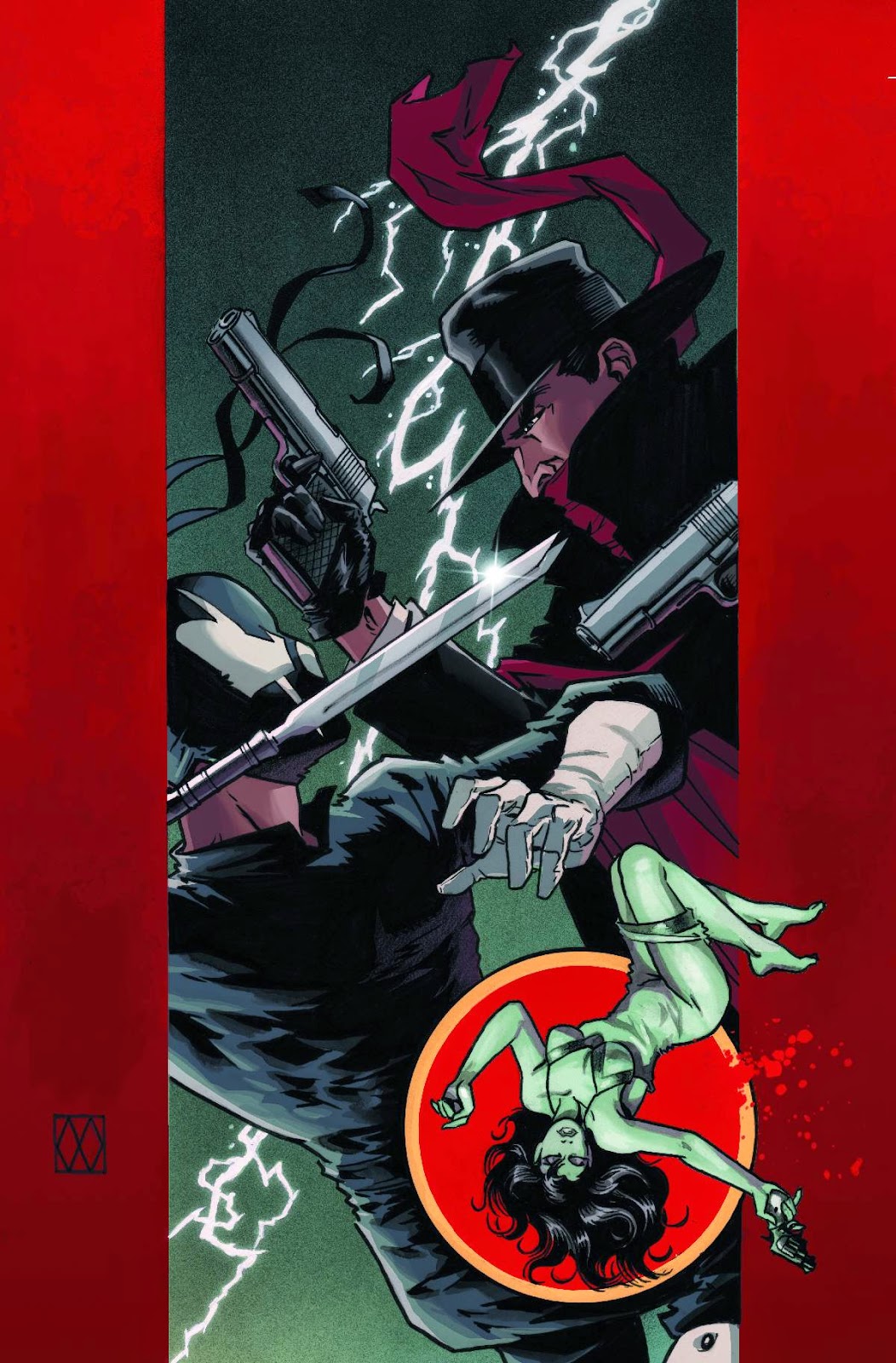
Who knows what evil lurks in the hearts of men? The Shadow clearly does. Matt Wagner has a history with the Shadow, the mystery man who is a direct spiritual ancestor to Batman; he wrote Shadow: Year One and wrote and drew the crossover between the Shadow and his own creation, the assassin/mob boss Grendel. This is the first full length story starring the Shadow written and drawn by Matt Wagner, and it's absolutely gorgeous. Wagner has a wonderful sense of the period these stories are set in, and the look of the buildings, the design work, and the costumes are all absolutely gorgeous. As with his other Shadow stories, this one is narrated by Margo Lane, the Shadow's romantic partner and one of his many agents in crime fighting, and sees the shadow in conflict with a new boss of the Tongs of Chinatown, the Red Empress. The Shadow's investigations lead him not just to the streets of New York, but to China itself, and then back, If you've never read the Shadow, or are unfamiliar with his world, this first issue does a great job of catching you up, introducing you to his powers, his allies, and his methods. It reads like a pulp, packed with narration and exotic locations, crooks and heroes, reporter and cops, everything you expect from a '30s crime story. As a story narrated in the past tense by Margo, I'm not sure exactly how the title and Margo's seeming death will play in unless she's narrating from beyond the grave, but we'll see as the series progresses. A good Shadow story is filled with crime, shocks, and a touch of the macabre, and this issue has all of that in spades.
And Dan Grote's back with a review this week, reviewing Deadpool #13, a four part crossover in one book...
Deadpool #13/Daredevil #7.1/Power Man and Iron Fist
#4.1/Deadpool #13.1
Story: Gerry Duggan, Charles Soule and David Walker
Art: Jacopo Camagni, Guillermo Sanna, Elmo Bondoc, Paco
Diaz
Colors: Veronica Gandini, Mat Lopes, Nolan Woodard and
Israel Silva
Deadpool teaming up with a hero who can’t stand him is a
time-honored tradition dating to his work with Banshee in 1994’s “Sins
of the Past” miniseries. This issue, which is actually a four-part
crossover in one $9.99 floppy, teams the worst Avenger with Daredevil, Luke
Cage and Iron Fist – none of whom has any lost love for him – to protect a Wall
Street investor wanted by multiple mobs and some of the more crooked parts of
the NYPD.
So yeah, it’s kind of like “The Other Guys,” one of the
better Will Ferrell/Adam McKay movies.
It’s also a spiritual sequel of sorts to the Daredevil/Deadpool
’97 annual, which saw the Man without Fear and the Merc with a Mouth team
up for the first time to stop the mentally unstable assassin Typhoid Mary.
Duggan, who writes the first and fourth parts of this
intrabook crossover, doesn’t often lean on the work of previous Deadpool
scribes. His
run has done an amazing job of building Wade Wilson’s world and rich
history on its own. But in this issue, he revisits the relationship between
Deadpool and Mary built early on in Joe Kelly’s run and says, flat out, what
we’ve all been thinking for 20 years.
“It was truly one of the worst experiences of my life,” Wade
recounts of the time Mary used an image inducer to pose as Wade’s crush of the
time, the X-Force member Siryn. “And that’s saying something, if you’ve read my
Handbook entry.”
This time around, Mary is working for the Russian mob, one
of the parties who wants investor Marvin Shirkley dead for losing their money.
Shirkley hires Deadpool for protection, and Wade agrees to take his case,
seeing it as an opportunity to work out his Mary issues. Deadpool takes Marvin
to the district attorney’s office – specifically, the broken
elevator-turned-office of Assistant District Attorney Matt Murdock – for
protection, but that idea falls apart once Deadpool realizes the key piece of
evidence they need to protect Marvin, the laptop Marvin gave him containing
information on all his clients, he threw in the trash because it didn’t fit in
his safe.
And so, with a host of Russian, Japanese and other mob
nasties coming for them, Deadpool, Shirkley and the Heroes for Hire spend a day
in a New York landfill trying to find the laptop. When the goon squad finally
shows, the sanitation workers help the heroes repel them, only after which does
a truck roll in with the laptop safe and sound. And after one last fight, Mary
is locked away in a SHIELD facility where she can get care for her dissociative
identity disorder, courtesy of an ever-softening Wade and his life-model decoy
SHIELD friend, Agent Emily Preston.
Oh, and there’s a framing sequence in which Daily Bugle
reporter Ben Urich tries to figure out how to report all this and gives up, but
it doesn’t really affect the story at all.
Had this been an actual four-part crossover, you would have
paid almost $20 to collect ‘em all. So while 10 bucks for one book is certainly
steep, you are getting one solid, self-contained, quadruple-sized story out of
it. And a lot of jokes about being blind.
Monday, April 11, 2016
Reviews of Comics from Wednesday 4/6
The Fix #1
Story: Nick Spencer
Art: Steve Lieber & Ryan Hill
There are a lot of great crime comics out there, that focus on smart criminals pulling of million dollar heists and getting away scot-free with the money and the police left in the dust. The Fix, the new crime series from Nick Spencer and Steve Lieber, published by Image, is... not one of those. At all. It is instead a crime story more in the Coen brothers school, a tale of incompetent and venal criminals in way over their heads. Roy (our narrator) and Mac are literally partners in crime. They're also partners on the police force. They're crooked cops who are also flat out crooks; they don't just take bribes and look the other way, but the opening of the issue sees the two of them committing a robbery. At a nursing home. Because they owe the local mob kingpin a bunch of money because of gambling debts. From illegal robot fights. And not cool future-tech robots, but old school Battle Bots type robots. I know that was an excessive use of sentence fragments, but I wanted to use it to emphasize how completely out there and funny this book is. I don't want to use the words tongue-in-cheek, because that implies a sort of send up sensibility, and this comic doesn't have that. It's not parodying crime stories, but playing the tropes straight while dropping people into them who aren't the usual hard bitten crooks. Despite being a self-admitted bastard, you can't help liking Roy; he might not be the kind of guy you want to hang out with, but he's definitely fun to read about. And since this is set in L.A., you know he's got a movie deal waiting to be optioned so he can get out of the deep doo-doo he's in, and the guy in the movie business he knows? Well, he's not exactly the most stable and normal guy either. Pretty much every character you meet throughout this first issue works against expectations, or in the case of Donovan, the producer, is such a broad stereotype that you can't help but be horrified and amused at the same time. When Lt. Malone of Internal Affairs shows up, you're expecting this to turn into a sorry of these two guys trying (and probably failing if their track record is any indication) to avoid being caught for the nursing home robbery. Only, oops, Malone works for the big mob boss. And Josh, the mob boss? He's this stay at home dad, who cooks organic and is an anti-vaccer. Only when he knows the guys don't have the money he's owed, he begins to discuss, "Carving out their taints." It's darkly funny, very blue, and reads breezily; the first issue has no ads, an expanded page count, and it takes time to read in he best way. here are all sorts of odd little moments too, things involving vintage pornography, Donovan's weird "romantic" life, and a drug-sniffing dog named Pretzels, who may be this year's canine character find, that just add to the air of caper gone bad. Having read and loved this issue, I now need to track down the trades of the creators' previous crime comic, Superior Foes of Spider-Man, which I have heard is a similar crazy caper book, but with capes and tights. If you're going through crime comic withdrawal, waiting for all those books announced at Image Expo to start, you need to go and read The Fix.
Star Wars: Poe Dameron #1
Story: Charles Soule
Art: Phil Noto
While Rey and Finn were the new characters who got the most screen time in The Force Awakens, I felt like every time Oscar Isaac appeared on screen as fighter ace Poe Dameron, he stole the show. I've always been a sucker for Star Wars stories focusing on fighter pilots, and so a new series about the adventures of Poe before the events of the film was something that I've been looking forward to. And with creators with some previous Star Wars credits (Charles Soule wrote the Lando mini-series and is writing the current Obi-Wan and Anakin one, while Phil Noto drew Chewbacca, as well as plenty of spot illustrations for Star Wars fiction), I had set the bar petty high. And while the first issue didn't speak to a lot of the questions about the character many fans have about him, it was a great debut and a fun adventure story. Set directly in the run up to the events of The Force Awakens, this issue sees Poe given the assignment by General Leia Organa to locate Lor San Tekka, the character played by Max von Sydow in the opening moments of the film. The issue does a lot of set-up, introducing members of Poe's Black Squadron, many of whom are drawn from background pilots in the film, and setting them off on their mission. The opening of the issue is actually in media res, as Poe flies through a series of tunnels and caverns, and Noto draws hem ably; dog fighting and flight can be a daunting task to draw, and panels of starfighter flight can easily become confusing, but Noto knows what he's doing. Poe's adventure lads him to meet The Creche, a sect that is dedicated to protecting a giant egg that they believe will birth some kind of cosmic messiah, and who have clues to Lor San Tekka's whereabouts. These interactions allow us to see a different side of Poe, one that is more diplomatic and less action based. But things look bleak when Poe finds a tracker on his ship, and Noto gets in one great shot of the arrival of The First Order, setting the bar high for what will be an exciting battle next issue. The issue also has a back-up story, "SaBBotage," written and illustrated by Chris Eliopoulos, about Poe's droid, BB-8, playing matchmaker for a fighter pilot and a repair technician. It's a cute story, and made me miss he classic Star Wars Tales anthologies from Dark Horse, where this story would have fit perfectly. A solid starting point for more stories set around he events of The Force Awakens, Poe Dameron #1 is a solid Star Wars comic, with a strong adventure, a touch of humor, and interesting new worlds, which is everything I want out of Star Wars.
Steven Universe: Too Cool for School OGN
Story: Ian Jones-Quartey & Jeremy Sorese
Art: Asia Kendrick-Horton w/ Rachel Dukes & Leigh Luna w/Andy Leigh R
Steven Universe gets to have lots of cool adventures, without very having to worry about the mundane, day-to-day stuff most kids have to go through, like school. But when Steven's friend, Connie, takes Steven to school for show and tell because he's bored and wants something to do, well, you can imagine that chaos is in the offing. Pretty soon, the school principal is insisting Steven stay in school to learn to properly socialize with kids his age, and get beyond his fantasies about being part alien and having alien friends. Following on he heels of successful original graphic novels based on Adventure Time and Regular Show, this new Steven Universe story works far better as a full graphic novel than it ever would as single issues; based on a story by animated series produced Ian Jones-Quartey, the narrative would have felt unnaturally choppy as monthly comics. Instead, we get a story that not only explores how Steven interacts with kids his own age, but get an exploration of Steven's relationship with Connie. The animated series has done a great job of establishing that relationship, making it deeper and far more rich than you'd expect from kids in middle school, but this story places them not in Steven's sphere, where they usually are, but in Connie's, and the quiet, usually reserved Connie is not as patient with Steven as he draws attention to her in ways she is unused to. But these are passing storms, as Connie and Steven are the best of friends, and Steven might be a good influence on Connie's social life, as people notice her. But Steven, as is usually the case, is followed by the usual madness of being a part alien, and when a giant snail monster attacks the school, it's not Steven, but Connie, who not only figures out how to stop it, but leads the other kids. I love the spotlight that Connie stands in, and how nicely balanced the story is between the day to day of school and Steven's adventures with the Gems and the monster attack. And the end of the story has a nice message about being yourself, something that is an ingrained part of the Steven Universe, well, universe. The back up story, "Yard Sale," from Josceline Fenton, who is writing the current Steven Universe mini-series, has Steven and the Gems going to a garage sale at the home of Vidalia. It's a sweet story that demonstrates just how nice a kid Steven is, and ends with a punchy little joke, on that fans of the show will appreciate. Hopefully, this volume will be successful and we'll se more Steven Universe graphic novels, as this one was great fun, especially as we wait for new episodes.
Monday, December 14, 2015
Reviews of Comics from Wednesday 12/10
Batman #47
Story: Scott Snyder
Art: Greg Capullo, Danny Miki, & FCO Plascencia
Jim Gordon's fight with Mr. Bloom continues as the countdown to Bruce Wayne's memory returning kicks into high gear. The end of last issues looked pretty grim for Gordon, as Mr. Bloom has taken over Gordon's Bat-armor and set it against him. Jim once again proves that he's more clever than people have given him credit for, by not only having the blocker that he was prepared to use on Bloom, but another handy device or two. And when thrown through the roof by his now villain-possessed armor, Jim uses his Bat tools and his smarts to avoid a particularly gory death in an action beat that Capullo handles beautifully; it's only two pages, but it shows exactly how talented Capullo is when it comes to motion and to faces, as the smile on Gordon's is priceless. Meanwhile, the two other character plots for the previous couple issues intersect, as Duke Thomas, still trying to make his way out of the Penguin's Iceberg Casino with Penguin and his fellow freak mobsters on his tail. But when it looks like two of Penguin's men have the drop on him, it turns out that it's Bruce Wayne who has the drop on them, having figured out where Duke was going. And it's Duke who is finally the person who pushes Bruce, who tells him who he is without flat out saying it. He points out that Bruce is the best in the world at deduction, and gives him the clues he needs. And standing in front of an oncoming subway train, as Bruce sees the lights bearing down on them, just before he pushes Duke out of the way, he sees the shape of what he was. If I haven't said it before, between here, We Are Robin, and his appearances in this week's "Robin War" issues, sign me up for the official Duke Thomas should be Batman's new partner club. He is my favorite new character launching out of the Bat books in years (Sorry, Harper Row. I like you too, but Duke is awesome). Meanwhile, things aren't quite as easy for Jim as it would seem, as we learn the one thing that is more creepy than one flower masked, gangly monster villain.And I don't want to say anything about the last page, even though it's been spoiled by various articles on-line, but it FINALLY begins answering a question I've been asking since we saw Bruce up and about again in issue forty-two, one that I'm surprised no one on the context of the comic has been asking, Whether we get payoff on it next issue, or it's going to be a long term plot, well, we'll have to see, but I'm excited to see where it goes.
Harrow County #8
Story: Cullen Bunn and Tyler Crook
Art: Tyler Crook and Simon Roy
The second arc of Cullen Bunn and Tyler Crook's exemplary horror coming, Harrow County, comes to an end with a war of ghosts and witches. The war between the series protagonist, Emmy, and her twin sister, the wicked witch Kammi, allows both of the series creators to show their strengths. Emmy's fight through the woods from the army of "haints" that have allied with her sister is full of some of Crook's painstakingly designed monsters, with things like harpies, swamp monsters, mud monsters, along with the ghost bears and flaming skeletons that remain loyal to Emmy. The woods themselves have an air of creepiness that Crook brings out in the long shadowed dark corners and the scrubby grass, and when you add in the monsters, it is a place you would not want to go in day or night. It's also impressive to see how, with an identical protagonist and antagonist, it's never hard to tell the two apart, even when Kammi is glamoured to have the same hair and clothes as Emmy. Expressions and body language are perfectly suited to each. The final confrontation between the sisters is Bunn's shining moment, letting everything the two have been feeling for the past arc come to the surface. And the final twist, as Emmy is able to dispose of Kammi, is a terrifying moment, one that makes perfect sense in the world, and ends in a heartbreaking splash of Emmy, once again alone. And while the end of the story seems a country idyll, as the narration points out, the things are still out there, waiting, which is the cornerstone of good horror. Throw in the one page back-up written by Crook and drawn by Simon Roy, a horror tied to something any homeowner knows and fears for mundane reasons, and you have a top notch issue. Two arcs in and Harrow County is one of the best horror comics on the racks right now.
Star Wars Annual #1
Story: Kieron Gillen
Art: Angel Unzueto & Paul Mounts
After Friday's post about Star Wars comics I'd like to see featured two espionage titles, I found it oddly fitting that this week's Star Wars Annual would be a story of the Rebel spy embedded in the Empire. Eneb Ray is a new character, working as a tax collector under the name Tharius Demo. I like the idea that the Rebellion is exploiting the colossal bureaucracy of the Empire to get its people in places where they can effect change, and that through taxes and tariffs they are able to impact change. But Ray isn't just a number cruncher, and he receives a mission more fitting a comic book, as he must go and liberate a group of senators who have spoken against the Empire from prison before they are executed. Ray's entrance to the prison, drawn beautifully by Angel Unzueto, is right out of Mission: Impossible or the James Bond series, with Ray diving off a pseeding transport, using magnetic gloves to stick to the side of the prison, and enter through the vents with the aid of a magnetic grapple gun. But the mission changes when Ray finds out that the Emperor himself is coming to have one last interview with the senators, and Ray decides it's time to make a play at assassinating Palpatine. Calling in all of the Rebellion's assets on Coruscant, Ray mounts what seems to be a very successful assassination of the Emperor. Too successful if you know anything about Star Wars, and I can't resist quoting everyone's favorite Mon Cal by simply pointing out, "It's a trap!" In the end, as good a spy as Ray is, he's nothing compared to the master of manipulation that is Palpatine, and things don't turn out too well for the Rebels. The issue is narrated by Ray, who thinks of himself as a man who makes the hard choices and not a hero. The journey that he makes throughout the issue is well written and is a great character arc. This is a new character who I hope gets to come back in future issues of this title, or in Darth Vader, which is written by this annual's writer, Kieron Gillen,
And Dan Grote is coming at you with two reviews this week...
Deadpool #3
Story: Gerry Duggan
Art: Mike Hawthorne, Terry Pallot, & Guru eFX.
It’s payday at Deadpool’s Mercs for Money ... or it would be if their
checks hadn’t all bounced.
That means Solo can't pay alimony to his ex-wife, Terror can’t afford
organ transplants from Morbius the Living Vampire, Slapstick can’t afford the
prostitutes he pays to pretend to be his family, and Foolkiller can’t afford
more guns.
Meanwhile, original-recipe Deadpool is being interrogated by the
police about the killing of the zoning commissioner in issue 1. Turns out
the cops don’t think he did it, even though whoever did left loud evidence to
the contrary. As part of a crazy-like-a-fox plan, Wade has the cops formally
arrest him. While being transported to jail, his bus is attacked by the fake DP
who’s been causing all the trouble. The two fight, and we get a brief glimpse
under the mask. Whoever’s under there has jaundiced, scaly skin and black eyes.
(Hey, you guys remember Slayback? Just a
thought.)
Fake DP gets away, but he leaves Wade a present – a well-beaten,
possibly actually still alive Scott Adsit, last seen stabbed in issue 2.
Now for the two Deadpools we haven’t talked about yet. Turns out
Stingray has been working as a mole for Steve Rogers, Wade’s Uncanny Avengers
boss. Stingray has some concerns about fellow faux-Pool Madcap, who apparently
wasn’t so much invited to join DP’s M4M as he just showed up one day. And so the
two go to confront him.
Madcap’s hotel room, in a word, is great. A bubble machine blows
nonstop, and there are lava lamps and welcome mats everywhere. Told to
straighten up and fly right, Madcap boops Stingray on the nose and tried to do
the same to Old Man Rogers, who grabs his finger and threatens to do World War
II things to him. In response, Madcap cuts off his own finger and jumps out a
window. “He needs to go,” Rogers declares. I disagree.
Last week I declared Doctor
Strange my favorite of the All-New, All-Different Marvel titles so far.
That ranking holds, but Deadpool is a
close second. The book has taken such a sharp turn from the previous volume,
with a nearly entirely new supporting cast, yet still feels solid. The creative
team clearly has a plan for each of the Mercs for Money and refuses to allow
them to become one bland mass of red-and-black-clad lunatic killers. A-game
stuff.
Gwenpool Holiday Special
Stories: Charles Soule (She-Hulk), Margaret Stohl (Ms.
Marvel), Gerry Duggan (Hawkeye & Deadpool), and Christopher Hastings
(Gwenpool)
Art: Langdon Foss (She-Hulk), Juan Gedeon (Ms. Marvel),
Danilo S. Beyruth (Hawkeye & Deadpool), and Gurihiru (Gwenpool)
What if I told you there was a place where all your favorite
canceled but beloved Marvel series characters gathered in one place to warm
your heart and make you smile?
What if I told you Deadpool was there, too? And his alternate-Earth
Gwen Stacy counterpart that started life as a variant-cover gimmick?
Welcome to Marvel’s 2015 holiday special, billed as a
Gwenpool one-shot but actually mostly a She-Hulk story reuniting the Atomic Age
attorney with writer Charles Soule.
A holiday happening at the Brooklyn building that houses
Shulkie’s law office (and Howard the Duck’s PI agency) acts as the framing
device for the book, as Jen and the gang party the night away to ward off
insectlike Realtors who use magic to convince people to give up on their dreams
and turn over their property so it can be flipped at higher values. In other
words, Charles Soule wrote a Charles Soule She-Hulk story, you guys!
A series of interludes shows other heroes making their way
to Jen’s party, stopping only to bust a skull or two.
In the first one, Ms. Marvel battles her conflicted feelings
about the holidays as a practicing Muslim, a Secret Santa exchange with her
platonic-but-not-really bestie Bruno and a store-robbing Santa. Though not
handled by her normal creative team, Kamala is as delightful as ever, even when
she’s being a Christmas crank. (Even her brother, the most devout Muslim in her
family, can find the joy in Rudolph.) After toppling bad Santa, K exchanges
gifts with her mentor, Captain Marvel, and the two head off to She-Hulk’s
place.
Next up, fellow Avengers Deadpool and Hawkeye (Clint Barton)
team up to catch a pickpocket who stole money from Simone, one of the residents
of Clint’s apartment building from the Fraction/Aja series. Hawkeye (Kate
Bishop) catches the crook, who says he was just trying to get money to buy
presents for his son. Wade opens his heart and his wallet, and the three
deliver the boy gifts before whisking his dad off to the police. Then it’s off
to Jen’s party … and just as quickly away from it, as she has a strict
no-Deadpool policy.
Finally, we come to Gwenpool, who combines all the
cutesiness of a superconfident fictional teenage girl with the murderiness and
colored speech balloons of Deadpool. Gwen is hired to take out a sword-swinging
snake-man who looks like the genie from Aladdin,
requiring her to watch hours of sword-training videos on YouTube till she gives
up and decides to just blow him up with a bomb. Because she’s been a supporting
player in Howard the Duck, she too
ends up at She-Hulk’s party, where she bonds with Ms. Marvel over karaoke, but
not so much over murdering dudes.
Quick shoutout to Langdon Foss, who drew the She-Hulk bits.
His splash pages are like a superhero Where’s Waldo, with many more Marvel
characters drawn into them than I’ve mentioned.
Monday, April 6, 2015
Reviews of Comics from Wednesday 4/1
Gotham Academy: Endgame #1
Story: Becky Cloonand & Brenden Fletcher
Art: Jeff Stokely, Clio Chiang, Joy Ang, Vera Brosgol
I firmly believe that scary stories are best told out loud, to a group of people, and in the dark. The communal scare is a binding experience. So, as the Joker's rampage continues through Gotham, the students of Gotham Academy, including series protagonists Olive, Maps, and Pomeline, are sealed up in the school gym in tents to avoid the chaos and share a series of Joker themed tales of terror. Olive tells the tale of a stolen Laughing Mask that haunts the boy who stole it. Professor MacPherson, who teaches history, tells a particularly macabre and gory tale from her native Scotland about the Wandering Jester, who if you don't laugh with him, you become a part of his act straight out the worst of EC Comics. And Olive shares a story told by her mother about Gotham's own version of Bloody Mary, the Smiling Man (a nod to Snyder's conceit in the main Batman title that the Joker is in fact an immortal who has been haunting Gotham for centuries, I believe). Each of these tales of terror is drawn by a different artist, giving them a unique look that still fits nicely with the style of the monthly comic. It's also interesting to see how jaded Maps is, how she brushes off the presence of the Joker as someone who interrupted her cartoons a couple times a year and then as stopped by Batman. When you look at how the adults and the superheroes are all affected by the Joker in all the other tie-ins, this reaction is fascinating: when you grow up with something like the Joker making the world as terrible as it can be, you just get used to it. There's also the mention of another of Gotham Academy's legends, The Custodian, who defends the campus from all threats external to the school, and as some of the people infected by Joker Venom begin to raid the school, a man dressed in antique garb with swords begins to fight them off. And where exactly is Headmaster Hammer in all this? If you've been picking up "Endgame" and not Gotham Academy, or vice versa, this is a great way to get a taste of the other series. And if you haven't read either, and just like a good spooky story, then pick it up.
Graveyard Shift #4
Story: Jay Faerber
Art: Fran Bueno
Jay Faerber and Fran Bueno's tale of vampiric terror, Graveyard Shift, comes to an action packed conclusion in this exciting fourth issue. Having identified where the vampires who turned Hope have been working out of, Liam and his vampire fiancee head to confront them. But Cromeyer, the master vampire, is prepared, and Hope is brought to his photography studio while Liam is brought down into his dungeon. We follow our two leads as they fight very different threats. Faerber sticks to all the classic vampire rules, so Liam come prepared with an arsenal that the cocky vampires don't even search him for, while Crommeyer attempts to lure Hope over to the dark side (Yes, a bad pun, but I stick by it). This was a really well structured series, starting out with an exciting, action filled first issue, then slowly building the world over the next couple issues to set up this final confrontation. It really gave Fran Bueno a chance to shine, showing some great fight scenes, and some really monstrous vampire faces. When the dust settles, Liam and Hope set off for future adventures to try to find a cure for Hope's vampirism. Yes, that gives away some of how the series ends, but this is a classic monster movie: good is going to defeat evil. And if you are even the slightest fan of vampire movies and tv, you are going to get the biggest smile when you see the last page; I'm not going to give that away. Graveyard Shift was a great horror story in a model that isn't often used anymore: the monsters were villains and the good guys were good guys. If you like The Lost Boys, Near Dark, or The Monster Squad, you can't go wrong with Graveyard Shift.
Guardians of the Galaxy: Best Story Ever
Story: Tim Seeley
Art: Reilly Brown, Iban Coelle, Jacopo Camagini
There are a lot of fans who don't like one shots because, unless they're part of major stories they, "don't matter." And fans of that particular mindset probably skipped this one-shot, and if they did, they missed a very fun comic. Star-Lord and Rocket are in prison, and in a cell together begin telling the story of one of the Guardians escapades; with Thanos on trial for his crimes before a gathering of cosmic entities, like Eternity, Infinity, and the Loving Trilobite ("Living Tribunal! Don't they teach you anything on Earth?"), Nebula is going to help free him, and the Guardians stand in their way. While the guards are distracted, the remaining Guardians are sneaking into the facility for reasons unknown. The bickering Rocket and Star-Lord sequence is a lot of fun, as writer Tim Seeley does a good job of capturing both of their voices. It's also cool to see Nebula backed up by the Graces, a group of female warriors introduced in the run up to the original Annihilation crossover brought together and trained by Gamora in one of her darker times, of which Nebula was a member. This is one of those plot threads I always hoped would be picked up somewhere, and I'm happy to see them used again. Rocket and Star-Lord wrap up their story as the caper works out and the Guardians make their escape, but we then get a different version of the ending, one that is a bit more thoughtful, and continues to draw the relationship between Gamora and Nebula a bit closer to the movie continuity without feeling forced. There's the final reveal of the McGuffin that the Guardians were trying to steal, which is just singularly ridiculous and perfect for the "Guardians as rag tag band" concept that has been their recent shtick. If you enjoyed last summer's Guardians of the Galaxy movie, this is a great issue to give you a better idea of their comic book status quo.
Kanan: The Last Padawan #1
Story: Greg Weisman
Art: Pepe Larraz
While I haven't disliked Marvel's new Star Wars line, I've grown less and less wowed by it. It's not that it's bad, it's just that it doesn't feel like anything new; after twenty plus years of stories set in that period between Episodes IV and V, there's not much new to be mined. But the debut of the first Marvel series set in another time period has rekindled my hope. Kanan: The Last Padawan tells the backstory of Kanan Jarrus, the lead of Disney's well received Star Wars: Rebels cartoon. Set as the Clone Wars are coming to an end, we see Caleb Dume, Kanan's real name that he abandoned to go on the run from the Empire, and his master, Depa Billaba, leading their clone battalion to retake the world of Kaller from the Separatist Droid Army of General Kleeve. After victory is assured, the Republic forces find themselves less than welcome by the natives, with Kalleran leader Gamut Key downright rude to Master Billaba, something she takes far better than her Padawan. Moving out of the city, we get a thoughtful discussion of how young Caleb is adjusting to being a Padawan instead of just a youngling at the Jedi Temple, how he fits in with clones, like Commander Grey and Captain Styles, and the Jedi's role in the war, something Billaba sees as heading in the wrong direction for the order. We also see more of Caleb as the inquisitive student, an impression first hinted at in the novel A New Dawn, another recent Star Wars tale that shone a light on another aspect of Kannan's backstory. The issue ends on a dark note, as writer Greg Weisman doesn't drag out the suspense leading up to what all Star Wars fans know is coming: Styles receives the transmission from the newly christened Emperor to execute Order 66, meaning next issue will begin Caleb's flight for his life and heading towards becoming Kanan. Greg Weisman, showrunner of the first season of Star Wars: Rebels and creator of one of the greatest modern animated series (Gargoyles) and showrunner of the one of the best superhero cartoons ever (Young Justice), does his usual deft work of establishing character and setting, and gives old fans of the Star Wars Expanded Universe hope that not everything has been forgotten; his reference to Master Billaba being known to be unstable is a clear reference to her fall to the dark side in the novel Shatterpoint. That bit of knowledge, or any foreknowledge of Rebels, is completely unnecessary, though, to enjoy a Star Wars comic that stands up well with many of the Dark Horse tales of the Clone Wars.
Southern Bastards #8
Story: Jason Aaron
Art: Jason Latour
The second arc of Jason Aaron and Jason Latour's southern Gothic, "Gridiron," wraps up the origin of the series antagonist Coash Euless Boss. After the first arc introduced and quickly killed off the character most readers assumed was going to be the series lead, it was an interesting choice to spend the second arc digging deep into the history of the man who killed that character. Aaron's work on Scalped showed that he was fascinated in making all his characters as three dimensional as he can, and so giving us an understanding of who Coach Boss is makes perfect sense. This issue we see the final confrontation between Euless and his abusive father, a confrontation that ends with Euless proving just what he'll do to be involved with football. He gives a speech about why the game matters, why he loves it, and what he loves about it; it's not the winning, it's the beating of the other team, the moment when they're so beaten he can see in their eyes they just want to quit. It's a cold speech, the kind that sends a little chill down your spine. And we see what Boss does to become the young coach, the deal he makes with local mobster Mozel, and how he tells Big, his mentor, that all this is "worth the blood" to be able to be on the field, to be able to do the only thing he's good at in the world. But it's apparent that Big has his misgivings, and the issue ends back at the present where it seems that the events of the first arc and the death of Earl Tubbs, has been the final straw that Big can no longer take. The final pages set up the next arc, as there's another Tubbs headed to Craw County, and there's a storm on the horizon. We might understand Coach Boss, but for me, I sure as hell don't like him, and I hope that storm hits him hard.
And Dan Grote visits Black Bolt in the zero issue of the new title in Marvel's new hoped for franchise...
Uncanny Inhumans #0
Story: Charles Soule
Art: Steve McNiven, Jay Leisten and Justin Ponsor
Uncanny is a loaded word to tack on as the title adjective
of the new Inhumans series. It plays into reader concerns about the
caste-obsessed subrace supplanting mutants because of movie-rights issues.
But the Uncanny in Uncanny
Inhumans doesn’t seem to be so much a shot at Uncanny X-Men as it is an homage to Rick Remender’s first volume of
Uncanny Avengers, specifically the
subplot about Kang the Conquerer raising the progeny of superheroes.
In Uncanny Avengers,
Kang stole the X-Man Archangel’s twin children from a Red Skull concentration camp
and raised them to get mutants out of his way so he could rule time properly.
In Uncanny Inhumans, Black Bolt –
deposed ruler of the Inhumans – asks Kang to send his son, Ahura, into the
timestream to save him from the end of the world, aka this summer’s Secret Wars.
The book presents itself as a Black Bolt solo title. We
follow him from the streets of Rio de Janeiro, thwarting a crew of poachers
hunting terrigenesis cocoons; to New Attilan, where his estranged wife, Medusa,
scolds him for past grievances before sending him through a portal; to 1908
Siberia, where Kang is hiding out with Ahura.
The opening of the Siberia sequence is some of Steve
McNiven’s best artwork in this issue, as Black Bolt storms Kang’s castle, which
is guarded by an army of time-plucked knights and soldiers. When Black Bolt’s
done playing games, he whispers “Goodbye” and blows a hole in the wall.
The one real downside to this book is it’s a little heavy on
exposition. The poachers explain to each other who Black Bolt is. Medusa
recounts recent events. Kang explains to Black Bolt that he is a time traveler
as if that were not already evident. And Ahura, moody teen that he is, feels
compelled to keep explaining that Black Bolt’s full name is Blackagar Boltagon,
one of the more patently ridiculous firsts and lasts in the Marvel Universe.
But first issues have a lot to set up. Writer Charles Soule
has built up a lot of good will having written the most recent She-Hulk series, one of this blog’s more
beloved titles of the past year, so let’s see where he and McNiven take
Marvel’s royal family.
Monday, February 23, 2015
Reviews of Comics from Wednesday 2/18
Secret Identities #1
Story: Brian Joines & Jay Faerber
Art: Ilias Kyriazis
We all have our secrets, and if you're a superhero, you probably have more than most. The debut issue of Brian Joines and Jay Faerber's Secret Identities is heavy on the secrets. Starring a team of heroes called The Front Line, the issue starts off looking like a by the numbers super hero team book. But pretty soon, we see that it's anything but. The private lives of the heroes are laid out before us, and we see the secrets they keep. Recluse has a secret prison beneath his mansion where he keeps prisoners for what seems to be a horrible purpose. Punchline is a failing comedian. Vesuvius seems to want to keep some aspect of his history a secret. Each of the seven members of Front Line have something they want to hide, and their new recruit, Crosswind, might have the biggest secret of all: he's a mole, sent in to learn the identities and secrets of his teammates to bring them down. And we learn that right out of the gate. This isn't a book about uncovering these secrets for the reader. Sure, there are details we don't know and twists that I'm sure will come, but this isn't about the secrets, but how we keep them and what they do to our lives. The Front Line, and the world they live in, jumps fully formed onto the page, with great designs for each of the characters by Ilias Kyriazis. It feels like a team that we know already, that lives in a world that has existed for some time. Jay Faerber is no stranger to the superhero soap opera, having written a book that falls more in line with that latter in Noble Causes, and while I'm less familiar with Brian Joines, I did enjoy the heck out of his Christmas action series, Krampus!, so the book is in good hands. This was a very strong start to a new series, one that established the stakes and the world, and gave us characters we could grow to like or despise. Let's hope for a nice long run, and answers to all the secrets and lies this first issue laid out for us.
She-Hulk #12
Story: Charles Soule
Art: Javier Pulido
*Sigh* Thus ends the current volume of She-Hulk. Charles Soule has written a book that focused more often on law then on super heroics, gave a full picture of who Jen Walters, She-Hulk, is, slowly built the mystery of The Blue File, and developed a great supporting cast for Jen Walters. This issue wraps up most of those plot threads. The issue starts out with exactly what happened to create the Blue File, the mystery case that Jen and various other super folk have been named as defendants in, and we see a seemingly new character, Nighteater. But with the revelation from the end of last issue about the culpability of Nightwatch in the case, things start to fall into place. This is one of the most action-centric issues of She-Hulk, but the intelligence and wit that have been the title's hallmark for this volume were not lost. While fighting Nighthawk, we get to learn exactly why he did what he did, why he remade himself as a hero. We get to see everything he's been up to, and we get a moment of, if not redemption, at least a moment where one of the villains we met earlier does the right thing. Hellcat and Angie Huang, Jen's employees, friends, and chief supporting cast, play a big role in the story as well. We never find out exactly what Angie's deal is, which is fine by me; I like the mystery of that, and what she is doesn't matter as much as what she is to Jen, her friend. The nature of heroism is a topic much discussed as She-Hulk fights Nightwatch, and in the end, Jen proves herself to be a true hero. But even with all these superheroics, the final few pages bring the series back around to what it's been about all along: Jen at her office, preparing for a new case. For the too short duration of its run, She-Hulk has been my favorite comic coming out from Marvel, a strong, character driven series that plays with the tropes of the Marvel Universe and builds on that history. I can only hope this isn't the last we'll see of Charles Soule writing this character.
Sparks Nevada, Marshal on Mars #1
Story: Ben Acker and Ben Blacker
Art: J. Bone
It's time to shine your astro spurs and don your robot fists, as we begin today's thrilling review of Sparks Nevada, Marshal on Mars #1! I've written before about how much I love The Thrilling Adventure Hour, live theatre and internet home to Sparks Nevada, Croach the Tracker, and a host of other characters. And their transition to monthly comics has gone off without a hitch. Written by TAH creators Ben Acker and Ben Blacker, this story takes place before the earliest Sparks Nevada story on the podcast, and so no prior knowledge of the characters is required. After a flashback to Sparks at the Academy (because all sci-fi worlds have an academy) with his parents, the story starts in earnest with Sparks escorting a stage coach across the crimson plains of Mars. The coach contains the Johnsons (one of whom we know from the shows and the issue title as the Widow Johnson, so it doesn't bode well for Mr. Johnson) and panicky local yokel Felton, who proves to be a chatty passenger to an increasingly irritated Sparks. As they travel across the plains, they run into Martians, who seek nothing more than to be out from under Onus (picture Wookiee life debt, only less for all your life and with way more complaining by those indebted) to Sparks, rogue robots, and aliens. The issue has the trademark Sparks mix of action and humor, with a healthy dose of the latter. The dynamic between Sparks and Croach, the martian who must perform the duty of helping Sparks and who will become his friend and companion, is already coming into focus this early, and their rapport and repartee (or lack thereof) is one of main sources of comedy. Artist J. Bone gets to stretch his artistic legs in his designs for the different robot rogues, as well as the group of aliens that appear at story's end. Accompanying the first issue is also a print version of the digital first Sparks Nevada #0, the story of how Sparks and Croach first met. so if you prefer your comics in print form, here's your chance to get this for the first time. Sparks Nevada, Marshal on Mars is a clever mixture of western and sci-fi tropes. one that should delight fans of either genre.
The Valiant #3
Story: Jeff Lemire & Matt Kindt
Art: Paolo Rivera
The Valiant #3 is really two great comics in one issue. Last issue left the series main characters divided, with Kay McHenry and Bloodshot on the run from the Immortal Enemy, while Eternal Warriro, Ninjak, and the rest of the Valiant heroes are ready to stand and fight. This issue, the two stories each develop on their own. The battle between the heroes and the Immortal Enemy is stunning. Paolo Rivera goes completely to town on drawing not just the combat, but the horrors when the Immortal Enemy gets into the heads of the heroes and shows them their worst fears. It's like a Scarecrow fear toxin attack on steroids. Rivera gets to draw all the Valiant heroes, from Archer & Armstrong to Quantum & Woody to Punk Mambo. It's the kind of thing that other companies would spread out over the course of three issues, but this series does it all in half an issue, and it doesn't feel rushed, and the art makes it so clear and crisp that you follow each stroke of sword and laser blast. The other end of the spectrum is Bloodshot and Kay. Bloodshot has been tasked with protecting Kay, so he brings her into a shopping mall. Lemire, who wrote this section of the issue, takes you through the pages in this issue's backmatter, and it's so cool to see these two people, thrust into lives of extreme weirdness, walking past home wares and all the things that they will never have. It's a very thoughtful scene, wonderfully written, as Kay keeps asking Bloodshot personal questions, and he keeps deflecting by doing his super soldier, preparing for the enemy thing. The dynamic between the two of them is wonderful, and I hope to see more of it in the future. The issue ends with Kay trying to help Bloodshot, but leaving them in a vulnerable position as the Immortal Enemy approaches. It's a great cliffhanger for a series that does everything you want from a crossover and does it without all the bloating from other companies. It's tightly paced and plotted, and never forgets character for action. There's still time to catch up before next month's finale, so if you haven't tried out The Valiant, what are you waiting for?
And Dan Grote brings us back to Jersey City, where Ms. Marvel goes to a dance and meets a certain god of Mischief...
Ms. Marvel #12
Story: G. Willow Wilson
Art: Elmo Bondoc and Ian Herring
After 11 issues of establishing Kamala Khan and her world, a
standalone issue is a breath of fresh air.
It’s also time for another Marvel team-up, this time with
the de-aged Loki currently starring in his own series by Al Ewing and Lee
Garbett. Loki is sent to Coles Academic High by his mother, Freyja, for
whatever expositionary reason is necessary to get Loki to willingly visit
Jersey City. Much of the humor of this issue lies in the residents of J.C.
mocking the Agent of Asgard as a “Hipster Viking from Brooklyn.” Loki certainly
doesn’t give anyone reason to doubt that label, literally prancing about and
writing love letters with the purplest of prose. One of the benefits of Loki
looking the way he does now, though, is that he’s not instantly recognizable as
the god of mischief, so it takes a while for Kamala to realize she’s locking
horn-helmets with a classic villain. It also lets Loki do cliche Loki things
like create duplicate illusions of himself and laugh while Kamala punches the
wrong ones.
There’s a few other great beats in this issue. First, Bruno,
the only human who knows Kamala’s secret, lectures his degenerate friend about
why being “friend-zoned” isn’t a negative thing, because “friendship is
something real and good and anybody who doesn’t understand that needs a
dictionary.” Granted, he says this because Kamala has no interest in him
romantically, but it takes a mature attitude to understand there are other
types of love besides romantic.
Later, Loki spikes the punch at a Coles Valentine’s dance with
truth elixir. Suddenly, a room full of teenagers stops being polite and starts
getting real.
Finally, after Loki’s finished having his sport, he agrees
to cast a spell of protection on the school, which is still half a mess from an
attack by one of the Inventor’s robots.
For another great standalone featuring Ms. Marvel, check out
last month’s SHIELD #2, in which Agent Simmons goes undercover at Coles High and
teams up with Kamala against some loose supervillain tech.
Labels:
ben acker,
ben blacker,
brian joines,
charles soule,
g willow wilson,
jay faerber,
jeff lemire,
matt kindt,
Ms. Marvel,
Secret Identities,
she hulk,
Sparks Nevada,
The Valiant,
weekly reviews
Monday, November 17, 2014
Reviews of Comics from Wednesday 11/12
Batman #36
Story: Scott Snyder/ James Tynion IV
Art: Greg Capullo/ Graham Nolan
At this point, a run of three plus years is a huge run in comics. And Scott Snyder's run on Batman has now continued for over three years, and continues to be a book I love to read every month. And when an issue features The Joker, who is my favorite villain in all of comics, beginning to roll out a mad plan against Batman, my favorite hero in all of comics, it is an issue that is something to look at closely. Snyder's Joker is the Joker of the 21st century, not the criminal mastermind of his early career, but the madman/ anarchist who is completely unpredictable. More than unpredictable, this Joker doesn't do what he does for money. Even more than Grant Morrison's Joker, Snyder's Joker is defined by his relationship to Batman. And while in Snyder's last Joker story, "Death of the Family," Joker went after Batman's nearest and dearest, this time he starts out going after the Justice League. Last issue saw Batman fight most of the League, but the beginning of this issue is Batman versus a Joker Venom controlled Superman. We've seen Batman and Superman fight plenty of times; Dark Knight Returns, "Hush," Superman: The Animated Series, and the oft-forgotten but pretty cool Superman Annual that tied into "Armageddon 2001" to name a few. Snyder's fight is a perfectly good one, with lots of cool gadgets that help Batman prevail, but it's nothing new. It is a showcase for some amazing fight choreography and art from Greg Capullo, though, so that is more than worth the price of admission. It's after the fight that the issue takes off for me. First, seeing Bruce interact with Alfred, an Alfred still weakened from the events of Batman: Eternal and who was abused by Joker severely last time he was in Gotham. Alfred and Bruce's relationship has been the touchstone of mush of what Snyder has done in the book, and to see Alfred flat out tell Bruce to go out there and take out the Joker shows how high the stakes are. The appearance by Julia, Alfred's daughter, continues to deepen her character, a character who has grown on me as Eternal has played out. But it's the scene in the wreckage of Arkham Asylum, destroyed recently, that makes the issue hit its high notes. This will be spoilery, but if you have been to any of the comics news sites in the last week, it's probably been spoiled. The reveal of the Joker's alter ego, the long game Snyder has been playing for over a year, is wonderful. I didn't see it coming, at all, but it makes me want to reread Batman Annual #2 and see exactly what Eric Border was saying and doing. Snyder's Joker is creepy (again aided ably by Capullo, whose Joker with a face might be even creepier than his Joker without one), obsessive, and smart, all things that make a great Joker, and as we see the next stage of his plan begin, as we see that Joker's twisted love has turned to hate, it's clear that Batman has an uphill battle ahead of him. And it makes for a great story when Batman is at a disadvantage, because it highlights many of his best traits, mostly his brain that allows him to work his way out of these problems, something I'm looking forward to seeing. The back-up continues with a group of Arkham inmates dragging Dr. Mahreen Zaheer around Gotham, telling them stories of the Joker, who has clearly manipulated them all. With the revelation of Eric Border's true identity, there's a new layer as to why the inmates chose to stalk Zaheer, and it makes me wonder more and more what Joker's endgame is in having them stalk the friend Border made in Arkham. The artistic hits also keep coming, with Graham Nolan, who penciled so many of the my favorite 90s Batman stories, doing the art on this back up. Two issues in, and "Endgame" might prove to be the highlight of Snyder's stellar run. I'm looking forward to see what paths the Joker is leading Batman down.
Django/Zorro #1
Story: Quentin Tarantino & Matt Wagner
Art: Esteve Polls
There are many things in pop culture I love. Some of them include Westerns, Quentin Tarantino, and the comics of Matt Wagner (more on that later). So Django Unchained was a movie I looked forward to and loved, and the announcement that Tarantino would be working with Matt Wagner on an official sequel in comics got me excited. My familiarity with Zorro isn't as much as it should be with him being an inspiration for Batman, but I've seen the classic Mark of Zorro and some modern TV and movie versions, so I have a basic grounding. The good news is, if you know nothing about Zorro or Django, you won't feel in the least bit lost here. The story starts with an elderly Don Diego (the secret identity of Zorro) travelling by carriage and picking up Django, whose horse had died. This turns out to be Django using Don Diego as bait for a bounty, and the two wind up discussing justice and their lives, and Django feels a kinship with Diego, who reminds him of his mentor from the film, Dr. King Schultz. When they arrive in town, Don Diego proves that even in his twilight years he is still tough by taking out a group of ruffians. And as the issue ends we find out the foe the two heroes will face... The Archduke of Arizona? Ok, well Emperor Norton was in San Francisco, so Arizona can have an archduke. This is a really strong first issue, with good introductions to both of our protagonists, some solid action, and dialogue that could have come right out of a Tarantino movie; Wagner clearly gets the rhythms that fans expect out of Tarantino. The violence is probably not as graphic as you'd get on the big screen, but it's there, and there are no punches pulled. If you enjoyed Django Unchained this come feels firmly placed in the same world, so if you need a Tarantino fix before The Hateful Eight hits big screens, get to your local comic shop and check out Django/Zorro.
Grendel Vs. The Shadow #3
Story & Art: Matt Wagner
Hey, it's Matt Wagner again! The conclusion of the confrontation between Grendel and The Shadow brings all the elements that Wagner has been building to a head. The character beats of the story deal very much with the series' title characters and the women in their life. Margo Lane, who has been struggling with her relationship with The Shadow and his distance from her, makes the choice to leave him early in the issue, but in the end The Shadow reaches out to her, something that he is not prone to do. It's a good counterpoint to Hunter Rose, who reaches out as well, breaking the vow he made to his lost love, Jocasta, by falling for mobster's daughter Sofia Valenti. In another world, I could completely see Sofia taking up the mantle of Grendel, as she is cold, calculating, and prone to betrayal. Hunter, in the end, views his dalliance with her as nothing more than him giving into nostalgia for the feelings he once had for Jocasta, not admitting he might have loved her, while The Shadow does his best to say those very words to Margo so he does not lose her. It's interesting, when so many female characters exist solely in relation to the male leads of a series, to see a story where we deal with how the male leads are reflected in their female counterparts, not entirely lampshading or inverting the trope, but showing how both Margo and Sofia would, could, and do exist without their men. Wagner, who always draws beautiful, almost balletic, fight sequences, pushes that skill to a new level, in a three way battle between Grendel, The Shadow, and a room full of mobsters. It's brutal and inspired. The series ends with vows. The Shadow wonders if Hunter was indeed a time traveler, but reaffirms his mission, because he still must do his best to make a better world. Hunter reaffirms his status as a man apart, saying he will share his affection only with his ward, Stacy, because she would never betray her. Those of us who know the full story of Hunter Rose know that is far from the truth, and what initially made me sort of chuckle in that same way I did when Obi-Wan Kenobi told Anakin Skywalker, "You'll be the death of me," upon further consideration gave a little chill, because it says that Hunter didn't learn anything from his time in the past, and what might have been the universe giving him a chance to save himself is instead just another adventure to him. With the series over, I'm left to wonder if this is Wagner's final word on Hunter Rose. He has said he has at least a Grendel Prime story in mind, but as with any creator owned project, this might be the last story of the first Grendel. If it is, it's a fitting sendoff, with Hunter having gone toe-to-toe with the character who inspired so many masked adventurers.
She-Hulk #10
Story: Charles Soule
Art: Javier Pulido
The penultimate arc of She-Hulk wraps with a courtroom battle between She-Hulk and Daredevil in the wrongful death suit against Steve Rogers, the original Captain America. There's a lot to love about this issue. The characterization of Steve Rogers as someone who wants be vindicated legally because the idea of Captain America is important to him is a highlight. The absolute joy of Hellcat for using her stealth suit is a great bit. Javier Pulido's usually stunning art is at its best, with the flashbacks to the 40s having a gorgeous feel to them. But the highlight for me was that the story, which started out as a conflict in the courtroom, ended as that. Sure, we got a supervillain manipulating things from the background (and if you know your Cap villains, it makes perfect sense when the reveal happens). but the true climax of the story are two pages that are nothing but a white background with full figures of each of the lawyers giving their closing statement. Charles Soule, a lawyer himself, writes eloquently for both sides. Even as a reader knowing that Cap is innocent, the statement given by Daredevil against him gave me pause. And the argument from She-Hulk was equally well thought out. With this story complete, we have two issues of the series left to wrap up the mystery of The Blue File, and the end of the issue seems to indicate a brawl with She-Hulks arch-enemy is coming, which is going to be a change from the past few issues that were much more intellectual. But I wouldn't be surprised if Soule found some way to defy expectations on that front too. He's made She-Hulk into my favorite Marvel monthly, after all, and that wasn't something I saw coming.
Subscribe to:
Posts (Atom)