Showing posts with label gabriel rodriguez. Show all posts

Friday, June 13, 2014

Recommended Reading for 7/13: NOS4A2 and Wraith: Welcome to Christmasland


After finishing a years long opus of deep emotional resonance and terror, many a writer would take a break from comics. Especially if that writer also is a best selling novelist. But not everyone. Joe Hill, best known in comics circle for his horror/coming of age story Locke & Key (follow the link to a previous recommended reading on that book), had just finished the heart wrenching finale of that series when he announced his next project, a comic prequel to his most recent novel, NOS4A2. The comic, Wraith: Welcome to Christmasland, wrapped up its seven issue run on Wednesday, so I thought this would be a good time to give a recommendation to both the comic and the novel.

Charles Talent Manx has a special car, a 1938 Rolls Royce Wraith, and with it he can do special things. The Wraith and Charlie are inextricably linked, the one the extension of the other, and the car's vanity plate, the eponymous NOS4A2, gives you a hint of the kind of creature Charlie is, even if he doesn't feed on blood. Charlie Manx is one of those people with a special psychic gift he channels through the Wraith, and with the help of a series of accomplices, he uses his car to abduct children and bring them to Christmasland, a magical theme park he has created, and there they become something less than human and Charlie siphons off their innocence to fuel his powers and his immortality.

Manx is a terrifying villainous creation. Hill has crafted a couple of great villains in the past, such as Dodge from Locke & Key and Craddock McDermott from his debut novel, Heart-Shaped Box, but Manx is something else entirely. Those who prey on children are especially despicable, and while Manx would never physically or sexually abuse any of his "charges" (he says there's a special place in hell for "kiddy fiddlers"), what he does is equally terrible. It is partially this strange dichotomy that makes him terrifying; Manx sees what he is doing as saving these children from abusive, cruel, or absentee parents. And while some might be, many are just in the right place at the right time to draw Manx's attention. It's this honest belief that he is doing the right thing that is part of what makes Manx so horrific; he is a cackling, mad villain, but one who truly believes he is in the right, and those are often the scariest kind of villains. And exactly what the children turn into is equally terrifying: soulless, sharp toothed monsters who revel in cruelty to any poor grown up that wanders into Christmasland who is not Manx.


Of course, a great villain can only get you so far. While we might love a good villain, the hero must be equally good to make you stay invested. The heroine of NOS4A2 is Victoria McQueen, who goes by Vic. Vic has her own special psychic gift: when Vic rides the Raleigh Tough Burner bicycle her beloved father bought her she seems to conjure from thin air and FIND things. Lost things like her mother's jewelry or a neighbor's lost dog; distance doesn't matter, the other end of the Shorter Way Bridge (once a real bridge, but now just part of Vic's psychic landscape which appears when Vic rides the bike) always brings her where she needs to go. She even finds a mentor of sorts in Maggie, a precognitive librarian who uses a bag of Scrabble tiles to see distances and the future. But there's a consequence to using these abilities, like blinding headaches and bouts of depression. And as she grows older, Vic does her best to forget what she thinks of now as childish fantasies, but as her family crumbles, a teenaged Vic does what Maggie told her not to do: Use her finding ability to track down the Wraith, a man who preys on children, who is, of course, Manx.

Vic finds Manx in his Colorado home with a victim in hand, and is able to escape his clutches, and with the help of a local youth named Lou Carmody who finds her, she is able to get locals to believe her and to stop Manx long enough for him to be arrested. Vic's life is changed; she has been attacked by Manx, and her own coping mechanism is to believe he kidnapped her. Vic leaves her home in New England and moves to Colorado, where she and Lou develop a relationship and they have a son, Wayne. Vic tries to keep her mind together, loving Lou and Wayne as best she can, and creating a series of popular children's books. But she is getting calls at random times, calls from children in Christmasland who torment her, and after some years, she finds herself alone after a stay in a mental hospital, Lou having taken Wayne at Vic's behest, worried she might hurt the boy. But things start to look up, and she begins to once again build a relationship with her son, even as her ability reawakens. But this is not to be.

During this whole time, Manx is in prison, and grows infirm and older. But the book begins to show someone who had bought the Wraith at auction and begins to repair it. As he removes the engine, Manx dies, but with a new engine installed, Manx revives and calls the Wraith to him, and his final accomplice, the mentally challenged Bing Partridge, a violent killer and rapist, goes to retrieve his mentor. The two are together again, and prepare to take revenge on Vic. And so, when the time is right, the two take Wayne, leaving Vic broken. The novel builds to a crescendo as Vic tries to convince the FBI or what has happened, and must make a last ditch effort with the help of Lou and her estranged father to save her son and to stop Manx once and for all. And so a final confrontation is due, one set against the pristine white and the large grinning moon of Christmasland.


While Hill is a brilliant horror novelist, building atmosphere and suspense with the best of them, he has picked up another gift as a writer. He builds wonderful characters, and builds their relationships in ways that make you really care about them. The Locke family were all beautifully distinct characters who you loved equally. Vic, Wayne, and Lou are equally well crafted. Vic is a broken person, tormented by a past she can't reconcile with reality, but trying her best to make a go of it. She is frightened but determined, and when the chips are down, she does her best for those she loves. Lou is a giant teddy bear of a geek, an overweight, awkward fanboy, who loves his son and the woman he wishes would marry him. And while Wayne is young, he shows some of his mother's steel when he is abducted by Manx.

Underneath all the killer children and magic cars, though, this is a book about parents and children. Vic's relationship with her parents, whether it's the mother who she feels is smothering or the father who abandoned her, Vic's own rocky relationship with Wayne, and Manx's own twisted relationship with his children, not to mention the horror of Bing Partridge and his relationship with his mother (this is a guy who actually makes Norman Bates look well adjusted when it comes to mommy issues), are all about what it means to be a parent, the lengths a parent will go to protect their child, and the responsibilities of family. These are themes that are familiar if you've read Locke & Key as well, where a deceased parent is a major part of the story. But here, Hill deals with an adult coming to terms with her family, and not children coming of age, and so it tells the story from a completely different angle.

The other central theme I feel in the novel is the power of the mind imagination to shape reality. Vic's Shorter Way Bridge, Manx's Christmasland, even the bag of Scrabble Tiles that Maggie uses, all are ways they channel their psychic gifts. And the psychic landscapes are a deep part of them, so deep that cutting herself off from it is part of what causes Vic's mental problems. Even her painting and her children's books aren't enough. Of course, there is a price to pay for using these gifts, as their is for anything, but it's the choice of the artist to pay the price to truly craft something special.

It's also fun to see Hill take a page from the books of his father, Stephen King, in starting to build a cohesive universe all his work takes place in. Manx talks about Craddock McDermott, the antagonist in Hearth-Shaped Box, and both the Treehouse of the Mind from the novel Horns and Keyhouse from Locke & Key appear on a map of mindscapes that appears at one point. I also have a theory that Eric's cape from Hill's short story, The Cape, is a channel; in the same way the bike and the Wraith are, but that's mere theory for another time. There are even a few references to Stephen King's work, with Manx talking about the Doors to Mid-World from The Dark Tower, and from It Pennywise's Carnival in Derry, Maine appears on the same Map as the other locales, but Hill has said those were just for fun and not to mean that his world and King's are the same. However, Manx is mentioned, along with his horrible car, in King's recent novel, Doctor Sleep, so there might be more to this than meets the eye.

Oh and a couple last notes about the novel before I move on to the comic. The book features illustrations by Hill's Locke & Key collaborator, Gabriel Rodriguez. They're pieces that appear at the beginning and end of each chapter, and a couple of illustrations of Christmasland appearing on the inside front and back covers, and if you like Rodriguez's art (and who doesn't), they're icing on an already delicious cake. And finally, make sure you read to the very end of the book, including the acknowledgements and the note about the typeface. Trust me.


The comic, Wraith: Welcome to Christmasland, takes place before the events of the novel, when Manx was still out and about, practicing his particularly evil craft. The first issue is a standalone story. It's a seven issue series, but the core of the story is issue's 2-5, with the first and last issues being standalone stories. Issue one is the full origin of Charlie Manx, his awful childhood, his troubled marriage, and exactly how he brought his first two children, his own daughters, to Christmasland. You can see exactly what formed Manx, what made him into the monster he is, but Hill does a good job of never making you want to root for him; just because you understand a monster doesn't make him less of a monster.

The main story starts out with a prisoner transport with guards are driving three criminals to prison. The criminals are Dewey Hansom, a sleezy Hollywood agent, King Geek, a carnival geek with a sadistic streak, and Chess Llewellyn, a man who seems out of place with the other two. But King Geek has no intention of going to jail, and after finding a way to overpower the guards, he leads the others away. Dewey Hansom then gets the bright idea to call an old friend of his, a friend he helped abduct children for. You guessed it, Hansom was one of Manx's accomplices, and he calls Manx to pick him and his fellow escapees up and bring them somewhere safe. And Manx does indeed bring them somewhere the law can't touch them. He brings them to Christmasland. And that's where the horror really begins.

Our cast is quickly separated as they realize the Christmasland isn't the home of some cult, as Hansom has always supposed it was, but something much darker. King Geek wants to take the power that Manx has, Hansom is led off by one of the children he helped Manx take, and Chess Llewellyn helps Agnes Claiborne, the guard still left alive after the initial introduction to the terrors of Manx's park, and the two attempt to find a way out. We gradually learn Chess's story, that he is in jail for assaulting a doctor who refused to treat Chess's dying son because of a technicality, and that he is a good man, not like the murderous Geek or the rapist Hansom. This ties directly into the themes of the novel, with parents and children, and there is a magical balloon that we see as another of the vehicles to the inner worlds of the mind.

Art based on a novel that you have read and loved is always challenging. Sometimes it stands out, but often it falls flat. The comics based on The Dresden Files are hit or miss, and the art for the Game of Thrones adaptation has left me cold. But the art on Wraith is perfect. I had a very clear picture of Manx, Christmasland, and his monster children in my head, and Charles Paul Wilson III actually crafted images that were even creepier than what I had in my head. His art on Stuff of Legends has a whimsical air, which works in a world of anthropomorphic toys, even ones in serious situations. But his art on Wraith is straight up horror comic. Evil children are a horror trope that makes me break out in goosebumps, and Manx's children are some of the creepiest I can recall. While all the chaos and monsters are gorgeously rendered, Wilson does an equally excellent job on the quieter moments. The scenes with Chess and Agnes trapped on the Ferris Wheel in Christmasland, just talking about their lives and being human are perfect, with facial expressions that paint a picture as well as any words.

The transition from novelist to comic book writer isn't always the easiest. I've seen great novelists fall flat in comics, and the same for great comic writer writing novels. Now with two series under his belt, it's clear that Joe Hill has the chops to write in either medium. While Wraith: Welcome to Christmasland is not the sweeping epic that Locke & Key was, it's a great horror story with the heart and mind that readers of  Hill's precious works have come to expect. And the novel NOS4A2 is one of, if not the scariest novel I have read in the past couple of years, but still tells a story about people who are engaging and interesting. With Wraith wrapped, I can only hope that Hill is working on his next big novel or comic, and that it will send just as many chills down my spine as these have.

NOS4A2 is available in both hardcover and a quality paperback edition at all major book outlets. Wraith, having just wrapped two days ago, is only available in single issues, but I'm sure a collection is just over the horizon, despite not having been solicited yet.


Monday, December 31, 2012

Reviews of Comics from Wednesday 12/19 & 12/26


Aquaman #15/Justice League #15
Story: Geoff Johns
Art (Aquaman): Paul Pelletier
Art (Justice League): Ivan Reis/ Gary Frank

Geoff Johns has been writing both Aquaman and Justice League since the dawn of the New 52, and it feels like we've finally hit the big story he's been building to. "Throne of Atlantis" is a five part crossover between the two titles that flows seamlessly between the two titles. A missile has struck Atlantis, launched by a US sub, and war has been declared. But the missile launch was caused by parties unknown who are attempting to foment a war between the countries, and as conflict escalates, Aquaman is caught in the middle. Atlantis, using a war plan designed by Aquaman during his time living in the undersea nation, has flooded much of the eastern seaboard and are planning to sink a city as a show of strength. And the Justice League is attempting to prevent this. And all of that in two issues. I know Geoff Johns has been accused of decompressed storytelling, but there's a lot packed into these issues.The interaction between Aquaman and Batman, two character featured heavily here, is excellent,. both of them treated as master strategists and leaders, butting heads about how to deal with the invasion. I also was happy to see Superman and Wonder Woman out on a date, and acting like a couple. I've felt human interaction has been lacking from Superman's characterization since the reboot, and it's nice to see him really acting human again. It was also great to see another chapter of the "Shazam" backup in Justice League. The back-ups have been my favorite part of the book, with this new version of Billy Batson proving an interesting character, not a bad kid but one who has been through a lot, and this issue begins addressing one of the classic questions about the Shazam mythos: If you could become a superhero, why would you turn back? Next issue looks to be the first big smackdown between Shazam and one of his archfoes, and I'm looking forward to seeing Gary Frank draw some major action scenes again.


Indestructible Hulk #2
Story: Mark Waid
Art: Lenil Yu

Mark Waid's Daredevil has been my favorite Marvel book since it started, and I was very curious to see him take over the Hulk, a character I really like but who I often find to be mishandled. Waid launched the book with a great high concept, one best summed up by my Dewey's coworker, John: Hulk smash to make better future for the children. Bruce Banner is working for S.H.I.E.L.D. to better serve humanity when he's Banner, and to have them point the Hulk at the right targets when he's angry. While only two issues in, I think this is a great direction. This issue sees a team up between Banner and Iron Man, and one where the usually reserved Banner is finally able to say exactly what he thinks of Stark. These are two of the Marvel Universe's great minds, and two of its greatest egos as well. The two don't get along from the beginning of the issue, masking it behind friendly barbs back and forth, but inn the end, Stark proves he thinks he's smarter than Banner, and that brings out the Hulk. It's a great issue that has no villain, but does an excellent job of building character and setting up the Hulk's new status quo.


Locke & Key: Omega #2
Story: Joe Hill
Art: Grabriel Rodriguez

The end gets closer, and the threads begin to pull tighter, showing just how brilliantly plotted Locke & Key has been from the beginning. This issue we see Rufus Whedon come back into the picture, the mentally handicapped boy who can see ghosts, and who learns some of the details of the demonic Dodge's plan. But trying to stop him just gets Rufus committed to an asylum, and makes it even harder for him to stop Dodge. Meanwhile, Kinsey and her friends prepare to go to the prom, a blissful calm before the storm that Dodge has planned. This is another  perfect example of how well balanced this series is. The action scenes, which are elaborate fantasies in Rufus's mind, featuring Nazi dinosaurs and robots, stand with his tragic memories of his brutal treatment at the hands of his grandmother and his mother's abuse at the hands of Dodge, and all of it stands with the brief scenes of fun at Keyhouse to make a comic that evokes many emotions. With only five issues left, the pace i only going to get faster, and this definitely feels like the calm before the storm.


I'd like to wish a speedy recovery to one of my favorite writers, Peter David, who recently suffered a stroke. I've been reading comics by Peter David for many years, from his seminal run of The Incredible Hulk, to his great Young Justice, to his continuing run on X-Factor. May you write many more brilliant and groanworthy puns soon, Mr. David.

So, that's it for today, folks. Have a safe and happy New Year's Eve tonight. I plan on a post about what I'm looking forward to in the New Year later this week, and I'm hoping to, at some point in the not too distant future, start updating regularly three times a week. But until next time, faithful reader, Happy New Year to one and all.

Monday, November 19, 2012

Reviews of Comics from Wednesday 11/14


Batman #14
Story: Scott Snyder/Scott Snyder & James Tynion IV
Art: Greg Capullo/ Jock

After last issue, I thought Snyder's Joker couldn't get any creepier. And then I read this issue. The Joker works best when he's unpredictable, and when he works as a sort of deranged chess master, making moves that make no sense to anyone as he does them, but fall perfectly into place when looked at in retrospect, and here the Joker fits that mold perfectly. No one seems to be safe from his macabre plan. The splash page of Jim Gordon collapsing into Batman's arms, bleeding form everywhere, is horrifying. One would think the image of the Joker with his face strapped to his head would get less disturbing the more you see it, but that's not true; it actually gets worse. The Joker's speech, saying he is the court jester to Batman's king, and that the Batfamily is weakening him, and that all this is being done for Batman's benefit, is actually chillingly logical. I mean, as logical as anything that the Joker says, and that makes the plan all the more interesting. The lack of Alfred was keenly felt this issue. Alfred has been a major part of Snyder's run on Batman, and as Batman's own inner monologue says, the possibility of the loss of Alfred is something Bruce can hardly fathom. this is a remarkably personal story, and even though it is writ large with action and gore, it really is a confrontation between these two great opponents. One thing that I want to really draw attention to in this issue is the distinct lettering of the Joker's dialogue. Letterers Richard Starkings and Jimmy Betancourt have done a great job of creating that style that is being used across all the "Death of the Family" tie-ins, and it's so perfectly warped. The back-up again focuses on the Joker interacting with another member of Batman's rogues, this time the Penguin. The Joker's plan seems to involve even using other villains to make Batman better, which is a nice wrinkle; not everything Joker is doing is directly in front of Batman. I especially liked Jock's Penguin, whose body language and appearance was even more birdlike than he is usually drawn without being freakishly Batman Returns. Batman continues to be the flagship title of the Batline, and each issue just makes me more excited for the next.


The Boys #72
Story: Garth Ennis
Art: Darick Robertson

Even under all the blood and swearing, I think Garth Ennis is a sentimentalist. While the main plot of The Boys wrapped up last issue, this final issue puts a nice little bow on the series. Wee Hughie, one of the few truly decent people in the series, does get his happy ending, but not before putting the hurt on The Man From Vought, Stillwell. It's not a physical thing, and it's not one of those grand good triumphs over evil sort of endings. Ennis isn't that soft. Stillwell points out that you can't really beat a company, and that they'll always find a way to make their profit, but what Hughie does do is give Stillwell pause, and in the end he might not be as confident in the plans that he has for the supers. Former CIA Director Rayner also gets some righteous payback at the hands of her former underling, Monkey, with a hand from Hughie in a scene that is mean and funny at the same time, something that's pure Ennis. But it's in the quiet scenes with Hughie, where he makes a small gesture of tribute to his fallen friends and where he makes his reconciliation with Annie January that this final issue sings. It's been a long, hard ride for Hughie, and while power does corrupt, maybe sometimes the good guy gets a victory, even if it's just a small, personal one.


Locke & Key: Omega #1
Story: Joe Hill
Art: Gabriel Rodriguez

As Dodge, the demon freed from beyond the black door, now is residense in the body of Bode Locke, begins its endgame to open the door again and let its brethern in, the other Locke kids face demons far more personal. One of the true strengths of Locke & Key has been its ability to juxtapose the everyday lives of the Locke family against the supernatural horrors of Keyhouse. The pages of Dodge using the keys and the crown of shadows to move past the things keeping him from the door are gorgeous. Gabriel Rodriguez does great work with the shadows that the crown brings to life, animating them in horrible ways. The other plot deals with Scot Kavanaugh, one of Kinsey's friends with whom she had a falling out, making a video of the graduating seniors from Lovecraft Academy, and asking what people would say to their younger selves. Ty Locke talks about the fight he had with his father, right before he lost him, and both Scot and Ty's uncle Duncan try to remind Ty that he isn't responsible for everyone, something Ty has struggled with over the course of the series. We also see Ty learning to smelt and pour iron, something that is clearly a set up for the climax of the series. Kinsey jumps into Scot's path, and has her own cathartic moment after reclaiming her fear and tears, and with that, and a grand gesture from Scot as well, Kinsey, Scot, and their two other broken friends, Jamal and Jackie, and reunited and reconciled. It's a touching scene, but one made bittersweet as, on the final page, Dodge arrives at the black door, presaging great horrors for the end of the series.


Saga #7
Story: Brian K Vaughan
Art: Fiona Staples

Oh, Saga, how I have missed you on your two month hiatus. Picking up right where the last issue left off (well, after a brief flashback to Marko's youth), Marko's parents make quite a splash. Marko runs off to retrieve Izabel, baby Hazel's ghost babysitter who his parents banished, with his mother following behind, while Alana and Marko's father have a heart-to-heart. Well, the closest one can have to a heart-to-heart when one of you is being held immobile in the air by the spaceship you're traveling in. Vaughan has always done a great job of mixing humor into his series, and Alana and Marko's father's conversation is both revealing and amusing, as is the talk Marko and his mother have while hunting for Izabel. Fiona Staples cotinues to do an excellent job drawing not just the central characters, but creating interesting sci-fi and fantasy backgrounds and some really hideous looking monsters. While we stop in briefly with our heroic couples pursuers, The Will and Prince Robot, this issue is really about the family. I like the mechanic that Vaughan has created for magic in his world, the fact that it is fueled by secrets, and the final secret revealed by Marko's father is quite a doozy. Vaughan is one of comics' kings of the cliffhanger, and the end of this issue is a great example of that. I don't know how anyone could read this and not come back to find out what happens next.


Where is Jake Ellis? #1
Story: Nathan Edmonson
Art: Tonci Zonjic

I really enjoyed the sci-fi/spy comic Who is Jake Ellis? and I was excited to see that image was releasing a sequel. The series opens with Jake Ellis, the titular CIA operative with the ability to astrally project into the mind of others, in a hospital with the scientists and spies interrogating him. Jake had spent the past few years comatose and only able to interact with another agent, Jon Moore, who though Jake was his subconscious, and at the end of the last series, the two had learned differently. Jon is still out there, on the run from the people behind the performed the experiments on Jake. The issue is an exciting thriller, with Jon and Jake escaping their pursuers. It's a fun action comic; nothing too deep happens this issue, but we get a great feel for our two leads and set them on their course to meet up again. I'm looking forward to see what happens to them next.

Friday, October 26, 2012

Recommended Reading for 10/26: Locke & Key


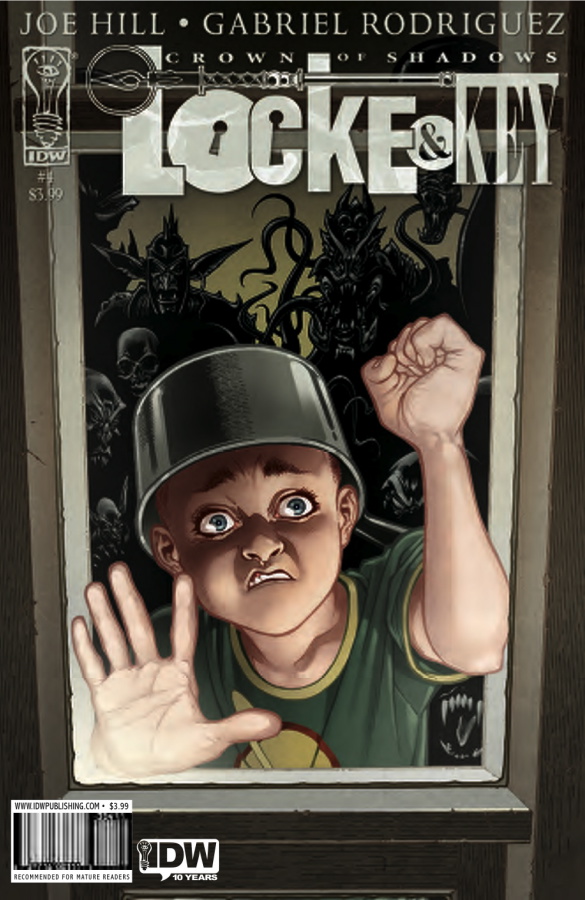
The end of a month of scary recommended readings had to go to my favorite horror comic currently on the stands, and one that I think will stand the test of time as one of the greatest horror comics ever. Locke & Key, from writer Joe Hill and artist Gabriel Rodriguez, is a horror comic in a grand sense; its not just about the monster under the bed, but the horror of loss, of growing up, of betrayal. It has aspects of a coming of age story, as most of the principal cast are kids and young adults, but the older characters still experience their own growth. And its those characters that keep you coming back; as good as the plots are, and they're very good, Hill has crafted some of the most memorable characters I've read in a long time, and your heart soars and breaks with them.

I first discovered Locke & Key because I had read Joe Hill's debut novel, Heart-Shaped Box, and was incredibly impressed. It was amazing to see such a perfectly crafted first novel, and one that was so damn scary. I read a lot of horror, in novel, short story, and comic form, and to read a book that actually gives me the heebie-jeebies is quite a feat. And to see that this guy was starting a horror comic was something I had to check out.

Locke & Key opens with the Locke family returning to their family's ancestral home, Keyhouse, in Lovecraft, Massachusetts (no, nothing foreboding in that name at all). The family is shaken by the recent murder of their father and husband, Rendell, at the hands of one of his students, Sam Lesser. Nina, Rendell's wife, has taken her three children, Tyler, Kinsey, and Bode to start fresh at Keyhouse, which is currently only inhabited by Rendell's younger brother, Duncan. Or so it seems, because Keyhouse has many occupants, and they're not entirely human.

The Locke kids are the central characters of Locke & Key, and the central story is really about them growing up while discovering the secrets of Keyhouse. When the reader first meets them, each of the kids is traumatized by the death of their father in different ways. Over the course of the series, each grow as people, and Ty and Kinsey, who are both high school students versus young Bode who is in grammar school, have to grow up, not just to face the normal challenges of life, but to face the challenges of Keyhouse.


Tyler Locke, using the Giant Key


The secret of Keyhouse is, not surprisingly, keys. But not just the kind of keys you have on your keychain. Each of the keys has a special power, given to them by their composition from something called Whispering Iron. The keys are a wonderful device, allowing Hill to solve problems or introduce new plot elements without resorting to anything outside the world of the series because this extraordinary element is already set. Keys include the Ghost Key, which allows you to leave your body and float as a ghost, the Anywhere Key, that's door opens to anywhere you need to go, the Head Key, which opens the head of the person it is used on and allows personality traits and memories to be added or removed, The Gender Key, that allows you to swap genders, and the Omega Key, which opens a very special, and very evil, door.

When it comes to writing about series that are horror and mystery based, it's hard to do without spoiling anything, something I have commented about before. With Locke & Key it is even harder to do, because the mythology of the series is so brilliantly and gradually pieced out that the reader doesn't get all the answers until the fifth volume, and even then I think there might be some surprises left for use in the sixth and final. But suffice it to say, the story is not limited to Lovecraft in the present. Stories flashback to the American Revolution, to Rendell Locke in his own teen years, and the two one shots, Guide to the Known Keys and Grindhouse, show different previous generations of Lockes.


Kinsey Locke


While I can't talk to much about plot, I can talk about characters, and that's where Hill shines. Each of the Locke kids are phenomenal, three dimensional characters. Tyler, the eldest son, is a boy at the end of his adolescence and preparing to see where life will take him. Haunted at the beginning of the series by an off hand, angry comment that he made to Sam Lesser he believes caused the young man to kill his father, Ty arrives in Lovecraft by far the most detached. But over the course of the series, he not only grows out of that shell and begins to connect with people, but he takes up the role of guardian of his family, supporting his mother who has sunk into alcoholism after the death of her husband, and protecting his siblings from the dark forces that seek the Omega Key.

Kinsey, the only girl in the family and a few years younger than Ty, starts out trying to live life as if nothing has happened. But with the realization of the magic in Keyhouse and the dark events of the end of the first mini-series and beginning of the second, Kinsey makes a decision to use the Head Key to get rid of the emotions that hurt. For much of the series, this is what defines Kinsey, who is a track runner, and who runs from facing her own emotions. Without fear, she is headstrong, and more free to sharing the knowledge of the keys with her friends. Kinsey's growth has a lot to do with realizing that the bad emotions, the fear, the tears, the anger, are as much a part of life as the good ones.

Bode, the youngest of the Lockes, is only six years old. His sense of wonderment at the discovery of all the magic that lives in Keyhouse is different from that of his older siblings. For Bode, it's all wonderment. Even though it comes with darkness, like mysterious voices in the Wellhouse or shadow demons, its still fun to use the Ghost Key and sail around the house, or to get a peak at someone's thoughts with the Head Key. His sense of wonderment is charming, and often the spot of light in an otherwise dark book. He still has to grown up, though, and events at the end of the series might have just placing Bode as the one who will save everyone.


Bode Locke


The cast around the Locke kids are all equally well developed characters. Ad the point of view shifts from character to character issue-to-issue, supporting characters get their moments to shine. Nina, the Locke's mother, is a strong woman who was broken by the death of her husband and the attack made on her, and is having a hard time putting the pieces back together. Duncan, Rendell's brother, is a gentle, quiet artist who loves his family and tries his best to support them while surrounded by tragedy. We also get to see various townsfolk in Lovecraft, including Ellie, one of the few surviving members of the Keepers of the Keys (Rendell's friends) and her son, Rufus, who is developmentally disabled but who has certain special knowledge that helps his new friend, Bode. And finally, there's Zack. Or Dodge, if you prefer. Or the Girl in the Wellhouse. Dodge is the villain of the piece, and I'll let you discover exactly what he's about yourself.

The suspense that builds its way through Locke & Key is done so slowly that you can start reading it and feel fine, but by the end of the issue you realize you've broken out in a cold sweat and gooseflesh. Watching the monsters come after the Lockes, whether they are Sam Lesser, Dodge, or shadow monsters, is part of it, and Hill is a master of the craft here. But it's not all monsters. While Hill and Rodriguez don't avoid violence and gore, and use them to great effect, it's the psychology of horror that makes something really scary. The slow build as Dodge's plan to find the Omega Key reaches fruition is a different kind of scary. Watching Dodge worm his way into the Locke family's life, watching him play with them, it's creepy. Monsters are what we make of them, after all, and sometimes to scariest ones are just people. Although I'm not saying Dodge is entirely human either. You'll have to read to find out.

Gabriel Rodriguez, artists on Locke & Key, is one of the most impressive artists I've seen in comics in recent years. Hi style is distinct and he falls into that category of artists that I love: he draws amazing expressive characters. Faces and body language are important in comics, and in horror comics even moreso, since what is not said is as important as what is said. Each of the Locke kids are made even more real by how perfectly captured they are in each panel by Rodriguez. And his talent for monsters, for shadow demons, for the things in the heads of people when the Head Key is used, is second to none. When we first see the Head Key used, and see into Bode's head, it's an amazing scene, and I don't know how much of what was in there was in Hill's original script and how much was crafted just by Rodriguez, but in the hands of a lesser artist, it could have been just cute or amusing; Rodriguez makes it jawdropping. Rodriguez also does an incredible job of altering his style to fit the story. The Grindhouse one-shot, a classic, gory gangster/revenge yarn, is grittier. And the first issue of the fourth volume, Keys to the Kingdom, is dedicated to Bill Watterson, and features panels drawn in the style of his classic comic strip Calvin and Hobbes, and as someone who loved that strip, the homage is perfect and loving. Every time I open an issue of Locke & Key I don't know what I'm going to get, but I just know it's going to be excellent.

With one final mini-series left chronicling this generation of the Locke family, you still have time to catch up with the series. There's something in this series for everyone, whether it's a well crafted family drama or a jump at a particularly scary moment. Come on, step into Keyhouse and see what's waiting for you.

There are five volumes of Locke & Key available in hardcover, and the first three have also been released in paperback. In order, they are Welcome to Lovecraft, Head Games, Crown of Shadows, Keys to the Kingdom, and Clockworks. The final mini-series, Omega, will begin coming out in single issue in November.