Showing posts with label weekly reviews. Show all posts
Monday, October 24, 2016
Reviews of Comics from Wednesday 10/19
The Backstagers #3
Story: James Tynion IV
Art: Rian Sygh & Walter Baiamonte
I have fond memories about both working backstage on student productions and high school theatricals, although not connected (I did most of my production work in college, while I acted in high school. I died on stage twice in one play!). So, because of this, I was drawn to The Backstagers, another of Boom Box's YA titles, along the same lines as Lumberjanes and Goldie Vance, and it is as delightful and charming as those titles, while being its own book. The Backstagers features a cast of five high school boys at an all boys school who are the stage crew on this year's production, a so-thinly-veiled-it's not-at-all-veiled production of Les Miserables. But what makes this more than just a behind-the-scenes of a play comic is that the backstage is full of tunnels, hallways, and passages full of monsters and creatures (which isn't too far off some of the back stages I've been in over the years. While the first two issues did a lot to set the tone and establish the characters through the eyes of new crew member Jory, issue three takes us to that most dreaded of times for a stage crew: Tech Week, the week where you run the show over and over and make sure everything works. This issue focuses on Beckett, one of the long time members of the crew, who has been the most, shall we say, standoffish member of the crew in those first couple of issue. Writer James Tynion IV does a great job of explaining why Beckett is the way he is in this issue, really fleshing out his character; not just establishing his crush on the play's leading lady, Bailey Brentwood, who is by no means the prima donna mean girl that one might expect from a high school drama star, but also exploring that Beckett is a classic introvert, someone who just needs his own time and space, something this introvert respects and understands with every part of his being.. Also, teaming the grumpy Beckett with the joyful little sprite that is other Backstager Sasha creates a classic duo who don't work. The issue has some great art from Rian Sygh, specifically a splash page of a scene from the play with cast members standing on a barricade, giving you an idea of just how weird this play is (it's Les Mis! Only they're clowns! And there's a bear!). And another two page spread that has small panels over a lighting plot where you get to see much of the crew and cast doing their work in little snippets is one of the best comic representations of what I picture as a TV or movie montage that I've ever seen. This issue is a great work in both character and craft, and just a ton of fun. And while this issue has very little of the supernatural aspects that the first couple have had, short of a magic crystal that powers the lights and lighting board, which is something every theater, high school, college, or professional, would love to have, the set up for what's coming next issue has the promise of all sorts of magic and monsters. Between Backstagers and Detective Comics, James Tynion IV is proving to be an amazing writer of ensemble, character based comics, and I'm looking forwar to where he takes this book next. And, yes, I swore after Goldie Vance that is Boom Box did another mini-series to ongoing transition I wouldn't get suckered in, but, well, if the folks at Boom read this and happen to make that decision, I'm in for the long haul.
Batman #9
Story: Tom King
Art: Mikel Janin & June Chung
Detective Comics has been the Bat book that has absorbed my love and attention since the beginning of the Rebirth era, which is not to say that Batman to this point hasn't been a good comic. It's been a solid, big screen action comics with some nice character beats and work establishing Duke Thomas's relationship with Batman and the new character of Gotham Girl. But the new arc that debuts this issue, "I Am Suicide" looks to be a story that is going to take a good book and push it to new heights. Batman has plans to go to Santa Prisca, home of Bane, to retrieve the villainous Psycho Pirate, who used his powers to infect Gotham Girl with a never ending cycle of fear, and to do it, he's going to need backup, and in this case, he's been offered it by Amanda Waller. Yes, Batman is leading a Suicide Squad. Before we get to Batman, though, the issue opens with Bane and Psycho Pirate, and a bit of a recap of some of Bane's formative years, which are horrifying, and why Bane has taken Psycho Pirate, which is interesting. Bane has been an odd character since the New 52 tossed away much of his later character development, returning him to the character he was in his earlier appearances, or worse to the more thuggish version from various media interpretations, but here it seems King is attempting to deepen the psychology of Bane, which makes for a truly creepy few pages. The majority of this issue a classic, "assembling the team," sequence, but it's not in a sunny happy place like the gathering of a new Justice League. Nope, we're in the bowels of Arkham Asylum. Batman walks out of the Asylum with five members for his team, each very different from the next, Firstly we get the original Ventriloquist, Arnold Wesker. Wesker was one of the characters resurrected by the continuity changes of Flashpoint, but has appeared only in cameos, and has been in many ways overshadowed by the new Ventriloquist created by Gail Simone for Batgirl and Secret Six. Here we get a half reformed Wesker who has broken away from Scarface, but still is seeking someone to pull his strings, which is an interesting view of the character. Bronze Tiger has also been a character who the New 52 continuity didn't treat well, turning him from noble fighter fighting his darker urges into just another member of the League of Assassins. This issue, though, returns him to the classic Suicide Squad member and gives him a great two page sparring session with Batman, one that ends with a smile and the two being revealed to share a history. Punch and Jewlee have been minor characters at the best of times, although they do have a history with the Squad as well, and I'm curious to see what King does to make them more than D-List Joker and Harley. And finally, well, here there be SPOILERS ... is Catwoman, awaiting execution for over two hundred counts of murder. When we last saw Catwoman, which was before Rebirth, she had given up leading Gotham's crime families and had returned to her old status quo, so this is a big, big shocker, and I'm curious to see exactly where King is taking this. On top of all of this, the art from Mikel Janin keeps getting better and better, Seriously, how this guy is not a star is beyond me, with a style reminiscent of early J.H. Williams III. The Bane flashback alone is chilling, and his take on Arkham is excellently creepy.This first issue sets up so much promise for this arc, I can't wait to see how it pays off.
Faith #4
Story: Jody Houser
Art: Pere Perez, Marguerite Sauvage, & Andrew Dalhouse
There are times when I feel like heroism in superhero comics are in short supply. DC is trying to course correct more in this direction with Rebirth, and the results are promising but still early. Marvel continues to have its heroes fighting other heroes more than villains, with some exceptions (like Squirrel Girl). But there's one comic you can always go to where heroism is front and center, and that is Valiant's Faith. At the end of last month a magical artifact created a duplicate Faith, and now both Faith's, along with Faith's boyfriend Obadiah Archer, are hunting down the villain who is using the magical duplication artifact to rob a comic con. It would be easy enough to make this an evil duplicate thing, but that's not where this story goes. Instead we have two heroic Faiths dealing with a legion of criminal doubles all cosplaying a character called Murderous Mouse. I again have to applaud Jody Houser for finding a way to make even the second part of a two-parter new reader friendly. You get a good explanation of Faith's status quo and you get to see all the best parts of her. There's a great exchange between the two Faiths about ysalamiri and how much they miss the Star Wars E.U., which touches on Faith's status as fangirl. You get to see her in action, showing her as a superhero. You get those delightful Marguerite Sauvage drawn daydreams, including a comment on how having two of her would make, "dating weird" (which reminds me of a hilarious moment from the Buffy the Vampire Slayer episode, "The Replacement," You know, the one with two Xanders, when Anya talks about keeping both of them around for a while. Hey, I'm reviewing Faith. Pop culture references are a must), which show that Faith has her head in the clouds at times. And at the end of the story, the duplicate Faith performs an amazingly heroic act, one I don't want to spoil, which shows that no matter which version of her you have, Faith is a hero at heart. And I have to say, while I want to see Faith on her own with her regular supporting cast, and Archer needs Armstrong, I would love a quarterly, "Archer & Faith," series where we just see them go on dates and get into crazy adventures because their dynamic is just adorable. Faith remains a book in classic superheroic tradition, where good wins, and good guys are good guys, and I will take that and relish it month in and month out.
Monday, October 17, 2016
Reviews of Comics from Wednesday 10/12
Darth Vader #25
Story: Kieron Gillen
Art: Salvador Larroca & Edgar Delgado and Max Fiumara & Dave Stewart
Darth Vader has been a consistent high point of Marvel's new Star Wars line. It's been a slow burn of a series, where all twenty-four issues and an annual have built towards this final issue. Dr. Cylo, the mad scientist who has been Vader's adversary throughout the series, first attempting to replace Vader in Emperor Palpatine's eyes and then to take over the Empire itself, faces his final battle with Vader this issue, and its a testament to artist Salvador Larroca. Vader is a force of nature, silent and terrifying. I went through and counted, and Vader has no more than fifteen word balloons throughout not just the battle, but the entire issue, many of which are one or two words. And Vader's face is covered the entire time, so an artist can't even fall back on facial expressions. So Larroca uses body language to show the readers what is going through Vader's mind, much of which is, well, pretty much murder. Beyond the battle with Cylo, we get a scene between Vader and the Emperor which is one of my favorite scenes between the two in a long time. It shows the twisted relationship between the Sith, how manipulation and betrayal are so central to everything they represent, and makes the reader feel for Vader in a way, as the one mentor figure he has left applauds him for betrayal. The final scenes of the main story show Vader dealing with his underling Dr. Aphra, and shows that while Palpatine has embraced the ideal of betrayal as strength and rewards it, Vader most assuredly has not, and we see Vader deal, quite harshly, with his other Imperial nemesis, this one a political foe, Grand General Tagge, and while I don't want to give too much away there, well, if you've seen the original Star Wars trilogy, you know what happens when you screw up in front of Vader, something Admiral Ozzel, who stood there and watched maybe should have learned from before the events of The Empire Strikes Back. But the final two pages take Vader in a different direction, as we get a silent view into his mind, and see him considering a much less violent confrontation with his son, Luke. This issue shows all manner of aspects of Vader: warrior enforcer, apprentice, leader, and father, and through that shows just what an incredibly nuanced character he is, no matter what words he speaks. The two epilogues to the issue are interesting in their own right. One is a brief scene that sets up Dr. Aphra's upcoming series, and helps establish her new trajectory and her supporting cast (the Wookiee bounty hunter Black Krrsantan and the evil droids Triple Zero and Beetee-One ). The other is a silent piece, set on Tatooine, as we see the results of what Vader has done to the Tusken Raiders, the Sand People. It's a chilling little story, and is hard to write about without laying it out point by point, but needs to be seen. I'm going to miss the Darth Vader ongoing series, it's powerful narrative and dark turns, but I'm looking forward to see where Gillen takes the Doctor Aphra series.
The Fix #6
Story: Nick Spencer
Art: Steve Lieber & Ryan Hill
In most cases, I have a hard time with stories where there are no redeeming characters, Even stories starring anti-heroes or downright villains show a nuanced portrayal of those characters, like Darth Vader in the previous review or Walter White in Breaking Bad. However, The Fix, Nick Spencer and Steve Lieber, is the exception to this rule, as there is not a single character in this book who has a redeeming characteristic. When the principal character who is the least morally reprehensible is the crooked internal affairs cop (with the exception of Pretzels the dog. Pretzels is the best), you know you're in for a ride. This issue gives us a new one of lead character Roy's crooked side businesses, trafficking in stolen celebrity personal items. And frankly, this is far from the worst thing we've seen Roy do, but it's the fact that he's actively employing meth addicts to do it that makes it even more reprehensible. The story of how Roy met Matty, the chief meth addict, is one of the darkly comedic things that makes The Fix work so well. I mean, I honestly laughed out loud so hard I doubled over and got a very strange look from my wife, and when I tried to explain why it was funny, the look just got stranger. In theory, bum fight shouldn't be funny, and in real life practice they aren't, but in the twisted world that Spencer and Lieber have created, the whole sequence is utterly hilarious. And as we understand exactly what Roy has been up to, and exactly where this has gone, and exactly what Roy has planned for Matty's friends who he assumed are responsible for the death of the starlet he had them rob and he assumed killed, well the hole he dug just keeps getting bigger. And the big reveal of what this has all been about, what the killers were looking for, well, I don't know if it would work in any other comic, but it sure as heck works here. If all of that wasn't enough, we get two scenes away from Roy, and if you were hoping for characters you could empathize with and see as light in a corrupt world, you are in the wrong place. We get a scene that further develops the mayor of L.A., who has a... unique habit during press conferences, and one with Donovan, the movie producer, and his really interesting fantasy life. The thing that keeps me coming back to this book, aside from the twisty plot, the comedy, and the excellent Steve Lieber art, is the fact that these characters have to get their comeuppance sooner or later, and I just can't wait to see how big a hole they can dig before they fall into it. And after this issue, I can't wait to see them all get what's coming to them more than ever, in the best possible way.
Hard Case Crime: Peepland #1
Story: Christa Faust & Gary Phillips
Art: Andrea Camerini & Marco Lesko
The Hard Case Crime label is an impressive publishing initiative that has presented both reissues of classic noirs and new stories in the best noir and crime fiction styles, and I became familiar with their novels by the publication of two original works by Stephen King, The Colorado Kid and Joyland. And when I heard they were going to partner with Titan Comics to produce new crime comics, I was excited, and I'm pleased to say that Peepland, one of their inaugural offerings, is an excellent crime comic. I chose to try this series for a couple of reasons. Firstly, the writers. I'm familiar with Christa Faust only by reputation, but Gary Phillips has written some amazing crime comics over his career, most notably to me the Vertigo mini-series Angeltown and from Boom Studios The Rinse. The setting also appeals to me. The comic is set in New York City in the mid-80s, back before the city was sanitized. I was a kid back then, so it's not like I spent any time wandering those red light districts, but I know people who did, people who tell stories of Time Square before Disney rolled in, and so I get a sense of the city I love from bygone days. And this comic is set deep in those red light districts. Starring Roxy, a peepshow performer, the comic starts with a man running for his life from two thugs before hiding a video cassette (remember those?) in Roxy's booth. Pretty soon, the police are involved as the man, the producer of a Girls Gone Wild-esque series of pornographic videos, is dead and more than one group is looking for the tape. Roxy is a sympathetic protagonist, and presented in a real way: she's not the sex worker who's just doing it to pay her way through law school or some similar trope, but is someone who does what she does and has a life outside it, an uncle slowly dying of AIDS when AIDS was a short-term death sentence, an ex-boyfriend, and curiosity about that tape that is going to get her in trouble before the series is out, I have no doubt, especially when we see what's on the tape. Aside from our lead, we get plenty of other characters, all fitting into a classic crime/noir mold: other dancers and performers at Peepland, thugs and toughs, hardnose cops; this might be set in the 80s, and the events might only work in that particular era, but it's got a gritty feel right out of the best 40s noirs. In case the title didn't make it clear, by the way, this is a comic for mature audiences, with nudity and lots of bad language, but it's also for mature audiences because it's smart and complex, with characters and a mystery that will appeal to readers who are looking for something to really dig their teeth into.
And Dan Grote's back with a very special issue of Deadpool...
Deadpool #20
Story by Gerry Duggan
Art by Matteo Lolli and Guru-eFX
In which Deadpool stops someone from committing suicide
through violence.
Let that sink in for a second.
We’ve all seen superheroes talk ordinary folks off the
ledge, literally and figuratively. Superman arguably did it best in All-Star Superman.
Deadpool is not Superman. Hell, he’s barely a superhero.
He’s a guy who often wants to be good but doesn’t know how because he’s lived a
life of violence and insanity. Which is why he gloms onto other superheroes –
Spider-Man, Captain America, etc. – and demands to become their new best friend
whether they like it or not.
On this night, a young woman named Danielle is staring down
at the street from the roof of the Schafer Theatre, formerly the home of the
Avengers’ Unity Team, the Mercs for Money, and Deadpool. Wade leads with “Don’t
jump!” and follows with “Parker Industries is just a few blocks down.”
Now, things have been pretty crappy – well, crappier, I
guess – for Wade lately. His wife has been cheating on him, his team has
abandoned him, his base was destroyed. Frankly, if this were the Joe Kelly era,
he’d be in the depths of a sadomasochistic pity party and probably push her off
the building himself.
Instead, Wade takes her to see Hamilton and lets her go on a ridealong while he beats up deadbeats
as part of his pro bono work. Along the way, Danielle learns useful things like
the best way to get bad guys to come to the door (Yell “Sexy maids!”) and when
to kick or blow down said door and begin delivering beatings. Danielle even
picks up a bat at one point and joins in the fun.
“Violence solves everything if you’re good at it,” Wade
insists.
Their magical smashy-smashy tour ends at the emergency room,
where Wade drops her off for pre-arranged help.
“I’m smart enough to know I’m dumb enough that I can’t help
you,” he says. “But they can.”
This isn’t Wade doing the right thing to impress Spider-Man
or Agent Preston or Cable or any of his usual over-the-shoulder angels.
Nobody’s watching. This is Wade doing genuine good the best way he knows how,
while remaining completely in character and recognizing his own flaws. This is
Gerry Duggan once again teaching a master class on how to develop a
chaotic-neutral quasihero.
After Danielle walks into the ER, Wade finally finds the
perfect thing to say: “You gotta remember: No matter how bad things get … that
life is fluid. There’s always the chance that something great is waiting around
the next corner. (Steps in dog poop) You just have to find a way to keep
rounding corners.”
In other words, “You’re much stronger than you think you are.”
Deadpool’s been
teasing a showdown with Madcap for months now, but recent issues have had next
to nothing to do with that. This issue is no exception, but it’s also probably
one of the best standalone ‘Pool issues ever.
Monday, September 19, 2016
Reviews of comics from Wednesday 9/14
Detective Comics #940
Story: James Tynion IV
Art: Eddy Barrows, Eber Ferreira, & Adriano Lucas
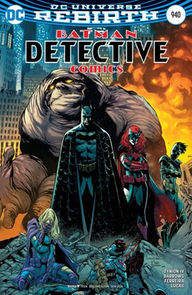
And so ends the first arc of the new Detective Comics, and what an ending it is. I've been singing the praises of this title since it returned with its new Rebirth era creative team, and this finale doesn't disappoint. There will be SPOILERS for the issue in this review, more than I usually would put in one, but frankly the ending of this issue has been all over all the major comic news sites since Wednesday, so I feel I can address it. I want to start by talking about thee aspect of the issue that hasn't been discussed all over the place, which is James Tynion's handling of Batwoman and her confrontation with her father, Colonel Jake Kane. Kane has been the primary antagonist of this arc, him and his para-military Colony organization, and to see Batwoman stand up to her father is a bravura moment for that character. This is the strong, take no prisoners hero that was introduced all those years ago in 52, the character who should have been a star and was shunted to the side until all the buzz around her had died down. Kate Kane is a woman of principal, who stands by what she believes in, even if it means her imprisoning her own father. And Kane remains just this side of sympathetic, a man who truly believes that what he's doing is right, which makes him all the more interesting as a foe. But now I have to touch on is Tim Drake, Red Robin, and his fate. On Friday, I wrote about what makes Tim Drake such a great character. And his final showdown with the drones that the Colony were sending to kill suspected agents of the League of Shadows is a perfect indicator of what makes Tim great: he went down a hero. He knew that his chances were slim, that he might be sacrificing his own life when he set himself as the drones only target, and when he knew he couldn't win? He stood his ground and went out a hero. It was a marvelous moment, and would have been an excellent death, if that's what it was. Instead, we see him taken by the mysterious Mr. Oz. There are interesting new hints to what exactly Mr. Oz is doing, and what his plans are, which are all good for the overall progress of the DC Universe and for Tim's future, but it's also great to see Tim, the one person who kept the faith when Batman "died" in Final Crisis and was sure Bruce was alive, still having faith that his friends will find him despite his own seeming death. Add in a perfect scene of Batman showing real and true sadness at the apparent death of one of his charges, and you have an issue that is as emotionally resonant as it was action packed, a perfect superhero comic.
Faith #3
Story: Jody Houser
Art: Pere Perez and Andrew Dalhouse & Marguerite Sauvage
In case you haven't read any of my previous reviews of her series or any articles about the character, Valiant's breakout hit character Faith is a fangirl. A major league fangirl. And that part of her character is part of her charm. So it's probably not the least bit surprising that Faith would spend a story arc going to a comic con. And she's bringing her boyfriend, Archer of Archer and Armstrong along for his first con. The two head out, in cosplay naturally, and because this is a superhero comic, pretty soon they're getting involved investigating thefts at the convention and the theft turns out to be way more than just a simple fan who wants to make off with stuff he couldn't afford. The appeal of this issue comes from the interactions between Faith and Archer. We saw their first date in a recent issue of A+A, but now we're seeing them more deeply into their relationship, and on Faith's home turf. The two are so perfect together, Archer so naive and Faith so confident in this setting. And the reasons why Faith is so determined to see that justice is done at the con, and what cons mean to her, is something that I think all of us who live in a world of fandom should read, because it's something that is easily forgotten: about how cons are places where we meet and greet those we admire and more how we get to share the things we love with others who love them, and how no one has a right to interfere with that. I love how positive Faith is, how she is always looking for the best in others, but how she's also always willing to stand up for herself and others. The art for the issue by Pere Perez is especially good, with all sorts of wonderful Easter Eggs in the con scenes, and a great design for Faith's cosplay, something that still evokes her costume while having a different, piratical air. Faith is one of the best comics from Valiant, a fun superhero comic that embraces fandom and fans, with a great hero; it's also a comic that is easy to jump on to at pretty much any point, and this issue is especially good as a jumping on point, as everything you need to know is right here. Oh, and not just everything you need to know about Faith; there are con going tips throughout the issue that are well worth taking note of, even if you're an old hand at it. I mean, who knows when you're going to be called on to fight evil at your next con?
And Dan Grote is here with a review of a... Batman comic!
All-Star Batman #2
Story: Scott Snyder
Art: John Romita Jr., Danny Miki and Dean White (main
story); Declan Shalvey and Jordie Bellaire (backup strip)
At the end of Season 2 of The Venture Bros., after the
Sovereign has revealed himself as (a shapeshifter who takes the form of) David
Bowie, Henchmen 21 and 24 remark on their favorite Bowie albums, and 21 harps
on 24 for liking “ChangesOne” because “Changes is a best-of.”
All-Star Batman is, in many ways, a best-of. But it’s also
something new.
Part of it is Batman barreling through a highlight reel of
his enemies (roughly) two by two as he and Two-Face buddy-cop their way across
the country. So we get appearances from requisite Bat-foes like the Penguin,
Killer Croc and Victor Zsasz, in addition to deeper cuts like the KGBeast and
Gentleman Ghost. We also get art from John Romita Jr., one of comics’ warmest
blankets for more than 30 years.
But while Scott Snyder spent five years cementing himself as
one of the all-time great Bat-writers, he’s not done leaving his mark.
Take, for example, his take on Two-Face. Snyder’s Two-Face
is portrayed as much darker than in years past, explaining away his campier
exploits as cries for help from the Harvey Dent side of his personality. This
Two-Face isn’t just setting other villains on the Bat. Even allies like Jim
Gordon have a vested interest in stopping Bruce from reaching the series’
MacGuffin, a purported cure for the Two-Face side of Dent. If successful,
Two-Face has threatened to release the dirt he has on everyone in Gotham, and
that’s a lot of dirt.
And yes, Bruce is training a new sidekick, but despite
headlining a title called We Are Robin, Duke Thomas is not taking up the
mantle, nor is he wearing the standard red, green and yellow. Just the yellow.
The backup strips focus on Duke’s training, which isn’t so much about learning
martial arts or how to win a melee fight but a study in psychology, both in
Duke’s relationship with his psychotically altered parents and in learning how
Batman’s never-ending parade of Arkham escapee foes thinks. Because let’s face
it, working with Batman means exposing yourself to messed-up stuff every second
of the day.
Oh, and Bats uses actual shark repellant against King Shark.
Because if Grant Morrison’s Unified Theory of Batman has taught us anything,
it’s that Batman done right should be grimdark and silly simultaneously.
So if Matt and I had the repartee of 21 and 24, he’d be
doing his duty by calling me a poseur for liking the “ChangesOne” that is All-Star
Batman. Also I’d be dead in a season. But whatever, my point is, as The Matt
Signal’s resident “Not a DC guy” guy, I’m loving this book. And Bowie rules.
Monday, September 12, 2016
Reviews of Comics from Wednesday 9/7
A+A: The Adventures of Archer and Armstrong #7
Story: Rafer Roberts
Art: Mike Norton, David Lafuente, Brian Reber, & Allen Passalaqua
I find that there are a lot more comics that are just plane fun now then there were back in the 90s when I started reading comics, and I'm glad for it. But there are few comics that are not only fun, but completely embraces the mad absurdity of comics than A+A, the current series that stars one of Valiant's classic odd couples, Archer and Armstrong. On a quest to find Armstrong's long forgotten wife (he got drunk and forgot he got married), the mismatched pair of Archer, the young man trained to be an assassin and can summon up any physical skill, and Armstrong, the drunken immortal, have instead stumbled across a Russian circus where everyone who performs bears and odd resemblance to Armstrong. That was last issue, but this issue, now that the scientists who created the circus are attacking, we get an entire issue of crazy escapades. Archer and Armstrong fight Soviet scientists, Archer and Armstrong meet the members of the freak show, the failed experiments, learn exactly what the nature of the circus people who resemble Armstrong are (and it is neither his illegitimate descendants or clones, as Archer theorized), perform in the circus in disguise, fight clowns, and meet the scientists behind the project, one of whom is a talking bear. It's a delightfully off kilter story, but while it is utterly bizarre, it is grounded in the reactions and the well established characters of the leads. Archer is curious an wants to get answers, and his recent time with his new girlfriend, Valiant's breakout heroine Faith, has him trying to solve problems by talking rather than punching, which doesn't sit well with the more bull in a china shop style of his partner. The issue is simply a delight to read. And if all that doesn't sound like enough story, well Archer's step-sister, Mary-Maria, is dealing with a coup within the order of assassin nuns she's the head of. And in a back-up, Davey the Mackerel, an anthropomorphic fish man who escaped the confines of Armstrong's bottomless bag (and shout out to all my fellow D&D players who look at it and think of Bags of Holding), is dealing with his time as the assistant and guide to a dark god who escaped the bag without his powers and who used to work making bags, satchels, and purses. The dynamic there is just killer; picture Doctor Doom, down to the ranting, if he made purses. I know that this review contained a little more plot than I usually put in a review, but the issue is so packed with stuff that I felt like calling that out; Valiant does a great job of making their comics dense with story, and A+A is one of the titles that really takes a bit of time to read in the best possible way.
Everafter: From the Pages of Fables #1
Story: Dave Justus & Matthew Sturges
Art: Travis Moore & Michael Wiggam
Vertigo has a long history of spin-offs from its best known titles. Some, like The Dreaming, are mostly forgotten. Some, like Lucifer, have spawned spin-offs of their own. Everafter is the first spin-off from Fables since that series, a personal favorite, wrapped up at issue 150, and is a good start to this series. At the end of Fables, magic came to the Mundane world, meaning Earth as we know it, and now things there are all sorts of screwy, and the Fables are trying to help keep things straight. Two plotlines run through this first issue, introducing, or reintroducing in some cases, the characters I assume will be the principal cast. One plot features Connor Wolf, one of the cubs of Bigby Wolf and Snow White, two of the principles of the original series, being recruited into the covert ops organization of Fables that polices magic in the now not-so-Mundy world. Connor was one of the least developed of the cubs in the original series, so there's a lot of wiggle room the creators have to work with on his personality. He's a great entry character, because he's dashing but headstrong, and looking to find his place in the world. You get an idea of what this operation is, who the key players are, and what they're doing through Conner's eyes. The second, more action oriented plot, features three of the agents on a mission in St. Louis. Bo Peep and Peter Piper, former thieves and assassins who starred in the Fables novel Peter and Max, and Hansel, the former Adversary's chief Witchfinder, are hunting down something that is causing a terrifying outbreak of monsters. The art from Travis Moore is spectacular, showing all sorts of great creatures, and the character action is exciting and clear. It's not unexpected that Hansel, someone who hunts and kills witches for a living, is not exactly the most pleasant of characters, and doesn't get along with the husband and wife team of Bo Peep and Peter, but as they near the goal, Hansel's motives are more clear and not unexpected. Dave Justus and Matthew Sturges have a history with Fables, having co-written the adaptation of the video game Fables: The Wolf Among Us, and Sturges co-wrote the original Fables spin-off, Jack of Fables, and they show a deft hand with both the characters we already know and the new ones. It's really exciting and interesting first issue, and even if you don't have any knowledge of Fables, you should be able to pick it up.
Kill or be Killed #2
Story: Ed Brubaker
Art: Sean Phillips and Elizabeth Breitweiser
I was on vacation when the first issue of Kill or be Killed was released, and so I didn't write it up, which I regret, because it was one of the best debuts in recent memory, but I will try to make up for that with a glowing recommendation of issue two. This isn't surprising, since the team of Ed Brubaker and Sean Phillips have been pretty much flawless in everything they have ever done together. Kill or be Killed exists in a the gritty world of a Brubaker and Phillips comic, a place that exists almost entirely in shades of moral grey to black, and explores the idea of vigilantism and how it effects people in a real world setting. This issue follows our lead, Dylan, on his first kill. If you didn't read the first issue and don't know the set up, Dylan survived what should have been a lethal fall only to be visited by a demon that says he is living on borrowed time and must commit an evil soul to Hell each month to keep on living. While I think we're supposed to take on faith that the demon is real, there's enough ambiguity to leave us questioning whether this is real or not, especially as the demon doesn't appear in this second issue; it's just Dylan systematically looking for a gun and a person who deserves to die. The issue is narrated by Dylan and is the usual tremendous character work that Brubaker does; it's hard not to sympathize with Dylan as you see that he doesn't want to die himself, and after all, he's only killing bad people. And Brubaker gives us the worst of the worst here, as Dylan tracks down the elder brother of a childhood friend of his that Dylan only realized too late was molesting his friend, who eventually died from drugs and depression. This is a person (and I use that term loosely) that no one would have sympathy for, and you feel yourself cheering for Dylan when he puts him down. But should you really? Is it right? These are the questions I think Brubaker wants us to contemplate. I'm just scratching the surface of the issue, a comic that explores Dylan's childhood and his father's life, and continues to lay out his present. Sean Phllips is at the top of his game, not just in the sequences in the past and present, but in a beautiful slash that shows the art that Dylan's father made for *ahem* gentlemen's pulp magazines. It's the kind of piece, painted by Phillips himself, that might be a little too good for those trashy porno mags, a really beautiful piece of art, which is just right for the art of a man who felt his dreams being crushed by doing art for a place that is beneath him. You don't buy a comic by Brubaker and Phillips for a happy trip; you read it to be entertained, certainly, but it will also make you think, be challenged, and to watch the idea of genres be broken, as nothing is off limits. Kill or be Killed is another gem in Image Comics crown, and in the constantly evolving and breathtaking work of these two amazing creators.
And after that more bleak review, something lighter and more fun from Dan Grote...
Jughead #9
Story by Ryan Q. North
Art by Derek Charm
Let’s be clear: Chip Zdarsky and Erica Henderson’s run on
Jughead was a ton of fun and used some of the sillier aspects of Archie history
(Jughead’s Time Police, anyone?) to its advantage. They will be missed on this
book.
But Forsythe Pendleton Jones III has been passed on to the
best possible hands.
Writer Ryan Q. North (Henderson’s partner on Marvel’s
Unbeatable Squirrel Girl) and artist Derek Charm roll fast and heavy with the
comedy in Jughead’s solo series, right from the opening splash page featuring a
sculpture of our hero composed of burgers, hot dogs and pizza, which he made to
win an art contest.
Zdarsky’s Jughead was canonically asexual, but North has him
questioning that identity after a girl takes the form of his favorite thing: a
burger. Pop’s Diner has employed a mascot who stands outside and hands out
coupons and menu advice to passing prospective customers, her costume changing
based on the day’s special (that’s a hefty budget to be pouring into wardrobe,
Pop Tate).
Jughead discovers he has feelings for this walking, talking
all-beef Patty, and so he turns to his friends for advice on love, all of which
is naturally terrible (Reggie: “Love is possession. It’s seeing something
really cool that someone else has, and knowing if you had it, you’d be just as
great as they are, and then they’d be worse, because they wouldn’t have it
anymore.”).
Except for Betty’s. Betty’s advice about how to approach a
woman is mandatory reading for every teen and adult male alive and takes into
account things like consent and how to properly compliment someone while
acknowledging that romance is complicated. Be like Betty. Don’t be like Reggie.
If we lived in an age where covers and solicitation text
didn’t instantly spoil endings, it’d be spoiling things to say Jughead’s burger
babe turns out to be none other than Sabrina the Teenage Witch, but c’est la
vie. It will be fun to watch them interact more next issue.
And kudos to North for giving us even more comedy between
the panels. Additional narration boxes accompany the bottom of half the pages
in the book, rightly pointing out that Zdarsky was ripping off the reader by
not providing the same, touting the importance of self-care and poking fun at
Malcolm Gladwell’s 10,000 hours theory.
A new creative team on a book can often be a cause for
concern, but at least for me, “Jughead” retains its Most Favored Comic status.
Monday, September 5, 2016
Reviews of Comics from Wednesday 8/31
Deadpool V Gambit #4
Story: Ben Acker & Ben Blacker
Art: Danilo Beyruth & Cris Peter
There have been a lot of groups of mutant villain henchmen over the years (if you want to learn more about them, check out Dan Grote's posts here and here). And when there are that many members of a team whose main purpose is to hench for some big bad, there's a good chance that those characters are one note characters. So it's interesting when writers Ben Acker and Ben Blacker pull back from the comedic caper that has been the first three issues of Deadpool V Gambit to spend pretty much the entire fourth issue not focusing on either of their leads, but instead telling the story of Scrambler. Scrambler is a member of the Marauders, the group that works for Mr. Sinister, but that isn't even important to know for this issue. Acker & Blacker start the story off by establishing the basics, that Scramber was a bad guy who fought the X-Men and who has tried to go straight. Acker and Blacker make us care about Kim Il Sung, a villain who has had very little development before this. Not only do they logically update his power set, which is trickier than you'd think, but they also give him a love interest, a family, and a logical desire to be a better person for them. I encountered Acker & Blacker through The Thrilling Adventure Hour, which is one of the funniest things, well, ever, and the earlier issues of this series have been lighter in tone. Even their Thunderbolts work, which had something of a darker tone, had a large portion of humor to it. And while this issue isn't grim (the reason Scrambler has it in for Gambit and Deadpool spins out of a scene that is actually pretty darn funny), this issue is much more a character study. We see Scrambler at his lowest, then his best, ans then dragged down back to the lowest by situations beyond his control. It's a really solid single issue in the middle of a mini-series, and while the series' two leads are pretty much incidental, it doesn't feel like something completely outside the scope of the series. There's a big reveal at the end of the issue, actually, that casts the events of the series in a completely different light. If you've been suffering from Gambit withdrawal since he hasn't been a regular in a series in a while, you just need some more Deadpool, or you like to see the other side of villains, you should really check out Deadpool V Gambit.
Gotham Academy Annual #1
Story: Brenden Fletcher & Becky Cloonan
Art: Adam Archer, Msassyk, Michael Dialynas, Chris Wildgoose, Sandra Hope, Serge Lapointe, & Rob Haynes
We've been away from Gotham Academy for a few months now (unless you've been checking out the very fun Lumberjanes/Gotham Academy, which you all should be), so the choice to do a one off annual to refresh current readers and introduce new ones before the new Gotham Academy: Second Semester starts was a good one, and this issue is a great jumping on point for new readers. A mysterious ailment is sweeping Gotham Academy, and our leads, the members of Detective Club, are split down the middle on what they think is responsible: Pomeline, always looking for a magical explanation, thinks it's a vampire, while Colton believes visiting professor Derek Powers is behind this. So Colton takes Kyle, and Pomeline takes Tristan, and Maps is left trapped in the middle. We get to see Olive, who is usually in the center of everything, on the sidelines in this issue, which allows the other characters to really stand out. What this issue does, which is a great example of what Gotham Academy does best, is balance the character work with the mystery and the macabre, while also tying into the deep mythology of Batman as a character. Note I didn't say the history of Batman, as what this issue ties into is actually the future of Batman. If you're at all familiar with Batman Beyond, either the animated series or the comics that have been released to tie into it, you know the name Derek Powers and know that no good will come of it. Also returning this issue is Warren McGinnis, introduced back in issue four of the series, who also has ties to the Batman Beyond universe. There's ealso an appearance from a supernatural one-off Bat villain, a character I never thought would pop up again, which is something that just fills me with joy; no other series from either of the Big Two embraces the crazy history of comics like Gotham Academy does. But what's even better is that if you're unfamiliar with any and all of that, nothing of the issue is lost on you. Instead you get two interlocking mysteries featuring two sets of likable protagonists. Pomeline is at her most demanding, and Colton at his most slick, but we get hints that there's more to Colton than we've seen before; of all the regular cast, he's the one who's gotten the least development so far, more or less being the campus ne'er-do-well, so it's nice that we're beginning to see more of his personality and his backstory come out. There are multiples artists across this issue, but fortunately Rob Haynes did breakdowns across the whole issue so the art has a consistent feel, but each plotline has a distinct look. Gotham Academy Annual #1 is an exciting romp across the grounds of the titular Academy and a treat for Batman fans of all ages and knowledge.
Suicide Squad: War Crimes Special
Story John Ostrander
Art: Gus Vazquez, Carlos Rodriguez, & Gabe Eltaeb
Now THIS is the Suicide Squad. I haven't written as much about the Suicide Squad as I feel like is deserved for how much I love the concept and the characters on this blog, mostly because the series as it's been running since I started writing here has rarely been a book I really loved. But this one-shot, written by the man who redefined the Squad in the '80s and a writer I have written a lot about, John Ostrander, hits every note that makes a good Suicide Squad story. Let's count them down, shall we?
1) It has great characters and character moments: The Squad in this issue is mostly made up of staples of the Squad: Deadshot, Captain Boomerang, and Rick Flag from the original series; Harley Quinn and El Diable from the New 52 era; and a new member, Mad Dog, who you know is not long for the team right out front. Flag and Deadshot have a great rapport in the issue, working together, and Ostrander writes one truly funny Harley moment. But it's Boomerang who Ostrander really captures. The arrogant, smarmy, easy to anger, quick to seek revenge Boomerang of those classic books is on display here, to the point that he is responsible for Mag Dog's death just because the bounty hunter rubbed him the wrong way. Boomerang is often played as comic relief or the team punching bag, but Ostrander remembers that he is a nasty piece of work at heart.
2) Interesting foes: Ostrander gave the Suicide Squad some really interesting enemies in his original run. The international mercenaries known as the Jihad (changed to Onslaught after their first appearance) were a great collection of characters with interesting powers and looks. The Loa was another fascinating nemesis. This story introduces Strikeforce Europa, a team of European mercenaries. And while they don't exactly walk out of this unscathed, they don't feel like characters who were created simply to be disposed of; they have a backstory and work as characters who have potential.
3) Real world events effect comic book stories: There was an interview I read somewhere once that I wasn't able to find to get the exact quote where Ostrander said he stopped writing stories for Suicide Squad set in real places because it seemed like every time he did it seemed that place popped up on the news. And while recent Suicide Squad stories have taken place in real countries, they are often just using those places as a setting and not discussing the political realities. This issue takes something very real and while changing the names to protect the innocent (or to protect the publisher from libel suits), there is a reality to this story. The Secretary of Defense from the "previous administration" has been kidnapped by Strikeforce Europa to stand trial for war crimes, for starting the last "Gulf action" to benefit "Black Mountain" the private military security contractor he has worked for an with. If you have any notion of modern American politics, none of this is particularly veiled commentary on politics, and it creates an interesting mission, as the Squad must rescue him.
4) Action action and more action: Much of this issue is an elaborate heist type story, only with what the team is trying to take is a human being. We get the Squad in battle with Strikeforce Europa, with the assassin Shado, who was sent by Black Mountain to silence the Secretary of Defense before he spilled their secrets at the World Court, not to mention your standard issue security forces. You get car chases, super powered fights, and a really cool scene with Deadshot on a motorcycle. It has an excellent balance of action and character, which was the hallmark of the best Suicide Squad stories.
5) The Wall: John Ostrander created Amanda Waller, and there are very few, if any, writers who get her better than Ostrander. Whether it's giving the team a briefing with her patented hardass attitude and biting humor, or debriefing when the team gets back, and all her contact in between, this is the Waller I hear in my head when I think of best Waller moments.And I've seen people of two minds on how coldly homicidal Waller was in the recent Suicide Squad movie, but anyone with any familiarity with the character would see that her actions at the end of this issue, and the reasoning behind them, are so perfectly logical that it's one of my favorite Waller moments of all time.
Seriously folks, whether you miss the old Squad stories or are a fan of the new ones, this is a perfect gem of a Suicide Squad story that everyone should check out.
And look! Dan Grote is back, with a review featuring two of his great fan passions: the X-Men and '90s music...
X-Men ’92 #6
Story by
Chris Sims & Chad Bowers
Art by Alti
Firmansyah & Matt Milla
Matt often
writes about how sometimes a book is so consistently good, he sometimes passes
on reviewing it because there are only so many ways to say “This book is consistently
good” month after month.
The same can
be said for Marvel’s X-Men ’92, which is if nothing else a love letter to the
1990s animated series and the comics of the time period.
Except this
issue ups the ante considerably by working in the music of the Extreme Era as
well. Coming of age in the ’90s as I did, I spent my teen years a) devouring
X-Men comics and b) listening to alternative radio. So to read a comic in which
the X-Men work as bodyguards for Lila Cheney at a music festival that includes
the Flaming Lips and the Toadies is to relive those years in their purest, most
crystalized form. The only thing missing is all those Sunday afternoons I
killed playing The Sims and Final Fantasy VI on the Super Nintendo.
After a
prologue that brings Joss Whedon creation SWORD into the ’92-niverse, the comic
opens with intergalactic rockstar Cheney joining the Lips on stage for “Race
for the Prize,” complete with lettered lyrics that sent me combing through my
CDs to see if I still had a copy of “The Soft Bulletin.” Even Beast is singing
along, and let’s face it, he would like an up-tempo song about two scientists
competing to save a dying sun.
And
seriously, the Toadies? The Toadies?! Raise your hand if you’ve thought about
the Toadies at any point after 1996. They’re about as ’90s as Adam X the
X-Treme.
Anyway, it
turns out Lila’s on Earth because there’s a bounty on her head, and she’s being
hunted down by British-import robot space bounty hunter Death’s Head. Hence her
asking the X-Men to act as security.
Also lurking
around disguised as a be-ponytailed roadie is none other than
Acolyte-slash-Upstart Fabian Cortez, whom a narration box accurately describes
as having “the power to make mutants mutant harder.” Cortez amps up Cheney’s
already-considerable teleportation powers amid the fight with Death’s Head,
transporting herself, the X-Men, Death’s Head and SWORD’s Abigail Brand to an
alienated planet populated by [spoilers].
I can’t say
enough how much of this book is sold on the strength of Alti Firmansyah’s art.
Chris Sims and Chad Bowers get the cheesiness of the era and what characters
will make fans wistful, but Firmansyah nails the fashion, the facial expressions
and the fun of what, at its worst, was a melodramatically angsty time. It doesn’t
mimic the animation style of the cartoon – if anything, she seems to take her
cues from “Voltron” and the Joe Madureira style of manga-light art that took
hold mid-decade – but you can see that she’s having fun, and I’d love to read
more of her work.
Labels:
becky cloonan,
ben acker,
ben blacker,
brenden fletcher,
chad bowers,
chris sims,
dan grote,
Deadpool,
gambit,
Gotham Academy,
john ostrander,
Suicide Squad,
weekly reviews,
X-Men '92
Monday, August 29, 2016
Reviews of Comics from Wednesday 8/24
Atomic Robo & The Temple of Od #1
Story: Brian Clevinger
Art: Scott Wegener & Anthony Clark
Atomic Robo is back! The pattern of Robo mini-series one set in the present and then one set in the past, and so this new series is a flashback to the late 1930s. Robo is tasked by the US military to go to Shanghai, which at this point was under Japanese control, and retrieve a Chinese scientist who has been taken by the Japanese and is developing a weapon using zero point energy, a source of power that is limitless and could destroy the world if used improperly. So, jet-setting adventurer Atomic Robo (that's his cover story, because really, how can you hide him) is off to Shanghai, and before the issue is over we have raids by Japanese soldiers, a motorcycle chase, Robo wising off at a dangerous time, and the return of a character from Robo's past. Now that we're into the eleventh volume of Atomic Robo, and that's not counting all the ancillary stories from Real Science Adventures, creators Brian Clevinger and Scott Wegener have built a large and elaborate universe, with so many different characters from different eras in Robo's long life that it makes sense that a character like Helen McAllister, Robo's first love from the early 30s, would show up again during his World War II era adventures. And as with any Atomic Robo series, it's fun to look for the Easter Eggs the creators have placed throughout, as these are two guys who love their pop culture. Robo's arrival in Shanghai holds more than its fair share of nods to Indiana Jones and the Temple of Doom, with a shoeshine boy who resembles Indy's sidekick Short Round, and a nightspot called Anything Goes. The best thing about Atomic Robo for me, though, is that even though the settings are new and the plot is filled with twists and turns you can't expect, if you're a fan of Robo it's like coming home; Robo as a character has a very specific voice, and his stories do as well. And if you're a new reader, even if you've never touched the character before it has such a welcoming, pulp feel to it that you can't help but be drawn in.
Detective Comics #939
Story: James Tynion IV
Art: Eddy Barrows, Eber Ferreira, & Adriano Lucas
Tim Drake is my favorite Robin. I started reading Batman comics regularly right after Tim was introduced, and I grew up with him. And I have felt like the post-Flashpoint DC Universe has done the character a huge disservice, shuffling him off to the sidelines. That is until this current run on Detective Comics, which has brought Tim right back into the fold of the Bat universe. After escaping the Colony last issue, Batman, Batwoman, and their squad are trying to figure out what to do next. The issue starts out with some great character moments between Batman and Batwoman, as they discuss what Bruce may and may not have known about Batwoman's father's involvement with the Colony, and Tim coming to a decision about his future and discussing it with Spoiler. It would be easy, in the middle of an arc so packed with intrigue and action to forget about the characters and focus on the story, but Tynion takes time to give us a look inside the inner lives of the characters. But the action picks up as the team learns the Colony is sending armed drones to wipe out every possible member of the League of Shadows, the urban legend ultra secret offshoot of the League of Assassins, and damned be the collateral damage. And as ever, we see that Batman, and by proxy his allies, honor life above everything else, as they jump into action to try to save the innocent. In these scenes, we actually get one of the smaller, but one of the best, character moments in the issue, where Clayface has to scare a group of people out of their apartment to get them to safety, and he feels sad that his best way to act is still as a monster. Clayface has gotten the least page time of any of the characters in the series so far, but this little beat sets up his character arc, and possible hero's quest, better than any long speech could.And in Orphan's scene, we get a hint of something to come, something that might mean Colonel Kane isn't quite as off center about the League of Shadows as Batman believes. But I started this review talking about Time Drake, Red Robin, and I'm going back there for the end.Tim spends this issue showing first his tech chops, an aspect of the character that has always been present but has been played up a lot in the new continuity. I especially like that fact that Tynion is playing with the idea of what a guy in his late teens would do with an unlimited budget and a penchant for crime fighting. But more than that, the issue ends on an amazing cliffhanger, with Tim using his brain to put himself in a position where he'll have to use all his other skills next issue to survive. I don't want to give anything away, but it's an amazing ending, and one that sums up Tim Drake perfectly; he's a good kid with a big heart, who is willing to put himself in harm's way to protect others. I've said this with each review of this new run on Detective Comics, and I'll say it again: this book gets better with every issue, and if you're a Batman fan, you should absolutely be reading it.
Kingsway West #1
Story: Greg Pak
Art: Mirko Colak & Wil Quintana
I love alternate history mixed with science fiction or fantasy. And I love the comics of Greg Pak. So when you combine them, you get a comic I'm pretty much guaranteed to like. Kingsway West takes place in an alternate old west, one where the discovery of Red Gold, an ore that channels mystical energy, led to war between two factions in California: the Chinese Queen of the Golden City and the Mexican Republica de los Californios. But this isn't a story of that war. Taking place in its aftermath, we meet Kingsway Law, a renegade gunslinger and soldier from the Chinese side of the war. The story starts with him meeting Sonia, a Mexican woman who is also fleeing her life from the war. And it's not unexpected that when the comic flashes forward five years, they're married. It's a classic Western set-up, the gunslinger trying to escape his past with the love of a good woman. And Kingsway seems genuinely like he wants to be a better man. But when a woman from the Golden Empire arrives looking for Kingsway, with word of whole new vein of Red Gold, he hopes he can just avoid her, but things don't work out like that, and soon Kingsway has had to take up his guns again to save the woman from the Golden City Guard and to find Sonia, who has disappeared. This first issue does a solid job of establishing the world that Pak is creating, the personalities of his leads, and the driving force of the plot. But I will say alternate history comics are only as good as the artist who is crafting the vision of this different world, and fortunately Pak is working with one who has some serious chops. I was unfamiliar with Mirko Colak before this issue, so I came in with no preconceptions, but the art is absolutely stellar. The characters are all solid and distinct, and the animals that populate the world, these hybrids of real animals, as well as fantastic creatures like dragons, have great designs. And the fight scenes are very well choreographed, not just easy to follow, and exciting; but brutal in a way that does not glorify the violence in the least, which works perfectly in the tale of a man who was trying to escape his violent past and is now being pulled back into it. If you enjoy classic Westerns like Unforgiven, or the strange sci-fi Western world of Jonathan Hickman and Nick Dragotta's East of West, you should really try out Kingsway West.
Wonder Woman #5
Story: Greg Rucka
Art: Liam Sharp & Laura Martin
Greg Rucka has a lot going on in Wonder Woman. Not only are there two A plots, stuff set in the present in the odd numbered issues and a Year One story in the even numbered ones, but the plot in the stories set in the present, like this week's issue, are packed with all sorts of threads and characters, making it a dense and rewarding read. There are three interconnected plots running through this issue, one featuring Wonder Woman, one featuring Steve Trevor, and one featuring Etta Candy and a surprise guest star who I'll talk about at the end. Wonder Woman and Cheetah continue their quest to free Cheetah from Urzkartaga, the god that granted her the powers of the cheetah, and who now seeks her death for betraying him. Cheetah's origins have always tied her to Wonder Woman as a former friend who went to the dark side, but as a reader, I've always known the two as nemeses only. Here, seeing the two of them having to work together, it deepens the relationship, gives us insight into their shared history, and makes the aspect of that history as former friends matter more. The deepening mystery of Wonder Woman's own history and the changes that have occurred in it, and what has happened to Olympus and Themyscira, remains front and center for Diana, and the slow trickle of clues and revelations keeps the reader guessing. Meanwhile, Steve Trevor has been captured by a warlord named Cadulo who happens to be a worshipper of Urzkartaga, and who is preparing sacrifices to the god to grant him power. Steve and Cadulo are cast as polar opposites, not just because one is the heroic type and the other villainous, but because they have very different definitions of masculinity. Rucka has never shied away from discussing his own views on society in his work, and with so many recent examples in fandom of toxic masculinity, it's not surprising for Rucka to call it out, going so far as to have Trevor actually use those words. Cadulo is the kind of guy who expects women to worship him, and Trevor is, to say the least, not. Trevor banters, even when captured, and I like how Rucka is giving this character more of a personality than he's been given in the last two decades. Finally, the third plotline sees Etta Candy, Wonder Woman and Trevor's friend and Trevor's current boss, going to seek advice in what to do with the captured Trevor, and the person she goes to? Sasha Bordeaux! If you don't know her, Sasha was a character created by Rucka during his run on Detective Comics, where she served first as Bruce Wayne's Wayne Enterprises assigned bodyguard and later one of Batman's partners, and became Black Queen of Checkmate when Rucka wrote the DC Universe spy title. And while Sasha seems helpful, there's far more to what's going on than meets the Eye (and yes, that capitalization is intentional if you know Sasha's history). I'm really excited to see Sasha back, and no one writes her like her creator. I also want to call out Liam Sharp's astounding art on this issue; he's an artist I always picture drawing monsters and horror comics, and that skill plays out well in Cadulo's den, but he also draws a beautiful Wonder Woman and a sleek Cheetah. This is Greg Rucka at his superhero best, and I haven't been this excited by Wonder Woman in a long time.
Monday, August 1, 2016
Reviews of Comics from Wednesday 7/27
Adventure Time Comics #1
Story & Art: Various
Boom! launches a new Adventure Time series this week, and it's totally mathematical! Featuring some of comics best cartoonists, this first issue features some of my personal favorites as well. This issue has four short stories, which vary from very light in both subject and continuity, to some deep dives into more obscure Adventure Time characters.
"Toothpaste Fairy" by Art Baltazar- Art Baltazar, co-creator of Tiny Titans and Patrick the Wolf Boy, brings us a story of Finn going on a quest for toothpaste! You have to imagine in the post-apocalyptic future of the Land of Ooo, toothpaste isn't exactly easy to come by, but fortunately there's a Toothpaste Fairy! It's a light, fluffy story (an apt description when you see all the clouds) and perfect if you've enjoyed Art's Tiny Titans stories.
"Stand Next to Me" by Katie Cook- Katie Cook, of Gronk fame, tells a story featuring some of Ooo's lesser known princesses. Breakfast Princess is the main character of the story, and I am reminded how awful she is; she's the Mean Girl of the princess set. She leads Pastry Princess and a cupcake person into the woods to retrieve a skeleton that is near Lump Space Princess's campsite because being near LSP is a fate "worse than death." The story shows that LSP, for all her usual craziness and narcissism, does have a good heart, and puts Breakfast Princess sort of in her place. I love Cook's art (I have a tiny commission of her's framed on my mantle), and I love her takes on the princesses and Ooo in general.
"Goliad Gets a Break" by Tony Millionaire- Taking one of Adventure Time's odder characters, the powerful psychic candy beast Goliad out for a romp is none other than Tony Millionaire, whose Sock Monkey and Maakies bear a similarity to the odder and darker corners of the Adventure Time mythos. Millionaire clearly knows his Adventure Time, cramming in cameos by such minor characters as Choose Goose, Ricardio, and the Orgalorg. Millionaire's style is no less cartoony than the rest, but has more of an edge, which fits the darker nature of the story, although it is still lighter than many of the recent episodes of the animated series.
"Good Shelf" by Kate Leyh- Kate Leyh has done some Adventure Time shorts before, and is a co-writer on Lumberjanes, so she knows how to write friendship, so it's nice to have her round out this inaugural issue with a tale of Finn and Jake, with Finn building things out of wood he found. Being this is Ooo, though, boards you just happen to find aren't usually just boards, and Finn's good nature and naivete lead to a bit of an issue. It's a fun short story, and like the best really short stories (only three pages), it has plenty packed into it without seeming cramped or rushed.
Batgirl #1
Story: Hope Larson
Art: Rafael Albuquerque & Dave McCaig
Batgirl enters the "Rebirth" era with a solid new status quo and a fun opening issue. After the trauma of the end of the previous volume of her series, Barbara Gordon is taking a trip "Beyond Burnside" (the title of the arc) to do some soul searching. Starting her travels in Japan, Babs is there to investigate the story of one of the world's first superheroines, the Fruit Bat, who fought crime in 1939 Japan, and who is now a one hundred and four year old woman. But Barbara starts off at a hostel where her roommate is a guy named Kai, who coincidentally was a friend of hers when the Gordons lived in Chicago. Barbara seems to take this at face value initially. Hope Larson gets Barbara right from the get go; Babs can't stop calling her friend Frankie back in Burnside to check in on things, even thought she's been gone for less than a day. Babs is fascinated with the history of superheroes. Babs is a good friend. Larson absolutely gets all the aspects of Babs as a character. But Larson doesn't hold back on the action, which is part of what makes this a great first issue. She finds a nice balance between establishing Barbara's new situation with a great action scene as sailor suited clown make-up wearing girl attacks Kai; Babs immediately knows that Kai, who was a kid with a past, is not saying everything about his innocent trip to tour Asia. And the mysteries of the series are deepened when we see that, despite being a centenarian, the Fruit Bat still has some moves, and sets Babs on the next leg of her journey. And I'm glad Rafael Albuquerque is the guy drawing it, because it looks amazing. It's been so long since he regularly did superhero work, except for a short run on Animal Man, that I forgot how great a superhero artist he is; I think of him as a horror artist thanks to American Vampire, forgetting how much I adored his Blue Beetle run. His style has so much energy, so much flare, that Batgirl practically jumps off the page. There's a bit with a thrown knife that flashes from panel to panel on a grid and another of Barbara thinking of how to take down the clown girl with a thrown ball that are absolutely stunning. If this first issue is any indication, the new volume of Batgirl picks up from the last one and maintains the air of fun and adventure while setting its own direction.
Detective Comics #937
Story: James Tynion IV
Art: Alvaro Martinez, Raul Fernandez, & Brad Anderson
When will I stop reviewing the Rebirth Detective Comics? When it stops being the best Bat book on the shelves and a love letter to Batman fans! Each issue, writer James Tynion IV packs in more references to classic Batman stories and continuity while still making a series completely accessible to new fans and fans of the characters on Batman's team who might not be mired in years of Batman minutiae. While last issue focused entirely on the team, this issue starts off with and focuses mostly on Batman himself. Imprisoned by the Colony, the military organization using Batman's tactics, we watch as Batman breaks his way out of their imprisonment and gets an idea of what the military is doing using his name. We see the base, the toys, and the man designing it all: Ulysses Hadrian Armstrong, better known as The General. A creation of Chuck Dixon, the general was a villain who moved on to be one of Tim Drake's arch-foes, a teenager with a brilliant military mind, and Tynion has him working for the military, designing Batman type weapons for the Colony. It's a great turn, and a great use of a character I love. There's one panel in particular, as Batman watches a video of the Colony do a wetwork mission, where The General offers to see a more gory video in delight, and Batman's one panel, shadowed, "No." radiates rage at the perversion of what he does. As things continue, we get the confrontation between Batman and his uncle, Jake Kane, the man behind the Colony, and again we see why they call Batman the world's greatest detective, as we learn how much Batman already knew before even recruiting his team. Speaking of the team, they have their own pages here, as we get to see the strengths of two of their members: Batwoman's indomitable will as she prepares to stand up to her father, and Red Robin's brain. As a life-long Tim Drake fan (his life, I suppose, as I was nine when he was created, but still he and I go way back), it's cool to see what Tim has been up to and designed in Gotham's underground, and how it also features another nod to one of Chuck Dixon's creations, the Bat-Rocket, the subway vehicle Azrael-Batman drove around. There's another bit of Batman continuity that gets a call out, but it's a mystery for now, a nod to other media Batman and to things to come that I don't want to discuss yet as it would be a spoiler of sorts, but I like that Tynion is building a whole long form narrative; I can't wait to see how it pays off. Seriously, if you're a fan of Batman in general and you're not trying out Detective, do yourself a favor and pick up the series now, because you're in for a treat.
Tuesday, July 19, 2016
Reviews of Comics from Wednesday 7/13
Daredevil #9
Story: Charles Soule
Art: Goran Suduka & Matt Milla
Daredevil is probably my favorite non-cosmic or mutant Marvel character. I've read his book regularly since the Marvel Knights relaunch, and have picked up plenty of back issues and trades along the way. And I was absolutely in love with Mark Waid's run on the series, with it's lighter tone. And I was excited when Charles Soule, an actual lawyer whose legal-centric run on She-Hulk is one of my favorite Marvel series in the past decade. The tone of his first arc was darker, as was his Daredevil, more akin to Bendis then Waid, and it took me a little while to adjust to the darker tone. But this two part story, of Daredevil in Macau playing poker and fighting the Triads, finds a nice balance between the dark Daredevil and the light one, helped by the guest-star: Spider-Man. Soule writes a great Spidey, quipping away constantly, and the less quippy Daredevil is a great straight man for him, and brings out the sense of humor in Daredevil, who makes his own share of quips. The majority of the issue is a chase, as Daredevil and Spidey chase a briefcase, the reason that Daredevil came to Macau to begin with. Artist Goran Sudzuka draws some amazing fight scenes, full of acrobatic action and flying billy clubs. But it's the character moments between Daredevil and Spider-Man that really makes the issue sing. The two of them, riding a hydrofoil from Macau to Hong Kong while basically parasailing using web-lines and billy-club lines, and Daredevil enjoying it. And the end of the issue, as Daredevil explains to Spider-Man why Spidey suddenly has holes in his memory involving Daredevil and what the briefcase is continues to show that Daredevil didn't fully think out whatever plan he had to remove the knowledge of his identity from the world. With all that going down, Soule gives Spidey one of the best last lines I've read in a long time, " Watch out for those black-costume phases. They can really do a number on you." It's a smart callback to one of Spidey's legendary stories and an acknowledgment of exactly where Daredevil seems to be now. This issue has me excited to see where exactly Soule plans to take Daredevil.
Detective Comics #936
Story: James Tynion IV
Art: Alvaro Martinez, Raul Fernandez, & Brad Anderson
Detective Comics just might be my favorite book out of the DC: Rebirth relaunch. After last issue's finale, with Batman taken out by the group of armored Bat soldier called The Colony, this issue opens with a much quieter moment: Kate Kane, Batwoman, out at a bar with her ex, GCPD detective Renee Montoya, talking about Kate's time in the military and her role as a leader. There's clearly still strain in their relationship, but I have to say, it's great to see Renee again. A call from Red Robin gets Batwoman to the belfry to watch the video of the assault on Batman, and they quickly call in the rest of the team, as well as Kate's father, Colonel Jake Kane. And as the others, including Kane, gather, Oprhan, Cassandra Cain, is attacked by the Colony. And it's only once Kane is in the Belfry that the other shoe falls: The Colony is a military project that Kane is in charge of, and he's here to recruit Batman's team, as well as get access to the Bat computer for the mission he has for The Colony. And even as the team makes their escape, Kane is sure that his plan will still work. The whole scene with Kane talking to the team, and to Kate specifically, is brilliantly tense. All the problems that Kate and her father have been having since Greg Rucka's original run on Detective, all the secrets and lies that have been pushing them apart, come to a head here. The idea, that the government would use Batman's example to create a black ops force, is a cool one, and the fact that it's being used against Batman and his allies is all the more intense. And placing Batwoman's father, Batman's uncle, at the head of it? I love it. All of this while working in strong character development and interactions between the cast, especially Batwoman and Red Robin, makes it an exciting and thoughtful read. The art from Alvaro Martinez is excellent, especially in the hints of the fight between The Colony and Orphan; most of it takes place off panel, but you see the set-up, as the soldiers surround her against a rainy and lightning filled Gotham sky, and the end, as she finishes off one of the soldiers, crashing to the floor of the Belfry through the skylight. It's beautiful, and shows the strength and speed of Orphan, and is stylishly done. Each issue of Detective has been better than the last, and as the fight with The Colony amps up, I can't wait to see where it goes.
Stumptown #10
Story: Greg Rucka
Art: Justin Greenwood & Ryan Hill
Each case private investigator Dex Parios has been involved in since the beginning of Stumptown have been byzantine affairs no matter how simple they seem on paper. But this issue, "The Case of the Night That Wouldn't End" is a one off story that has a couple of twists to it,because what good PI story doesn't, but is at its heart fairly simple: Dex is hired to find out if a man's wife is cheating on him, and she follows the wife to a motel. The issue actually features two of my favorite types of comics: a great one off issue, and a great mostly silent issue, both of which are few and far between in comics nowadays (and don't I sound like an old fogey?). Justin Greenwood tells the story with his art as ex silently watches her suspect and a younger man meet at the motel, but not everything is as it seems. There are little details about their interactions, plus what's going on with a courier skateboarding out in the rain that are hints to things going on deeper with all these characters. PI and mystery shorts are some of the trickiest to write, since you have to establish everything and have it pay off not only for the reader the first time, but also on a second reading if they already know the solution, and this story succeeds. Rucka doesn't forget about Dex's personal life, or lack thereof, as we get hints of exactly how bad Dex is at dealing with personal relationships through a series of texts. It's a really solid introduction to the world of Stumptown, so if you're looking for a good crime comic, and want to get in and try it before the new volume starts in January, this is a great place to start.
Subscribe to:
Posts (Atom)