Showing posts with label Detective Comics. Show all posts

Monday, September 19, 2016

Reviews of comics from Wednesday 9/14


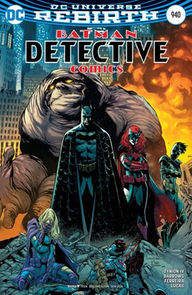
Detective Comics #940
Story: James Tynion IV
Art: Eddy Barrows, Eber Ferreira, & Adriano Lucas

And so ends the first arc of the new Detective Comics, and what an ending it is. I've been singing the praises of this title since it returned with its new Rebirth era creative team, and this finale doesn't disappoint. There will be SPOILERS for the issue in this review, more than I usually would put in one, but frankly the ending of this issue has been all over all the major comic news sites since Wednesday, so I feel I can address it. I want to start by talking about thee aspect of the issue that hasn't been discussed all over the place, which is James Tynion's handling of Batwoman and her confrontation with her father, Colonel Jake Kane. Kane has been the primary antagonist of this arc, him and his para-military Colony organization, and to see Batwoman stand up to her father is a bravura moment for that character. This is the strong, take no prisoners hero that was introduced all those years ago in 52, the character who should have been a star and was shunted to the side until all the buzz around her had died down. Kate Kane is a woman of principal, who stands by what she believes in, even if it means her imprisoning her own father. And Kane remains just this side of sympathetic, a man who truly believes that what he's doing is right, which makes him all the more interesting as a foe. But now I have to touch on is Tim Drake, Red Robin, and his fate. On Friday, I wrote about what makes Tim Drake such a great character. And his final showdown with the drones that the Colony were sending to kill suspected agents of the League of Shadows is a perfect indicator of what makes Tim great: he went down a hero. He knew that his chances were slim, that he might be sacrificing his own life when he set himself as the drones only target, and when he knew he couldn't win? He stood his ground and went out a hero. It was a marvelous moment, and would have been an excellent death, if that's what it was. Instead, we see him taken by the mysterious Mr. Oz. There are interesting new hints to what exactly Mr. Oz is doing, and what his plans are, which are all good for the overall progress of the DC Universe and for Tim's future, but it's also great to see Tim, the one person who kept the faith when Batman "died" in Final Crisis and was sure Bruce was alive, still having faith that his friends will find him despite his own seeming death. Add in a perfect scene of Batman showing real and true sadness at the apparent death of one of his charges, and you have an issue that is as emotionally resonant as it was action packed, a perfect superhero comic.


Faith #3
Story: Jody Houser
Art: Pere Perez and Andrew Dalhouse & Marguerite Sauvage

In case you haven't read any of my previous reviews of her series or any articles about the character, Valiant's breakout hit character Faith is a fangirl. A major league fangirl. And that part of her character is part of her charm. So it's probably not the least bit surprising that Faith would spend a story arc going to a comic con. And she's bringing her boyfriend, Archer of Archer and Armstrong along for his first con. The two head out, in cosplay naturally, and because this is a superhero comic, pretty soon they're getting involved investigating thefts at the convention and the theft turns out to be way more than just a simple fan who wants to make off with stuff he couldn't afford. The appeal of this issue comes from the interactions between Faith and Archer. We saw their first date in a recent issue of A+A, but now we're seeing them more deeply into their relationship, and on Faith's home turf. The two are so perfect together, Archer so naive and Faith so confident in this setting. And the reasons why Faith is so determined to see that justice is done at the con, and what cons mean to her, is something that I think all of us who live in a world of fandom should read, because it's something that is easily forgotten: about how cons are places where we meet and greet those we admire and more how we get to share the things we love with others who love them, and how no one has a right to interfere with that. I love how positive Faith is, how she is always looking for the best in others, but how she's also always willing to stand up for herself and others. The art for the issue by Pere Perez is especially good, with all sorts of wonderful Easter Eggs in the con scenes, and a great design for Faith's cosplay, something that still evokes her costume while having a different, piratical air. Faith is one of the best comics from Valiant, a fun superhero comic that embraces fandom and fans, with a great hero; it's also a comic that is easy to jump on to at pretty much any point, and this issue is especially good as a jumping on point, as everything you need to know is right here. Oh, and not just everything you need to know about Faith; there are con going tips throughout the issue that are well worth taking note of, even if you're an old hand at it. I mean, who knows when you're going to be called on to fight evil at your next con?


And Dan Grote is here with a review of a... Batman comic!


All-Star Batman #2
Story: Scott Snyder
Art: John Romita Jr., Danny Miki and Dean White (main story); Declan Shalvey and Jordie Bellaire (backup strip)

At the end of Season 2 of The Venture Bros., after the Sovereign has revealed himself as (a shapeshifter who takes the form of) David Bowie, Henchmen 21 and 24 remark on their favorite Bowie albums, and 21 harps on 24 for liking “ChangesOne” because “Changes is a best-of.”

All-Star Batman is, in many ways, a best-of. But it’s also something new.

Part of it is Batman barreling through a highlight reel of his enemies (roughly) two by two as he and Two-Face buddy-cop their way across the country. So we get appearances from requisite Bat-foes like the Penguin, Killer Croc and Victor Zsasz, in addition to deeper cuts like the KGBeast and Gentleman Ghost. We also get art from John Romita Jr., one of comics’ warmest blankets for more than 30 years.

But while Scott Snyder spent five years cementing himself as one of the all-time great Bat-writers, he’s not done leaving his mark.

Take, for example, his take on Two-Face. Snyder’s Two-Face is portrayed as much darker than in years past, explaining away his campier exploits as cries for help from the Harvey Dent side of his personality. This Two-Face isn’t just setting other villains on the Bat. Even allies like Jim Gordon have a vested interest in stopping Bruce from reaching the series’ MacGuffin, a purported cure for the Two-Face side of Dent. If successful, Two-Face has threatened to release the dirt he has on everyone in Gotham, and that’s a lot of dirt.

And yes, Bruce is training a new sidekick, but despite headlining a title called We Are Robin, Duke Thomas is not taking up the mantle, nor is he wearing the standard red, green and yellow. Just the yellow. The backup strips focus on Duke’s training, which isn’t so much about learning martial arts or how to win a melee fight but a study in psychology, both in Duke’s relationship with his psychotically altered parents and in learning how Batman’s never-ending parade of Arkham escapee foes thinks. Because let’s face it, working with Batman means exposing yourself to messed-up stuff every second of the day.

Oh, and Bats uses actual shark repellant against King Shark. Because if Grant Morrison’s Unified Theory of Batman has taught us anything, it’s that Batman done right should be grimdark and silly simultaneously.


So if Matt and I had the repartee of 21 and 24, he’d be doing his duty by calling me a poseur for liking the “ChangesOne” that is All-Star Batman. Also I’d be dead in a season. But whatever, my point is, as The Matt Signal’s resident “Not a DC guy” guy, I’m loving this book. And Bowie rules.

Friday, September 16, 2016

Why I Love Tim Drake


Tim Drake has been all over the comic book news sites this week. I'm not going to talk about the details of why right here, just to make sure everyone who doesn't want to be spoiled has a chance to read the issue that's causing the furor. I'm just going to make a short post today about who Tim Drake is as a character and why he's not only my favorite Robin, but one of my ten favorite comic characters ever.

I started reading comic officially (or as official as you can get) with Batman #445. Tim Drake made his first appearance in costume in Batman #442 (although he would be out of costume, simply training, and wouldn't get his own until issue 457). So first and foremost, I grew up with Tim. Now, Tim is lucky that he's perpetually stuck at an age between 16 and 18, while I have continued to grow sadly older, but I don't hold that against him. There's something about that character, a character who was new when you were just starting out as a fan, that you latch onto and connect with. That's, frankly, why sidekicks were created, to give readers an entry point for these stories about adults.

But more than just our relative newness, the thing that made Tim Drake great is he was a good kid who got into superheroing because it was the right thing to do. Ultimately, all of the many tragedies that Tim would encounter over the years took place after he took up the mantle of Robin; I'll discuss the changes made in the New 52 and why I feel they detract from Tim as a character later. Tim wasn't an orphan (although he was a rich kid with absentee parents which I doubt many readers had), he didn't have a reason to become Robin except he felt like Batman needed a Robin and Gotham and the world needed a Batman. Tim, like one of my other favorite sidekicks made good, Wally West, was basically a fanboy who got to live the dream: he got to partner with his favorite hero. And who amongst us in fandom wouldn't like that?


The other thing that made me love Tim Drake initially was that he was a brain. He had figured out Batman and Robin's identities using his natural deductive skills. Tim's first solo mission isn't a Robin mission, but is Tim trying to use his computer and detective skills to try to find a hacker called Moneyspider, who turns out to be the Batman villain Anarky, a teenage villain, who would go on to be one of Tim's nemeses. Tim was naturally more physically capable than most of the readers, but he wasn't a kid acrobat like Dick Grayson; there's a great moment in Robin #10, a Zero Hour crossover where Tim briefly meets a time displaced teenage Dick Grayson, where Tim marvels at Dick's acrobatic skills and doesn't think he'll ever be able to live up to them. And that was fine, because Tim was the smartest of the Robins, the best detective of the lot. And for readers who love Batman because he's the smartest guy in the room, that made Tim the ideal Robin.

After finally taking on the name of Robin, Tim would develop his own rogues gallery and supporting cast as he starred in first three mini-series and then an ongoing series that lasted for well over one hundred issues. Tim would fight the blind martial artist and gang leader King Snake, his lieutenant, Lynx, and their street gang, the Ghost Dragons; the aforementioned Anarky, the teen anarchist; Ulysses Hadrian Arstrong, the teen strategic genius known as The General. The characters around him included his dad, Jack Drake and step mom Dana, his geeky best friend Ives, his first girlfriend, Ariana, and his on again/off again main squeeze, Spoiler. That's not to mention his friendship with other heroes as a member of the teams Young Justice and Teen Titans, and of course his regular team-ups with Batman and the other members of the Batman family. There is a wonderful issue of Nightwing, issue twenty-five, "The Boys," that really looks into the brotherly relationship between Tim and Dick Grayson. This was a richer life as a character than either of the previous Robins had while they were Robin, and made Tim a much more interesting character,


Eventually, when a new Robin needed to come along, in this case Bruce's son Damian. He was a very different character than Tim. While Tim was an everyman sort of sidekick, Damian was completely unique and uncommon: while Tim was a fanboy, Damian had been trained since birth to be a deadly assassin. And when the time came for Tim to take up his new identity as Red Robin, the first storyline in his series reaffirmed his status as the number one Batman fan: he was the only one who believed that Bruce Wayne had not died in battle with Darkseid in Final Crisis, and he went out to find him. There's a wonderful meta-commentary there about how the hero who started out as a fan would be the one who would persevere through apparent death to believe wholeheartedly that the hero he idolized would still be alive.

But with the introduction of Damian, Tim was a little at ends as a character. Dick Grayson was able to take up the Nightwing identity when Jason Todd came along and became Robin, but Tim had a second hand new identity; Red Robin was Dick Grayson from an alternate future, whose identity had been briefly co-opted by Jason Todd before Tim took it. His last ongoing series, the Red Robin ongoing, was cut short by the New 52 reboot of DC Comics, with Tim in a very dark place. And I was hopeful that the reboot would give Tim a fresh start and make him the fun, young hero he was at his beginning.


Alas, this was not to be. The Tim Drake of the Teen Titans series from the New 52 bore only a passing resemblance to his previous incarnation. He had never been Robin and wasn't even really named Tim Drake; that was a name he took when he came to work with Batman. He was suddenly a gymnastic savant, and had a tragic backstory, where his own carelessness had forced his parents into witness protection. And most keenly felt, he no longer had any real emotional ties to Batman and Nightwing. Batman had been a foster father to him, and Nightwing the coolest big brother you could imagine pre-New 52. Now, Tim kept them at arms length and always had; and while he was part of their family, he wasn't close with them. He did suddenly become close friends with Jason Todd, Red Hood, who had repeatedly tried to kill Tim in the old continuity, which did more to help further Jason's redemption than did anything for Tim as a character. And the greatest of indignities: while Tim did still figure out Batman's identity, so did Dick Grayson, using pretty much the same methodology Tim did in the old continuity, taking away yet another thing that made Tim unique.

I don't necessarily lay all of this on the heads of the creators of those titles. Tim has been a historically difficult character to handle when taken out of his specific point of introduction. The Tim Drake in Batman: The Animated Series is much more Jason Todd than Tim Drake, as he has Jason's origin and doesn't have Tim's intellect; he basically has Tim's good nature grafted on to Jason to make him less of a jerk. The Tim in the Batman: Arkham games is a little better, but is still more of a roughneck than Tim is.  Young Justice got it closest to right; while it gave Tim's hacker skills to Dick Grayson initially, when Tim himself appeared, he was the quiet, smart member of the younger generation of heroes.

So where did that leave Tim? Well, in the past year and change, thing have gotten better for him. Batman and Robin Eternal, the weekly Batman mini-series that focused on the various Robins and other Bat family members working together in a globetrotting adventure during the brief period of time where Bruce had no memory of being Batman, did a great job of re-establishing Tim's relationship with the other member of Batman's family, and the arc of Detective Comics that wrapped this week played on all of Tim's best traits: his intellect, how well he works with others, and how much he cares about people. It got everything right, and made Tim feel like Tim again, and that Tim is a character that readers will keep hoping to see more of.


Friday, September 9, 2016

A History of Batman Vs. Deathstroke


So, Deathstroke the Terminator is going to be the villain in the upcoming solo Batman movie. I am of mixed feelings about this, as I find Deathstroke to often be written in odd and confounding ways, ways that put him way stronger than his weight class. But the more I considered it, the more I realized I have the same problem with Deathstroke that a lot of readers have with Batman, and so with a shrug of my shoulders I decided that it was a pretty cool idea, and decided that I wanted to write about Deathstroke.

But how to do that? There have already been plenty of articles on sites with way bigger readership than mine about who Deathstroke is. So I decided to come at it from the angle I'm best qualified for: the specific relationship between Batman and Deathstroke, and their confrontations, as well as a little about my history with Deathstroke. So what you're going to find is a little personal history, followed by a brief bio, and then a spotlight on the comic book and associated media battle between Batman and Deathstroke.

So I first encountered Deathstroke as a reader in New Titans #72 (well, a cameo at the end of #71 technically, but that was one panel), the issue at the top of this post, which was the second part of the famous (or infamous depending on who you ask) "Titans Hunt" story, the one that drastically altered the Titans line-up and began Deathstroke's trip from villain to anti-hero. It was the '90s, after all, and the only thing the big publishers liked more than a hero was an anti-hero. So I got to know Deathstroke as this tortured sort of good guy who still killed. And that was his status quo for a quite a while at DC. He had an ongoing, he guest starred in the various Titans titles a lot, and he never did much for me.

I actually started liking Deathstroke more when he returned to flat out villainy in the first volume of Titans and the Geoff Johns written Teen Titans series. By that point, I had read "The Judas Contract," which remains the definitive Deathstroke story, and other earlier appearances, and there, while he had a code of honor, he was still a hardcore villain. And he's sort of waffled from that over time, sometimes returning to being an almost anti-hero, but usually now being portrayed as a homicidal maniac for the highest bidder. When you factor in the infamous Identity Crisis #3, where he takes out the entire Justice League single handedly by counting on such plot improbabilities as Kyle Rayner, the Green Lantern who is not a scrapper, deciding to come at him by punching him instead of, oh I don't know, trapping him in a bubble, and you get a character who is sort of all over the place, often portrayed as a deus ex machina sort of character.


Deathstroke made his first appearance in New Teen Titans #2, created by Marv Wolfman and George Perez, where he accepted a contract on the Titans after the Ravager, his son Grant, died in battle with the Titans. Over time it was revealed that Deathstroke was Slade Wilson, a former soldier who had agreed to go through an experimental process that did not work as planned: it was supposed to make him more resistant to chemical interrogation, but instead granted him access to the 90% of his brain a normal human doesn't, which increased his tactical skills and reflexes, as well as enhanced strength, speed, and durability. When he left the army, he became a mercenary and assassin for hire. When fellow assassins kidnapped one of his sons, Deathstroke was not fast enough to save the boy from having his throat slit. While the child, Joe Wilson, survived, this drove a wedge between Deathstroke and his wife, Adeline, that was furthered when, enraged, Adeline tried to kill him, but Slade used his enhanced reflexes to dodge the bullet, just losing his eye and earning his trademark eyepatch; the two split up.

Deathstroke's earliest appearances were all in relation to the Titans, trying to complete the contract that his elder son, Ravager, had accepted from the HIVE to take them down. Eventually, Deathstroke employed Terra, a young metahuman, to go undercover and get him all the secrets of the Titans; which she did, giving him the information he needed to defeat the team. Fortunately, Robin had recently left the team, and returned, with the new identity of Nightwing, with help from Deathstroke's younger son, Joe, who was the mute hero Jericho, to save the Titans and capture Deathstroke. Deathstroke was found not guilty, and returned to his mercenary ways, but had a newfound respect for the Titans.


As I said above, this led to a period of cooperation between the Titans and Deathstroke, a period that included Deathstroke having to kill Jericho, who had been possessed by the Trigon corrupted spirits of the people of Azarath (ah, there's a statement you could only make in comics). As the '90s waned, so did Deathstroke's popularity, and with the loss of his ongoing series, he returned to his status first as a Titans supporting cast member, and then adversary.

Since the return of Jericho, who as it turned out wasn't dead but had used his power to possess people to enter Deathstroke's body and had lain in wait, dormant, until he was strong enough to exert control, Deathstroke has been more of a full-on villain than he ever was before. He has worked with Alexander Luthor's Secret Society, bombed Bludhaven with a nuclear Chemo, and tried to kill the Titans on numerous occasions. The Deathstroke of the New 52 has no real ties to the Titans anymore, and is just the world's greatest assassin.

That was a really elementary rundown of who Deathstroke is, and there's a whole lot more to it, especially when you start to bring in more about Jericho, Grant, and Slade's daughter, Rose, who is the on-again-off-again Titan who took the name Ravager. All of these children have also appeared in the new DC continuity, although none with a real Titans connection (Rose worked for Harvest, the evil being who hunted teen heroes, but that's about it). Also, in recent years, Deathstroke became a regular nemesis of Green Arrow, something made even more a part of the character as he has been a recurring threat on Arrow.

So, with all that laid out, what exactly does Deathstroke have to do with Batman? For a pair of characters with such similar backgrounds (highly trained fighters with massive extended families that are Shakespearean in their trauma), they have actually met face-to-face relatively few times. Mostly, Deathstroke is thought of as one of the main nemeses of Nightwing, as the two have a long history. Deathstroke also had more than his share of run-ins with Tim Drake in his days as Robin with the Titans, and Deathstroke manipulated Cassandra Cain, then Batgirl, with a drug to make her one of his puppets in his vendetta against the Titans. So, what are the notable battles between Batman and Deathstroke, and who came out ahead in each?


City of Assassins (Deathstroke the Termination V.1 #6-9)

The first on page meeting of the two characters, this storyline sees the two initially fighting, and then teaming up, to save the life of a mob hitman who has escaped witness protection. It is an exciting four part story, Marv Wolfman at his best on Deathstroke. It does feature a scene of Deathstroke pretty savagely beating Batman down, which establishes which side of the debate on who would win in a fight Deathstroke's co-creator falls on.


The Death Lottery (Detective Comics #708-710)

When a dying man decides his last wish is to see the wealthy of Gotham die as well, a contract is put out on the wealthiest men in Gotham, bringing assassins to the city for around the world, including low level Batman rogue Gunhawk. Deathstoke, who had previous encounters with Gunhawk, has also come to Gotham to get revenge against the assassin. Batman and Deathstroke fight twice in this arc, the first time with a clear win by Dethastroke, and once with Batman victorious, although he did attack by surprise. This story is from Chuck Dixon and Graham Nolan's nearly 100 issue run on Detective, a vastly under-rated run of solid stories, and features a notable instance of Batman using firearms.


Infinite Crisis (Infinite Crisis TPB)

When DC released it's crossover event Infinite Crisis in collection, it made certain strategic art and dialogue changes, as well as adding a few pages of new content. One of those pages was a confrontation between Batman, Robin, Nightwing and Deathstroke. This time, it's Batman who pretty clearly wins, although this is Deathstroke at one of his lowest points, driven pretty crazy by the loss of his family, so you have to take mental stress into account.


Stop Me If You've Heard This One... (Superman Batman Annual #1)

So, Batman doesn't really fight Deathstroke in this issue, but they both appear, as Slade has been hire to kill Bruce Wayne. Needless to say it is not successful. This is a tremendous comic, one that I am always surprised that more people don't know. Written by Joe Kelly, with principle pencils by Ed McGuinness (with various others throughout), it retells a Golden Age story of how Batman and Superman learned each other's identities, while also tossing in counterparts from the morality reversed Earth-3. And not just Owlman and Ultraman, but an unnamed Deathstroke doppelganger, who is obviously Deadpool. And it's written by Joe Kelly, master of the Deadpool quip. Oh, and no matter what some people might want to believe, Slade Wilson/Wade Wilson? Come on, there's clearly a connection.


Battle Royale (Deathstroke Vol.2 #5)

Deathstroke comes to Gotham. Batman fights Deathstroke. They both get in some good punches. Deathstroke escapes. That's pretty much it. It's some of Tony Daniel's most action packed art, really well drawn, but is pretty much an issue long fight sequence.


Son of Batman

Again, not really much Deathstroke Vs. Batman in here, mostly Damian vs. Deathstroke. This was the first Batman movie in the new DC Direct-to-DVD universe, and introduced Damian in a story VERY loosely based on Grant Morrison's "Batman and Son." And by based on, I mean it introduces Damian and has a similar name. In the story, Slade kills Ra's al Ghul to take over the League of Assassins, and when Damian comes to get revenge on Slade for the death of his grandfather, we get a sort of war of philosophies between Slade's merciless assassin thinking and Batman's value of life. Damian spares Slade,so you can chalk this up a a win for Batman.


Batman: Arkham Origins

On Christmas Eve, Black Mask has hired some of the world's best assassins to kill Batman. And when you're hiring the world's best assassins, you have to get Deathstroke in there. But since the game has Batman in the name, and you're playing as Batman, take a guess who wins this fight? Although I will say Deathstroke puts up one of the best fights of any of the big bads in the game. From what I gather, Deathstroke also appears in the final game in the Arkham series, Arkham Knight, but I don't have a PS4 yet so I don't know how that one turns out, but the game isn't called Deathstroke: Arkham Knight, so I've got to give the edge to Bats there again.


So, what has past experience taught us about who will win in the movie fight between Batman and Deathstroke? Well, it's going to be a big fight, that's for sure, but I have to give the edge to Batman, since it's his movie. Still. it's rare to see Batman fight a character on the big screen who is his physical equal, so I'm excited to see the fight choreography on it, and I like Joe Manganiello, announced yesterday to be playing Deathstroke (and returning to comic book movie acting, as he played Flash Thompson in Spider-Man), so I remain cautiously optimistic on this one.

Monday, August 29, 2016

Reviews of Comics from Wednesday 8/24


Atomic Robo & The Temple of Od #1
Story: Brian Clevinger
Art: Scott Wegener & Anthony Clark

Atomic Robo is back! The pattern of Robo mini-series one set in the present and then one set in the past, and so this new series is a flashback to the late 1930s. Robo is tasked by the US military to go to Shanghai, which at this point was under Japanese control, and retrieve a Chinese scientist who has been taken by the Japanese and is developing a weapon using zero point energy, a source of power that is limitless and could destroy the world if used improperly. So, jet-setting adventurer Atomic Robo (that's his cover story, because really, how can you hide him) is off to Shanghai, and before the issue is over we have raids by Japanese soldiers, a motorcycle chase, Robo wising off at a dangerous time, and the return of a character from Robo's past. Now that we're into the eleventh volume of Atomic Robo, and that's not counting all the ancillary stories from Real Science Adventures, creators Brian Clevinger and Scott Wegener have built a large and elaborate universe, with so many different characters from different eras in Robo's long life that it makes sense that a character like Helen McAllister, Robo's first love from the early 30s, would show up again during his World War II era adventures. And as with any Atomic Robo series, it's fun to look for the Easter Eggs the creators have placed throughout, as these are two guys who love their pop culture. Robo's arrival in Shanghai holds more than its fair share of nods to Indiana Jones and the Temple of Doom, with a shoeshine boy who resembles Indy's sidekick Short Round, and a nightspot called Anything Goes. The best thing about Atomic Robo for me, though, is that even though the settings are new and the plot is filled with twists and turns you can't expect, if you're a fan of Robo it's like coming home; Robo as a character has a very specific voice, and his stories do as well. And if you're a new reader, even if you've never touched the character before it has such a welcoming, pulp feel to it that you can't help but be drawn in.


Detective Comics #939
Story: James Tynion IV
Art: Eddy Barrows, Eber Ferreira, & Adriano Lucas

Tim Drake is my favorite Robin. I started reading Batman comics regularly right after Tim was introduced, and I grew up with him. And I have felt like the post-Flashpoint DC Universe has done the character a huge disservice, shuffling him off to the sidelines. That is until this current run on Detective Comics, which has brought Tim right back into the fold of the Bat universe. After escaping the Colony last issue, Batman, Batwoman, and their squad are trying to figure out what to do next. The issue starts out with some great character moments between Batman and Batwoman, as they discuss what Bruce may and may not have known about Batwoman's father's involvement with the Colony, and Tim coming to a decision about his future and discussing it with Spoiler. It would be easy, in the middle of an arc so packed with intrigue and action to forget about the characters and focus on the story, but Tynion takes time to give us a look inside the inner lives of the characters. But the action picks up as the team learns the Colony is sending armed drones to wipe out every possible member of the League of Shadows, the urban legend ultra secret offshoot of the League of Assassins, and damned be the collateral damage. And as ever, we see that Batman, and by proxy his allies, honor life above everything else, as they jump into action to try to save the innocent. In these scenes, we actually get one of the smaller, but one of the best, character moments in the issue, where Clayface has to scare a group of people out of their apartment to get them to safety, and he feels sad that his best way to act is still as a monster. Clayface has gotten the least page time of any of the characters in the series so far, but this little beat sets up his character arc, and possible hero's quest, better than any long speech could.And in Orphan's scene, we get a hint of something to come, something that might mean Colonel Kane isn't quite as off center about the League of Shadows as Batman believes. But I started this review talking about Time Drake, Red Robin, and I'm going back there for the end.Tim spends this issue showing first his tech chops, an aspect of the character that has always been present but has been played up a lot in the new continuity. I especially like that fact that Tynion is playing with the idea of what a guy in his late teens would do with an unlimited budget and a penchant for crime fighting. But more than that, the issue ends on an amazing cliffhanger, with Tim using his brain to put himself in a position where he'll have to use all his other skills next issue to survive. I don't want to give anything away, but it's an amazing ending, and one that sums up Tim Drake perfectly; he's a good kid with a big heart, who is willing to put himself in harm's way to protect others. I've said this with each review of this new run on Detective Comics, and I'll say it again: this book gets better with every issue, and if you're a Batman fan, you should absolutely be reading it.


Kingsway West #1
Story: Greg Pak
Art: Mirko Colak & Wil Quintana

I love alternate history mixed with science fiction or fantasy. And I love the comics of Greg Pak. So when you combine them, you get a comic I'm pretty much guaranteed to like. Kingsway West takes place in an alternate old west, one where the discovery of Red Gold, an ore that channels mystical energy, led to war between two factions in California: the Chinese Queen of the Golden City and the Mexican Republica de los Californios. But this isn't a story of that war. Taking place in its aftermath, we meet Kingsway Law, a renegade gunslinger and soldier from the Chinese side of the war. The story starts with him meeting Sonia, a Mexican woman who is also fleeing her life from the war. And it's not unexpected that when the comic flashes forward five years, they're married. It's a classic Western set-up, the gunslinger trying to escape his past with the love of a good woman. And Kingsway seems genuinely like he wants to be a better man. But when a woman from the Golden Empire arrives looking for Kingsway, with word of whole new vein of Red Gold, he hopes he can just avoid her, but things don't work out like that, and soon Kingsway has had to take up his guns again to save the woman from the Golden City Guard and to find Sonia, who has disappeared. This first issue does a solid job of establishing the world that Pak is creating, the personalities of his leads, and the driving force of the plot. But I will say alternate history comics are only as good as the artist who is crafting the vision of this different world, and fortunately Pak is working with one who has some serious chops. I was unfamiliar with Mirko Colak before this issue, so I came in with no preconceptions, but the art is absolutely stellar. The characters are all solid and distinct, and the animals that populate the world, these hybrids of real animals, as well as fantastic creatures like dragons, have great designs. And the fight scenes are very well choreographed, not just easy to follow, and exciting;  but brutal in a way that does not glorify the violence in the least, which works perfectly in the tale of a man who was trying to escape his violent past and is now being pulled back into it. If you enjoy classic Westerns like Unforgiven, or the strange sci-fi Western world of Jonathan Hickman and Nick Dragotta's East of West, you should really try out Kingsway West.


Wonder Woman #5
Story: Greg Rucka 
Art: Liam Sharp & Laura Martin

Greg Rucka has a lot going on in Wonder Woman. Not only are there two A plots, stuff set in the present in the odd numbered issues and a Year One story in the even numbered ones, but the plot in the stories set in the present, like this week's issue, are packed with all sorts of threads and characters, making it a dense and rewarding read. There are three interconnected plots running through this issue, one featuring Wonder Woman, one featuring Steve Trevor, and one featuring Etta Candy and a surprise guest star who I'll talk about at the end. Wonder Woman and Cheetah continue their quest to free Cheetah from Urzkartaga, the god that granted her the powers of the cheetah, and who now seeks her death for betraying him. Cheetah's origins have always tied her to Wonder Woman as a former friend who went to the dark side, but as a reader, I've always known the two as nemeses only. Here, seeing the two of them having to work together, it deepens the relationship, gives us insight into their shared history, and makes the aspect of that history as former friends matter more. The deepening mystery of Wonder Woman's own history and the changes that have occurred in it, and what has happened to Olympus and Themyscira, remains front and center for Diana, and the slow trickle of clues and revelations keeps the reader guessing. Meanwhile, Steve Trevor has been captured by a warlord named Cadulo who happens to be a worshipper of Urzkartaga, and who is preparing sacrifices to the god to grant him power. Steve and Cadulo are cast as polar opposites, not just because one is the heroic type and the other villainous, but because they have very different definitions of masculinity. Rucka has never shied away from discussing his own views on society in his work, and with so many recent examples in fandom of toxic masculinity, it's not surprising for Rucka to call it out, going so far as to have Trevor actually use those words. Cadulo is the kind of guy who expects women to worship him, and Trevor is, to say the least, not. Trevor banters, even when captured, and I like how Rucka is giving this character more of a personality than he's been given in the last two decades. Finally, the third plotline sees Etta Candy, Wonder Woman and Trevor's friend and Trevor's current boss, going to seek advice in what to do with the captured Trevor, and the person she goes to? Sasha Bordeaux! If you don't know her, Sasha was a character created by Rucka during his run on Detective Comics, where she served first as Bruce Wayne's Wayne Enterprises assigned bodyguard and later one of Batman's partners, and became Black Queen of Checkmate when Rucka wrote the DC Universe spy title. And while Sasha seems helpful, there's far more to what's going on than meets the Eye (and yes, that capitalization is intentional if you know Sasha's history). I'm really excited to see Sasha back, and no one writes her like her creator. I also want to call out Liam Sharp's astounding art on this issue; he's an artist I always picture drawing monsters and horror comics, and that skill plays out well in Cadulo's den, but he also draws a beautiful Wonder Woman and a sleek Cheetah. This is Greg Rucka at his superhero best, and I haven't been this excited by Wonder Woman in a long time.

Monday, August 1, 2016

Reviews of Comics from Wednesday 7/27


Adventure Time Comics #1
Story & Art: Various

Boom! launches a new Adventure Time series this week, and it's totally mathematical! Featuring some of comics best cartoonists, this first issue features some of my personal favorites as well. This issue has four short stories, which vary from very light in both subject and continuity, to some deep dives into more obscure Adventure Time characters.

"Toothpaste Fairy" by Art Baltazar- Art Baltazar, co-creator of Tiny Titans and Patrick the Wolf Boy, brings us a story of Finn going on a quest for toothpaste! You have to imagine in the post-apocalyptic future of the Land of Ooo, toothpaste isn't exactly easy to come by, but fortunately there's a Toothpaste Fairy! It's a light, fluffy story (an apt description when you see all the clouds) and perfect if you've enjoyed Art's Tiny Titans stories.

"Stand Next to Me" by Katie Cook- Katie Cook, of Gronk fame, tells a story featuring some of Ooo's lesser known princesses. Breakfast Princess is the main character of the story, and I am reminded how awful she is; she's the Mean Girl of the princess set. She leads Pastry Princess and a cupcake person into the woods to retrieve a skeleton that is near Lump Space Princess's campsite because being near LSP is a fate "worse than death." The story shows that LSP, for all her usual craziness and narcissism, does have a good heart, and puts Breakfast Princess sort of in her place. I love Cook's art (I have a tiny commission of her's framed on my mantle), and I love her takes on the princesses and Ooo in general.

"Goliad Gets a Break" by Tony Millionaire- Taking one of Adventure Time's odder characters, the powerful psychic candy beast Goliad out for a romp is none other than Tony Millionaire, whose Sock Monkey and Maakies bear a similarity to the odder and darker corners of the Adventure Time mythos. Millionaire clearly knows his Adventure Time, cramming in cameos by such minor characters as Choose Goose, Ricardio, and the Orgalorg. Millionaire's style is no less cartoony than the rest, but has more of an edge, which fits the darker nature of the story, although it is still lighter than many of the recent episodes of the animated series.

"Good Shelf" by Kate Leyh- Kate Leyh has done some Adventure Time shorts before, and is a co-writer on Lumberjanes, so she knows how to write friendship, so it's nice to have her round out this inaugural issue with a tale of Finn and Jake, with Finn building things out of wood he found. Being this is Ooo, though, boards you just happen to find aren't usually just boards, and Finn's good nature and naivete lead to a bit of an issue. It's a fun short story, and like the best really short stories (only three pages), it has plenty packed into it without seeming cramped or rushed.


Batgirl #1
Story: Hope Larson
Art: Rafael Albuquerque & Dave McCaig

Batgirl enters the "Rebirth" era with a solid new status quo and a fun opening issue. After the trauma of the end of the previous volume of her series, Barbara Gordon is taking a trip "Beyond Burnside" (the title of the arc) to do some soul searching. Starting her travels in Japan, Babs is there to investigate the story of one of the world's first superheroines, the Fruit Bat, who fought crime in 1939 Japan, and who is now a one hundred and four year old woman. But Barbara starts off at a hostel where her roommate is a guy named Kai, who coincidentally was a friend of hers when the Gordons lived in Chicago. Barbara seems to take this at face value initially. Hope Larson gets Barbara right from the get go; Babs can't stop calling her friend Frankie back in Burnside to check in on things, even thought she's been gone for less than a day. Babs is fascinated with the history of superheroes. Babs is a good friend. Larson absolutely gets all the aspects of Babs as a character. But Larson doesn't hold back on the action, which is part of what makes this a great first issue. She finds a nice balance between establishing Barbara's new situation with a great action scene as sailor suited clown make-up wearing girl attacks Kai; Babs immediately knows that Kai, who was a kid with a past, is not saying everything about his innocent trip to tour Asia. And the mysteries of the series are deepened when we see that, despite being a centenarian, the Fruit Bat still has some moves, and sets Babs on the next leg of her journey. And I'm glad Rafael Albuquerque is the guy drawing it, because it looks amazing. It's been so long since he regularly did superhero work, except for a short run on Animal Man, that I forgot how great a superhero artist he is; I think of him as a horror artist thanks to American Vampire, forgetting how much I adored his Blue Beetle run. His style has so much energy, so much flare, that Batgirl practically jumps off the page. There's a bit with a thrown knife that flashes from panel to panel on a grid and another of Barbara thinking of how to take down the clown girl with a thrown ball that are absolutely stunning. If this first issue is any indication, the new volume of Batgirl picks up from the last one and maintains the air of fun and adventure while setting its own direction.


Detective Comics #937
Story: James Tynion IV
Art: Alvaro Martinez, Raul Fernandez, & Brad Anderson

When will I stop reviewing the Rebirth Detective Comics? When it stops being the best Bat book on the shelves and a love letter to Batman fans! Each issue, writer James Tynion IV packs in more references to classic Batman stories and continuity while still making a series completely accessible to new fans and fans of the characters on Batman's team who might not be mired in years of Batman minutiae. While last issue focused entirely on the team, this issue starts off with and focuses mostly on Batman himself. Imprisoned by the Colony, the military organization using Batman's tactics, we watch as Batman breaks his way out of their imprisonment and gets an idea of what the military is doing using his name. We see the base, the toys, and the man designing it all: Ulysses Hadrian Armstrong, better known as The General. A creation of Chuck Dixon, the general was a villain who moved on to be one of Tim Drake's arch-foes, a teenager with a brilliant military mind, and Tynion has him working for the military, designing Batman type weapons for the Colony. It's a great turn, and a great use of a character I love. There's one panel in particular, as Batman watches a video of the Colony do a wetwork mission, where The General offers to see a more gory video in delight, and Batman's one panel, shadowed, "No." radiates rage at the perversion of what he does. As things continue, we get the confrontation between Batman and his uncle, Jake Kane, the man behind the Colony, and again we see why they call Batman the world's greatest detective, as we learn how much Batman already knew before even recruiting his team. Speaking of the team, they have their own pages here, as we get to see the strengths of two of their members: Batwoman's indomitable will as she prepares to stand up to her father, and Red Robin's brain. As a life-long Tim Drake fan (his life, I suppose, as I was nine when he was created, but still he and I go way back), it's cool to see what Tim has been up to and designed in Gotham's underground, and how it also features another nod to one of Chuck Dixon's creations, the Bat-Rocket, the subway vehicle Azrael-Batman drove around. There's another bit of Batman continuity that gets a call out, but it's a mystery for now, a nod to other media Batman and to things to come that I don't want to discuss yet as it would be a spoiler of sorts, but I like that Tynion is building a whole long form narrative; I can't wait to see how it pays off. Seriously, if you're a fan of Batman in general and you're not trying out Detective, do yourself a favor and pick up the series now, because you're in for a treat.

Tuesday, July 19, 2016

Reviews of Comics from Wednesday 7/13


Daredevil #9
Story: Charles Soule
Art: Goran Suduka & Matt Milla

Daredevil is probably my favorite non-cosmic or mutant Marvel character. I've read his book regularly since the Marvel Knights relaunch, and have picked up plenty of back issues and trades along the way. And I was absolutely in love with Mark Waid's run on the series, with it's lighter tone. And I was excited when Charles Soule, an actual lawyer whose legal-centric run on She-Hulk is one of my favorite Marvel series in the past decade. The tone of his first arc was darker, as was his Daredevil, more akin to Bendis then Waid, and it took me a little while to adjust to the darker tone. But this two part story, of Daredevil in Macau playing poker and fighting the Triads, finds a nice balance between the dark Daredevil and the light one, helped by the guest-star: Spider-Man. Soule writes a great Spidey, quipping away constantly, and the less quippy Daredevil is a great straight man for him, and brings out the sense of humor in Daredevil, who makes his own share of quips. The majority of the issue is a chase, as Daredevil and Spidey chase a briefcase, the reason that Daredevil came to Macau to begin with. Artist Goran Sudzuka draws some amazing fight scenes, full of acrobatic action and flying billy clubs. But it's the character moments between Daredevil and Spider-Man that really makes the issue sing. The two of them, riding a hydrofoil from Macau to Hong Kong while basically parasailing using web-lines and billy-club lines, and Daredevil enjoying it. And the end of the issue, as Daredevil explains to Spider-Man why Spidey suddenly has holes in his memory involving Daredevil and what the briefcase is continues to show that Daredevil didn't fully think out whatever plan he had to remove the knowledge of his identity from the world. With all that going down, Soule gives Spidey one of the best last lines I've read in a long time, " Watch out for those black-costume phases. They can really do a number on you." It's a smart callback to one of Spidey's legendary stories and an acknowledgment of exactly where Daredevil seems to be now. This issue has me excited to see where exactly Soule plans to take Daredevil.


Detective Comics #936
Story: James Tynion IV
Art: Alvaro Martinez, Raul Fernandez, & Brad Anderson

Detective Comics just might be my favorite book out of the DC: Rebirth relaunch. After last issue's finale, with Batman taken out by the group of armored Bat soldier called The Colony, this issue opens with a much quieter moment: Kate Kane, Batwoman, out at a bar with her ex, GCPD detective Renee Montoya, talking about Kate's time in the military and her role as a leader. There's clearly still strain in their relationship, but I have to say, it's great to see Renee again. A call from Red Robin gets Batwoman to the belfry to watch the video of the assault on Batman, and they quickly call in the rest of the team, as well as Kate's father, Colonel Jake Kane. And as the others, including Kane, gather, Oprhan, Cassandra Cain, is attacked by the Colony. And it's only once Kane is in the Belfry that the other shoe falls: The Colony is a military project that Kane is in charge of, and he's here to recruit Batman's team, as well as get access to the Bat computer for the mission he has for The Colony. And even as the team makes their escape, Kane is sure that his plan will still work. The whole scene with Kane talking to the team, and to Kate specifically, is brilliantly tense. All the problems that Kate and her father have been having since Greg Rucka's original run on Detective, all the secrets and lies that have been pushing them apart, come to a head here. The idea, that the government would use Batman's example to create a black ops force, is a cool one, and the fact that it's being used against Batman and his allies is all the more intense. And placing Batwoman's father, Batman's uncle, at the head of it? I love it. All of this while working in strong character development and interactions between the cast, especially Batwoman and Red Robin, makes it an exciting and thoughtful read. The art from Alvaro Martinez is excellent, especially in the hints of the fight between The Colony and Orphan; most of it takes place off panel, but you see the set-up, as the soldiers surround her against a rainy and lightning filled Gotham sky, and the end, as she finishes off one of the soldiers, crashing to the floor of the Belfry through the skylight. It's beautiful, and shows the strength and speed of Orphan, and is stylishly done. Each issue of Detective has been better than the last, and as the fight with The Colony amps up, I can't wait to see where it goes.


Stumptown #10
Story: Greg Rucka
Art: Justin Greenwood & Ryan Hill

Each case private investigator Dex Parios has been involved in since the beginning of Stumptown have been byzantine affairs no matter how simple they seem on paper. But this issue, "The Case of the Night That Wouldn't End" is a one off story that has a couple of twists to it,because what good PI story doesn't, but is at its heart fairly simple: Dex is hired to find out if a man's wife is cheating on him, and she follows the wife to a motel. The issue actually features two of my favorite types of comics: a great one off issue, and a great mostly silent issue, both of which are few and far between in comics nowadays (and don't I sound like an old fogey?). Justin Greenwood tells the story with his art as ex silently watches her suspect and a younger man meet at the motel, but not everything is as it seems. There are little details about their interactions, plus what's going on with a courier skateboarding out in the rain that are hints to things going on deeper with all these characters. PI and mystery shorts are some of the trickiest to write, since you have to establish everything and have it pay off not only for the reader the first time, but also on a second reading if they already know the solution, and this story succeeds. Rucka doesn't forget about Dex's personal life, or lack thereof, as we get hints of exactly how bad Dex is at dealing with personal relationships through a series of texts. It's a really solid introduction to the world of Stumptown, so if you're looking for a good crime comic, and want to get in and try it before the new volume starts in January, this is a great place to start.

Monday, June 27, 2016

Reviews of Comics from Wednesday 6/22


Buffy the Vampire Slayer: Season 10 #28
Story: Christos Gage
Art: Rebekah Isaacs & Dan Jackson

This issue of the current Buffy the Vampire Slayer season feels a lot like an episode of the TV show right before a season finale, which makes sense as this season wraps with issue #30. Buffy and her friends have been driven apart by, well, growing up (or growing down in the case of the de-aged Giles), and this is the issue where they get the band back together. People often give the character of Buffy a hard time, for being the title character but not the brains of the group, but its Buffy who has the plan this issue, and as she makes preparations, she and Spike discuss their relationship. Christos Gage does a great job, a job equal to that of Joss Whedon, of balancing the personal with the supernatural in this issue, and while we don't know what Buffy's plan is, the issue does a great job of building up the anticipation of what it is. The way Buffy and Spike interact, Buffy talking about how her instinct is to run from relationships while Spike realizing he needs to take Buffy off the pedestal he has placed her on, are mature reactions, and show signs of growth not just from the beginning of these character's live, but of this season. Meanwhile, Willow realizes that working with the army isn't going to fly anymore, and Andrew meets with his kinda-boyfriend and has a realization about himself. As I've said in other times I've talked about Buffy here, I detest Andrew as a character, but I think Christos Gage has finally had him grow up and realize exactly what he is and what he's done, to a point I don't cringe every time he enters the scene, which is a major achievement. And finally, there are Dawn and Xander, who, having been left in a hell dimension a few issues back to seal the gate from that dimension to Earth, make their trip back home. I don't know how much Rebekah Isaacs adds to the story in these issues, but the different dimensions Dawn and Xander, as well as their demon sidekicks, pass through usually only hey one panel each, but they're so well realized that if Isaacs didn't suggest at least some of them, she embraced them fully. There's even a reference to the classic explanation of parallel worlds involving shrimp, or the lack thereof. This balance, between the mundanity of Buffy and Willow (and Giles in the previous issue) dealing with their relationship woes while Dawn and Xander travel through dimensions, is a great example of what makes a Buffy story work. If you lean to heavily on the metaphor and the weird it gets overblown, and if you do nothing but everyday character stuff, you lose what makes it special. There are only two issues left in this season of Buffy, and this issue makes me really excited to see what Gage and Isaacs have planned for us.


Detective Comics #935
Story: James Tynion IV
Art: Eddy Barrows, Eber Ferreira, & Adriano Lucas

Detective Comics knows how to kick off an issue. We open to see a desperate Red Robin, Spoiler, Orphan, and a de-powerd Clayface facing down an army of Jokers. That's an opening that sure grabs your attention. We quickly learn things aren't as they seem, and we get introduced to the Belfry, the team's new headquarters, and the Mud Room, the Danger Room if it were powered by Clayface's powers. It's interesting to see that Batwoman, who is running the training session, is hard on Orphan, Spoiler, and Clayface, but leaves Red Robin alone, respecting him. It's Red Robin who is the focus of the early part of the issue, as we see him first interact with Batwoman, then Batman, and finally Spoiler; it seems that Red Robin and Spoiler are destined to be together on whichever timeline they're in, which is sweet. What's a little different is the way Tim Drake interacts with Batman. In pre-Flashpoint continuity, Tim was Robin for years before becoming Red Robin, and was an integral part of the Batman family, but in the new continuity it's not only established he was always Red Robin, but it's been said numerous times that he has kept his emotional distance from Batman and the others. Tim has frankly been one of the biggest victims of the New 52 compressed timeline and the need to come up with reasons why he's in Teen Titans and not a Bat book. This issue we see Batman reaching out to him, telling him he's welcome to come in and be a part of the family, which is a nice gesture, and we see exactly what's going on with Tim, and that he might just have a life outside Gotham and the shadow of the Bat planned, which adds a different sort of tension. Through Tim we get to see some of Spoiler and Orphan, and we also get to see what happened to Azrael and we get the return of the classic Leslie Thompkins, who is treating Azrael and who is still judging Bruce for bringing teenagers into his war; thanks for that James! Batwoman gets in another scene with her father, Jake Kane, and we get a better feeling for why the Kane family, Batman's maternal relatives, haven't been a part of his life, as Jake warns Kate away from him. "Zero Year" and Grant Morrison's Return of Bruce Wayne mini-series both established issues between the Wayne and the Kane families, but here we see it on a much more grounded and personal level, with Jake's issues not just with Bruce, but an undercurrent of resentment towards Bruce's long dead father, Thomas. While the issue has a lot of character building, it ends with an action scene (after a clever bit of Alfred's trademark snarking at Bruce), as we start to get a better idea of who is behind the vigilante hunting, the new threat called Colony. The final page is one of those classic Batman being a badass pages, which shows that Tynion also knows how to get a reader desperate to come back for more.


James Bond #7
Story: Warren Ellis
Art: Jason Masters & Guy Major

James Bond is a character right in that Warren Ellis wheelhouse. He's a hard drinking, hard smoking man with a penchant for women and brooding. The Bond Ellis writes is closer to the one in the current films and in Ian Fleming's original stories, and not the campy one of the bigger, bolder Bond movies. And while Bond is grounded, the first arc of Ellis's Bond read like one of Ellis's sci-fi stories, where he reads about something in a tech journal and extrapolates the science into a crazy sci-fi comic. And while this second arc might go the same way, this arc feels more in line with a dark spy thriller, as Bind has to rescue an undercover agent from the Turkish Consulate in America, only to have things go off the rails. The first issue sets the tone, giving us a mysterious villain who combines the typical Bond mastermind with a more physical threat, continues to build on the internal conflict in British intelligence established in the first arc, re-introduces Bond's CIA counterpart, Felix Leiter, who now has cybernetic parts because why not, and introduces the agent Bond has to retrieve, who has the absolute Bondiest Bond name I've seen in comics yet, Cadence Birdwhistle. The fight when the Turkish agents catch up to Bond and Birdwhistle is well choreographed by Jason Masters and is as brutal as anything you'd see Daniel Craig do; frankly, Bond leaves these guys in so many pieces it feels like James Bond by way of the Midnighter. But even after taking out an entire Turkish hit squad, things don't go well for Bond, as he now has to survive 24+ hours with a non-combatant and no weapon. It's a great set-up for a tense thriller, as Bond has the Turks and the mysterious villain who is laundering money through Turkey after him to silence Birdwhistle. Also, along the way, Ellis gets off a pot shot at America and guns that is sadly accurate, as Ellis is never one to shy away from making a political point; I'm frankly very curious to see if Ellis spends some time in arc three taking on the recent EU referendum, something that both fits with Bond's place in the world and Ellis's topical sense of politics and humor. James Bond is a great spy comic, one that will satisfy the appetite of long time Bond fans as well as newcomers to fiction's greatest secret agent.


Princeless- Raven: The Pirate Princess #9
Story: Jeremy Whitley
Art (Present Day): Rosy Higgins, Ted Brandt, & William Blankenship
Art (Raven's Tale): Sarah Suhng, Nicki Andrews, & William Blankenship

After last issue's confrontation between Raven Xingtao, the pirate princess, and her two usurping brothers left her old friend, and something more, Ximena badly wounded, Raven and her crew make for a nearby island where they might find someone who can help Ximena, leaving Raven to stay by the side of the woman she loves and just talk to her, to keep her on this side of life. The beginning and ending of the issue take place in the present, and while much of the page space is dedicated to the story Raven tells, we get more characterization in the frame around the main story than most comics give in a normal issue. Not only do we see Raven being tender, which has peaked out of her normally brash exterior before when it comes to Ximena, we see bits with many other members of the crew, especially Amirah, who has become a favorite character of mine, as she helps stabilize Ximena as best she can and get Raven to be with her. Also, we see the deepening of the romantic triangle brewing, as Sunshine, who has clearly had deepening crush on Raven since they met in issue one, growing resentful of Ximena's place in Raven's heart. The main story though, the one that Raven tells Ximena as she lies unconscious, is the story of how Hei Xing, Raven's ancestor and the first pirate queen, met Rong Tao, the love of her life. Jeremy Whitley conjures a world that's a little more wild, a little more full of fantasy then Raven's is; while the book is rooted in the same fairy tale world as it's progenitor, Princeless, the magic and magical creatures have been considerably less in the spin-off then the parent title, and so the demons would feel a bit out of place in a story set in the present. But in this almost fairy tale story that Raven is telling, it all fits. We see Raven takes after Hei Xing, who was full of spirit and fire, willing to fight more demons than she should be able to in order to save the life of a boy she has never met. And Rong Tao, who was a pacifist, has connections to Ximena, who is also never willing to fight. The story is a parable of balance, as Rong could not have survived being attacked by demons if Hei had not been willing to right, and Hei could never have saved her beloved horse if Rong had not had the patience to slowly dig away at the trap the demons had set. The inversion of the traditional trope, of having the female character as the fighter and the male character as the one who does not fight wasn't lost on me, and continues to show how Princeless and its related titles work to subvert expectations. All taken, it's the truest love story we've seen from this world yet, a beautiful tale of two people finding each other, whose differences make them stronger. Princeless itself has begun to explore love and relationships as well, and it feels like these titles, written with teens in mind, are going through that phase where you start questioning even more how you fit in the world and what love is. I'm curious to see what answers Raven gets as she has two very different romantic interests now, and how this story will play into what comes next.


And Dan Grote reviews the new Deadpool team-up mini-series, where Deadpool fights his soon to be fellow movie-star, Gambit, written by Matt Signal favorites, Ben Acker and Ben Blacker...


Deadpool V Gambit #1
Story: Ben Acker & Ben Blacker
Art: Danilo Beyruth & Cris Peter

Deadpool has nearly always been a comedic character. But for the past four years, he’s also been a foot in the door for comedians and comedy writers at Marvel, since Gerry Duggan and Brian Posehn began their run post A vs. X. That paved the way for Annual stories, miniseries and backup strips from the likes of Paul Scheer (The League), Scott Aukerman (Comedy Bang Bang) and Jason Mantzoukas (Also The League), as well as Bens Acker and Blacker (The Thrilling Adventure Hour podcast), whose greatest contribution to Deadpool lore to date may be clearing up that whole multiple-narration-boxes mess from the Daniel Way run and introducing Madcap into the mix.

The Bens return with this miniseries pairing the Regeneratin’ Degenerate and the Ragin’ Cajun and revealing their hidden mutual history as con men. Apparently, this is very recent history, as a flashback to their last job takes place during the crafting of the musical “Hamilton,” which opened just last year. Now, I don’t keep up with the X-books like I used to, so I have no idea what Gambit’s been up to since he ended up a horseman of Apocalypse 10 years ago. But Deadpool’s memories, like his sexuality, allegedly, are fluid, so I’m not really planning to look too deeply into the continuity of it all.

Anywho, this miniseries reads like it was written by a pair of comedy writers riffing off each other, in so much as that’s exactly what the title characters do. In their last job, Deadpool and Gambit dressed as Spider-Man and Daredevil, respectively, and engaged in a very vocal and public superhero fight across the city, in the process stealing from criminals for a man named Chalmers. Bits abound, as Deadpool/Spider-Man tries to exorcise Destiny’s Child’s “Survivor” from his head, the two try to explain why they’re fighting (Mind control? Political disagreement? They’re both on the same case, and each thinks the other is the bad guy?), Gambit/Daredevil argues the conceit of musicals with Lin-Manuel Miranda and the two learn that being beangan is when you’re vegan but also you don’t eat beans (“Wait, why not?” “I think because you don’t like beans.”).

And where were the real Spider-Man and Daredevil for all this? Apparently Peter Parker and Matt Murdock sometimes go antiquing together. They’re friends.

Artist Danilo Beyruth gets in on the fun, too. Before the fight, Deadpool/Spider-Man is drawn wearing a dress shirt and suit over his Spidey costume. The disguised Miranda has the head of Alexander Hamilton from the $10 bill superimposed on him, so he resembles a character in a JibJab video. A market full of hipster vegans is an ocean of beards and curled-up mustaches, seemingly also on the women (Sidenote: Has anyone thought to resurrect Turner D. Century lately?). And Gambit gets to blow up everything from diamonds to frying pans to a manhole cover, until Deadpool yells “Stop exploding things at me!”

Yes, we are living in an age of peak Deadpool. Besides his solo ongoing, there’s the Spider-Man/Deadpool teamup book, and a new Deadpool & the Mercs for Money ongoing is starting. But if you don’t mind stretching your DP budget just a little bit further, Deadpool V Gambit is pretty funny and worth a read.

Monday, June 13, 2016

Reviews of Comics from Wednesday 6/8


Birthright #16
Story: Joshua Williamson
Art: Andrei Bressan & Adriano Lucas

The fourth arc of Birthright begins an arc that looks like it's going to provide answers to many of the series long burning questions. Birthright is usually a strong mix of action and character, but this issue mostly takes a step back from the action and gives us a very strong dose of character. We don't get much more of the most awkward dinner ever between the sorcerer Mastema and the mother of our protagonists, Wendy, and Mikey's ex/friend.babymama, Rya, before two of the remaining other mages, Kylen and Enoch show up to discuss what to do about finding Mikey and the betrayal of their fellow, Samael. But after only a few pages of this, we're back with Mikey, his brother Brennan, his dad Aaron, and Samael, revealed to be the boy's grandfather, Aaron's father. If we got the impression from the end of the previous issue that Aaron has some issues with his dad, And now we can see how, as hard as it would be for anyone to be accused of the murder of their son, and to have their son disappear, how much this plays right into the issues Aaron has as the son of a father who abandoned him. And how furious he is that his father, who knew about the magical land of Terrenos, never came to him and his family in their hour of need, when Mikey was gone. And Samael may have good reasons, but his evasion and his simply saying that he has good reasons without explaining anything? That doesn't make him sound like the most trustworthy of guys. We also get more explanation of Brennan's burgeoning mystical abilities, and his use of them sets off what looks to be the series next major fight scene. A series with so many mysteries needs to start paying them off eventually, and as Williamson has proven in his other creator owned series, he knows when the time is ripe for some answers. Ad as good as the story is, and it's very good, the art on this issue is Andrei Bressan's best. Not only do we have great character moments in the faces of both Samael and Aaron, but Bressan gets to draw Samael's lair, a treasure trove of mystical artifacts. This is always something an artist can have fun with, but this particular treasure trove is littered with props from many classic fantasy movies. In a once over I saw all sorts of stop motion creatures from Harryhausen movies, the skull of the pirate from Goonies, Audrey II from Little Shop of Horrors, the crocodile from Hook, and the Wicker Man from, well, The Wicker Man. I'm a big fan of Easter Eggs, and the two page spread that introduces Samael's treasure room is just packed with them. Birthright is an exciting, character-driven modern fantasy story, and one for fans of the stories that explore the thin line between fantasy and reality. The first three arcs are out in trade, so it would be easy for you to catch up and start grabbing the single issues as things really start speeding forward.


Detective Comics #934
Story: James Tynion IV
Art: Eddy Barrows, Eber Ferreira, & Adriano Lucas

"DC:Rebirth" keeps moving forward, and you'll be seeing a lot of it this week. We're starting it with the new issue of Detective Comics, which returns to its original numbering. Detective has been the most inconsistent of the Batman titles since the Flashpoint changeover, a book that has ranged from some excellent arcs to some of the worst Batman comics I've read. The new dawn of the series takes aspects from various places, including Batman & Robin Eternal and the late Batwoman series, and starts creating a new Batman team title. There's a lot of mystery built into this first issue, as someone is impersonating Batman and using scientifically advanced drones to chase down other Gotham vigilantes. With this going on, Batman recruits Batwoman, who has a military background, to serve as team leader and drill sergeant for a team of young vigilantes, specifically Red Robin, Spoiler, Orphan (Cassandra Cain's new identity, and one reforming villain, Clayface, who Batwoman worked with at the end of her own series. I probably have every appearance of Batwoman, and while she has shared page time with Batman before, this issue felt like the most substantive meeting between the two. In the past, Batman has mostly given her his usual routine when a vigilante is in Gotham he hasn't trained, the, "This is my city," shtick. But here, he's reaching out to her for help, and it's the more stable Batman on the end of Scott Snyder's run we're seeing here, someone who is willing to work with people and not be the paranoid figure he has often been portrayed as in the past fifteen years or so. To really show that, he unmasks in front of Kate Kane, and we get to see her react on the best possible way, "I've been waiting for you to admit it for the last year and a half." And the utterly shocked look on Bruce's face is priceless; it's rare to see Batman surprised, and it's a nice change, We get little bits of each of the characters on the team, probably the least with Red Robin, which I'm a bit sad about as I've been waiting for Tim Drake to have a regular spot in a Bat book since the post-Flashpoint universe began, but he's got time. I like the feeling we get for Orphan, who is still haunted by the events of Batman & Robin Eternal, Spoiler, who plays up her name a lot more than it was played up in her pre-Flashpoint years as someone who spoils the plans of villains, and the scene where Batman and Batwoman find Clayface actually does a good job of making Clayface a more sympathetic figure, much more akin to his Batman: The Animated Series portrayal then the mustache twirling Basil Karlo of the comics. And we see Kate Kane still dealing with the fallout of her disagreements with her father and I assume her final break-up with Maggie Sawyer, who appeared back in Metropolis in the week's Action Comics. I hope we get to see a lot of the dangling threads from Batwoman's series played out here as the series progresses. This was an excellent debut issue, a great way to introduce new readers to these characters, and a really enjoyable issue for old time Bat fans looking to see the next generation of the Batman family back together.


Flash: Rebirth #1
Story: Joshua Williamson
Art: Carmine Di Giandomenico & Ivan Plascencia

Flash: Rebirth actually combines aspects from both of the above reviews: It's part of "DC: Rebirth" and is written by Joshua Williamson. So much of this issue is new series writer Joshua Williamson giving readers his view if Barry Allen. Barry is having a hard time of things here: he's been assigned to a murder case that oddly resembles his mother's, and he's having visions. If you read DC Universe: Rebirth, you know those visions are connected to Wally West trying to make his way back into the world, and we get to see the sequence from that one shot from Barry's point of view, and it still warms my heart. Barry is such a warm, friendly guy, and seeing him with his protege and surrogate son just brings out the best in him. And I am such a huge fan of  this Wally West, I'm just glad to see him back. The sadness that he is experiencing, knowing that most of the people he knows and loves, and the confusion that his Aunt Iris and Uncle Barry are "just friends" in this reality, is palpable. And if I wasn't pleased enough that I see Barry interacting with Wally, I get to see Barry interact with my favorite character of all time as well, Batman. I like that Williamson doesn't have Barry and Bruce interact as detectives, since that's not what Barry really is, but as scientists, which is how Barry thinks of himself. This issue is the first to really build on the reveals of the DCU: Rebirth one-shot, and begins Batman and Flash's investigation into what changed the universe and what's happened to them, analyzing the Comedian's button that Batman found in the cave. We don't get any answers, but a lot is set up for the future of the series. The wrap up of the case Barry was investigating has some very different hints, hints of Professor Zoom being back in the picture. I'm personally left to wonder if the Zoom who is imprisoned in Iron Heights, the New 52 Zoom, is still there and the yellow blur we see is the pre-52 Zoom, somehow having survived his apparent death in Flashpoint, and is now an agent of Dr. Manhattan, or simply is back to his old tricks of screwing with Barry. The art from Carmine Di Giandomenico is absolutely gorgeous, and really captures the feel of speed, and the colors by Plascencia add to it, making for a visually striking comic. With this issue, we have an excellent starting issue that gives readers a good idea of who Barry Allen is and what his world is like, who his supporting cast is, and a taste of what's to come.


Wonder Woman: Rebirth #1
Story: Greg Rucka
Art: Matthew Clark, Sean Parsons, and Jeremy Caldwell & Liam Sharp and Laura Martin

This first issue of Wonder Woman in the Rebirth era is about truth and contradictions. Greg Rucka start his new run on this series by examining the contradictions between Wonder Woman's pre-Flashpoint origin and her post-Flashpoint one, between how the world looks at her and how the world looks at other heroes. As with most of the Rebirth one-shots, this issue feels like a statement on where the character is and how the creators perceive them, so it is also lighter on the action, but is filled with a thoughtful examination of Wonder Woman as a character. Greg Rucka's previous run on the character leading up to Infinite Crisis is my favorite Wonder Woman run, so I'm thrilled to see him back, and I love how he embraces all the history of the character, how he doesn't ignore the New 52 incarnation of the character, but uses the contradictions and the current status quo to spotlight Diana's strength as a champion of truth. I love the change from the New 52 costume to the more armored version of Diana's traditional garb, and Liam Sharp's Diana is both beautiful and fierce, a force to be reckoned with, and if the big fight scene at the end of the issue between Diana and constructs in the design of Greek mythological creatures is any indication, we're in for a visual feast as Sharp gets more creatures to draw. Rucka builds a mystery at the heart of his new take on the series, questions of Olympus and what Diana has been a part of, and the hinted at brother from the end of Geoff Johns's Justice League. Rucka more than any other writer is facing down the changes made in the New 52 head on in this stellar one-shot.