Showing posts with label roger langridge. Show all posts

Monday, March 14, 2016

Reviews of Comics from Wednesday 3/9


The Baker Street Peculiars #1
Story: Roger Langridge
Art: Andy Hirsch & Fred Stresing

I love Sherlock Holmes. I love the work of Roger Langridge. So a comic by Roger Langridge working in the world of Sherlock Holmes is guaranteed to catch my interest. But being that this is a Roger Langridge project, it's not going to be a straight adaptation. The issue introduces us to three children, street smart Rajani, sweet Molly, and upper crust Humphrey (along with his dog/valet Wellington), who start the issue chasing after what seems to be a lion statue come to life. Artist Andy Hirsh has a style well in line with Langridge's own, and his page layouts and especially a page where the kids are chased by a police officer feel like a natural fit. The kids' personalities  compliment each other nicely, creating a cast that is charming an likable, but distinct. Rajani is a street kid, while Humphrey is going to the boarding school St. Baskerville's (another Holmes nod, obviously), with Molly as the middle ground between them. Their meeting with "Holmes" officially makes the kids part of Holmes's network of informants and agents, usually called irregulars. The big twist at the end, though, is that Holmes is not in fact Holmes, but is Mrs. Hudson, Holmes's redoubtable landlady. It's clear from her reaction when Molly says that her grandfather says all Molly can be is a housekeeper and never a detective, that Mrs. Hudson understands what it's like to have people react to her like that; Langridge's comics, as fun as they are, never exist on just that one level of fun. There's always more to them. And so the kids are now helping "Holmes" investigate the statues that have been going missing all over London. And while Mrs. Hudson does not believe in any magic that may have animated the statues, we readers know different, and the title of the series, "The Case of the Cockney Golem" gives readers who know their myths another hint of what's going on. It's great to have a new Roger Langridge series with it's usual mix of charm, wit, and warmth, and the extra flavor ofSherlock Holmes is going to make The Baker Street Peculiars something really special.


Batman/Teenage Mutant Ninja Turtles #4
Story: James Tynion IV
Art: Freddie Williams II & Jeremy Colwell

The inter-company crossover is a tricky beast. You have all these moving parts, and all these characters, and it can be easy to just make it this big slugfest. But after three high octane action issues, the fourth issue of Batman/Teenage Mutant Ninja Turtles takes a step back. Aside from some sparring between Batman and Leonardo, and some off panel fighting, this is a character issue. While the Turtles and Splinter are trapped on Batman's world, with the mutagen that created them due to wear off any time now and leave them as normal animals, and three of the brothers are just living and enjoying their time: Leo is sparring with Batman, Donatello is looking at Batman's tech, and Michelangelo is infuriating Alfred by riding his skateboard in the house. But the interaction with the infuriated Raphael is the centerpiece of the issue. Raph is furious about how little is being done, and views Batman as a poseur, and lets him know. It's not exactly an uncommon argument in fandom, about Batman just being a rich guy whop beats on crooks. But when Bruce picks up Raph in the Batmobile and takes him to Crime Alley and explains to him the whys and wherefores of what he does, well James Tynion has a really good understanding of who Batman is. Meanwhile, Shredder and his new ally, Ra's al Ghul, have been able to open a portal to the Turtles home, connecting to a signal from that world, and who pops out but one of the Turtles main allies, Casey Jones. The battle between Jones and the League of Assassins is entirely off panel, which is a shame, but I have a feeling we'll be seeing Casey fight all sorts of monster and mutants as the series reaches its climax. It was also nice to see Tynion revisit Dr. Mahreen Zaheer, the Arkham doctor he wrote about in his "Endgame" back-ups, something you don't need to know to appreciate the scenes with the Foot Clan Ninjas in Arkham, it's a nice nod for those of use who are big Batman readers. If you're a fan of either of these franchises in comic or animated form, Batman/Teenage Mutant Ninja Turtles is a must read.


The Haunted Mansion #1
Story: Joshua Williamson
Art: Jorge Coelho & Jean-Francois Bealieu

After writing about Joshua Williamson's decidedly non-all ages Nailbiter on Friday, it's interesting to visit his work that, while still tinged with horror, is decidedly more family friendly. The most recent "Disney Kingdoms" mini-series from Marvel is inspired by my favorite Disney ride, Haunted Mansion. Danny is a kid who recently lost his grandfather, a world traveler and adventurer. Before his grandfather left on his last adventure, he promised Danny that the two of them would investigate the local haunted house when he got back. But now, Danny has lost his grandfather, and his parents are both not taking it well either. But one night, not long after his grandfather's death, a spirit from inside the house reaches out and calls Danny to come to the house to help save his grandfather's spirit. And so Danny sets out for the mansion, and when he gets there, the house is filled to brimming with all sorts of spirits, most of them seemingly malevolent. And so, after talking to the spirit of the fortune teller Madame Leota, Danny knows that he must find a way to stop the ghost of the evil Captain to save his grandfather and the other good spirits in the house. The first issue already has a few images cribbed right from the ride, and I'd be disappointed if all the more of them don't pop up over the rest of the series. Artist Jorge Coelho draws the ghosts and goblins really well, making them perfectly creepy and right in tone with the writing. But he also draws the more benevolent spirits in a way that is otherworldly but not frightening. Williamson's writing walks that perfect line for all ages horror. I think we don't give younger readers enough credit; they're more resilient than grown-ups think they are a lot of the time. If you're a grown-up who likes to share a spooky story with the little ones in your life, I think The Haunted Mansion is going to be a great choice for you.


Spider-Man 2099 #8
Story: Peter David
Art: Will Sliney & Rachelle Rosenberg

Peter David is a writer who plays a long game. After a two parter involving Inhumans and terrigensis (the second part of which was excellent, and due to a problem with shipping to me local shop I only got this week as well), we return to Spider-Man 2099 Miguel O'Hara's tragic love life. And not tragic in the, "Oh, no Mary Jane can't know I'm Spider-Man way," but in the, "My fiancee's mother faked her death and I just found out," way. Yes, thanks to keeping Tempest, Miguel's fiancee, in the hospital, Miguel's employee, Jasmine, wounded in the previous issue, sees Tempest, and Miguel storms the hospital looking for answers. And at the hospital, he finds the room Tespest is in being guarded by Man Mountain Marko, a C-List Spidey villain (not to be confused with Cain Marko, the considerably harder to fight Juggernaut). I really liked the fight scene between Miguel, both in and out of costume, and Marko. Will Sliney's fight choreography is excellent. You need a good handle on layout when you're dealing with an acrobatic hero, and Sliney has that in spades. I also think the panel where Miguel loses his temper with his assistant Raul when he finds out Tempest might still be alive is phenomenal, his look of rage chilling; he also lets his fangs slip, so I'm wondering what that's going to mean for future issues (see, like I said, David plays the long game). The way David writes Miguel at this point rings very true to me. Many super-heroes, when faced with a tragedy or a mystery close to them, do this cold, rational approach. Not Miguel. He goes in guns blazing and filled to the brim with anger. And while, with a little help from a friend, he succeeds, it looks like things are only going to get worse. I also have to admit that when Man Mountain Marko showed up, I kinda laughed him off, but David makes him a threat through his actions; this guy has no qualms about threatening the most innocent people, and so I hope he comes back soon so Miguel gets a chance to lay him out. Peter David has been weaving a lot of threads throughout the first eight issues of this volume of Spider-Man 2099 (not to mention the ones left over from the previous volume), and I think those threads are finally tightening into something that is going to only get more exciting.


Dan Grote takes on the book he was born to talk about, Joe Kelly's SpiderMan/Deadpool...


Spider-Man/Deadpool #3
Story by Joe Kelly
Art by Ed McGuinness, Mark Morales, & Jason Keith

I’ve avoided writing about this book up to now largely because, quite frankly, I needed to take a break from writing about Deadpool.

Spidey and Deadpool are an odd pairing. On one hand, teaming up Marvel’s two biggest jokers sounds like a naturally funny book. On the other hand, it forces one of them – specifically Spidey – into the role of straight man. In any other Marvel Team-Up, old Double-P would be the one getting asked to stuff a sock in it.

Spider-Man/Deadpool plays off current continuity, in which Peter Parker is the CEO of a major tech company and Wade is a universally beloved superhero, Avenger and head of his own band of misanthropic mercenaries. He’s also been hired to off Parker by an as-yet-unseen enemy, and he sees cozying up to Parker’s errand boy, Spidey, as the best way to get close enough to him to do the deed. Spidey can’t stand Deadpool, but he sees that Deadpool actually has an understanding of what it means to be a good guy and is willing to give him the benefit of the doubt.

In the meantime, they partner up with each other’s supporting casts and punch baddies from Spidey’s rogues gallery. In this issue, they tackle the obscure nihilistic duo Styx and Stone, who are terrorizing a Bolivian drug-farming village Wade and the Mercs for Money were hired to protect.

Once Spidey realizes he’s protecting a drug farm, he climbs up on his high horse, but Deadpool – who earlier in the issue rode an actual horse, which he later forgets about – ends up providing the situation’s moral nuance:

“We’re not here helping Scarface or Pablo Escobar. Look at these people – it’s cook drugs or get shot for half of them. Then it’s get shot or farm drugs for the other half. We don’t all get to be white guys in America. What they’re doing is for their own survival.” Also, “The check cleared.”

Having successfully checked Spidey’s privilege, DP continues to surprise the wall-crawler by introducing him to his daughter, Ellie, thoroughly melting whatever was left of Spidey’s anti-Deadpool heart.

“Just when you think you know a guy you hate,” he says as he webs off.

Don’t get too misty, though. While they were in Bolivia, Wade had one of his mercs, Foolkiller, scan Spidey for weaknesses, looking for a way to take him down so he can take out his boss, Parker, because Wade believes they are two different people (Hobie Brown, the former Prowler, dresses up as Spidey early in the issue so Spidey and Parker can be in the same room at the same time).

This book does a great job showing how Ed McGuinness’ art has evolved over the years. McGuinness’ original, short-lived run on DP showed off a blocky, cartoonish style that ultimately got him gigs drawing the Hulk and Superman. Here, his edges are rounder and his heroes trimmer. Merc-for-Money Slapstick may be the tiniest heroes he’s ever drawn (unless he drew the Atom at some point while at DC).

While this book reunites the creative team from the original Deadpool ongoing, it’s no nostalgia trip. Kelly and McGuinness are telling a brand-new story, and so old DP mainstays like Blind Al, Weasel, and Deuce the Devil Dog are nowhere to be found. That said, after 15 years away, Kelly may have a firmer grasp now on what makes Deadpool tick than he did when he originally wrote the character. Spider-Man/Deadpool is an excellent companion to Wade’s solo series, and if you’ve got the dollars to commit to a second Deadpool title each month, this should be the one.

Monday, March 30, 2015

Reviews of Comics from Wednesday 3/25


Abigail and the Snowman #4
Story & Art: Roger Langridge

Roger Langridge wraps up his story of a girl and her Yeti with an action packed double sized issue, as Abigail and Claude flee the government agents who have been chasing them, specifically the one-eyed monster hunter, who will stop at nothing to make sure if the British government can't have Claude, no one will. The issue has car chases, a helicopter with machine guns, and some mortal peril. The man from the government clearly has no problem hurting or killing Abigail to get at Claude, which leads to some pretty scary moments. But the violence never moves beyond something you'd see in a PG rated movie, and I think we underestimate kids: something can have some scares and some serious moments and still be all ages. Those are teachable moments, moments that can spur a discussion. But while there's more action in this issue, and a last minute reversal, as the other government agents decide they don't like the way this newcomer is willing to do anything to get what he wants, including hurting a little girl, the heart of this book is still the friendship between Abigail and Claude.  The concern they share for each other when in peril, the joy in the photo montage page as Abigail wants a few more pictures of memories with Claude before he leaves, and the wonderful scene of their reunion at issue's end will warm the coldest of hearts. Abigail and the Snowman is another charming delight from Roger Langridge, who is one of those creators whose work I always look forward to. With this series complete, I hope he has something else for us soon.


Batman and Robin #40
Story: Peter J. Tomasi
Art: Patrick Gleason

After forty issues (plus a zero issue, and a Futures End one), Pete Tomasi wraps up his run on Batman and Robin. Damian, still super powered, gets to go on a big adventure with the Justice League, fighting a giant robot attacking Japan. While this is a very cool action centerpiece to the issue, and shows off Patrick Gleason's skill at drawing big action, it isn't what the issue is really about. No, this issue is really about how much Damian has grown as a character, not just from the beginning of the series but from his introduction. This isn't the killing machine trained by the League of Assassins. No, as Batman points out, during the battle with the robot he works with the team and keeps his emotions in check. But more than that, when we return to Wayne Manor, we see that Damian has made a gift for Bruce and Alfred, something the haughty psychopath he once was never would have done. We get glimpses of everything that this book has done for the character over its run, including Damian's Bat-pet menagerie (Titus the dog, Alfred the cat, and Batcow). I don't think it's a major spoiler or surprise that Damian loses his powers by the end of the issue, since I doubt anyone thought them permanent. I liked that Batman created the situation with the robot to have Damian bleed off the last of his super energy, but did it in a way that allowed Damian to have a big adventure and not in a dictatorial way. Maybe Batman has learned as much about parenting along the way as Damian has learned about himself. While this Wednesday will see a final annual from Tomasi, this issue would serve as a perfect coda to everything this book has done to make Damian the character that he is now.


Django/Zorro #5
Story: Quentin Tarantino & Matt Wagner
Art: Esteve Polls

Now past the halfway point, Django/Zorro is starting to roll towards its inevitable, blood soaked, Tarantino-style conclusion. After Don Diego donned his Zorro costume last issue, the native slave labor of the self-styled Duke of Arizona is starting to stir. And the Duke has decided that Django, seen in proximity to them, is behind it and should be interrogated. After a brief fight between the Duke's guards and Don Diego and Django, Don Diego is able to arrange a meeting with the Duke, and needs Django to steal into the Duke's study to find evidence that he has concocted the whole dukedom plot as a land grab. And to allow Django to more easily slip into the mansion, Don Diego provides Django with a special outfit. So much of what has made this book great has been the interaction between Django and Don Diego, with Django continually perplexed by Diego's demeanor and attitudes, and Diego's completely charming and friendly demeanor. Despite all of this, the highlight of the issue was a flashback of Django's to his time travelling with his friend, the former dentist turned bounty hunter Dr. King Schultz. Schultz was a strong presence in Django Unchained, very similar to Don Diego, in that his urbane exterior masked a capacity for violence, but at his core he was a good man. It was a delightful scene to watch Scultz put a pair of racist thieves in their place while teaching Django an object lesson. It's a great scene, pitch perfect in its dialogue; I could actually here Christoph Waltz delivering the dialogue. Django/Zorro has been slow building, spending a lot of time with character, getting us to understand who these people are, with only brief flashes of violence. I think we're heading towards a climax worthy of the blood soaked conclusion of Django Unchained, and I wonder if there will be a new Zorro once the story is over.


The Valiant #4
Story: Jeff Lemire & Matt Kindt
Art: Paolo Rivera

The Valiant, the first event that touched every corner of the Valiant Universe concludes with an ending that is as bitter as it is sweet. The Immortal Enemy, the monstrous entity that seeks to kill the Geomancer, has defeated all the heroes who were set before it, and only Bloodshot stands as the last line of defense between it and Kay McHenry, the current Geomancer. As with the last issue, we really have two stories here, one with Bloodshot and Kay, and the other with Gilad Anni-Pada, the Eternal Warrior and guardian of the Geomancer, unlocking a mystery box sent from the future by himself that he is told will be the one thing that can stop the Enemy. The battle between the Enemy and Bloodshot is brutal, the kind of fight you can only have between two beings that can pretty much recover from any wound. I have to give writers Lemire and Kindt a lot of credit for seeding the fact that Bloodshot has no memories of who he once was throughout the series, making it an important part of his interactions with Kay, and paying it off in the big fight with an enemy who relies not just on physical might but on playing with the worst memories of his victims. The big moment of the issue was when Kay finally stands up to the Enemy. Still wearing the face of Mr. Flay, Kay's childhood boogeyman, Kay stood up to Flay to help save Bloodshot. One of the very cool tricks of the issue is once Gilad touches the mystery box with the weapon in it, we see a five minute countdown that continues to play out even when we move away from his scene, clicking off time in the lower right corner of each page. It adds to the tension of the already intense battle. I'm really loathe to talk about the last few pages, as they are really full of not only some major surprises, but events that completely toss the status quo of the Valiant universe on its ear, setting up Bloodshot Reborn, and hopefully another Eternal Warrior mini-series, since Gilad's final narration screams for a follow up of its own. I'm amazed how Valiant was able to have a crossover that was completely contained in one book, was of high quality, and really did affect its universe. This is great comics. And in a couple months, it will be out in trade for $9.99, so if all my words of praise have gotten you curious, then you'll have no excuse to not check it out when that happens.

Tuesday, February 3, 2015

Reviews of Comics from Wednesday 1/28 Part 2


Abigail and the Snowman #2
Story & Art: Roger Langridge

Friendship is an important theme in a lot of the all ages work I've read by Roger Langridge. It is a tent pole of the Muppet franchise, was the key theme in Musical Monsters of Turkey Hollow, and it's the friendship of the Carpenter and the Prince and Princess that make the selfish Walrus become a better person in Snarked!. Once again, Langridge looks at unconventional friends in Abigail and the Snowman. After befriending the Yeti she dubbed Claude, young Abigail brings the Abominable Snowman only children can see with her to school. When the other kids see Claude, they begin to open up to Abigail. The sad, lonely little girl of the previous issue is happy, something her father notes. Abigail's dad is a wonderful character, loving and doping his best by his daughter while struggling to make ends meet. Of course then men in black from the previous issue are still hunting Claude, but a run in with Abigail's teacher, who will not permit people to wear sunglasses in doors (a little beat set up early in the issue, so when it comes up with the agents it makes perfect sense), has them remove the classes that allow them to see Claude, and we get a series of slapstick moments that are very funny. Langridge has a talent for balancing comedy and character, so we get scenes of Claude snoring away on Abigail's floor balanced with scenes of Abigail's father hustling to get work as an electrician. The happy scene of Abigail, Claude, and her new school friends at Burger Thing for Abigail's birthday is a picture of joy, and is shortly juxtaposed with the appearance of a new threat, a new man called to hunt down Claude who looks considerably more competent than his previous pursuers. It's high stakes without being scary; Langridge knows exactly how far to push the story and keep it all ages. Two issues down means the series is half over, and Abigail and the Snowman is another example that Boom! is publishing the best all ages line of monthly books in comics right now.  And , by the way, boy does Langridge draw an awesome Nessie. If that sentence doesn't pique your interest, I don't know what will.


The Dying & the Dead #1
Story: Jonathan Hickman
Art: Ryan Bodenheim

Ah, the Jonathan Hickman first issue... I'm a huge fan of Hickman's creator owned works, with both East of West and Manhattan Projects on my list of the best books Image is publishing right now. And Hickman is a master of giving you a first issue that has a ton of story and is loaded with potential. And that's even more clear when he has a first issue that's the size of two issues. The feel in this book is more fantasy than anything I've read by Hickman. While East of West has it's apocalyptic overtones, that fantasy is set in a very science fiction world. Here, we're dealing with a "real" seeming 1969 that has mystical ancient beings, artifacts, and magic sounding words. What I found most interesting about this issue is how it feels more intimate than any Hickman comic I've ever read. His series usually charge out of the gates with these sprawling casts. Here, while we meet quite a few characters, including a legion of identical women whose names all seem to begin with an A (Hickman's own Clone Club?), the mysterious Bah al Sharur, and the pale denizens of the mystic City, the Courier, the Bishop, and his Advisor, this is very much the story of The Colonel. Hickman has addressed this as the last story of the greatest generation, and the Colonel was a war hero of that generation, and is now about to lose his wife to cancer. But he is offered a chance to save her by the Bishop, who he has some past association with, by retrieving a stolen object. This is a classic story, a variation of sorts on Orpheus. This is going to be a series about love and about one man's attempt to save the one thing he loves. A Hickman comic is always full of big, crazy ideas, but this time it's more grounded in statements of what love is and means. Ryan Bodenheim's art fills the world with almost balletic violence, while designing a wonder in The City. A world of conspiracies, artifacts, and magic seems perfectly fit to Hickman's style, and I'm curious to see which direction he takes this new series.


Graveyard Shift #2
Story: Jay Faerber
Art: Fran Bueno

It's hard to find fiction nowadays where the primary purpose of a vampire is to scare you. Thanks to the likes of Anne Rice, Joss Whedon, and Stephanie Meyer, vampires are sex symbols, tortured souls who only need to be loved. And there's nothing wrong with that. I like Lestat and Spike as much as the next genre fan. But I do miss days where vampires were freakin' terrifying. Jay Faerber and Fran Bueno's Graveyard Shift is putting that terror back in vampires. After being attacked by vampires the previous issue, and finding his fiancee has been turned, police officer Liam runs from the collected vampires, dragging Hope along with him. Safe in a mausoleum, the two discuss what they should do next once she comes out of her vampire form. It looks like we're dealing with vampires in the mostly classic sense; they're vulnerable to holy objects as well as the sun. Bueno does a great job of making the vampires scary looking, and the action sequence as Liam and Hope flee the vampires is excellent. As Liam tries to learn more about the case that earned him the dubious honor of the vampires' attention, he tries to figure out what to do with his new status quo with Hope. We're still in the story phase where Liam is up to his neck in questions and doesn't have many answers. Horror has always existed closer to the real world than it's sister genres of science fiction and fantasy because the horrific encroaching on the real is part of what gives the genre its power. The ending of the issue is tragic but not unexpected, as it seems clear that vampires in this world are monsters, but ti's still sad when you realize the repercussions. Faerber is working a slow build this issue, after all of last issue's action. It's not drowning in exposition, but it spends a lot of time setting up the action that the series will climax in, which I think is the way a second chapter should work. It definitely has me hooked to see exactly what Liam is going to do as the vampires close in.


King: Flash Gordon #1
Story: Ben Acker & Ben Blacker
Art: Lee Ferguson

This week saw the debut of the first two of five titles from Dynamite that will celebrate the centennial of King Syndicate, the company that published many of the great newspaper strips, by creating a universe where these characters will coexist. I've never read many of those classic strips, but with the creators involved in these books, I had to give them a try. Flash Gordon comes from Thrilling Adventure Hour creators Ben Acker and Ben Blacker. Thrilling Adventure Hour is a throwback to classic radio, so it seems appropriate that they're writing something here that hearkens back to another classic form, but with their usual modern take. Acker & Blacker throw you right into the action on this one. There's no exposition to explain who Flash is or exactly who the people around him are, but the story does a good job of getting that across. You get to know Dale Arden and Dr. Zarkov, and while Ming the Merciless doesn't have a large role in the action, it's not hard to understand his place as despotic dictator. The issue opens with Flash waking up in Dale's bed after a night of drinking, and him being sure they must have slept together, despite Dale never confirming it, and it's pretty clear there's more there than what is being said, but the joke of Flash just being, :Well, we're together now," is charming. The action of the issue has Flash and Dale infiltrating a mine to get a telestone, the substance that allows Ming's minions and governors to communicate over distance. Of course, things don't go according to plan and soon they're running from robots and Ming's men. Flash is a charming meathead, not stupid but always referencing his sports prowess and being a bit full of himself, while Zarkov is the egotistical jerk he is often portrayed as. If you read the 2014 Flash Gordon Annual, you could tell that Acker and Blacker love Dale from the short featuring her they wrote, and that comes across here, with her as the most together of the trio of heroes.This comic is classic space opera, full of the fun and action you can expect if you know Acker and Blacker's Sparks Nevada, only inverted, with a bit more action than humor. Oh, and at one point, one of the alien princesses says of Flash, "Will you save every one of us?" His response? "I'm just a man." You quote Queen, you've got me sold.


King: The Phantom #1
Story: Brian Clevinger
Art: Brent Schoonover

And the second of these King titles is The Phantom, coming from Atomic Robo co-creator Brian Clevinger. For a character who I only know from cartoons and that Billy Zane movie, I'm suddenly reading two books featuring him (the other from Hermes Press written by Peter David). Clevinger starts out by introducing a new Phantom, and by doing this has a good way to explain the legacy of the character. But the new Phantom is not a member of the family that has long held the name. Lothar Kehwabe is serving as a sort of Phantom regent, seeking out the person who should rightly hold the name. But he's capable, fighting modern pirates and warlords in Africa with the aid of Guran, his tech guy. We learn that Earth was targeted by an alien warlord (no details yet, but I can only assume it's Ming) and tech has been reset to pre-internet levels (think the early 80s). It does make for different story choices, and works well with the throwback feeling of these books. By issue's end, Lothar and Guram have to infiltrate the Vultures, a clan of pirates that numerous previous Phantoms have fought, whose leader has set himself up as a warlord. Along the way, we also meet intrepid reporter Jen Harris, who is also investigating the Vultures. Of course, being an intrepid reporter in comics whose name doesn't rhyme with Dark Trent, she is captured, and looks to be meeting our hero next issue. The comic has all the pulpy feelings you'd expect from The Phantom, action and excitement, something that is right up Clevinger's alley. Like everything Clevinger writes, it's a fun, action packed, engaging comic, and is well worth checking out, even if you don't know anything about The Phantom. This could make you a fan.


Rasputin #4
Story: Alex Grecian
Art: Riley Rossmo

Alex Grecian and Riley Mossmo's historical fantasy about the like of the Mad Monk Rasputin reaches the point where he comes into contact with the Tsarina Alexandra, the moment that sets him down the path that will lead to his eventual... I don't know what exactly. Going to the palace to attend to the ailing prince, Rasputin must prove his abilities by first healing the dog of little Anastasia, an act that costs Rasputin dearly. But Rasputin is a good man, although one literally haunted by his past. and he does it. But the animal nature enters him, and now part of the dog resides in Rasputin, a part that is in the fore for much of the issue. Rasputin snarls, snaps, and eats like a dog, a contrast to the soft spoken monk who we have seen in previous issues. And still, we know his fate is coming, as these scenes are flashbacks told from the moments of Rasputin's betrayal, as he flees after being shot, stabbed, etc/ I never imagined sympathizing with a monster like Rasputin, but the series has done it's job well, fleshing out a character who is historically known to be a vulgar glutton who dealt in the pleasures of the flesh. Riley Rossmo's art on the issue astounded me; his feral Rasputin is a terror. The wild designs as Rasputin using his abilities are aided by the tremendous colors of Ivan Plascenia, who has done impressive work throughout the series. Rasputin is an excellent character study, building a portrait of a man, not a monster.


Teenage Mutant Ninja Turtles/Ghostbusters #4
Story: Erik Burnham & Tom Waltz
Art: Dan Schoening

The crossover of the century ends with a satisfying bang. As Donatello and Egon attempt to get the portal to send the Turtles home ready before the window to get them home closes, the rest of the teams must face the forces of Chi-You, the Chinese ghost/god. It's an issue packed to the gills with action, with possessed people, evil gods, and possibly exploding containment units. Burnham and Waltz again perfectly capture the voices of all the characters. I am really impressed with how they've written Winston of the Ghostbusters. In the movie, Winston was the straight man and the audience proxy, there to ask the questions so the big brains could explain the crazy technobabble, hence his classic, "Tell him about the Twinkie." But over the course of Burnham's run on Ghostbusters, Winston has been given the background as an ex-Marine, and the most steadfast of the Ghostbuisters. As an ex-soldier, he connects with the Turtles on a different level than the others, as one fighting man to another. But the Science Bros of Egon and Don have their own plot, and I like how the two, who spent early issues arguing over the existence of ghosts versus aliens, now come together to save everyone from getting blown up. This series seems to mark the end of the Ghostbusters line from IDW, probably in preparation for a big relaunch around the new movie, and I'm sad to see it go; especially under Burnham and Schoening, a lot was done to really expand the Ghostbusters universe and both flesh out the classic characters and add some new members. But if it has to go, this mini-series was a great send off.


And this week, Dan Grote gives us another book from Image


Bitch Planet #2
Words by Kelly Sue DeConnick
Art by Valentine De Landro, Cris Peter and Clayton Cowles

We’re two issues in to Kelly Sue DeConnick’s women in prison in spaaaaaace tale, and already we’re going for the Hunger Games thing. But I have a sinking feeling we’re not headed for an on-the-nose ripoff.

The administration of the Auxiliary Compliance Outpost (aka Bitch Planet) has extended an offer to inmate Kamau Kogo, the central character, to participate in a series of brutal games called Megaton. She smells a setup from the start, but her fellow inmates try to talk her into it with visions of sabotaging the system, in a great multipanel sequence in which plus-sized inmate Penny Rolle wordlessly starts a riot in the background.

At this point, we don’t have a great handle yet on the individual women of Bitch Planet, but one face that’s already familiar is that of the author herself. The pink hologram that appears in different forms to the inmates is the spitting image of DeConnick, and I get a kick out of it every time, be it dressed as a Catholic nun, a workout instructor, a news anchor or a heretofore unseen member of the Hellfire Club.

We also meet the literal patriarchy that runs the government, headed by a man who insists on being called Father and who believes that pitting us vs. them is what makes a society work.

If you find the misogynist conspiracy in this book a bit overreaching (as if the concept of a prison planet for “noncompliant” women weren’t out there enough), definitely read the backup essays by feminist authors, who do a great job of explaining why the book’s message matters.

Also, the book’s ’60s pulp-movie covers and fake Silver Age comic book ads on the back are perfect works of pop art.

Tuesday, January 6, 2015

Reviews of Comics from Wednesdays 12/24 & 12/31


Abigail and the Snowman #1
Story & Art: Roger Langridge

If you haven't picked it up from the things I've written about The Muppet Show Comic Book, Snarked!, and The Musical Monsters of Turkey Hollow, I love the work of Roger Langridge. The fact that BOOM! Studios chose the first issue of his new project, the all ages Abigail and the Snowman, to be their skip week end of year book made me happy, because it meant that, due to the limited field of what was released, the book got a higher profile than it might have gotten otherwise. Abigail is a lonely girl who just moved to a new town, hasn't made any friends, has a dad who's a bit clumsy, and has a vivid imagination. She's sweet and funny, and has her own imaginary dog. And then, one day, playing alone at the park, she meets a Yeti. The Yeti escaped from a government lab, and has the power to cloud men's minds, so no adult can see him. However, kids can, and he and Abigail become fast friends. The government agents, guys who you could easily see working in spy stories like Get Smart, are pursuing the Yeti, so now the race is on for Abigail to protect her friend. The Yeti, by the way, is not your Harry and the Hendersons cryptid, but is intelligent and well spoken. The set up for the book is charming, as would be expected from Langridge. The characters are all lovable, and I think many comic readers will feel a kinship to Abigail, with her wild imagination. The set up is simple and elegant, and let's Langridge play with character, something he is a master of in these all ages stories. His art is second to none, and his design for the Yeti is wonderful, making him expressive without losing the fact that he's, well, a Yeti. Abigail and the Snowman was a perfect comic to start 2015 with, something that glows with fun, joy, and promise. I'm crossing my fingers for the series to go over well enough to earn some more issues, like Lumberjanes did, or at least a sequel. More Langridge is always a good thing.


Graveyard Shift #1
Story: Jay Faerber
Art: Fran Bueno

I'm calling it right now: there is no genre Jay Faerber can't write. Between his current space western, Copperhead, his crime series Near Death, and his superhero series Noble Causes and Dynamo 5, Faerber has written some great comics. Graveyard Shift is a classic horror story, about a police raid gone wrong. After a suspect is seemingly killed in a raid, the police officers who were on the raid are murdered all in one night. Liam, the last remaining member of the squad, is having dinner with Hope, his fiancee, when a knock at the door admits... vampires. The fight is dirty and brutal, leaving a fire,a wounded Liam, and a dead Hope. But Hope was bitten, and upon visiting her grave, Liam sees more of the darkness that is hiding in the world. There's a lot to like in this comic, with it's well written characters, and dark, moody art. One of the things that really grabbed me is how old school this feels when it comes to its horror. In the essay at the back, Faerber talks about his influences, and you can see the classic monster movie feel. These aren't Joss Whedon witty vampires, or Twilight sparkly ones. Nope, these are monsters in the sense of your best 80s horror movie, Fright Night, Lost Boys, or Near Dark. Fran Bueno adds to the atmosphere with art that makes the monsters look good and scary. Liam is a likable protagonist, and spending time with him and Hope in their home life makes the horror all the more real when it happens, and I'm curious to see where he goes in the rest of the series, whether he becomes the grim avenger or is partnered with a classic vampire hunter (or maybe the Frog Brothers. It could be them). So many horror comics have a modern feel, are trying to do something different, which is great, don't get me wrong.  But Graveyard Shift takes the classic horror tropes and runs with them, crafting a scary narrative that follows all the old rules and still feels fresh.

And from Dan Grote...


S.H.I.E.L.D. #1
Story: Mark Waid
Art: Carlos Pacheco, Mariano Taibo and Dono Almara

Marvel’s newest book may have been “inspired by the hit TV series,” but it reads more like a love letter to the Phil Coulson of the first Avengers movie, the one who gushed about his Captain America trading cards and became a rallying point for the heroes upon his (quickly reversed) death.

In S.H.I.E.L.D., Coulson’s title is “Special Ops Supreme Commander.” And while he doesn’t wear a metal faceplate or a blue bag over his head, he does appear to have access to every superhero in the Marvel Universe.

And he knows how to use them, a skill honed through a childhood of figuring out which superheroes could beat whom in a fight, or memorizing the X-Men in the order in which they joined. “Remind me to tell you sometime how Quicksilver could kill the Hulk if he wanted to,” he tells Agent May at one point.

That right-tool-for-the-job approach has Coulson throwing tanks like the Hulk and Hyperion at fire demons, Valkyrie and the Black Knight (nice to see you again after MI13, Dane) at a MacGuffin-empowered, sword-wielding Mideast terrorist and the Vision at a possessed Heimdall.

Coulson’s relationship with the heroes is downright rosy compared with the way other high-ranking SHIELDers have interacted with the capes-and-tights set. We’ve been subjected to years of Nick Fury standing in a corner chomping a cigar looking like his secrets have secrets, and about a decade of Maria Hill getting in good guys’ faces wagging her finger and saying, “I don’t like you, I don’t trust you, etc.” Coulson plays poker with these guys, but he also has their tells memorized.

Agents May, Fitz and Simmons make their 616 debuts in the book, but the big missing TV agent – Skye – is glaringly obvious. If you’ve seen the mid-season finale of the show, you know working Skye back into the comics is going to be tricky, and I’m curious to see how Mark Waid and company handle it. That said, this book is already the best attempt I’ve seen at cramming Coulson into the comics.

Friday, November 21, 2014

Recommended Reading for 11/21: The Musical Monsters of Turkey Hollow


I think it's pretty safe to say that most people who grew up in the 70s and 80s have a love of The Muppets and many of the other creations of visionary Jim Henson. And no creator in comics has worked with the worlds of Henson more than Roger Langridge, whose Muppet Show Comic Book was one of my first recommended readings. So, if there was one creator who would adapt a lost Henson Thanksgiving special, it would have to be Langridge, and so it was that Archaia Entertainment, publishers of various other Henson adaptations, and their parent company, BOOM Studios!, who initially published Langridge's Muppets comics and his series, Snarked!, got Langridge to adapt The Musical Monsters of Turkey Hollow.

Originally written by Henson and his collaborator Jerry Juhl in 1968, Musical Monsters has a feeling similar to the Henson holiday specials of the 80s such as Emmet Otter's Jug Band Christmas; you won't see Kermit or the other familiar Muppets, but you'll absolutely know it's a Henson story. The themes that it explores are friendship and family, both themes that are central to Muppet stories.

The plot of Musical Monsters has that simple charm of all the best Henson stories. Timmy Henderson lives with his big sister, Ann, and his aunt, Clytemnestra, on land outside of the town of Turkey Hollow, where the turkeys vastly outnumber the people. They're a little different, a little quirky, and their neighbor, Mr. Sump, wants their land. Timmy is learning to play the guitar, and when he goes out to practice in the woods, he finds the Musical Monsters, creatures from space, who make harmony with his playing and helps him find his rhythm. He befriends the Monsters, they play music and have fun, and soon they they befriend Timmy's whole family. But Mr. Sump finds out about the Monsters, and soon Timmy must help save his new friends.

The characters in this story are simple characters that can be summed up easily. Timmy is a good kid, Ann is his sweet big sister, Aunt Cly is the quirky hippy lady, Mr. Sump is a big jerk, and the local sheriff, Grover Cowley, is a nice guy with a crush of Cly. And for a story like this, that works perfectly. It's a holiday story about Musical Monsters, and so a simple plot with simple characters works perfectly. They all have dimension and motivation, Henson and Juhl were too good as writers to make their characters two dimensional, but the story doesn't require haunted backstories and long monologues. It's just a holiday story, one about making friends no matter their shape or size.

The Monsters themselves don't speak, but each interact through making a specific sound. Anyone familiar with The Muppet Show can picture this kind of Muppet creation, as they would often appear as one off skit creatures. It's here that the graphic novel format really helps the Musical Monsters. Muppets can be wonderfully expressive, but as simple puppets, they only have so much range of facial and physical expression. Langridge is able to give the Monsters so much personality, even though they don't speak, just by look and body language. They're all well designed, with Langridge expanding on the initial designs by Henson to make them full creatures, since most Muppets don't show all their appendages after all. There are test images of the original Muppets, along with Henson's daughters, and you can absolutely see that, while Langridge expanded the Monsters, he stayed very true to Henson's original intentions.


Now, one of the problems with telling a story that has so much music in it, as most Muppet stories do, in this kind of format is that, well, you can't hear the music. In his afterword, Langridge himself admits that music and comics go together like, "chalk and peanut butter," but he knew he needed to do something, since music is central to the plot of the story. Through the wonders of the creativity of Langridge and colorist Ian Herring, music is symbolized through color. Notes of different colors dot the pages as Ann sings her song, and as the Musical Monsters harmonize with Timmy whole pages are covered in whirls of gorgeous hews, all bright, warm colors that seem to send joy from the page. I found myself making little tunes to each of the sings and pitches and tones to the Monsters sounds.

Oh, one very cool thing to look out for when you check out the book: at one point in the story, the Musical Monsters sneak into Timmy's bedroom and he wakes up to see them standing at the foot of the bed. The internal back cover and the last page are a two page spread that show the shot from the other angle, and it shows the Muppeteers performing the parts, including Henson, and Juhl holding some script pages. It's one of those charming pages and ideas that makes Langridge such a brilliant creator and something that brought a big smile to my face.

So, that's The Musical Monsters of Turkey Hollow. I was talking to a customer this week at Dewey's, and they asked if this would be good to read to a kid, and that got me to think this would be a perfect book to share with your kids. I can see making up tunes, making funny sounds, and doing every silly thing to make a kid smile throughout the story. And those smiles are the greatest tribute that a man like Jim Henson could have asked for.

Even though there will be at least a couple posts next week, I just wanted to thank everyone reading this for taking the time to read my little blog. Have a safe and happy holiday weekend.

The Musical Monsters of Turkey Hollow is available at better comic shops, as well as bookstores.


Monday, October 8, 2012

Reviews of Comics from Wednesday 10/3


Detective Comics #13
Story: John Layman
Art: Jason Fabok & Andy Clarke

Detective Comics has had a rocky time since the New 52 started. It started out solid, but quickly meandered, with new villains who weren't fleshed out and a love interest who was equally a cipher. I'm happy to report that John Layman's first issue puts the book right on track. The Penguin has gotten quite a bit of use in the past year, but I really enjoyed how he is portrayed here. Penguin's jealousy over being passed over and look on by Gotham as a crook has been a part of his character for years, but Layman puts that front and center. Penguin's plan to make his own name bigger than Bruce Wayne's, and to take out Wayne in the process, and how he plans to keep Batman busy, are clever; this isn't a waddling Burgess Meredith Penguin, but one who would fit in well in the Nolan universe. I also enjoyed Layman's take on Batman. He's clever and is able to think one step ahead of Penguin; the Batman in the book is suited for it, as he is a detective, putting evidence together to beat his foes. He also has levels, thinking about donating to charities that deal with the injuries he inflicts on he enemies and caring about his mother's memories. The backup features focuses on Ogilvy, Penguin's new right hand man, going on the caper that facilitates Penguin's plot in the main story with a new hire. It's a little crime story, abut what it's like to be a rank and file crook in Gotham; the flipside to Gotham Central. Jason Fabok's art has improved leaps and bounds from the first time I saw his work on the first volume of Batman: The Dark Knight; he's developing his own style separate from David Finch, who his early work strongly resembled.


Legends of the Dark Knight #1
Story: various
Art: various

The original Legends of the Dark Knight series was the first series I collected starting with the first issue, and so I have a soft spot for the series, and was curious to see what this new anthology of digital first stories would bring. The first issue had three stories, each of which was an excellent Batman short. The standout was "The Butler Did It," from Lost creator Damon Lindelof and Jeff Lemire, who I have encountered mostly as a writer. A story of Batman's early years, it presents a cocky young Bruce being put into his place by Alfred. It's a dark little story, but one that ends reminding us of the bond between Bruce and Alfred, and that everything Alfred does in the end is for Bruce's good. "All of the Above" is a Batman versus Amazo story on the JLA watchtower. It's one of those stories that shows that Bruce's mind is his greatest weapon, one that could allow him to stop any of the more traditionally powerful members, and its J.G. Jones art is stunning. The final piece, "The Crime Never Committed," comes from Star Wars scribe Tom Taylor and Secret Six & Earth 2 penciller Nicola Scott. The story of Batman preventing a desperate man from committing a crime is tight and clever, another good story of Batman as detective. I love a good short comic story, and I hope each issue can provide just as many good shorts.


Muppets #4
Story & Art: Roger Langridge

And this is it: the final Muppets story from Roger Langridge. The issue is the perfect coda to everything Langridge has done with the Muppets, mixing classic bits with the warm heart that he puts into his work and fits so beautifully with the Muppets. It's Christmas at the Muppets Theater, and Miss Piggy wants a kiss and a ring from Kermit, and is trying to find him the best Christmas present possible. Gonzo's latest stunt has destroyed the Theater's new fridge. And a wild Christmas Pudding is on the loose. Mix that in with a Pigs in Space and a Swedish Chef, and you get some perfect Muppet chaos. I am going to miss Langridge in these characters, and with the end of Snarked as well, I just have to keep my ear to the ground for whatever is next from him. I know I won't be disappointed.


Uncanny X-Men #19
Story: Kieron Gillen 
Art: Dale Eaglesham

In the same week we get the end of Avengers Vs. X-Men, an issue I had a lot of problems with, we get this gem, "The Passion of Scott Summers." The issue is a travel through Scott's mind, covering the same period of time as the last two issues of Avengers Vs. X-Men. it's chilling to watch Scott fight with the Phoenix Force, to try his best to stay master of it, and fail so utterly. Memories of his life, of the times the Phoenix has effected him, dance through his mind as he fights the assembled Avengers and X-Men. He's not a completely mad monster, but a man who was trying to do what he truly believed was best and has been corrupted by something outside himself; the road to Scott's hell has been paved with good intentions. In the end it is his contact with the Phoenix Force, and with apparently Jean Grey's spirit, plus his own pain, that stops him long enough for Hope to finally put a stop to all this. In the end, when he finds out that new mutants are being born, he feels like he has done what was right, that the ends have justified the means. That is not to say he does not have regrets; the look of pain on his face as he realizes he has killed Charles Xavier is poignant. But he has done what he has set out to do, and he will take responsibility for the end results. Dale Eaglesham does a tremendous job mixing the chaos of the Phoenix battle with Scott's more pleasant memories. The final scene, between Scott and the Beast is written beautifully, but Eaglesham puts the right touches to it to really make it pop off the page. My final note on this issue, and the whole event, is something I'm borrowing from Comics Alliance. I hope someone makes these shirts, because I'll be first in line to buy them.


Monday, September 24, 2012

Reviews of Comics from Wednesday 9/19


Nightwing #0
Story: Tom DeFalco & Kyle Higgins
Art: Eddy Barrows

Dick Grayson's origin in one of the most iconic in comics. It's almost as well known as the origins of Batman, Superman, or Spider-Man. So there's really only so much you can do with it in a retelling or revamp without getting fans up in arms or losing the purity of the origin. Fortunately, it seems the creative team on Nightwing #0 understood this when they started the issue. All the familiar elements are here: the circus, his parents' fall from the trapeze, Dick learning at Batman's side. And some little details are changed into things that are more organic to a modern retelling. But the center of the story is here. More important than any of this is the choice to have Dick narrate the story himself. We see just how clever Dick is when he deduces Batman's identity. But more important, we see just how different Dick is from Bruce. In a scene with Alfred, Dick talks about how he's not as angry as he once was, and how he's not remembering the night of his parents' death as clearly as he's remembering their life, and Alfred points out that this is a healthy progression. And this is where there difference between Bruce and Dick really lies: Bruce's most vivid memory of his parents will always be in that alley, and this issue does a really good job of showing how Dick can never become that. The end, featuring the first appearance of the New 52 Lady Shiva, ties nicely into the next arc on the series without being forced, and I'm glad to see a favorite character of mine pop back up. Nightwing #0 is a great introduction to the character, and feels like one of the best of the Zero Month issues. If you only know Dick Grayson from other media, this is an excellent time to check out his comic adventures.


Roger Langridge's Snarked! #12
Story & Art: Roger Langridge

And another great series comes to its end. I feel like I've been writing a lot of reviews for the final issues of series I really enjoy lately. Snarked wraps up this issue very nicely, tying the whole series together beautifully. Wilberforce J. Walrus, our protagonist, has gone on a wild journey, across land and sea, and with this issue, he acts bravely, something the self-described coward would not have done at the beginning of the series. His time playing guide and guardian to the royal children Scarlett and Rusty, along with his carpenter pal McDunk, has changed the Walrus in ways he would never have expected. Scarlett as well proves her valor and her intellect, making it clear she is the right girl for the job of ruling. The ending to a series can be a bittersweet thing, but the sweet far outweighs the bitter here, with the Walrus, for all his self examination and change, still being the rogue he was at the beginning, even is his heart is a little bigger for it. Langridge shows his master's hand at finding the perfect balance of humor and sentimentality in the conclusion of the story, and I can only hope the Walrus and the Carpenter make their ways onto the page again sometime.


The Unwritten #41
Story: Mike Carey
Art: Peter Gross

In between each arc of The Unwritten, Mike Carey gives a little breather and gives readers a one off issue that fleshes out minor characters, or fills in a gap in the narrative. This issue, told by Richie Savoy, main character Tom Taylor's vampire partner in crime, tells exactly what happened after Tom's climactic battle with Pullman, gives us some insight into Richie's current state of mind and a little more information on the predicament the world is in. In the Villa Diodati, Richie brings the wounded Tom to only find the ghosts of the people who have died along Tom's road to his battle with the Cabal, and Richie tries to nurse Tom back to health. He begins to experience more of his vampirism, and by the end of the issue comes to a starling realization about his own fate and about the world surrounding Tom Taylor. This issue does a great job in answering some of the questions readers have had since the end of the first act of The Unwritten, explaining why Richie sought out Madame Rausch in the last arc, and setting up exactly what Tom is going to have to do to put the world right again by the end of the series. Richie is the character who usually provides comic relief in the series, and who has spent much of the series getting turned into a vampire and getting smacked around, but has become something of a badass as he's become more confident in his vampire abilities. This issue has Richie come into his own and his power, and leaves the reader's with questions about just how close Richie might be to Count Ambrosio, the vampire who turned him and the archnemesis of Tommy Taylor (the book within a book character). The Unwritten has done a great job of getting its wheels back under it after the end of what would seem to have been the driving force of the series, and I can only wonder what else Carey has in store for us.

Monday, August 6, 2012

Reviews of Comics from Wednesday 8/1


The Boys #69
Story: Garth Ennis
Art: Russ Braun

When Garth Ennis is wrapping up a series or a run, you know it, because the body count just gets higher and higher. The new issue of The Boys moves us closer and closer to the inescapable conclusion of the series. I know I believed that the series was heading towards the final confrontation between Billy Butcher and the Homelander for most of the series. But when that confrontation happened at the end of the penultimate arc, I knew Ennis had something else up his sleeve. And then I realized something, something this issue makes more clear: The Boys has never been Butcher's story. It's been Wee Hughie's. And so the coming storm, the confrontation between Hughie and Butcher, is really the trajectory we've been on all along. Hughie proves this issue that he's probably more clever than many have given him credit for, but is he any braver? Aside from Hughie, we spend some time with The Frenchman and The Female. While Frenchie is a character steeped in absurdism, there have been plenty of moments in the series that flesh him out as a character, and many of those are in his tender, almost paternal, relationship with The Female. This issue gives us plenty of those, with an introspective Frenchie wondering if what he has done has really benefited The Female. Russ Braun does a fabulous job of giving us The Female's thoughts on this, since she is as silent as ever. Three issues to go until the end of the series, now. Let's see what Ennis has in store for us.


Daredevil #16
Story: Mark Waid
Art: Chris Samnee
With his time in Latveria having left Daredevil in complete sensory deprivation, this issue sees some of the rest of the superhero community attempting to restore him. While Iron Man and Dr. Strange are involved, the main hero involved is Giant Man, Hank Pym. Pym is a problematic character, to say the least; he could save the world a hundred times over, but he would always be remembered as the guy who hit his wife. This issue does something interesting, as it draws parallels between Pym's own battles with sanity and stability and those of Daredevil. Samnee continues blowing me away with the visuals on the book, especially during Pym's battle with nanites in the journey to the center of Matt Murdock's brain. The issue's ending, with the falling out between Matt and his best friend and partner, Foggy Nelson, is a major event for the series. Whether Matt has really been suffering further mental complications, or if he's being set up, will he and Foggy be able to reconcile? Foggy has always been there for Matt, and when he hasn't been around, things tend to go poorly for Matt. Waid's run on Daredevil has been his best work in years, and I can't wait to see what new twist he has in store.


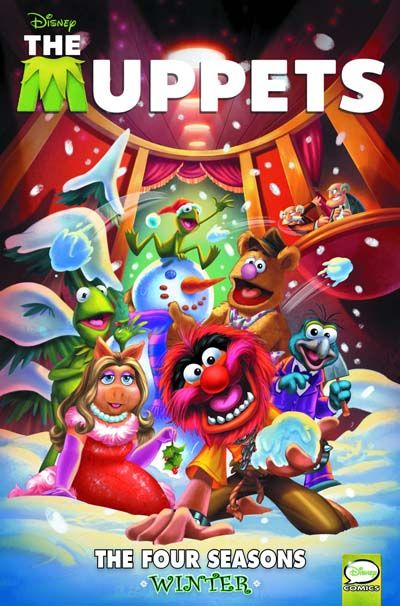
The Muppets: The Four Seasons #2
Story and Art: Roger Langridge

The second issue of Langridge's final Muppets story, "The Four Seasons," is primarily a Fozzie Bear story. When I was a little kid, Fozzie was my favorite Muppet. I found him hilarious. I don't think I realized that he was supposed to be not that funny, and thus I loved him, and I still do. Fozzie gets invited to spend the summer with another theatre troupe, one that could be his big break, and he heads off to take his chance. Meanwhile, the rest of the Muppet crew is doing a summer show at the beach. Of course, being this is the Muppet Theatre, things go horribly awry, with a freak summer snowstorm more or less devastating their plans. Fozzie, meanwhile, sees this other troupe and talks to their resident comic, who has gotten his big break and is leaving, and realizes something important about himself. No reader would have expected the issue to end any way than it did, with Fozzie back with the Muppets, but the ending says somethint beautiful about friendship, something that has always been at the core of the Muppets, and about being who you are and doing what you love because you love it, and not because you think it's the way to something better.

Monday, July 9, 2012

Reviews of Comics from Wednesday 7/4


Animal Man #11
Story: Jeff Lemiere
Art: Steve Pugh

Animal Man has been one of the very pleasant surprises of the New 52 for me. I enjoyed Grant Morrison's run on the character back in the day, and his appearances in 52, but Animal Man has never been a character high on my radar. But this new series has been an excellent blend of horror and superhero tropes, in the same way its sister title, Swamp Thing, has been. As we approach the crossover between the two titles, Buddy Baker returns from the world of The Red (the world of animal spirits where de draws his power), with some altered powers and a serious grudge against the creatures of The Rot. Buddy is one of only a couple heroes who are married in the New 52, and his family ties have always been an important aspect of the character. Him demanding to come back to life to save his family from the thing that had possessed his abandoned body is perfectly in character, and shows the depth of Buddy's love. The scene where he returns, where he morphs his body slowly from the most primitive life form to the most complex is well written, and Steve Pugh does a beautiful job in using each of the higher creatures with a humanity in its eyes that shows that Buddy is there looking to get out. As the issue ends, we get one final push for Buddy's meeting with Swamp Thing. Can't wait to see what happens when the two horror heroes meet next month.


The Boys #68
Story: Garth Ennis
Art: Russel Braun

Garth Ennis is probably known best as the writer of comics with twists and turns, a slightly sophomoric sense of humor, and over the top violence. But having read the majority of Ennis's major works, there's a lot more below the surface of his writing. He actually has a sentimental heart that comes through in a lot of his characters, and each of his major works has a strong central theme. As we reach the end of The Boys, that theme is coming to the fore: the responsibility of power, and how one is supposed to use it. There's not a lot I can say without spoiling this issue, ir without spoiling aspects of the series if you haven't read it yet and want to, but I can say this: the opening scene of the issue is pure Ennis. Four of the Boys sit around and discuss what to do with their possibly/definitely wayward leader. There's comedy (oh, the Frenchman...), a serious look at what has come before and what to do when one of your own goes to far, and a moment that is shocking and sweet when they all make the choice to do what must be done. The ending is trademark Ennis as well: a violent confrontation between two former friends where only one walks away. The roller coaster ride of The Boys is nearly over, but that doesn't mean Ennis doesn't have a few more drops and loops left.


The Muppets: The Four Seasons #1
Story & Art: Roger Langridge

After talking about the previous Langridge Muppet stories on Friday, I was excited to sit down and read the first of his last four issues, and he did not disappoint. This issue is the Spring story, and is all about love. The guest host for the Muppet Show is an attractive ape who Animal falls in love with, and the two have a whirlwind romance, to the despair of her admirer. It's a sweet little story, with all the Muppet touches, including a particularly hilarious "Pigs in Space" where the crew must turn themselves into vegetables as their ship, the SS Swine Trek, crashes to avoid being eaten by the local carnivores. And if you can think of any other comic where you could read that sentence with a straight face, I'll be shocked and have to track it down.


Thief of Thieves #6
Story: Robert Kirkman & Nick Spencer
Art: Shawn Martinbrough

I picked up the first issue of Thief of Thieves, and I really wasn't feeling it.  I loved all the creators involved, but something here just didn't click with me. I tried the second issue, and that was it, I thought. But John, my partner in crime at Dewey's, told me I should try issue three, and so one day on lunch, I read it. And this was what I had been looking for! It felt like the first two issues were just exposition setting up the action beginning in issue three. Now, at issue six, the end of the first arc, some serious action is going down. It seems that master thief Redmond has sold out his crew to get his son out of jail, but there is much more than meets the eye. Maybe it's a triple-cross, with Redmond double crossing the FBI to get his crew loose and get what he wants. And who knows, maybe there's a quadruple-cross coming down the line. What I think I have come to realize about this book is it's less a crime book, like Criminal, where the actual mechanics of the crime are important, and more a character piece, investigating a man who is trying to make right after years of doing wrong. I do love a good caper, but here the caper doesn't really matter and its not given the page count of something that does. Now, the question is whether Redmond will survive having burned his fellow crooks and the feds. Frankly, things don't look good for him; but isn't that half the fun of it?

Friday, July 6, 2012

Recommended Reading for 7/6: The Muppet Show Comic Book


Like many of you reading, I grew up watching The Muppet Show. It was the craziest half hour on television, mixing old school vaudeville with variety TV show with puppeteering with sheer absurdism, and it all balanced perfectly. Kermit and the gang at the Muppet Theater put on a heck of a show, and then graduated to Hollywood and the movies, but quietly faded into something like obscurity for a good decade or so, doing some made for TV movies but really not in the public eye. Last year, the great comeback began with the release of The Muppets, the wonderful feature film that drew the public ete back to the Muppets. But for those of us in the world of comics, the Muppet comeback began two years before that.

When Boom! Studios acquired the rights to do comics based on Disney properties, one of the first books they released was The Muppet Show Comic Book by cartoonist Roger Langridge, who I talked about in my weekly review of his current excellent Lewis Carroll homage, Snarked; Langridge probably got the gig on the strength of his Fred the Clown and The Show Must Go On work, which also dealt with goings on in a theater, and the hijinks backstage, although in a less all ages format. This line had a lot of quality comics, and I'll probably come back and revisit some of the others in later weeks, but Langridge's Muppet comic was hands down the best of them.

Reading these comics, it seems like Langridge found a lost cache of Muppet Show scripts and adapted them for comics. This is a high, high compliment. All the various characters ring completely true to their "real world" counterparts. Kermit is friendly, reliable, and harried. Fozzie is goofy and good natured. Miss Piggy is haughty and lovestruck by Kermit. Scooter is a blur of motion, following the orders of Kermit, his "chief." And Gonzo is... well, Gonzo.

Langridge's art is always detailed, and his depiction of Muppet Theater's backstage is that and more. Langridge must have thoroughly researched the old sets, because his backgrounds look like they were lifted right from them. And all of the minor Muppets appear in the background and in their own scenes! Sweetums (the ogre), Uncle Deadly (the blue monster), and my favorite, Crazy Harry (the explosion happy Muppet) all pop up, along with the usual comedy stylings of Statler and Waldorf, the theater's resident hecklers.

I went into the first issue of the series with some trepidation. After all, could this live up to the long shadow cast by the original Muppet Show? Any doubt I had was put to rest quickly. The first issue of the series sees Kermit feeling a bit down. Antics ensue as the other Muppets attempt to cheer him up to no avail. When his nephew Robin discovers the reason for Kermit's melancholy is that Kermit misses the swamp. Robin convinces Kermit to sing a song at the end of the show, "The Pond Where I Was Born." Even without the music, you can hear the strum of Kermit's banjo, the tune, and the sound of Jim Henson's voice coming from Kermit. The song is sweet and heartwarming, in the tradition of "The Rainbow Connection." After that song, I was sold.

You might be wondering if some of the Muppet shtick would work on the printed page, as opposed to in a TV/movie medium, and I can assure you it does. All the classic Muppet sketches are represented: Pigs in Space, Veterinarian's Hospital, Wayne & Wanda, Kermit reporting from the planet Koozebane, they're all here and as funny as ever. There are even "guest hosts" in many of the stories, who are often thinly veiled parodies of celebrities. Langridge understands that there is a formula to The Muppet Show, even outside the sketches; the Muppets try to put on a show, things go wrong, catastrophe occurs, but in the end everything comes out for the best, and usually with a positive message. It's a tried and true formula.

The original mini-series was four issues, followed by a second four issue mini-series, and finally an ongoing that ran twelve issues. Even into the ongoing, the series was divided into four issue blocks, although each issue does a good job of standing on its own since in most cases the ties are thematic rather than story driven, so here's a quick rundown of each of the arcs.


Meet The Muppets

Meet The Muppets serves as an introduction to the Muppet characters if you're not familair with them, or giving a reminder to people familiar with the Muppets of how great they are. Each issue focuses on a different member of the principal cast: issue one is the Kermit story I talked about above, issue two has Fozzie Bear looking to freshen up his comedy act, issue three deals with the eternal question of what species exactly is Gonzo the Great, and issue four is a story where Miss Piggy has her fortune read and interprets it as meaning she will lose Kermit, so jealousy rears its ugly head and chaos ensues.


The Treasure of Peg Leg Wilson

When Scooter discovers that the Muppet Theater may be the final resting place of the treasure of pirate Peg Leg Wilson, various interested parties begin tearing the theater apart to try to find it. This is a more elaborate story than the first arc, working as an actual continuing four part narrative. Other than the treasure plot, there is a sub plot involving Animal wanting to act more civilized, which ends in the usual wreck.


On The Road

The end of the previous mini-series ended with The Muppet Theater in disarray, so for this arc, the Muppet crew go on the road while repairs are made. Fozzie goes out on the road on his own, and readers follow his misadventures separate from the Muppet tour. Statler and Waldorf also get a nice focus throughout. Langridge does a great job writing for the old cranks, and its never more apparent than here. The first issue collected in this trade was the 0 issue, a one shot that showed Fozzie and Rizzo pitching a "Pigs in Space" movie, which is littered with sci-fi references, and is one of the few issues not drawn by Langridge; art is handled admirably by Shelli Parlone.


Family Reunion

Family Reunion is interesting for Langridge's use of the full Muppet library of characters, including those introduced in later Muppet projects. While Langridge generally stuck to the classic Muppets, this arc features appearances by Piggy's nephews, Andy and Randy, from the attempted 90s TV revival, Muppets Tonight, and Skeeter, Scooter's twin sister from Muppet Babies. Skeeter is actually heavily featured, and her penchant for pranks and causing trouble leads to all sorts of problems. This arc is also only written by Langridge, with pencils provided by Amy Mebberson. Her style is different from Langridge's, a little more cartoony, but it works well with the Muppets.


Muppet Mash

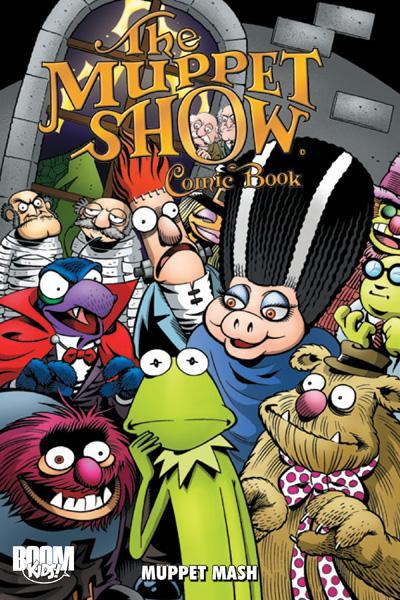
As the cover and the title imply, each issue of this arc features the Muppets and a classic moster trope. Vampires, werewolves, mummies, and robot/Frankenstein monster hybrids. Specific nods to the classic Universal monster movies (like the possible werewolf guest host being Howlin' Jack Talbot, the last name shared with Larry Talbot, the lead character in the classic The Wolfman), are littered throughout, making for nice easter eggs for film buffs. This is my favorite arc, simply because it plays with my love of Muppets and monster movies.

Aside from The Muppet Show Comic Book, Boom! also released a series of minis that took classic stories and recast them with Muppets, in line with films like Muppet Christmas Carol and Muppet Treasure Island. These did not involve Langridge, and varied from series to series in how good they were, but I would definitely recommend Muppet Sherlock Holmes, especially if you are at all familiar with the classic Holmes stories.

The Muppet Show Comic Book is a fun ride, and one that appeals to my nostalgic inner child, my affection for all ages comics, and my love of great comics in general. Whether you're an old school Muppet fan, or someone who only recently found them, I can't think of a better place to get more Muppets. After all, even if it's only on paper, it's time to raise the curtain, it's time to light the lights, it's time to meet the Muppets on the Muppet Show tonight!

All the arcs of The Muppet Show Comic Book were collected in trade by Boom! Studios. These are sadly out of print, although many comic shops will still have them. When Disney comic rights recently went to Marvel, Marvel began reprints of these earlier arcs in magazine form. Meet the Muppets is available in this format, with the others hopefully to follow. This week, Marvel began printing, in normal comic format, The Four Seasons, Langridge's final unpublished Muppet arc. I'm looking forward to reading it and talking about it.