Showing posts with label Matt Wagner. Show all posts

Monday, June 6, 2016

Reviews of Comics from Wednesday 6/1


Batman: Rebirth #1
Story: Tom King & Scott Snyder
Art: Mikel Janin & June Chung

The whole DC Universe is, well, being born again with Rebirth, and so it's time to reset that Batman status quo back to closer to, well, status quo in Batman: Rebirth. There's a passing of the creative baton, as this issue is co-written by Scott Snyder, who has been writing Batman for the past fifty-plus issues and new series writer Tom King. The issue ties up a bunch of plot threads, including fixing Bruce Wayne's issues with his fortune and exactly how Duke Thomas, late of We Are Robin and a semi-regular part of Snyder's run since the "Zero Year" storyline, will fit into the series moving forward. While there's a lot of table setting for the future, and tying up of plot threads from the previous run, we also get a solid done in one story that reintroduces a "classic" Batman foe, the Calendar Man. I use the quotes because the original version of Calendar Man has been mostly forgotten, and the version that most people know is the version from Batman: The Long Halloween and Batman: Dark Victory. But as with many of the other villains that Snyder re-introduced in his run on Batman, he's added a little bit to the mythos, adding a supernatural or metahuman angle, where Calendar Man changes with the seasons, dying in winter and being reborn in spring, becoming a better version of himself each time. Batman is working to find a way to stop Calendar Man's new mad scheme, where a device is speeding up the seasons, allowing not just Calendar Man's cycle to speed up, but to release deadly spoors on Gotham in the "spring" which would be week's end. It's a crazy super science plot, but that makes it cool to me; it's not grounded in some grim, gritty reality, but it superhero comics at their best. It also does something that I love with Batman: he pushes the limits of what a human is supposed to be able to do. It's not ridiculous, superhuman stuff, but a man who is pushing himself beyond what any human has done because it's what he needs to do to save his city. That's what makes Batman an optimistic character in my mind: he does what he does because he needs to save his city. The art by Mikel Janin is extraordinary, gorgeous and fluid, and is a step up from his already impressive work on Grayson. Seriously, DC, you need to get this man on a Batman book again, and you need to do it soon. If the Rebirth one-shots are designed to get readers excited about the new direction for the DC titles, Batman: Rebirth does a great job.


Buffy: The High School Years- Freaks & Geeks
Story: Faith Erin Hicks
Art: Yishan Li & Rod Espinosa w/ Tony Galvan

There have been plenty of Buffy the Vampire Slayer comics, from the  original series that ran concurrently with the series to the recent series that continue the TV series for three more seasons. I know many fans who are of mixed feeling about those later seasons, so this, the first in a series of original graphic novels set during seasons 1 & 2 of the TV series, is for them. This story feels right out of the first season of Buffy, as a matter of fact, since she doesn't know about Angel being a vampire yet, it's easy to squeeze it into the timeline. The story sees a Buffy, who is new to Sunnydale and her friends, is coming to terms with her status as more of an outcast and not the popular girl she was before she moved to Sunnydale. The antagonists are a group of four recently turned vampires, who were geeks before they were sired, and thought they'd be cool now that they were undead, but instead are simply geeks in the vampire set. And when they're told that the way to get in with the vamp set would be to kill the Slayer, well, they set out to do it. And since I said this takes place during season one of Buffy and the comic is now in season ten, you can guess who wins. Still, it's interesting to see the vampires call Buffy out on being a bully, as they're used to the pretty girls picking on them, and see how Buffy reacts to it. It embraces ll the angst that made those early seasons of Buffy classics. You can hear the dialogue in the voices of the actors it's so spot on. And while the story embraces the unlimited budget of comics to produce a spell and a creature that would be difficult on a TV show's budget, it doesn't let that fact drown out the character driven nature of the best Buffy stories. I've enjoyed the comic universe of recent Buffy stories, but there's something nice about returning to these early years, when the most Buffy had to worry about was failing a test and the occasional apocalypse.


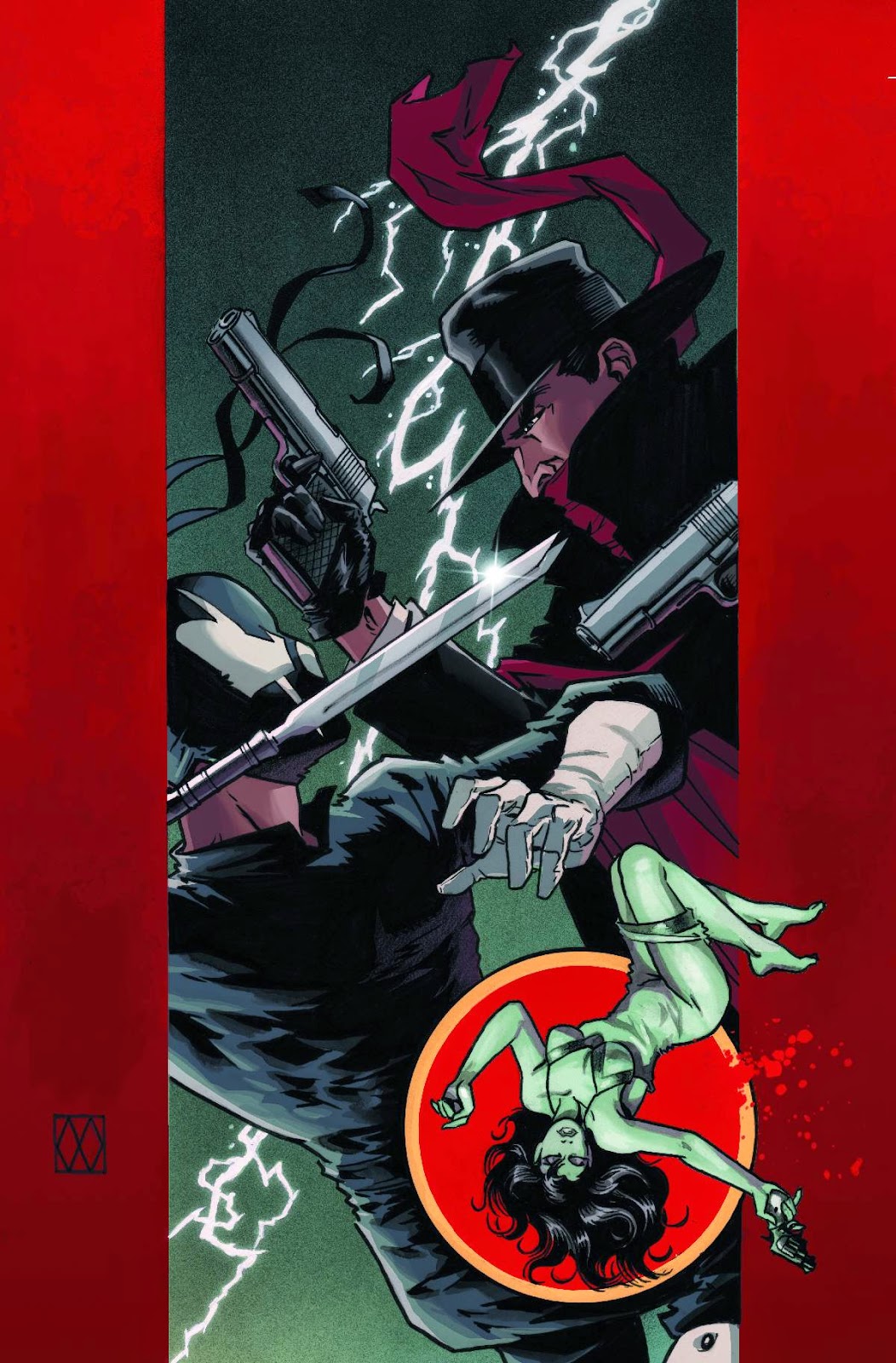
The Shadow: The Death of Margo Lane #1
Story & Art: Matt Wagner
Colors: Brennan Wagner

Who knows what evil lurks in the hearts of men? The Shadow clearly does. Matt Wagner has a history with the Shadow, the mystery man who is a direct spiritual ancestor to Batman; he wrote Shadow: Year One and wrote and drew the crossover between the Shadow and his own creation, the assassin/mob boss Grendel. This is the first full length story starring the Shadow written and drawn by Matt Wagner, and it's absolutely gorgeous. Wagner has a wonderful sense of the period these stories are set in, and the look of the buildings, the design work, and the costumes are all absolutely gorgeous. As with his other Shadow stories, this one is narrated by Margo Lane, the Shadow's romantic partner and one of his many agents in crime fighting, and sees the shadow in conflict with a new boss of the Tongs of Chinatown, the Red Empress. The Shadow's investigations lead him not just to the streets of New York, but to China itself, and then back, If you've never read the Shadow, or are unfamiliar with his world, this first issue does a great job of catching you up, introducing you to his powers, his allies, and his methods. It reads like a pulp, packed with narration and exotic locations, crooks and heroes, reporter and cops, everything you expect from a '30s crime story. As a story narrated in the past tense by Margo, I'm not sure exactly how the title and Margo's seeming death will play in unless she's narrating from beyond the grave, but we'll see as the series progresses. A good Shadow story is filled with crime, shocks, and a touch of the macabre, and this issue has all of that in spades.


And Dan Grote's back with a review this week, reviewing Deadpool #13, a four part crossover in one book...


Deadpool #13/Daredevil #7.1/Power Man and Iron Fist #4.1/Deadpool #13.1
Story: Gerry Duggan, Charles Soule and David Walker
Art: Jacopo Camagni, Guillermo Sanna, Elmo Bondoc, Paco Diaz
Colors: Veronica Gandini, Mat Lopes, Nolan Woodard and Israel Silva

Deadpool teaming up with a hero who can’t stand him is a time-honored tradition dating to his work with Banshee in 1994’s “Sins of the Past” miniseries. This issue, which is actually a four-part crossover in one $9.99 floppy, teams the worst Avenger with Daredevil, Luke Cage and Iron Fist – none of whom has any lost love for him – to protect a Wall Street investor wanted by multiple mobs and some of the more crooked parts of the NYPD.

So yeah, it’s kind of like “The Other Guys,” one of the better Will Ferrell/Adam McKay movies.

It’s also a spiritual sequel of sorts to the Daredevil/Deadpool ’97 annual, which saw the Man without Fear and the Merc with a Mouth team up for the first time to stop the mentally unstable assassin Typhoid Mary.

Duggan, who writes the first and fourth parts of this intrabook crossover, doesn’t often lean on the work of previous Deadpool scribes. His run has done an amazing job of building Wade Wilson’s world and rich history on its own. But in this issue, he revisits the relationship between Deadpool and Mary built early on in Joe Kelly’s run and says, flat out, what we’ve all been thinking for 20 years.


“It was truly one of the worst experiences of my life,” Wade recounts of the time Mary used an image inducer to pose as Wade’s crush of the time, the X-Force member Siryn. “And that’s saying something, if you’ve read my Handbook entry.”

This time around, Mary is working for the Russian mob, one of the parties who wants investor Marvin Shirkley dead for losing their money. Shirkley hires Deadpool for protection, and Wade agrees to take his case, seeing it as an opportunity to work out his Mary issues. Deadpool takes Marvin to the district attorney’s office – specifically, the broken elevator-turned-office of Assistant District Attorney Matt Murdock – for protection, but that idea falls apart once Deadpool realizes the key piece of evidence they need to protect Marvin, the laptop Marvin gave him containing information on all his clients, he threw in the trash because it didn’t fit in his safe.

And so, with a host of Russian, Japanese and other mob nasties coming for them, Deadpool, Shirkley and the Heroes for Hire spend a day in a New York landfill trying to find the laptop. When the goon squad finally shows, the sanitation workers help the heroes repel them, only after which does a truck roll in with the laptop safe and sound. And after one last fight, Mary is locked away in a SHIELD facility where she can get care for her dissociative identity disorder, courtesy of an ever-softening Wade and his life-model decoy SHIELD friend, Agent Emily Preston.

Oh, and there’s a framing sequence in which Daily Bugle reporter Ben Urich tries to figure out how to report all this and gives up, but it doesn’t really affect the story at all.


Had this been an actual four-part crossover, you would have paid almost $20 to collect ‘em all. So while 10 bucks for one book is certainly steep, you are getting one solid, self-contained, quadruple-sized story out of it. And a lot of jokes about being blind.

Friday, September 4, 2015

The Players on the Other Side: A Guide to Your Anti-Bats

Years and years of reading Batman comics have shown me something very interesting: writers love the idea of the anti-Bat. I'm not talking an opposite; The Joker is the opposite of Batman. Joker is chaos to Batman's order. I'm talking that villain who is the cracked mirror version of Batman. Most superheroes have one villain like that, but with Batman it seems like they could form a club. So I was thinking, as something fun for this Friday, to run down the anti-Bats, and end with a mention of a character who isn't a DC character who is, in my opinion, the ultimate dark version of Batman. I won't be drawing in any of the other characters from outside DC who are takes on Batman, so fans of Nighthawk of the Squadron Supreme or Darkwing of the Guardians of the Globe (or Darkwing Duck, for that matter), I understand your love, and there might be s piece someday about alternate takes on Batman. But today, let's bring on the bad guys.


Killer Moth
First Appearance: Batman (Vol.1) #63

Killer Moth is looked on a kind of a joke character now. I think the striped leggings don't help much in that respect, to be honest. But when he was introduced, he set himself up as the Batman of the criminal set. He had a Mothcave and a Mothmobile, and criminals would hire him to help them escape the police and Batman. This goes about as well as you might expect, with Batman shutting him down repeatedly. When he first appeared, he even had a millionaire secret identity, as Cameron Van Cleer (who sounds like the jerk rich boyfriend in a 80s movie). Over time, he became more of a generic 60s villain, performing all sorts of heists and capers. He's probably best remembered as the first villain who fought Barbara Gordon as Batgirl. He would pop up occasionally throughout the 70s and 80s, and in the 90s, he got one really great story, "The Misfits", in Shadow of the Bat, a new secret identity, Drury Walker, and was one of the villains who got a serious Underworld Unleashed treatment, transformed into a giant moth monster called Charaxes in Robin. As opposed to a lot of the villains from that crossover, this change stuck, and he remained Charaxes until he was killed in Infinite Crisis. While there was another Killer Moth briefly after Charaxes's death, and one who has appeared in the New 52, he has mostly returned to obscurity. For a villain who hasn't been a major threat, well, pretty much ever, Killer Moth has a pretty interesting career in other media. He never made Batman '66 (although there was a test short of Batgirl with him as the villain), or Batman: The Animated Series. However, he did make The Batman, both in his Killer Moth costume and his Charaxes form, and pops up a couple times in Batman: The Brave and the Bold. He is also a recurring villain on Teen Titans and Teen Titans Go!, where his form is closer to Charaxes than Killer Moth. Starfire's pet grub, Silkie, is a product of Killer Moth's experiments. I list him as the first anti-Bat, though I will admit that Deadshot, who pre-dates him by a year, did start out as something of an anti-Bat as well.


The Wrath
First Appearance: Batman Special #1

Created by Mike W. Barr in one of his numerous excellent Batman stories, The Wrath is one of two villains on this list whose origins directly mirror Batman's. In his one appearance in the one-shot, "The Player on the Other Side," (from which I drew this piece's title), Barr and artist Michael Golden created the Wrath as a criminal whose parents were shot by police in Gotham, and who trained around the world as a hitman. He comes back to Gotham on a contract, and plans to take out the officer who killed his parents, namely Jim Gordon. This is an excellent issue, and it's been collected a couple of times, but only in recent years. The Wrath never popped up again after his death in this issue, but an apprentice of his appeared as a new Wrath in a Batman Confidential arc by Tony Bedard and Rags Morales, and Jonathan Layman and Jay Fabok introduced a New 52 Wrath during their run on Detective Comics. Interestingly, the Wrath also appeared on an episode of The Batman, along with a Robin-like sidekick called Scorn. This was towards the end of that series, when it was firing on all its cylinders and was pretty solid.


Bane
First Appearance: Batman: Vengeance of Bane #1

Right before The Dark Knight Rises, I wrote a long piece about Bane's history, so I'll just give a quick rundown here and you can go and read that of you want to read more about probably the most infamous of the anti-Bats. Created by Chuck Dixon, Doug Moench, and Graham Nolan, Bane was a child raised in an island prison, paying for the crime of his father. There, he trained his mind and body to perfection, escaped, and went to Gotham to prove himself by defeating Batman. While Bane isn't as much a direct visual counterpart to Batman as Killer Moth or Wrath, he is the self-made man, the man who pushed himself harder than anyone else to become the pinnacle of human achievement. His use of the super-steroid Venom also makes an interesting parallel, as Batman was addicted to the drug during its first appearance in Legends of the Dark Knight, but kicked the habit. And as Bane grew, he also spent time as the chosen heir of Ra's al Ghul. The great thing about Bane (at least before the New 52 reset him to being similar to his original incarnation) was that Bane grew out of his role as an anti-Bat and became a fascinating character in his own rights, mostly thanks to Gail Simone's tremendous work with the character in Secret Six. Bane is a solid part of the Batman mythos now, entering that highest echelon of Batman villains, He has appeared in all modern animated forms of Batman, as well as in both movie series, and had a prominent role in the Arkham video games series.


Prometheus
First Appearance: New Year's Evil: Prometheus #1

Prometheus is a character created by Grant Morrison, so you know you're in for a trip right off the bat. Prometheus's basic origin is the same as the Wrath: criminal parents killed by the police. But while the Wrath's parents were petty crooks, Prometheus's were like the couple from Natural Born Killers. And instead of training with the best people the mob could find, Prometheus trained with evil monks and the like, and got his Batcave as a house in a void dimension. So, yeah, totally Morrison there. He decided that if he was going to make an impact, he had to kill superheroes, and set his sights on the Justice League. He also had a helmet that enabled him to download the fighting styles of anyone, so it's interesting to note that, as much of a parallel to Batman he might be, he cheated to do it. And when Batman finally defeated him in Morrison's final JLA arc, it was by exploiting the helmet. When Prometheus next appeared, he had inexplicably gone from a guy who could face down the whole Justice League to a henchman for another villain (more on him later) who Green Arrow took out handily. It was eventually revealed that the Promethus from those stories was in fact the apprentice of the original Prometheus, who the original killed when he recovered from his defeat by Batman. Prometheus was the main villain in the much derided Justice League: Cry For Justice mini-series, where he exacted vicious revenge on any superhero who crossed his path, and was killed by Green Arrow. He has not appeared since.


Hush
First Appearance: Batman (vol.1) #608

Hush is a tricky character. Created to be the mastermind villain of a mega-arc in the ongoing Batman title, Hush was Tommy Elliot, a childhood friend of Bruce Wayne who came from a privileged background. But as opposed to the loving Waynes as parents, the Elliots were terrible people, and so young Tommy tried to kill them. He would have succeeded, if Thomas Wayne hadn't saved his mother's life, and so years of slow planning began for Tommy to get his revenge on Bruce. When he was pulled into a conspiracy with Jason Todd, Riddler, and Scarecrow, Tommy took on the identity Hush, and became a criminal mastermind.I think a lot of the problems people have with Hush comes from the fact that he came from out of nowhere, was an obvious suspect, and there were various structural issues with the story, and that the next stories featuring the characters were an awkward series of stories in Batman: Gotham Knights where he and Prometheus teamed-up with Prometheus as the lesser partner (see, I said there'd be more on this later). Paul Dini did a great job rehabilitating the character in his run on Detective Comics and Streets of Gotham, making him a fully formed character, and even making him more of an anti-Bruce Wayne by Hush having surgery to look like Bruce and try to take his place. Hush popped up recently in Batman: Eternal as one of the suspects for mastermind of that conspiracy, but has not been seen since that series wrapped.


Owlman
First Appearance: Justice League of America (Vol.1) #29

Owlman is a little bit of a cheat for this list, as he is simply a version of Batman from another universe, specifically Earth-3, the Earth where good guys are evil and bad guys are good. However there are some wrinkles that made me want to call him out. One is that he has interacted wit the "real" Batman in various battles between the Justice League and their evil opposite numbers, the Crime Syndicate. Also, he's an interesting character in his own right; in his various origins, Thomas Wayne Jr. either killed his parents or watched his brother, Bruce, and mother killed, and decided to become a criminal. Grant Morrison reintroduced the Crime Syndicate in his excellent JLA: Earth 2 graphic novel, and the Syndicate popped up a few times after that. Since the DC reboot, there have actually been two Owlmans. One is this version, the alternate Thomas, who is still lurking out in the DCU after the events of Forever Evil. The other is Lincoln March, the ally of the Court of Owls, who claims to be Thomas Wayne Jr. of Earth Prime. He was a centerpiece of the "Court of Owls" storyline, and appeared at the end of Batman: Eternal, where he was recaptured by the Court. What will happen to him next remains a mystery.


Grendel (Hunter Rose)
First Appearance: Comico Primer #2

OK, here's my pick as the greatest anti-Bat in comics, and he wasn't even created to be one! The assassin/mobster/bon vivant Hunter Rose, better known as the first Grendel in Matt Wagner's epic cycle, shares many of the same cultural roots as Batman, with the pulps as the backdrop (although I have to imagine Batman factors in somewhere in that cultural DNA as well). Hunter is a self-made man, who as opposed to Batman didn't have everything laid out in front of him. He pulled himself up, as an exceptional person in a world of ordinary people. And while Batman had legions of good influences (Alfred, Leslie Thompkins, etc.), Hunter was only noticed by Jocasta Rose, a woman who became his lover and confidant at an impressionable age. With her loss, Hunter decided that he would never be mundane, he took the flashy name of Hunter Rose, he became an internationally best selling novelist, and when that wasn't enough, he took over the New York mobs. Hunter is as cool, as calculating, and as brilliant as Batman, but everything he does is for himself. Except for one thing. He has a young ward, Stacy Palumbo, who he took in after he killed her uncle and saved her from a child pornography ring. But, in another inversion, instead of this being the thing that saves them both (as I feel Bruce Wayne taking in Dick Grayson kept Bruce in touch with his humanity), when Stacy discovered that Hunter was in fact Grendel, she manipulated events that led to his death, and her own eventual slide into madness. Hunter is a phenomenal character on his own, with no Batman necessary, but Wagner's Batman/Grendel is an excellent showcase of the two characters and how they relate. Seriously, it's the best batman related intercompany crossover ever, and should be in the collection of any Batman fan.

Monday, June 29, 2015

Reviews of Comics from Wednesday 6/24


The Fade Out #7
Story: Ed Brubaker
Art: Sean Phillips

As readers get deeper into Ed Brubaker and Sean Phillips's filmland noir, The Fade Out, they see that every player in the series is haunted by something. Most of the issue is actually taken up by the romantic and sexual romp of the series protagonist, screenwriter Charlie Parrish, and Maya Silver, the starlet who replaced the murdered Valeria Sommers. But even as the two of them dance and have sex at a beach house away from all the pressures of Hollywood, that world doesn't release them. A particular physical trait of Maya's causes Charlie to ask a question that once again brings to mind Val and the suspicions he has about the hedonism of the head of the studio he's working for and exactly how much that might play into Val's murder. And when they're called back to the city early, Charlie gets himself immediately sloshed and into a fist fight with another writer who attacks him for naming names and getting his old partner, Gil, blacklisted. Charlie is haunted by Val's death and his own writer's block, by the corruption of the world around him. And when he goes to clean up after getting beaten down, he finally has a conversation with the man he remembers seeing the night of Val's death, who identifies himself as Drake Miller from the studio, who clearly knows that Charlie is a front for Gil's writing. Charlie knows the threat for what it is, that being outed as a front is suicide in Hollywood at this time, and still does nothing. This paralysis of action is Charlie's defining character trait and flaw, and clearly is connected with his wartime experiences in Germany. The issue also has us drop in on PR girl Dottie and Tyler Graves, the closeted gay James Dean analogue, forwarding their plots, but it's really Charlie and Maya's issue. We do get a little more about Maya and exactly what she went through to get her job on this movie. Brubaker doesn't forward the plot of the series as much as the character, although the final scene with Miller and the note he slips to Charlie are clearly important, something he's done with various issues of his earlier series as well. Phillips balances both the lovely beach scenes with the deeper darks of the bedroom scenes, which are not graphic but sexual. The Fade Out, more than any of Brubaker and Phillips previous series, is a slow burn, piecing out its information slowly while bathing us in atmosphere. I'm wondering if there were clues in this issue that will come back around to be more important later. Oh, and if you've been enjoying Devin Feraci's essays on Hollywood of days gone by that accompany each issue, you should check out You Must Remember This, an excellent podcast about the history of Hollywood in the 20th century.


Gotham By Midnight #6
Story: Ray Fawkes
Art: Juan Ferreyra

After the two month Convergence hiatus, Gotham By Midnight returns with its strongest issue to date, thanks in no small part to new series artist Juan Ferreyra. Ben Templesmith did a good job on the first arc, but I'm a huge fan of Ferreyra's from his work on Colder and Kiss Me, Satan and his talent for drawing the supernatural and the disquieting is well suited to Gotham City in general, and the macabre cases of the Midnight Shift in particular. The ghost haunting Powers Corp R&D is grotesque and shiver-inducing, exactly what I'd expect out of Ferreyra. The issue's story picks up shirtly after the conclusion of the previous arc, with the Midnight Shift attending the funeral of Sister Justine, who fell to help stop the Spectre from wiping out Gotham, and still under investigation by Sgt. Rook of Internal Affairs. After a tense argument about the powers of both Jim Corrigan as The Spectre and his partner, Lisa, Drake, who is part banshee, the two are sent to investigate the aforementioned haunting at Powers Corp. The story there is a tale we've heard before, of corporate greed run rampant, caring more for the bottom line than the human lives of those who work for it, but Fawkes infuses it with character, and makes you really want to slap around the unctuous Mark Jenner, whose corporate think and ultimatums led to the death of George Wooley, who haunts Jenner and Powers to get his justice, something the Spectre can understand. Meanwhile, Lt. Weaver spends time with Dr. Tarr, the Midnight Shift's resident scientist, who has taken Sister Justine's death the hardest, and who continues to investigate the black flowers from Slaughter Swamp, which take on an eerie turn. If that wasn't enough, the final page reintroduces one of my favorite DC characters, one who hasn't been seen since the universe reshuffling that was Flahspoint: Kate Spencer! Yes, the last character to bear the name Manhunter, the tough as nails superhero/attorney is back. Methinks this might mean a recommended reading for Manhunter is coming soon from this very blog, but for now I just want to thanks Ray Fawkes for bringing Kate back, and adding her to the cast of this comic.


The Shadow #100
Story & Art: Various listed below

I don't know exactly what math was used to determine that Dynamite was at issue one hundred of the comic featuring pulpdom's original masked vigilante, but however they got to the number, the celebrated it with an impressive prestige format anthology collecting six stories of The Shadow.

Story 1: "The Laughing Corpse," written and illustrated by Francesco Francavilla, is the story of the Shadow following leads as prominent scientists are dying with their bodies contorted and  with grotesque smiles on their faces. No, it's not a crossover with another famous masked avenger (that's for later), but a story of revenge with Francavilla's usual style and grace, with gorgeous layouts an tons of atmosphere.

Story 2: Writer Victor Gischler and artist Stephen B. Scott's story deals with members of the card club frequented by the Shadow's alter ego of Lamont Cranston being robbed and killed. It's the most detective oriented story in the collection, although the reader is on on what's going on from the beginning.

Story 3: "Black and White and Red All Over" by writer/artist Howard Chaykin, who has quite a history with the Shadow, deals with The Shadow dealing with an old friend of his from World War I who is now a published of this new fad, comic books. We get a tale right out of the early days of comics, with gangsters and unscrupulous businessmen. And the final page shows an incensed Margo Lane, the Shadow's female companion, irked that the same crooks who bought out Shadow's old friend are no publishing a Shadow comic, something the Shadow takes in stride. Less so in...

Story 4: Michael Uslan, best known for being the producer of the Burton Batman films but who has written some comics featuring both the caped crusader and The Shadow in the past, and artist Giovanni Timpano, tell a story with so much 30s charm and in jokes that I couldn't help but smile. After The Shadow saves a couple and their young son from being mugged (if it wasn't clear who they are to readers at the outset, there's a bit with pearls that seal the deal), the Shadow slips off to tell off the guy who's voicing a radio version of his, something the Shadow does not approve of. If you know anything about the classic Shadow radio show, you know who this is, and Timpano captures the actor's look perfectly, and the final page mentions of Hearst and Rosebud  again make it clear what famous actor the Shadow has set on a course to make his masterpiece

Story 5: Left out of the credits at the beginning of the comic, the back cover told me this story, of a criminal watching as the Shadow takes apart the underworld, comes from Chris Roberson and artist Ivan Rodriguez. This story feels like it follows in the footsteps of some of the best Will Eisner Spirit stories, where the Spirit, or in this case The Shadow, serves as more a plot device, letting us get into the head of a denizen of the city, in this case a crook with a sense of honor who the Shadow seeks to add to his collection of agents.

Story 6: The collection is rounded out by " The Curse of Blackbeard's Skull" a prose story with accompanying illustrations by Matt Wagner. The format, similar to that of the pulps where the Shadow comes from, makes it an excellent choice to end the anthology, and Wagner knows the Shadow. A story of rich men dying after possessing the cursed skull turns into a story of greed and avarice.

If you've never read a story of The Shadow before, or only know him vaguely, this is a great place to first read him, as it will give you a good feel for the character and his world.


We Are Robin #1
Story: Lee Bermejo
Art: Jorge Corona & Rob Haynes

The final major issue one of this month from DC is We Are Robin, where the idea of Robin, of a teenager doing something to protect Gotham from the crime that infests it, has reached a point where it has become a movement. But we only get hints of that this issue. The main focus of this issue is Duke Thomas, who will be the series point of view character. For those of you who haven't read Duke's earlier appearances, he has popped up a couple times in Scott Snyder's run on Batman, most recently in "Endgame," where the Joker used Duke and his parents as bait for Batman. This issue opens with Duke in foster care, as his parents are among the missing after the Joker's rampage. His case worker is long time Batman supporting cast member Leslie Thompkins, who has popped up intermittently and inconsistently since the reboot, and writer Lee Bermejo captures her in a way that makes me hope she is a regular supporting cast member in the book. As for Duke, one issue in and I love him. He's likable, clever, with a bit of an attitude, but he's not written to be a stereotypical street kid in any way. He's already well rounded by Bermejo just by drawing on his few appearances in Batman and what Bermejo does in this one issue. Looking for his missing parents, Duke goes into Gotham Underground and comes across a plan to blow up Gotham City proper. And when he's in trouble, that's when the Robins show up. Someone has been directing them to Duke, and we don't exactly know who that is or what their agenda is, but the final pages indicate someone with some resources is backing up the Robins.Jorge Corona, drawing off breakdowns by Rob Haynes, provides art removed from the DC house style, but with a lot of energy, appropriate for a book that is going to be populated by young, acrobatic characters. With mainstream superhero comics' recent push for greater diversity, a book featuring a young African-American lead and a group that looks to cross every possible societal group is a smart choice for the less than diverse recent DC Universe, but Duke is presented as a character first here, and that's the key to a solid character and title, something this first issue of We Are Robin sets up well.

Monday, March 30, 2015

Reviews of Comics from Wednesday 3/25


Abigail and the Snowman #4
Story & Art: Roger Langridge

Roger Langridge wraps up his story of a girl and her Yeti with an action packed double sized issue, as Abigail and Claude flee the government agents who have been chasing them, specifically the one-eyed monster hunter, who will stop at nothing to make sure if the British government can't have Claude, no one will. The issue has car chases, a helicopter with machine guns, and some mortal peril. The man from the government clearly has no problem hurting or killing Abigail to get at Claude, which leads to some pretty scary moments. But the violence never moves beyond something you'd see in a PG rated movie, and I think we underestimate kids: something can have some scares and some serious moments and still be all ages. Those are teachable moments, moments that can spur a discussion. But while there's more action in this issue, and a last minute reversal, as the other government agents decide they don't like the way this newcomer is willing to do anything to get what he wants, including hurting a little girl, the heart of this book is still the friendship between Abigail and Claude.  The concern they share for each other when in peril, the joy in the photo montage page as Abigail wants a few more pictures of memories with Claude before he leaves, and the wonderful scene of their reunion at issue's end will warm the coldest of hearts. Abigail and the Snowman is another charming delight from Roger Langridge, who is one of those creators whose work I always look forward to. With this series complete, I hope he has something else for us soon.


Batman and Robin #40
Story: Peter J. Tomasi
Art: Patrick Gleason

After forty issues (plus a zero issue, and a Futures End one), Pete Tomasi wraps up his run on Batman and Robin. Damian, still super powered, gets to go on a big adventure with the Justice League, fighting a giant robot attacking Japan. While this is a very cool action centerpiece to the issue, and shows off Patrick Gleason's skill at drawing big action, it isn't what the issue is really about. No, this issue is really about how much Damian has grown as a character, not just from the beginning of the series but from his introduction. This isn't the killing machine trained by the League of Assassins. No, as Batman points out, during the battle with the robot he works with the team and keeps his emotions in check. But more than that, when we return to Wayne Manor, we see that Damian has made a gift for Bruce and Alfred, something the haughty psychopath he once was never would have done. We get glimpses of everything that this book has done for the character over its run, including Damian's Bat-pet menagerie (Titus the dog, Alfred the cat, and Batcow). I don't think it's a major spoiler or surprise that Damian loses his powers by the end of the issue, since I doubt anyone thought them permanent. I liked that Batman created the situation with the robot to have Damian bleed off the last of his super energy, but did it in a way that allowed Damian to have a big adventure and not in a dictatorial way. Maybe Batman has learned as much about parenting along the way as Damian has learned about himself. While this Wednesday will see a final annual from Tomasi, this issue would serve as a perfect coda to everything this book has done to make Damian the character that he is now.


Django/Zorro #5
Story: Quentin Tarantino & Matt Wagner
Art: Esteve Polls

Now past the halfway point, Django/Zorro is starting to roll towards its inevitable, blood soaked, Tarantino-style conclusion. After Don Diego donned his Zorro costume last issue, the native slave labor of the self-styled Duke of Arizona is starting to stir. And the Duke has decided that Django, seen in proximity to them, is behind it and should be interrogated. After a brief fight between the Duke's guards and Don Diego and Django, Don Diego is able to arrange a meeting with the Duke, and needs Django to steal into the Duke's study to find evidence that he has concocted the whole dukedom plot as a land grab. And to allow Django to more easily slip into the mansion, Don Diego provides Django with a special outfit. So much of what has made this book great has been the interaction between Django and Don Diego, with Django continually perplexed by Diego's demeanor and attitudes, and Diego's completely charming and friendly demeanor. Despite all of this, the highlight of the issue was a flashback of Django's to his time travelling with his friend, the former dentist turned bounty hunter Dr. King Schultz. Schultz was a strong presence in Django Unchained, very similar to Don Diego, in that his urbane exterior masked a capacity for violence, but at his core he was a good man. It was a delightful scene to watch Scultz put a pair of racist thieves in their place while teaching Django an object lesson. It's a great scene, pitch perfect in its dialogue; I could actually here Christoph Waltz delivering the dialogue. Django/Zorro has been slow building, spending a lot of time with character, getting us to understand who these people are, with only brief flashes of violence. I think we're heading towards a climax worthy of the blood soaked conclusion of Django Unchained, and I wonder if there will be a new Zorro once the story is over.


The Valiant #4
Story: Jeff Lemire & Matt Kindt
Art: Paolo Rivera

The Valiant, the first event that touched every corner of the Valiant Universe concludes with an ending that is as bitter as it is sweet. The Immortal Enemy, the monstrous entity that seeks to kill the Geomancer, has defeated all the heroes who were set before it, and only Bloodshot stands as the last line of defense between it and Kay McHenry, the current Geomancer. As with the last issue, we really have two stories here, one with Bloodshot and Kay, and the other with Gilad Anni-Pada, the Eternal Warrior and guardian of the Geomancer, unlocking a mystery box sent from the future by himself that he is told will be the one thing that can stop the Enemy. The battle between the Enemy and Bloodshot is brutal, the kind of fight you can only have between two beings that can pretty much recover from any wound. I have to give writers Lemire and Kindt a lot of credit for seeding the fact that Bloodshot has no memories of who he once was throughout the series, making it an important part of his interactions with Kay, and paying it off in the big fight with an enemy who relies not just on physical might but on playing with the worst memories of his victims. The big moment of the issue was when Kay finally stands up to the Enemy. Still wearing the face of Mr. Flay, Kay's childhood boogeyman, Kay stood up to Flay to help save Bloodshot. One of the very cool tricks of the issue is once Gilad touches the mystery box with the weapon in it, we see a five minute countdown that continues to play out even when we move away from his scene, clicking off time in the lower right corner of each page. It adds to the tension of the already intense battle. I'm really loathe to talk about the last few pages, as they are really full of not only some major surprises, but events that completely toss the status quo of the Valiant universe on its ear, setting up Bloodshot Reborn, and hopefully another Eternal Warrior mini-series, since Gilad's final narration screams for a follow up of its own. I'm amazed how Valiant was able to have a crossover that was completely contained in one book, was of high quality, and really did affect its universe. This is great comics. And in a couple months, it will be out in trade for $9.99, so if all my words of praise have gotten you curious, then you'll have no excuse to not check it out when that happens.

Monday, November 17, 2014

Reviews of Comics from Wednesday 11/12


Batman #36
Story: Scott Snyder/ James Tynion IV
Art: Greg Capullo/ Graham Nolan

At this point, a run of three plus years is a huge run in comics. And Scott Snyder's run on Batman has now continued for over three years, and continues to be a book I love to read every month. And when an issue features The Joker, who is my favorite villain in all of comics, beginning to roll out a mad plan against Batman, my favorite hero in all of comics, it is an issue that is something to look at closely. Snyder's Joker is the Joker of the 21st century, not the criminal mastermind of his early career, but the madman/ anarchist who is completely unpredictable. More than unpredictable, this Joker doesn't do what he does for money. Even more than Grant Morrison's Joker, Snyder's Joker is defined by his relationship to Batman. And while in Snyder's last Joker story, "Death of the Family," Joker went after Batman's nearest and dearest, this time he starts out going after the Justice League. Last issue saw Batman fight most of the League, but the beginning of this issue is Batman versus a Joker Venom controlled Superman. We've seen Batman and Superman fight plenty of times; Dark Knight Returns, "Hush," Superman: The Animated Series, and the oft-forgotten but pretty cool Superman Annual that tied into "Armageddon 2001" to name a few. Snyder's fight is a perfectly good one, with lots of cool gadgets that help Batman prevail, but it's nothing new. It is a showcase for some amazing fight choreography and art from Greg Capullo, though, so that is more than worth the price of admission. It's after the fight that the issue takes off for me. First, seeing Bruce interact with Alfred, an Alfred still weakened from the events of Batman: Eternal and who was abused by Joker severely last time he was in Gotham. Alfred and Bruce's relationship has been the touchstone of mush of what Snyder has done in the book, and to see Alfred flat out tell Bruce to go out there and take out the Joker shows how high the stakes are. The appearance by Julia, Alfred's daughter, continues to deepen her character, a character who has grown on me as Eternal has played out. But it's the scene in the wreckage of Arkham Asylum, destroyed recently, that makes the issue hit its high notes. This will be spoilery, but if you have been to any of the comics news sites in the last week, it's probably been spoiled. The reveal of the Joker's alter ego, the long game Snyder has been playing for over a year, is wonderful. I didn't see it coming, at all, but it makes me want to reread Batman Annual #2 and see exactly what Eric Border was saying and doing. Snyder's Joker is creepy (again aided ably by Capullo, whose Joker with a face might be even creepier than his Joker without one), obsessive, and smart, all things that make a great Joker, and as we see the next stage of his plan begin, as we see that Joker's twisted love has turned to hate, it's clear that Batman has an uphill battle ahead of him. And it makes for a great story when Batman is at a disadvantage, because it highlights many of his best traits, mostly his brain that allows him to work his way out of these problems, something I'm looking forward to seeing. The back-up continues with a group of Arkham inmates dragging Dr. Mahreen Zaheer around Gotham, telling them stories of the Joker, who has clearly manipulated them all. With the revelation of Eric Border's true identity, there's a new layer as to why the inmates chose to stalk Zaheer, and it makes me wonder more and more what Joker's endgame is in having them stalk the friend Border made in Arkham. The artistic hits also keep coming, with Graham Nolan, who penciled so many of the my favorite 90s Batman stories, doing the art on this back up. Two issues in, and "Endgame" might prove to be the highlight of Snyder's stellar run. I'm looking forward to see what paths the Joker is leading Batman down.


Django/Zorro #1
Story: Quentin Tarantino & Matt Wagner
Art: Esteve Polls

There are many things in pop culture I love. Some of them include Westerns, Quentin Tarantino, and the comics of Matt Wagner (more on that later). So Django Unchained was a movie I looked forward to and loved, and the announcement that Tarantino would be working with Matt Wagner on an official sequel in comics got me excited. My familiarity with Zorro isn't as much as it should be with him being an inspiration for Batman, but I've seen the classic Mark of Zorro and some modern TV and movie versions, so I have a basic grounding. The good news is, if you know nothing about Zorro or Django, you won't feel in the least bit lost here. The story starts with an elderly Don Diego (the secret identity of Zorro) travelling by carriage and picking up Django, whose horse had died. This turns out to be Django using Don Diego as bait for a bounty, and the two wind up discussing justice and their lives, and Django feels a kinship with Diego, who reminds him of his mentor from the film, Dr. King Schultz. When they arrive in town, Don Diego proves that even in his twilight years he is still tough by taking out a group of ruffians. And as the issue ends we find out the foe the two heroes will face... The Archduke of Arizona? Ok, well Emperor Norton was in San Francisco, so Arizona can have an archduke. This is a really strong first issue, with good introductions to both of our protagonists, some solid action, and dialogue that could have come right out of a Tarantino movie; Wagner clearly gets the rhythms that fans expect out of Tarantino. The violence is probably not as graphic as you'd get on the big screen, but it's there, and there are no punches pulled. If you enjoyed Django Unchained this come feels firmly placed in the same world, so if you need a Tarantino fix before The Hateful Eight hits big screens, get to your local comic shop and check out Django/Zorro.


Grendel Vs. The Shadow #3
Story & Art: Matt Wagner

Hey, it's Matt Wagner again! The conclusion of the confrontation between Grendel and The Shadow  brings all the elements that Wagner has been building to a head. The character beats of the story deal very much with the series' title characters and the women in their life. Margo Lane, who has been struggling with her relationship with The Shadow and his distance from her, makes the choice to leave him early in the issue, but in the end The Shadow reaches out to her, something that he is not prone to do. It's a good counterpoint to Hunter Rose, who reaches out as well, breaking the vow he made to his lost love, Jocasta, by falling for mobster's daughter Sofia Valenti. In another world, I could completely see Sofia taking up the mantle of Grendel, as she is cold, calculating, and prone to betrayal. Hunter, in the end, views his dalliance with her as nothing more than him giving into nostalgia for the feelings he once had for Jocasta, not admitting he might have loved her, while The Shadow does his best to say those very words to Margo so he does not lose her. It's interesting, when so many female characters exist solely in relation to the male leads of a series, to see a story where we deal with how the male leads are reflected in their female counterparts, not entirely lampshading or inverting the trope, but showing how both Margo and Sofia would, could, and do exist without their men. Wagner, who always draws beautiful, almost balletic, fight sequences, pushes that skill to a new level, in a three way battle between Grendel, The Shadow, and a room full of mobsters. It's brutal and inspired. The series ends with vows. The Shadow wonders if Hunter was indeed a time traveler, but reaffirms his mission, because he still must do his best to make a better world. Hunter reaffirms his status as a man apart, saying he will share his affection only with his ward, Stacy, because she would never betray her. Those of us who know the full story of Hunter Rose know that is far from the truth, and what initially made me sort of chuckle in that same way I did when Obi-Wan Kenobi told Anakin Skywalker, "You'll be the death of me," upon further consideration gave a little chill, because it says that Hunter didn't learn anything from his time in the past, and what might have been the universe giving him a chance to save himself is instead just another adventure to him. With the series over, I'm left to wonder if this is Wagner's final word on Hunter Rose. He has said he has at least a Grendel Prime story in mind, but as with any creator owned project, this might be the last story of the first Grendel. If it is, it's a fitting sendoff, with Hunter having gone toe-to-toe with the character who inspired so many masked adventurers.


She-Hulk #10
Story: Charles Soule
Art: Javier Pulido

The penultimate arc of She-Hulk wraps with a courtroom battle between She-Hulk and Daredevil in the wrongful death suit against Steve Rogers, the original Captain America. There's a lot to love about this issue. The characterization of Steve Rogers as someone who wants  be vindicated legally because the idea of Captain America is important to him is a highlight. The absolute joy of Hellcat for using her stealth suit is a great bit. Javier Pulido's usually stunning art is at its best, with the flashbacks to the 40s having a gorgeous feel to them. But the highlight for me was that the story, which started out as a conflict in the courtroom, ended as that. Sure, we got a supervillain manipulating things from the background (and if you know your Cap villains, it makes perfect sense when the reveal happens). but the true climax of the story are two pages that are nothing but a white background with full figures of each of the lawyers giving their closing statement. Charles Soule, a lawyer himself, writes eloquently for both sides. Even as a reader knowing that Cap is innocent, the statement given by Daredevil against him gave me pause. And the argument from She-Hulk was equally well thought out. With this story complete, we have two issues of the series left to wrap up the mystery of The Blue File, and the end of the issue seems to indicate a brawl with She-Hulks arch-enemy is coming, which is going to be a change from the past few issues that were much more intellectual. But I wouldn't be surprised if Soule found some way to defy expectations on that front too. He's made She-Hulk into my favorite Marvel monthly, after all, and that wasn't something I saw coming.

Monday, October 13, 2014

Reviews of Comics from Wednesday 10/8 (with Bonus Animated Discussions for Star Wars: Rebels)


Batgirl #35
Story: Cameron Stewart & Brenden Fletcher
Art: Babs Tarr

And now for something completely different... The beginning of the new creative direction for Batgirl has been anticipated since it was announced, and now having read the first issue, I can say that it's a success. It's a jarring difference for the first handful of pages, I admit, as it feels completely different than anything else coming out from DC right now, but once you settle in to the groove, it's a ton of fun. New writers Cameron Stewart and Brenden Fletcher have moved Barbara Gordon out of Gotham City proper and into Burnside (Gotham's answer to Brooklyn), and we see a completely different life for Barbara, and see her fighting crime that is very much 21st century crime, with tech theft and on-line sleaze mongering factoring into this first story. So much of Gail Simone's run was about Barbara recapturing her identity, both as Barbara and Batgirl after regaining the use of her legs, that it's different to see Barbara struggling with normal twenty-something problems, like getting her stuff stolen, including all her research work for her new college research project, being broke, and losing her costume (well, not all of it is trypical). We do meet Barbara's new roommate, Frankie, and we still see Alysia, Barbara's roommate from the Simone run. Frankie seems like a more grounded character than Alysia, not going out and protesting and breaking and entering, but being a normal person, which will be a nice balance to the chaos around Barbara. Rounding out the supporting cast is Black Canary, who shows up on Barbara's doorstep after her place burned down. Her falling out with BBarbarafrom the end of Birds of Prey is addressed, and by issue's end, we get an answer to how that happened, and it looks like Dinah will be crashing on Barbara's couch for a while. It's fun to have the slightly older, and very caustic, Canary to balance out the jubilant energy of so much of the rest of the cast, and I'm glad Canary has a home after the end of Birds of Prey. I love the way that the writers use Barbara's photographic memory to help her solve the case of her stolen laptop, and the way she defeats the villain of the issue, Riot Black, the guy who runs an internet blackmail site, is perfectly Barbara, clever and tech savvy (and Black speaks with hashtags. Nine times out of ten, that's an excuse to smack a guy down on its own). Babs Tarr's artwork was equally different from anything DC is doing, and really grabbed my attention. Her art is heavy on the panels, in many cases working with something close to a traditional nine panel grid, instead of the more splash page heavy artwork that is the modern DC house style, and it works perfectly with the script she was given. Even the two pages spread where Barbara reconstructs the party at her apartment from the night before when her computer was stolen is not a sloppy two page spread used to fill up space, but is filled with detail and character. With it's quick wit, smart story, and excellent art, it's an auspicious beginning to this new direction for Barbara Gordon and Batgirl.


Batman #35
Story: Scott Snyder and James Tynion IV
Art: Greg Capullo and Kelly Jones

On the other end of the spectrum from the hip, quirky Batgirl, this week's issue of Batman is full of superhero action. The issue opens with Batman having an internal monologue about the reconstruction of a theatre in Gotham after Zero Year, and the concept of deus ex machina, where the gods come down at the end of classic Greek drama to set things right. And in this issue, the gods do come down to Gotham, only they are wrathful gods ready to destroy Gotham's resident hero. The Justice League is attacking Batman, and we watch as Batman dons a giant suit of battle armor to defeat them. This is a story that plays with the now classic trope that Batman is prepared for everything. not only does he have this armor designed exactly for this, but he has a contingency to clear out a good part of Gotham to be able to fight the League without fear of collateral damage. The plans to take out Wonder Woman, Flash, and Aquaman without lethal force are clever, and don't recycle the plans from the story that established the contingencies, Mark Waid's "Tower of Babel" from his JLA run. The non action sequences establish some of the post Batman: Eternal status quo for Batman without giving away too many of the details of the end of that series, and none of those details are shocking; I don't think anyone expected Alfred to remain locked in Arkham for the rest of his life. Still, some of those details are tantalizing, like why Bruce is living in a suite decked out in Court of Owls motif for one. Capullo hits the art for this issue out of the park, drawing a battle between Batman and the League that is second to none. The final page reveal of the villain of the piece, which the creators did a creators job of keeping a surprise and I won't spoil here if you haven't read it on-line yet, makes for an especially creepy splash page from Capullo. The issue also features a full on back-up story tied into the main plot, from Snyder collaborator James Tynion IV and classic Bat artist Kelly Jones. I won't say too much about it to not spoil the villain reveal, but it features five Arkham escapees abducting a doctor and over the course of this series of back-ups, will each tell a story. The first story comes from Ephram Snow, whose tale of devils is suited to Jones's horror style. It's a good coda to the main story, and if the first chapter is any indication, it looks like Snyder and Capullo have another hit Batman arc on their hands.


Birthright #1
Story: Joshua Williamson
Art: Andrei Bressan

Joshua Williamson is already writing two very strong creator owned series from Image (Nailbiter and Ghosted, which had a really good issue this week as well), and now he's hit the triple crown with the first issue of his new series, Birthright.  Birthright looks at what happens to the real world when a kid runs off to have a great adventure in another world, like in The Chronicles of Narnia or The Never Ending Story. The story opens with Mikey and his dad, Aaron, playing catch on his birthday. Mikey runs into the woods to retrieve the ball and never comes back. Pretty soon, the disappearance of Mikey tears his family apart. Aaron and Wendy, Mikey's mom, split up over the disappearance and the suspicion that Aaron had something to do with Mikey's disappearance, and Brennan, their elder son, is torn between his parents. But a year after his disappearance, Mikey reappears fully grown and with a big beard and dressed as a barbarian. He tells the story of his time in Terrenos, where he met an ogre named Rook and a flying girl named Rya, who said he was prophesied to defeat the evil God King Lore. The book zigzags between the real world tragedy of a missing child, the heart wrenching drama of what happens to his family, and the fantasy world he lives in, Williamson manages to keep these very different balls all in the air, and keeps them balanced. Andrei Bressan draws the story equally well, balancing a style that is grim and real with gorgeous fantasy settings and cool looking monsters. I have to applaud Williamson's talent for making each of his series feel distinct, because other than the high quality, I wouldn't know that each of his books were written by the same writer. With a great twist ending, an essay from Williamson explaining his inspirations, and a map drawn by "Mikey" in crayon of Terrenos at the back, the issue is packed with so much material, and yet you still set it down wanting the next issue to be waiting for you. Birthright is a stand out addition to Image Comics stable of titles, with its mixture of reality and fantasy and gorgeous art.


Grendel Vs. The Shadow #2
Story & Art: Matt Wagner

I don't know what I can say about this comic's awesomeness that's different from what I said about the first issue, but I'm going to try. Issue two of the series picks up precisely where issue one left off, with our two title characters about to do battle. If you're at all familiar with Matt Wagner's art, you know that this is the kind of scene he was born to draw. The fight scene is gorgeously fluid, one of those fights that, despite knowing these are static panels, you can actually feel the characters moving. After the battle, which ends in something of a draw with both of our protagonists surviving (although points to Shadow for capturing Grendel's fork, his weapon of choice), we see Hunter Rose and Lamont Cranston's orbits intercept as well as those of The Shadow and Grendel. Hunter spends more time consolidating his hold on the mob in his usual efficient and brutal fashion. We also see more of the female companions to the two, as The Shadow's constant companion Margo Lane continues to feel discontent with how The Shadow's single minded quest leaves her out in the cold and we get a better feel for Sofia Valenti, daughter of Don Valenti and the woman who has caught Hunter Rose's eye. Hunter is usually portrayed with an almost Sherlock Holmes-like lack of interest in women, as none can live up to the image of Jocasta Rose, the woman who seduced him as a teenager and showed him the possibilities of the world, so for any woman to draw his attention makes the reader take notice. The fact that she is also trying to get the best of Grendel makes her all the more interesting, and woe to the man who abused her friend, because I see a reckoning for him next issue that will go very much in Sofia's favor. There are so many beautiful scenes in this book that I can really only recommend that you read it, and get caught up before the final issue. The threads are coming together for a clash of the ages between our leads.


Star Wars: Rebels- Spark of Rebellion

At New York Comic Con this weekend, Marvel announced what will be there first Star Wars ongoing not set during the classic trilogy, Star Wars- Kanan: The Last Padawan. This series will tie in to the new Star Wars animated series, Rebels, which has its series premiere tonight. But last week, there was a one hour special movie that kicked off the series, introducing us to this crew of new characters, and I watched it over the weekend, and was very pleased with what I saw.

Set in the period between the prequel trilogy and the classic trilogy, Rebels follows a ragtag group of, well, rebels out to fight the Empire.We are introduced to the crew through Ezra, a street urchin who runs into the rebel cell as they try to liberate a cargo from the Empire. The cast feels like it's playing with a lot of the classic Star Wars character types. Kanan, the leader of the group, was a young Jedi at the time of Order 66 and the fall of the Jedi, so he has a touch of the Han Solo rogue, while having to be master to Ezra, who is strong in the force. Zeb is a Lasat, a big alien, but as opposed to Chewbacca, he can speak normally and has a harder edge, but seems to have a softer side underneath it. Hera is the Twi'lek hotshot pilot, and is the heart of the crew. Sabine is a Mandalorian, but seems closer to the warrior Mandalorians than the peace loving ones we saw in The Clone Wars, yet still has a heart and cares about the rest of the crew as much as blowing things up, which she seems top notch at. The crew is rounded out by Chopper, an astromech droid (like R2-D2) who has a sense of humor and seems to be the comic relief. Star Wars is also known for it's villains, and we seem to get two major players in this special. Kallus is an agent for the Imperial Security Bureau, who is tasked with bringing down the Rebellion before it takes off, and when Kanan is revealed as a Jedi, Kallus contacts The Inquisitor, the Empire's Jedi hunter, who only makes a cameo, but strikes a fearsome figure in the tradition of many dark Force users.

The plot of the movie starts out with a caper that turns into a speeder bike chase, leads to a trap, and ends with a big battle to liberate a group of Wookiee slaves. It's well paced, and feels like Star Wars. For good or ill, depending on the opinion, it does not have the darker edge of many of the better episodes of The Clone Wars, and feels very accessible to all ages and levels of Star Wars knowledge. Using the familiar character tropes makes for easy accessibility as well, but none of the characters feel cookie cutter; the crew of the show does a good job of making them unique and interesting in their own right. My only quibble is the animation isn't quite as clean as the later episodes of The Clone Wars; it feels like they were using the same modelling as the early episodes of that series. It's not bad, just not as crisp, and hopefully, the animation will grow as the show does. Still that is a small issue with an episode full of action, character, and spaceships, which is so much of what makes Star Wars great.

The series premiere is of Star Wars: Rebels is on Disney XD tonight at 9 pm.

Monday, September 8, 2014

Reviews of Comics from Wednesday 9/3


The Death-Defying Doctor Mirage #1
Story: Jen Van Meter
Art: Roberto de la Torre

Valiant continues to move from strength to strength with the debut of The Death-Defying Doctor Mirage. While all of Valiant's books are superhero comics at their heart, they all exist within the trappings of other genres. X-O Manowar is really the most superhero of the lot, Bloodshot is an espionage comic, Archer & Armstrong is about conspiracies, Quantum & Woody is a buddy comedy, etc. Shadowman has been the occult comic, and with its end, it feels like this series is picking up that baton. From what I gather from a friend who reads all the Valiant books, Dr. Mirage made her first appearance in the pages of Shadowman. However, you don't need to know anything about that other appearance to get into this first issue; all I know is that it happened, nothing more, and I really enjoyed this issue. Dr. Shan Fong, also known as Dr. Mirage, is a medium and paranormal investigator who is the real deal. She can speak to the dead. The issue opens with her agent having ambushed her with a seance for a group of wealthy widows, and this sets off some issues for Shan; you see, her husband, Hwen, died and she has never been able to speak to him. Dr. Mirage is tough as nails, and she admits it freely. She isn't a warm, fuzzy character, not one of those John Edwards-esque mediums. She calls 'em as she sees 'em, and no one gets in her way. After the initial scene, that does a great job of establishing personality and the status quo, we get the thrust of where the series is going. A billionaire hires Mirage to help solve an occult problem, one that he is clearly not being entirely up front about, and unbeknownst to him, Mirage gets a hint from a creature that he is vonbed to of what might have become of her husband. And so the issue ends with the beginning of a classic Orphues in the Underworld journey. Jen Van Meter is one of those writers whose work I always really enjoy, as she has a great feel for character, and this issue does an excellent job of packing a lot of that in with all the required backstory and never feeling burdened by it. Roberto de la Torre's art is well suited to the story, with dark tones that are still realistic but with a bit of creepiness to them; I'm looking forward to seeing what he can do with the much more abstract canvas of the afterlife next issue. As someone who appreciates a supernatural hero, I was pleased to see Valiant resurrecting Dr. Mirage, and this first issue makes me hope that, if the series keeps up at this pace, we'll see this five issue mini spin off an ongoing in the not too distant future.


Grendel Vs. The Shadow
Story & Art: Matt Wagner

New Grendel written and drawn by Matt Wagner is something I look forward to a lot. When Wagner is just writing Grendel stories they're still great, but that mix of his story and art are a real treat. And when it was announced that not only would the new Grendel story feature my favorite Grendel, Hunter Rose, but it would also be a crossover with The Shadow, one of the prototypes for all masked men, and a character who Wagner has written before but not drawn except for covers, I was chomping at the bit. The story starts with Hunter Rose being displaced in time from the present (well, Hunter's present, which is the 80s) to the 30s. With Prohibition ending and one of the leaders of the Five Families dying, Hunter begins to take over the gangs of New York as Grendel while making himself the toast of New York literary set as Hunter. Meanwhile, the Shadow is also preparing for the coming gang wars and learning more of this new player, Grendel. The issue has dual narrators, with Hunter narrating his own parts in his inimitable style, and the Shadow's companion, Margo Lane, narrating others. It's interesting that Wagner chooses to not have The Shadow narrate his own parts of the stories, something that amplifies the mystery of the character (it is of note that in his The Shadow: Year One mini-series, Wagner also chose Lane as the narrator). This also gives the reader a different sort of insight into The Shadow, and lets the reader really understand Margo, who is a key character in the Shadow mythos. The plot is fine, a good gangster/30s/masked man story, but the issue is really outstanding for its atmosphere. Hunter slides into the 30s perfectly; he's a man about town and a bon vivant, so he fits perfectly in this era, The looks of the piece is outstanding, with Wagner really drawing the hell out of the vintage clothing, cars, and settings. And the action scenes are equally astounding, with Grendel's usual graceful slaughters and The Shadow's appearances and disappearances and his gun play. It's also of note that the story starts in the present with the typical Grendel color palate of black, white, and red, and when he moves back into The Shadow's time, the story shifts to full color, which is a great storytelling technique. This is a great jumping on point if you're a fan of one of these characters and not the other, or haven't read anything featuring either.


Justice League #33
Story: Geoff Johns
Art: Doug Mahnke

Justice League is a comic I've had very mixed feelings about, and I've said that before. I've been unsure of the gravity of it, of the darkness, of the fact that the League, which was before sort of a group of peers and friends, were bickering like the Avengers at their worst. But things feel a little different since Forever Evil. While we're still waiting to see if that crossover will have any real long term effects, the short term effects on this book have been to kick into a much higher gear. This issue wraps up the Justice League's first confrontation with the New 52 Doom Patrol. Johns takes the Grant Morrison idea that The Chief, mad scientist and the leader of the Doom Patrol, is comics biggest ass, and plays it to the hilt. When there is a guy on the page who is even more full of himself than Lex Luthor, you know this guy has some serious chips on his shoulder. The dialogue between the Chief and Luthor is crackling, with them feeding off each other's egos. I'm not a big fan of the Doom Patrol. I don't have anything against them, but with the exception of Morrison's run, I don't think I've read more than an issue here or there featuring them, although I did like their appearances on Teen Titans and Batman: The Brave and the Bold. I do like what Johns does here, which is give each of them a unique personality and reaction to their freakishness, from Elasti-Girl's mind numbing happiness to Negative Man's apathy. I'm not sure of these are logical extensions of previous characterization or something new, but I liked it. The other moment in this issue that spoke to me was when Batman has to talk down Jessica Cruz, the young woman possessed by the Power Ring from the alternate Crime Syndicate universe, where the green ring is sentient, evil, and powered by fear. There's a scene from the episode of Justice League Unlimited, "Epilogue," where Batman finds the immensely powerful psychic called Ace, who is dying, and sits with her and talks to her and agrees to stay with her until the end. Here, Batman, the master of using fear as a weapon, talks to a woman who is agoraphobic and traumatized about his own fears and how he was able to not give in to them, and get her to come around and throw off the ring, which is fueled by her fear. It's a wonderful scene, and one that shows that Johns can really get Batman. Batman isn't some aloof, ogre, but someone who is intrinsically and at times almost painfully human, who understands fear and pain, and really wants no one else to experience it. The issue ends with the completely expected induction of Lex Luthor into the Justice League, but the scene leading up to it, between the DC trinity, gives a new context to that, once that I think will make for some great plot in the future.


She-Hulk #8
Story: Charles Soule
Art: Javier Pulido

She-Hulk is beginning to feel like Batman, in that it's a comic I review every month. I freakin' love this comic. It's smart, it's well written, the cast is wonderful, the art by Javier Pulido is beautiful. This issue, where Jen starts representing Steve Rogers, better known as Captain America, in a wrongful death suit from the 40s, is a really solid story, and write Charles Soule writes Steve so well. But this month, I want to pull back a bit and focus in a particular aspect of the issue that made me unadulteratedly happy. With Jen Walters, the lawyer also known as She-Hulk, having to go out to represent Cap in California, she needs to find a firm that she can attach herself to, since she isn't licensed to practice in the state. And the firm she chooses is the firm headed up by the character find of 2014: Matt Rocks. If you don't know your Marvel comics well enough to get the joke there, and haven't read enough about X-Factor on this blog to pick it up either, what we're dealing with is a duplicate of Jaime Madrox, the Multiple Man, former leader of X-Factor who can create duplicates of himself. Jaime sent out legions of dupes years ago to learn skills so that when he reabsorbed them, he would pick those skills up himself. Turns out, one of those dupes became a leading Hollywood entertainment lawyer who has basically been paying Jaime off with half his income so Jaime wouldn't reabsorb him. It's a weird, crazy idea, and deeply steeped in the knowledge of a pretty obscure Marvel comic; X-Factor isn't the Avengers or Uncanny X-Men, it had a pretty niche audience. But Soule doesn't shy away from it. He dives right in, explains what you need to know about the character and creates something delightfully fun with it. I'm the guy that scene was written for, someone inundated in this comic book minutiae, someone who would have gotten the joke without the prompting, and I say thank you for it. Next month, the trial will begin, and an idea that I'm shocked no one has pulled before, two super-hero lawyers challenging each other in court, will kick off in earnest for a story that I'm sure will be full of fascinating twists and turns. But for this month, well, Matt Rocks is just going to make me smile.

Friday, August 3, 2012

Recommended Reading for 8/3: Grendel


A dark figure sneaks through the night, a figure of fear to all who perceive him. He arrives home, and assumes the identity of a fantastically wealthy man with a young ward. It might sound like I'm talking about Batman, which I do a lot. But I'm not. I'm talking about Hunter Rose, the first Grendel in Matt Wagner's generational saga. And believe me, while the two characters share a lot of similarities, Hunter Rose is definitely no Batman knock off.

Grendel is a series of stories that take place over the course of hundreds of years, tracing the history of the mask and mantle of Grendel, something that goes from the identity of one man into a force that conquers the world. The scope of the various Grendel stories and series is something truly impressive; stories run the gamut from superhero-tinged crime to supernatural thriller to psychological drama to dystopian future, and all are tinged with a dark social commentary.

I will discuss various aspects of the Grendel mythos in this piece, and touch on various Grendels, but I intend to focus on my favorite of these characters, the one I mentioned at the beginning: Hunter Rose. Hunter made is first appearance in Comico Primer #2, and his exploits continued in a three issue series that ended when the publisher, Comico, went under. Wagner returned to Grendel as a back-up feature in his other opus, Mage, only this time as a text with spot illustration format. This is the piece that would form the foundation of all things Grendel, Devil by the Deed, telling the entire story of Hunter Rose.


Hunter Rose is another character in the tradition of Batman or Doc Savage, a man who has worked to make himself the pinnacle of what a human can be, with a touch of Arsene Lupin and Professor Moriarty tossed in. Born with the name Eddie, Hunter was a genius, an exceptional person; his mind was turned to the idea that he was superior, and so he decided to prove it, changing his name to something that would reflect his uniqueness. He created the mask of Grendel (or did he? The exact nature of Grendel is a central question in the entire mythos), took up the fork, his trademark weapon, and began his career as an assassin in New York City. Eventually, Hunter conquered the underworld, as he also conquered high society as a best selling novelist. He dueled with New York's defender, Argent the Wolf, a sort of wolfman who was a vigilante, and adopted Stacy Polumbo, the young niece of one of his victims and a friend of Argent. In the end, it is Stacy, discovering Hunter Rose is Grendel, the man who killed her father, that orchestrates the final confrontation between Hunter and Argent.

Hunter Rose strides across the page of a comic and draws all attention to himself. He is charming, brilliant, and, at his core, completely amoral. Crime isn't something he does for the money, although it doesn't hurt, but because it is something that lesser men won't. Hunter believes that he is above the laws of men, and flaunts them because he feels like obeying them would be conforming. Crime also gives Hunter one thing that he never had as a youth: a challenge. Hunter was so brilliant, everything came easy to him. Only when he met Jocasta Rose, a beautiful woman twice his age, did he feel challenged and loved; but Jocasta died, and Hunter Rose was born. Wagner has described Grendel as, "the demon of society's mediocrity," and this is true of Hunter: in a society that cherishes conformity and mediocrity, what is left for the exceptional but to throw off society and create something new for themselves.

While Hunter is the star and central figure of Devil by the Deed and the few other stories that feature him, he has an interesting supporting cast. Argent is Hunter's opposite. Where Hunter is subtle, Argent is direct. Where Hunter is suave, Argent is savage. Grendel's one close associate is Larry Stohler, an underworld information broker, who walks in criminal and high society circles, and provides Hunter with intelligence. While Hunter looks down on Larry with the same contempt he looks at others, Larry is a little more clever than Hunter thinks, and is interesting to watch how he moves about on Grendel's game board. Stacy is Hunter's true daughter, even if they share no blood. She is as brilliantly manipulative as he is, and when she realizes how much she has been hurt by Hunter, she arranges his death with no remorse. She might be the next Grendel, despite never wearing the mask herself. Argent and Stacy both have their own spotlight miniseries, Stacy in Devil Child and Argent in Silverback.


With the death of such a strong principal character, many would think that was the end of Grendel, but Wagner decided to pass on the mantle. The second Grendel was Christine Spar, the Stacy's daughter, whose stories are set in the not too distant future, and who took up the mantle to find her son, who had been kidnapped by a troupe of travelling vampires, and avenge his death when she could not save his life. This story, Devil's Legacy, not only has a different tone than the Hunter Rose story, much less about crime and the underworld, and more a classic revenge tale, but it presents a Grendel in Christine who is not supremely confident, who is not simply a female Hunter Rose. And after Stacy, her lover Brian Li Sung became another Grendel, haunted and at war with the voice in his head that was Grendel, in The Devil Inside. Whether or not that was the voice of a possessing demonic force or simply Brian's break with reality, is left for the reader to interpret.

Grendel changes drastically after Brian's tenure as the titular character. After a few interim issues, the series jumps about five hundred years into the future, into a desolate dystopia where the Catholic Church has conquered the world society is decadent and media driven. This story, God and the Devil, leads the the ascension of Orion Assante in Devil's Reign, a man who overthrows the theocracy and conquers the world himself, taking up the mantle of Grendel, with his soldiers being called Grendels. Now being a Grendel is a point of honor and pride, with the Grendel entity possessing many and ruling the world. Wagner had taken his crime/superhero comic, and fully transformed it into something different. Rarely does a creator in any genre decide to take a formula that works, throw it out, and insert the core conceit into something that is nothing like the initial setting. And even more rarely did it work as well as it did with Grendel.


The final Grendel epic story that Wagner has written so far followed on the heels of this. War Child followed Jupiter Assante, son of Orion, who, after his father's death, is spirited away by a mysterious warrior called Grendel Prime. The series follows the cyborg Grendel Prime as he protects and trains Jupiter to reclaim his throne from his stepmother, who has corrupted Orion's intentions. This is a major sci-fi action epic, with great set pieces and incredible action, and inspirations that range from spaghetti westerns to Lone Wolf and Cub. It also presents a Grendel who, while brutal, is truly a noble warrior. Grendel Prime might be partially robotic, but he does his duty, and when it is done, he heads off into the sunset to wait until he is needed again.

There are many other Grendel stories out there as well. Wagner has written other Hunter Rose stories, including two anthologies and a mini-series, Behold the Devil. He also allowed other writers and artists to play around with his toys in a series of miniseries called Grendel Tales, which included Four Devils, One Hell by James Robinson and Teddy Kristiansen and Devils and Deaths by Darko Macan and the late, great Edvard Biukovic. There have even been two crossovers with Batman, one where the Dark Knight confronted Hunter Rose, another where he fought a time travelling Grendel Prime.


The art on Grendel has some very cool touches. For the anthology mini-series Wagner wrote, with art from many of comics' best artists, he decided to use a limited color pallet of Black, White, and Red, which gave the series its title, as well as the second series, Red, White, and Black. Since then, the reprint of Devil by the Deed and the new series Behold the Devil have used this color scheme too. Aside from Wagner's own excellent artwork, many great comic artists have worked on the core Grendel stories, including Bernie Mierault, Pat McEown, John K Snyder III, the Pander Bros., and early work from Tim Sale. The diversity of art suited the various types of Grendel stories.

Wagner still publishes the occasional Grendel short, most recently in last year's CBLDF Liberty Comics benefit book. He has said that he has another Grendel Prime story in mind as well. I look forward to any new stories set in this strange and complex world. Anyone who is interested should come and have a look. The devil awaits.

While much of Grendel is currently out of print, this coming Wednesday marks the release of the first of four of Dark Horse's omnibus editions, reprinting all of the Grendel that is available in the order the stories take place. This volume, Hunter Rose, includes Devil by the Deed, Behold the Devil, and all the shorts from the Black, White, and Red miniseries. The second volume, Legacy, will be released in December.