Saturday, April 11, 2015

Animated Discussions: Teen Titans Go! Appetite for Disruption (Season 2, Part 1)


More than 30 years ago, Marv Wolfman and George Perez gave The New Teen Titans, a mix of sidekicks and new characters that were essentially a younger version of DC’s Justice League. Many of the original Titans grew up over the years, joining the League (Cyborg), changing codenames and patrolling their own city (Robin/Nightwing) or inheriting the mantle of their mentor (Kid Flash/Flash).

But on Cartoon Network, they’ll always just be a pack of goofy kids having Meat Parties and watching Pretty Pretty Pegasus while being all goth.

On a network of quality shows (Adventure Time, Steven Universe, etc.), Teen Titans Go! is easily one of the most watchable, both by my 3-year-old and by his 34-year-old father.

Each of the Titans is a clearly distinct character. Robin, the team’s self-appointed leader, is uptight, tactical and obsessed with Starfire. Cyborg is excitable, afraid of the dark and obsessed with meat. Raven is sarcastic, loves a My Little Pony-like show and rebels against her demon-lord father. Starfire is a sweet, naïve alien with a pet prawn who inserts “the” in front of more nouns than is needed. Beast Boy is a lazy vegetarian and best bros with Cyborg.

The cartoon isn’t so much about how they fight supervillains as what they do in their downtime, like throw a dinner party or practice going on stakeouts or help Starfire learn about popular idioms. So it’s not heavy on violence, but maybe a little heavy on bathroom humor. And food humor. We also learn lessons like if you eat too many vegetables, you get abs of steel but turn green. Or that if your friends are all turned into old people and die, if you go to the underworld to try to resurrect them, they will come back as zombies. OK, maybe these are mixed messages.

And sometimes things happen that are never intended to be resolved or explained, such as the time Robin eats Beast Boy after BB transforms into an insect, or how when Cyborg is aged he suddenly has three grandchildren.

TTG has a respectable pedigree in co-creator Michael Jelenic, who previously worked on Batman: The Brave and the Bold, the official second-best Batman cartoon ever created, in which the Dark Knight teams up with random DC heroes to fight villains from the Joker to Gorilla Grodd to space pirate Kanjar Ro. Titans also occasionally features other DC characters, such as Flash villain Dr. Light, classic Titans baddie Brother Blood, and the Brain, a brain attached to a robot body whom the Titans keep calling Brian. Raven’s father, Trigon, also shows up regularly, less so as a scary demon as a father struggling to bond with a daughter who is embarrassed by him.

Batman also shows up, but very, very sparingly and without dialogue, which is great because he has a tendency to pull focus from other characters, intentionally or otherwise, and it’s not his show.

The Appetite for Disruption set is more than four hours long and contains 26 episodes over two discs, which translates to a lot to watch for about $20.


Favorite episodes include “Salty Codgers,” about the team being turned into old people, with the exception of Raven, who finds the aged Titans endlessly adorable; “Vegetables,” in which the team first battles “meat gut” from eating too much meat, then gets addicted to vegetables, gets rock-hard abs and turns green; and “I See You,” in which they practice going on stakeouts and Starfire dons a mask that turns her into a middle-aged man called The Jeff.

Teen Titans Go! Appetite for Disruption comes out this Tuesday, April 14th.

Dan Grote’s new novel, Magic Pier, is available however you get your books online. He has been writing for The Matt Signal since 2014. He and Matt have been friends since the days when making it to issue 25 guaranteed you a foil cover.

Friday, April 10, 2015

Recommended Reading for 4/10: Deadpool by Duggan and Posehn


It would be really easy to write (and write off) Deadpool as just a wisecracking psycho. And a lot of guest appearances (and a couple runs on his own various titles), have done exactly that. But over the years, various writers have given him a lot more depth. Starting with Joe Kelly (written about eloquently in the past by Dan Grote), writers saw more to Deadpool then just a crazy guy who didn't want anyone to see his hideously scarred face. Christopher Priest, Gail Simone, Rick Remender, and co-creator Fabian Nicieza have all done long runs that have explored Deadpool's weirder, wilder, and/or darker corners, as a solo character or a team player. But for my money, no run since Kelly's has touched on the heart of Wade Wilson as much as the current run from writers Gerry Duggan and Brian Posehn, a run that just wrapped up this past Wednesday. I'll be discussing that run today, but I'll be stopping  my discussion at the end of the last trade released, to avoid spoilers, and to allow Dan to discuss that last issue with Monday's review. There's plenty to discuss in those trades, so let's begin.

The first story arc of this new run on Deadpool had me raising an eyebrow. A necromancer resurrects all the dead US presidents, who then go on a rampage, to retake or destroy America. S.H.I.E.L.D. can't have their agents or the superheroes seen wiping out George Washington and the like, so they hire Deadpool, who is teamed with Agent Emily Preston, and by story's end has also teamed up with the Necromancer, Michael, who is himself former S.H.I.E.L.D., and Dr. Strange. It's a big, loud, crazy story. I remember initially reading the description and thinking this is more suited to one of the long string of crazy Deadpool mini-series that Marvel has running than an ongoing, but reading the story, there was depth; Deadpool seemed to connect with Preston and Michael, and when it turns out Preston's soul/mind has taken up residence in Deadpool's body after her own is killed, we have the beginning of something bigger.

Putting Preston in Deadpool's head starts off a chain of events that set the thematic tone for what Duggan and Posehn are doing on this run. With Preston in his head, Deadpool begins to realize he has episodes of lost time, which leads him to learn some particularly dark secrets from his past. Deadpool's history, his relationship with violence, and his idea of family, who and what that is to him, becomes a larger and larger part of his mindset and what the series is about.

The third arc of the series, collected in the trade, "The Good, the Bad, and the Ugly" is when the series really takes off thematically. Over the course of this story, we get some answers about Deadpool's past, we learn exactly what the blackouts and abductions that go with them actually mean, we see Deadpool pushed to the brink and beyond, and we see him team up with Wolverine and Captain America. And it makes perfect sense. Joe Kelly used Cap and Deadpool together, but it wasn't the friendliest encounter. Here, it completely makes sense. We see Butler, a scientist once associated with the Weapon X project and Department K has been experimenting on Deadpool, removing his organs, wiping his memory, and grafting his organs onto others, along with X-Men DNA, to create an army of superhumans for North Korea. Deadpool leads a breakout, but finds the families of these experiments slaughtered in a mass grave... along with the mother of the daughter he didn't know he had. Cap and Wolverine, who had ignored Deadpool's request for help before he was abducted for the last time, have been kidnapped as well, and they see what Deadpool is going through and develop a new sympathy for him. Meanwhile Preston is trapped in Deadpool's head, watching his exact viscous revenge on the North Koreans and Butler. It's a harrowing story, one of the darkest Deadpool stories ever written, but it shows that there's a good balance to be struck between funny Deadpool and serious Deadpool.


The loss of Carmelita, the woman who he ignored and drove off, is the thing that drives Deadpool throughout the rest of the series. He feels remorse, and wants nothing more than to find the daughter he never knew he had, even though part of him is sure she's dead as well. It's Preston, after she gets out of his head and into a S.H.I.E.L.D. issue Life Model Decoy body, who starts tracking down Eleanor. And when Deadpool finds out she is alive, nothing will stop him from saving her. We see that Deadpool, as lost and violent as he is, wants to be a father to the girl. He wants the family he's never had.

The family that Deadpool makes over the course of the series is large, odd, and well suited to him. Dan wrote last week about Deadpool's supporting cast. It's interesting that each creative team seems to reinvent that cast. While Weasel, or Copycat, or Taskmaster might pop up in multiple runs, usually a new writer comes on and brings a new set of characters to suit their take on Deadpool. This series surrounds Deadpool with families and family members. Preston is clearly his foil/conscience/friend, but she comes with her partner, Scott Adsit (who looks exactly like his namesake, the comedian best known for his role on 30 Rock), her husband Shane, and her son Jeff. Along with Eleanor, his daughter, he also has her grandmother, Mrs. Comacho, who hates Deadpool for what he put her daughter through. The faux-X-Men from North Korea, who literally have a part of Deadpool in them, return, especially Kim, the Nightcrawler analogue, who becomes friends with Deadpool. The Necromancer, Michael, and the ghost of Benjamin Franklin, who helped defeat the zombie presidents, keep coming back. And eventually, there is Shiklah, Deadpool's wife, a demonic succubus who loves him for his violent, crazy ways. Wade sees them, sees them happy, and wonders why he can't be happy, which is pretty deep for a character known for fart jokes.

One of the things that really impressed me about what the writers were able to do was that they worked two of Marvel's big events into the series and made it feel organic. Original Sin allowed them to find Eleanor and to learn the fate of Deadpool's parents (there's family again). And Axis flipping the moral alignment of heroes and villains freed Zenpool, a calm, peaceful version of Deadpool we had seen in the gallery that existed in Deadpool's head that serves as his own mental landscape, a great visual representation that was used when he and Preston would meet inside his mind. This arc brought Evan Saban Nur, Genesis, the child Apocalypse who Deadpool had become a sort of surrogate big brother to during Uncanny X-Force, into the book, rounding out the family Deadpool had formed. I've commented in other posts that it's often hard for these kind of events either have a long lasting effect on books they crossover into, or to feel like it's anything other than a shameless cash grab, so it's doubly impressive how well these events worked in this title, one that has previously not often had much to do with big Marvel events.


Shiklah, Deadpool's wife, deserves a little time for discussion on her own. Deadpool's romantic life hasn't exactly been wine and roses. From crazy and obsessive, like Copycat or Typhoid Mary, to torn by her attraction, like Siryn, Deadpool has never had an easy time with the ladies. But by giving him this proud, haughty, powerful wife, Duggan and Posehn have created a character who will never fear him, and who accepts him for who and what he is. Introduced in a digital first series now collected in hardcover as Deadpool: Dracula's Gauntlet (it's not numbered as part of the series but fits between volumes four and five), Shiklah is a fun character, and since Deadpool stole her away from that armored poseur claiming to be Dracula (who I still consider a different character from classic Marvel Dracula, continuity be damned), I give it two thumbs up.

OK, I've talked mostly about the serious themes of this run, and they're very important. But this is Deadpool, and so you have to bring the funny if you're writing him. And it would be odd if Brian Posehn, a noted stand up comic and comedy writer, wrote something dead serious. And the run isn't. The humor is often pretty bleak and violent, with Deadpool killing Ultimatum agents is creative ways, or fighting Crossbones who has been reduced to wearing nothing but tightie whities, through the streets of New York, but it's funny. Modern Deadpool fights vampires with 70s era Dazzler. C-List villains often don't fare too well, often becoming the brunt of Deadpool's jibes and swords. Deadpool remains a self aware character, making wry observations. And the art is often littered with Easter eggs. A particular favorite has rapper and noted Marvel fan Jean Grae slugging Deadpool in the face after he and Crossbones interrupt her bike ride with their fight.

But the humor highlight of this run are the "lost" issues of Deadpool. All drawn by Scott Koblish, these issues are done in the style of different Marvel eras, and are as if Deadpool had a series long before he was even introduced. See Deadpool get drunk and steal Iron Man's armor. Watch Deadpool team up with Power Man & Iron Fist to fight The White Man (a seventies era pimp dressed mobster, not the metaphor for white power, although he's kind of that too).Stare in awe as Deapool travels the galaxy on a cosmic adventure. Cheer as a time traveling Deadpool and Cable team up with Nick Fury to fight Hitler. Shed a tear as Deadpool meets and murders his own parents under the mind control of Butler (OK, they're not all funny). And learn about gracking (that's gamma fracturing) in a comic sponsored by the Roxxon Corporation and guest starring comedian Sarah Silverman and comic book creators Jason Aaron and Jason Latour. This conceit works really well for a book that is known to break the fourth wall, and while these are mostly wacky stories, little elements from them pay off in a big way.

Deadpool has a movie coming out, so I can't imagine the interest in the character is going to decrease. There's a lot of Deadpool trades available, from the Deadpool Classics line, to all the various mini-series of recent years, to ultimate collections of the past few runs. But this current run stands head and shoulders above most of the rest. With a tender heart (often in a jar under the bed, but tender nonetheless), a wicked sense of humor, and great action, this is an excellent run on a character who has grown a lot over the years. Kudos to Duggan and Posehn for helping forward that growth to new levels.


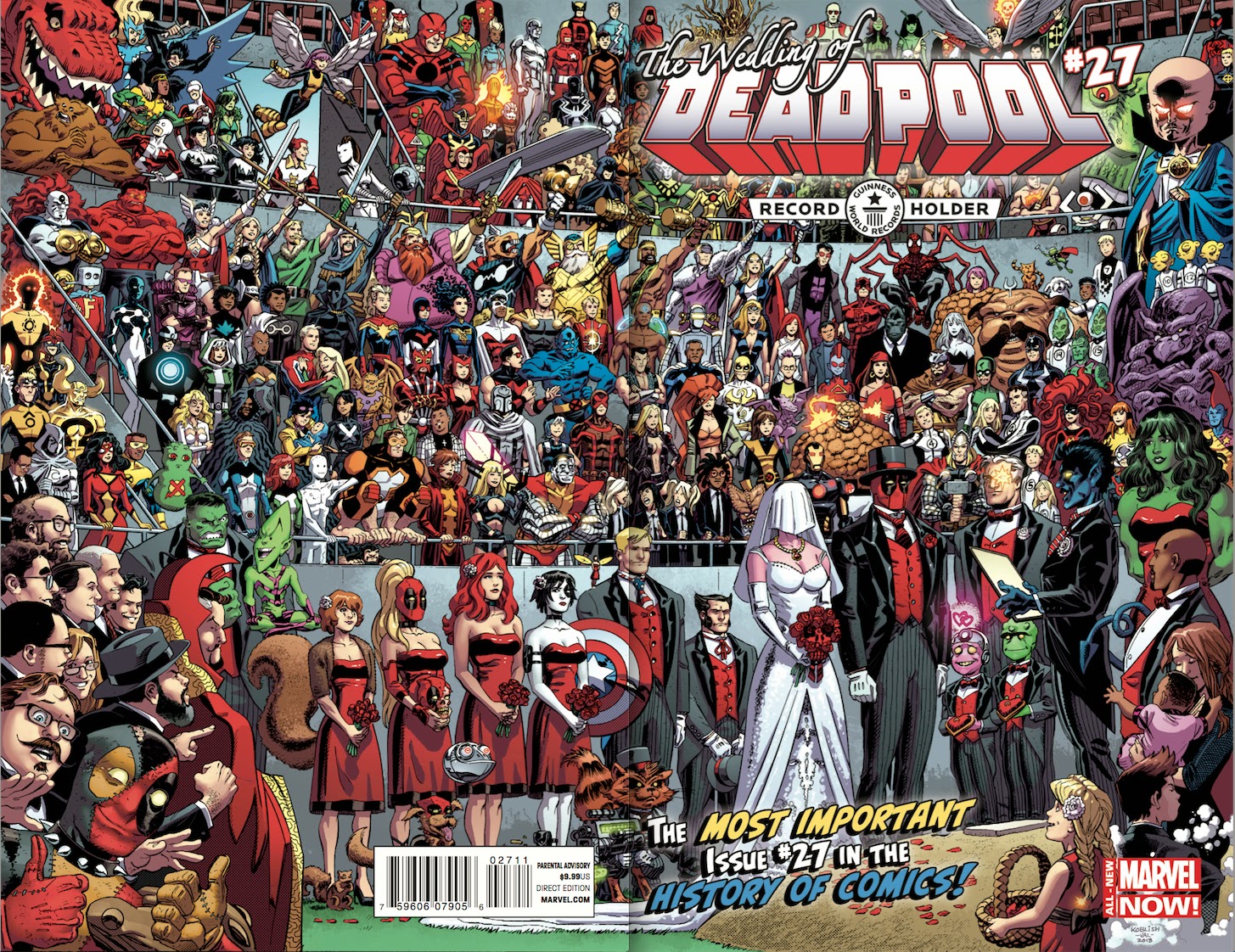
There are seven trades of this volume of Deadpool currently available: Dead Presidents, Soul Hunter, The Good, the Bad, and the Ugly, Deadpool V.s S.H.I.E.L.D., The Wedding of Deadpool, Original Sin, and Axis. The final volume, All Good Things... will be released in May. Hardcovers collecting two volumes each, are also being released, with two out now and at least a third on the horizon. You might also want to check out Deadpool: Dracula's Gauntlet (collecting the story of how Deadpool met his wife), The One with All the Deadpools (collecting the various annuals and one-shots related to this volume), and Hawkeye Vs. Deadpool (the title says it all, written by co-writer Gerry Duggan), all available in collection.


Thursday, April 9, 2015

Fit to Be Tied In: A History of Marvel Crossovers and Events Part 2- Mutant Massacre to Muir Island Saga- The Crossovers of Chris Claremont

These days, a month that goes by without more than a dozen X-books weaving stories into each other is an anomaly. But 30 years ago, in that strange time known as the 1980s, such a thing was a novel idea.

Back then, Chris Claremont was in charge of nearly all the mutants and two ongoing series: Uncanny X-Men and the New Mutants. The original five X-Men, however – Cyclops, Marvel Girl, Beast, Iceman and Angel – were under the purview of Louise Simonson in the earliest incarnation of X-Factor.


What brought these three teams (and also Thor and Power Pack) back together in 1986? Genocide. A new group called the Marauders was slaughtering the Morlocks, a community of mutants that lived in the sewers below New York. The Mutant Massacre was one of Claremont’s darkest, most violent stories to date, and had some of the most lasting effects on the X-books. Angel’s wings were broken and later amputated, leading him to become Apocalypse’s Horseman Death. Nightcrawler and Shadowcat were injured and left the team to recuperate on Muir Island, which led to them co-founding a new team, Excalibur. In their place would come Psylocke and, later, Dazzler and Longshot. Sabretooth – a Claremont creation ported over from his run on Iron Fist – would stake a claim as a major X-villain and specifically an arch-nemesis of Wolverine. The Marauders’ employer would later be revealed as Mr. Sinister, the mad geneticist obsessed with the Summers bloodline. The Massacre would also later be tied in to the backstory of Gambit, who would not appear in the comics for another four years.

Next, in 1988, came Fall of the Mutants, which wasn’t so much a crossover as a label that appeared on the three main X-books but was considered a major event nonetheless, not the least so because the X-Men died … for about a minute.


The X-Men and Madelyne Pryor sacrificed themselves fighting the Adversary, a Native American demon god linked to Forge, during a battle in Dallas. Upon vanquishing their foe, Roma, the daughter of Merlin, resurrected them, made them invisible to technology (a plot thread that, near as I can tell, just sort of disappeared) and gave them access to the Siege Perilous, a one-time transporter that, once a person passes through it, basically gives them a new life somewhere else with no memories of their previous one until such time as a writer finds that inconvenient. Meanwhile, in X-Factor, the team fights Death, aka Archangel, and breaks him of Apocalypse’s control, and in New Mutants, Doug Ramsey, aka Cypher, is shot and killed by The Right, an anti-mutant group led by Cameron Hodge, whose name will pop up a few more times in this post.


The following year brought an Inferno to the streets of New York in a convoluted plot involving, in no particular order, the demons of Limbo, inanimate objects coming to life, Pryor becoming the underboob-exposing Goblin Queen, Colossus’ sister Illyana being reverted from a magic-wielding sorceress back to a child, Hodge making a deal with demons for immortality, a number of babies – including the baby that would grow up to be Cable – being stolen to complete a spell, Pryor being revealed as a clone of Jean Grey created by Mr. Sinister, the Spider-Man villain Hobgoblin becoming a demon, another demon getting infected with Warlock’s Transmode Virus, the X-Men and X-Factor fighting each other, and the X-Mansion being destroyed again. Inferno cast a wide net, stretching from the X-books to Spider-Man and Daredevil to, quite sensibly, Damage Control, the Marvel Universe’s post-event cleanup crew. And Power Pack. Those kids got a lot of hangtime in the ’80s.


Hodge surfaces again in 1990 as a creepy spider-robot with a human face pulling the strings on the mutant-enslaving island of Genosha in The X-Tinction Agenda. By this point, Jim Lee was drawing Uncanny X-Men and Rob Liefeld had come aboard New Mutants, so we’re starting to see some of the deck-clearing exercises that will pave the way for X-Men #1 and X-Force #1 a few months down the line. Some of the X-Men who went through the Siege Perilous are reunited. Cable has taken over the New Mutants. Storm is restored from her de-aged self back to an adult weather goddess, and she introduces everyone to the creepy Cajun friend she made while evading the Shadow King. Havok is revealed to have been working as a Genoshan magistrate. Wolfsbane of the New Mutants is turned into a Genoshan mutate, or slave. Warlock is killed. A bunch of people see former British woman Psylocke as an Asian ninja for the first time. And the Genoshan government is toppled – literally; Rictor destroys their Citadel.


The Claremont age ends in summer 1991 with a mini-crossover called the Muir Island Saga that straddles Uncanny X-Men and X-Factor. The Saga served a few goals: It wrapped up a long-running (there’s no other kind with Claremont) arc involving the Shadow King; it re-crippled Xavier; it reunited the X-Men with their original members to form an all-killer, no-filler superteam that would need two books to hold them; and it transitioned X-Factor from a book about the original five X-Men to a book about a government-sponsored mutant team written by Peter David. If you have any affection for Jamie Madrox, Strong Guy or Polaris, it starts in X-Factor #70.

Next week, Matt takes us into space for some cosmic crossovers, so bring your favorite Infinity Gem and prepare to get Annihilated.


Dan Grote’s new novel, Magic Pier, is available however you get your books online. He has been writing for The Matt Signal since 2014. He and Matt have been friends since the days when making it to issue 25 guaranteed you a foil cover.


Tuesday, April 7, 2015

Fit to Be Tied In: A History of Marvel Crossovers and Events - Part 1: Secret Wars and Annual Events

Welcome to the first of a multipart series breaking down the history of Marvel’s many crossovers, from 1984’s Secret Wars to 2015’s Secret Wars. For the next few weeks, we’ll take a look at the highs and the lows of the company’s biggest events, the stories that had you saying everything from “Oh man, the Watcher just showed up; this must be important” to “I don’t care who’s in it, I’m not buying this Moon Knight Infinity Crusade tie-in issue.”


The original Marvel crossover event series, 1984’s 12-issue Marvel Super Heroes Secret Wars, came about because Marvel needed a toy line. Then Editor-in-Chief Jim Shooter has been on record as saying Mattel wanted to produce a toy line for Marvel, but only if Marvel could tie it to a publishing event. Also, focus-grouped children really like the words “secret” and “wars.” So Shooter and artists Mike Zeck and Bob Layton crafted a story that was the rough equivalent of what happens when my 3-year-old pulls out his Imaginext figures: All the good guys and all the bad guys fight each other.

The wars start after an entity called the Beyonder pulls a whole bunch of good guys and bad guys to a place called Battleworld and makes them fight. Among the heroes are Monica Rambeau, Storm, Captain America, Mr. Fantastic, the Wasp, the Hulk, Cyclops, Professor X, Wolverine, Thor, the Thing, Iron Man, Rogue, Spider-Man, a not-yet-converted Magneto, She-Hulk, Hawkeye, Colossus, Nightcrawler and the Human Torch. Repping the bad guys were Galactus, the Enchantress, Ultron, the Absorbing Man, the Wrecking Crew, the Lizard, Dr. Octopus, Dr. Doom, Kang and Molecule Man.

Amid all the fighting, a few significant things happen. Spider-Man gets a new black costume you may be familiar with. Colossus falls in love with an alien and subsequently breaks the heart of Kitty Pryde, who was too young for him anyway. The Thing decides to hang out in space for a while, and She-Hulk takes his place on the Fantastic Four. Subsequently, Alicia Masters starts dating the Human Torch, but it’s later revealed “Alicia” was really a Skrull named Lyja.


A sequel the following year by Shooter and Al Milgrom saw the Beyonder come to Earth, tick off Mephisto, work as a mob enforcer and hit on totally ’80s mutants Dazzler and Boom-Boom.

The next companywide crossovers would take place in Marvel’s annuals – double-sized, multistory issues that come out once a year with their own numbering sequence. In 1988 and 1989, the annuals told one sweeping story across a vast number of books. The following three years, they were broken down into groups of three to five.


Marvel’s 1988 crossover was called “The Evolutionary War.” The main baddie of the war was the High Evolutionary, a guy in a pink metal suit who lives on a mountain and likes to experiment on people in the name of evolution. As evolution-based Marvel villains go, the High Evolutionary ranks pretty low on the list, certainly below the big guy in the blue armor who’s obsessed with survival of the fittest and the albino with the red diamond on his forehead and the fringed cape who commands an army of cloned Marauders.

Speaking of Apocalypse, "The Evolutionary War" actually begins in X-Factor with the High Evolutionary arguing philosophies and fighting with En Sabah Nur. It goes on to include the Punisher, Silver Surfer, New Mutants, Fantastic Four, Amazing Spider-Man, Uncanny X-Men, Web of Spider-Man, West Coast Avengers, Spectacular Spider-Man, Avengers, and, finally, the 1980s sitcom alien, Alf. Guys, Alf met the High Evolutionary. Not only that, his Highness tried to tie the explosion of Alf’s home planet, Melmac, to the Phoenix Force.


Marvel tried a second companywide annual crossover in 1989 with “Atlantis Attacks,” a story about a ridiculous plot to revive an ancient serpent god that at some point involves the underwater kingdom of Atlantis. “Attacks” upped the ante from the Evolutionary War, consisting of 14 books to the previous story’s 11 (not including Alf). Books involved include Silver Surfer, Iron Man, Uncanny X-Men, Amazing Spider-Man, Punisher, Spectacular Spider-Man, Daredevil, Avengers, New Mutants, X-Factor, Web of Spider-Man, West Coast Avengers, Thor, and Fantastic Four.

1990’s annuals were broken up by family. “Days of Future Present” crossed over Uncanny X-Men, X-Factor, New Mutants, and Fantastic Four. “Lifeform” crossed over the Punisher, Daredevil, Incredible Hulk, and Silver Surfer. “Spidey’s Totally Tiny Adventure” traversed the three Spider-Man books. And “The Terminus Factor” crossed over Captain America, Iron Man, Thor, Avengers, and West Coast Avengers.

1991 gave us “The Von Strucker Gambit” (Captain America, Daredevil, Punisher), “The Korvac Quest” (Fantastic Four, Thor, Silver Surfer, Guardians of the Galaxy), “Kings of Pain” (New Mutants, New Warriors, Uncanny X-Men, X-Factor), “The Vibranium Vendetta” (the Spidey titles) and “Subterranean Wars” (Avengers, Hulk, Namor, Iron Man, West Coast Avengers).


Finally, 1992 saw “Shattershot” (Uncanny X-Men, X-Men, X-Factor, X-Force), “Return of the Defenders” (Hulk, Silver Surfer, Namor, Dr. Strange), “The System Bytes” (Punisher, Daredevil, Wonder Man, Guardians of the Galaxy), “Assault on Armor City” (Iron Man, Darkhawk, West Coast Avengers), “The Hero Killers” (the Spideys and New Warriors), and “Citizen Kang” (Captain America, Avengers, Thor, Fantastic Four).


In Part 2, we’ll tackle the X-crossovers of the 1980s and early 1990s, from the "Mutant Massacre" to "The Muir Island Saga." Expect the X-books to take up an outsize portion of this series.


Dan Grote’s new novel, Magic Pier, is available however you get your books online. He has been writing for The Matt Signal since 2014. He and Matt have been friends since the days when making it to issue 25 guaranteed you a foil cover.

Monday, April 6, 2015

Reviews of Comics from Wednesday 4/1


Gotham Academy: Endgame #1
Story: Becky Cloonand & Brenden Fletcher
Art: Jeff Stokely, Clio Chiang, Joy Ang, Vera Brosgol

I firmly believe that scary stories are best told out loud, to a group of people, and in the dark. The communal scare is a binding experience. So, as the Joker's rampage continues through Gotham, the students of Gotham Academy, including series protagonists Olive, Maps, and Pomeline, are sealed up in the school gym in tents to avoid the chaos and share a series of Joker themed tales of terror. Olive tells the tale of a stolen Laughing Mask that haunts the boy who stole it. Professor MacPherson, who teaches history, tells a particularly macabre and gory tale from her native Scotland about the Wandering Jester, who if you don't laugh with him, you become a part of his act straight out the worst of EC Comics. And Olive shares a story told by her mother about Gotham's own version of Bloody Mary, the Smiling Man (a nod to Snyder's conceit in the main Batman title that the Joker is in fact an immortal who has been haunting Gotham for centuries, I believe). Each of these tales of terror is drawn by a different artist, giving them a unique look that still fits nicely with the style of the monthly comic. It's also interesting to see how jaded Maps is, how she brushes off the presence of the Joker as someone who interrupted her cartoons a couple times a year and then as stopped by Batman. When you look at how the adults and the superheroes are all affected by the Joker in all the other tie-ins, this reaction is fascinating: when you grow up with something like the Joker making the world as terrible as it can be, you just get used to it. There's also the mention of another of Gotham Academy's legends, The Custodian, who defends the campus from all threats external to the school, and as some of the people infected by Joker Venom begin to raid the school, a man dressed in antique garb with swords begins to fight them off. And where exactly is Headmaster Hammer in all this? If you've been picking up "Endgame" and not Gotham Academy, or vice versa, this is a great way to get a taste of the other series. And if you haven't read either, and just like a good spooky story, then pick it up.


Graveyard Shift #4
Story: Jay Faerber
Art: Fran Bueno

Jay Faerber and Fran Bueno's tale of vampiric terror, Graveyard Shift, comes to an action packed conclusion in this exciting fourth issue. Having identified where the vampires who turned Hope have been working out of, Liam and his vampire fiancee head to confront them. But Cromeyer, the master vampire, is prepared, and Hope is brought to his photography studio while Liam is brought down into his dungeon. We follow our two leads as they fight very different threats. Faerber sticks to all the classic vampire rules, so Liam come prepared with an arsenal that the cocky vampires don't even search him for, while Crommeyer attempts to lure Hope over to the dark side (Yes, a bad pun, but I stick by it). This was a really well structured series, starting out with an exciting, action filled first issue, then slowly building the world over the next couple issues to set up this final confrontation. It really gave Fran Bueno a chance to shine, showing some great fight scenes, and some really monstrous vampire faces.  When the dust settles, Liam and Hope set off for future adventures to try to find a cure for Hope's vampirism. Yes, that gives away some of how the series ends, but this is a classic monster movie: good is going to defeat evil. And if you are even the slightest fan of vampire movies and tv, you are going to get the biggest smile when you see the last page; I'm not going to give that away. Graveyard Shift was a great horror story in a model that isn't often used anymore: the monsters were villains and the good guys were good guys. If you like The Lost Boys, Near Dark, or The Monster Squad, you can't go wrong with Graveyard Shift.


Guardians of the Galaxy: Best Story Ever
Story: Tim Seeley
Art: Reilly Brown, Iban Coelle, Jacopo Camagini

There are a lot of fans who don't like one shots because, unless they're part of major stories they, "don't matter." And fans of that particular mindset probably skipped this one-shot, and if they did, they missed a very fun comic. Star-Lord and Rocket are in prison, and in a cell together begin telling the story of one of the Guardians escapades; with Thanos on trial for his crimes before a gathering of cosmic entities, like Eternity, Infinity, and the Loving Trilobite ("Living Tribunal! Don't they teach you anything on Earth?"), Nebula is going to help free him, and the Guardians stand in their way. While the guards are distracted, the remaining Guardians are sneaking into the facility for reasons unknown. The bickering Rocket and Star-Lord sequence is a lot of fun, as writer Tim Seeley does a good job of capturing both of their voices. It's also cool to see Nebula backed up by the Graces, a group of female warriors introduced in the run up to the original Annihilation crossover brought together and trained by Gamora in one of her darker times, of which Nebula was a member. This is one of those plot threads I always hoped would be picked up somewhere, and I'm happy to see them used again. Rocket and Star-Lord wrap up their story as the caper works out and the Guardians make their escape, but we then get a different version of the ending, one that is a bit more thoughtful, and continues to draw the relationship between Gamora and Nebula a bit closer to the movie continuity without feeling forced. There's the final reveal of the McGuffin that the Guardians were trying to steal, which is just singularly ridiculous and perfect for the "Guardians as rag tag band" concept that has been their recent shtick. If you enjoyed last summer's Guardians of the Galaxy movie, this is a great issue to give you a better idea of their comic book status quo.


Kanan: The Last Padawan #1
Story: Greg Weisman
Art: Pepe Larraz

While I haven't disliked Marvel's new Star Wars line, I've grown less and less wowed by it. It's not that it's bad, it's just that it doesn't feel like anything new; after twenty plus years of stories set in that period between Episodes IV and V, there's not much new to be mined. But the debut of the first Marvel series set in another time period has rekindled my hope. Kanan: The Last Padawan tells the backstory of Kanan Jarrus, the lead of Disney's well received Star Wars: Rebels cartoon. Set as the Clone Wars are coming to an end, we see Caleb Dume, Kanan's  real name that he abandoned to go on the run from the Empire, and his master, Depa Billaba, leading their clone battalion to retake the world of Kaller from the Separatist Droid Army of General Kleeve. After victory is assured, the Republic forces find themselves less than welcome by the natives, with Kalleran leader Gamut Key downright rude to Master Billaba, something she takes far better than her Padawan. Moving out of the city, we get a thoughtful discussion of how young Caleb is adjusting to being a Padawan instead of just a youngling at the Jedi Temple, how he fits in with clones, like Commander Grey and Captain Styles, and the Jedi's role in the war, something Billaba sees as heading in the wrong direction for the order. We also see more of Caleb as the inquisitive student, an impression first hinted at in the novel A New Dawn, another recent Star Wars tale that shone a light on another aspect of Kannan's backstory. The issue ends on a dark note, as writer Greg Weisman doesn't drag out the suspense leading up to what all Star Wars fans know is coming: Styles receives the transmission from the newly christened Emperor to execute Order 66, meaning next issue will begin Caleb's flight for his life and heading towards becoming Kanan. Greg Weisman, showrunner of the first season of Star Wars: Rebels and creator of one of the greatest modern animated series (Gargoyles) and showrunner of the one of the best superhero cartoons ever (Young Justice), does his usual deft work of establishing character and setting, and gives old fans of the Star Wars Expanded Universe hope that not everything has been forgotten; his reference to Master Billaba being known to be unstable is a clear reference to her fall to the dark side in the novel Shatterpoint. That bit of knowledge, or any foreknowledge of Rebels, is completely unnecessary, though, to enjoy a Star Wars comic that stands up well with many of the Dark Horse tales of the Clone Wars.


Southern Bastards #8
Story: Jason Aaron
Art: Jason Latour

The second arc of Jason Aaron and Jason Latour's southern Gothic, "Gridiron," wraps up the origin of the series antagonist Coash Euless Boss. After the first arc introduced and quickly killed off the character most readers assumed was going to be the series lead, it was an interesting choice to spend the second arc digging deep into the history of the man who killed that character. Aaron's work on Scalped showed that he was fascinated in making all his characters as three dimensional as he can, and so giving us an understanding of who Coach Boss is makes perfect sense. This issue we see the final confrontation between Euless and his abusive father, a confrontation that ends with Euless proving just what he'll do to be involved with football. He gives a speech about why the game matters, why he loves it, and what he loves about it; it's not the winning, it's the beating of the other team, the moment when they're so beaten he can see in their eyes they just want to quit. It's a cold speech, the kind that sends a little chill down your spine. And we see what Boss does to become the young coach, the deal he makes with local mobster Mozel, and how he tells Big, his mentor, that all this is "worth the blood" to be able to be on the field, to be able to do the only thing he's good at in the world. But it's apparent that Big has his misgivings, and the issue ends back at the present where it seems that the events of the first arc and the death of Earl Tubbs, has been the final straw that Big can no longer take. The final pages set up the next arc, as there's another Tubbs headed to Craw County, and there's a storm on the horizon. We might understand Coach Boss, but for me, I sure as hell don't like him, and I hope that storm hits him hard.


And Dan Grote visits Black Bolt in the zero issue of the new title in Marvel's new hoped for franchise...


Uncanny Inhumans #0
Story: Charles Soule
Art: Steve McNiven, Jay Leisten and Justin Ponsor

Uncanny is a loaded word to tack on as the title adjective of the new Inhumans series. It plays into reader concerns about the caste-obsessed subrace supplanting mutants because of movie-rights issues.

But the Uncanny in Uncanny Inhumans doesn’t seem to be so much a shot at Uncanny X-Men as it is an homage to Rick Remender’s first volume of Uncanny Avengers, specifically the subplot about Kang the Conquerer raising the progeny of superheroes.

In Uncanny Avengers, Kang stole the X-Man Archangel’s twin children from a Red Skull concentration camp and raised them to get mutants out of his way so he could rule time properly. In Uncanny Inhumans, Black Bolt – deposed ruler of the Inhumans – asks Kang to send his son, Ahura, into the timestream to save him from the end of the world, aka this summer’s Secret Wars.

The book presents itself as a Black Bolt solo title. We follow him from the streets of Rio de Janeiro, thwarting a crew of poachers hunting terrigenesis cocoons; to New Attilan, where his estranged wife, Medusa, scolds him for past grievances before sending him through a portal; to 1908 Siberia, where Kang is hiding out with Ahura.

The opening of the Siberia sequence is some of Steve McNiven’s best artwork in this issue, as Black Bolt storms Kang’s castle, which is guarded by an army of time-plucked knights and soldiers. When Black Bolt’s done playing games, he whispers “Goodbye” and blows a hole in the wall.

The one real downside to this book is it’s a little heavy on exposition. The poachers explain to each other who Black Bolt is. Medusa recounts recent events. Kang explains to Black Bolt that he is a time traveler as if that were not already evident. And Ahura, moody teen that he is, feels compelled to keep explaining that Black Bolt’s full name is Blackagar Boltagon, one of the more patently ridiculous firsts and lasts in the Marvel Universe.

But first issues have a lot to set up. Writer Charles Soule has built up a lot of good will having written the most recent She-Hulk series, one of this blog’s more beloved titles of the past year, so let’s see where he and McNiven take Marvel’s royal family.

Friday, April 3, 2015

An Annual Event: A History of Crossover Events in DC Comics Part 3

Welcome back to our final installment of the history of events in DC Comics. This final installment talks about the crossovers and theme years of the Annuals, the oversized comics that were published, obviously, once a year. Originally, this was done to get around certain publishing and postal regulations about magazines, but over the years, as these rules were relaxed and books could come out more than once a month, the annual faded from prominence. Annuals used to be a big deal, especially over at Marvel. Many landmarks happened in those massive Stan Lee-era annuals. The Sinister Six made it's first appearance in Amazing Spider-Man Annual #1, and Reed and Sue got married in Fantastic Four Annual #3 While I can't recall any such huge events in DC Comics annuals, you still got Alan Moore writing Batman in Batman Annual #11 and Superman in Superman Annual #11, so there are some pretty great stories in those earlier annuals.

But in 1991, DC tried to get some extra buzz going on their annuals. Marvel had been doing company crossovers in their annuals for a few years, and so DC decided to give it a try with...


Armageddon 2001, bookends (issues at the beginning and end of the series, with the crossovers doing the heavy lifting in the middle) written by Archie Goodwin and with art by Dan Jurgens, was a classic sci-fi dystopia story. In the year 2030 the world is ruled by Monarch, an armor clad conqueror who is said to once have been a great superhero who turned on his own, and wiped them all out in the year 2001. Matthew Ryder, a scientist in that time, travels back in time to find out who Monarch was and to stop him from becoming the despot. Transformed into a being of pure time energy called Waverider, he arrives in 1991 and goes about encountering as many heroes as he can, and by touching them, he sees their possible futures.

This is a really fun conceit, as it allows for all these stories of the heroes in the future, What If? or Elseworlds type stories, but they have a little more resonance because they are presented as actual possible futures. Of course, Waverider learns the classic time travel trope that if you interact with the past it can change things, so he has to touch some (more popular) heroes multiple times to see if he's actually created Monarch. The ending of the crossover is legendary, as the original ending, that Captain Atom was Monarch, was leaked, and so a quick change was made to make the much less logical ending that Hawk of Hawk & Dove was in fact Monarch. A great event was somewhat spoiled by this quick change, but it's still my favorite full scale annual crossover.

Some of the annuals are really solid stories. Superman Annual #3 is one of the early examples in the Modern Age of a trope that's gotten stale now, where Superman is corrupted and has to be stopped. Since it's 1991, it's one of the first comics to riff on the classic conclusion of Dark Knight Returns, inverting the final battle between Superman and Batman. Justice League America Annual #5 steps back from the darkness of the Breakdown story happening at the time to tell a series of very funny vignettes. New Titans Annual #7 introduced a team of Titans from the future who came back in time later to form the Team Titans, which must have seemed like a good idea at the time. And Flash Annual #5 tells the story of Wally West coming out of retirement and witness protection to save his son from old enemies in a story written by a fresh young writer named Mark Waid a year before his legendary run on The Flash would begin.


The 1992 annual event was Eclipso: The Darkness Within, bookends written by Robert Loren Fleming and Keith Giffen with art from Bart Sears. This story took Eclipso, a C-List villain from 60s villain who was the Hyde to solar scientist Bruce Gordon's Jekyll, and made him a world beater by revealing he's not just Gordon's dark side, but is in fact an ancient vengeance god who has been trapped on the dark side of the moon in a castle for centuries, and is now making a play for his freedom. To do this, the black diamonds that hold Eclipso's earthly essence begin to posses and control super beings so Eclipso can gather an army.

This series gives a lot of classic hero on hero action, as various heroes and their allies become possessed by black diamonds. The black diamonds in some cases don't possess characters but create monsters made of the anger of the holder. So if you ever wanted to watch Jim Gordon vomit up a smoke monster to go kill the Joker, you can check out Detective Comics Annual #5. I'm being glib, but it's actually a solid event, and Eclipso is made into a really solid threat.

There was also some very distinct fallout from this series. Eclipso remains a major part of the DC Universe to today, having an ongoing that spun out of this series that had some ripples. That series brought Amanda Waller back from limbo, was an early example of a DC trend where a squad of B- and C-list heroes raided Eclipso's fortress and were mercilessly wiped out, and had a great two part story in issues seven and eight where Eclipso fought Sherlock Holmes in Victorian London. He showed up after that series in John Ostarnder's The Spectre, Geoff Johns's run on JSA, and James Robinson's run on Justice League of America. He has appeared in a few places in the New 52 as well. The series also seemingly killed off Will Payton, the sixth Starman, setting the stage for Jack Knight to take the name, and making the quest for what really happened to Payton a key point on James Robinson's seminal Starman.


Bloodlines was... well, not either of these previous two events. Large, spinal fluid sucking aliens arrive on Earth and begun feeding on the populace. If you happen to survive the encounter, you get superpowers. Seemingly random powers; it's not a consistent set. This was an attempt to create a batch of popular new characters. It did not succeed in that. Instead of having bookends like the previous two events, Bloodlines culminated in a two issue mini-series called Bloodbath, written by Dan Raspler with art by Chuck Wotjkiewicz and Sal Velutto, where these New Blood heroes joined the other DC heroes to stop the parasites.

Of the 27 annuals, six individual titles were spun off, as well as a team called Blood Pack. Most of these were mini-series, and of the three ongoings, two ended pretty quickly. The only real breakout success was Hitman, the irreverent story of Tommy Monaghan,written by Garth Ennis and drawn by John McCrea, who debuted in Demon Annual #2, and whose series ran 60 issues plus an annual and some specials. Some of these characters, like Flash Annual #6 debut Argus, were pretty decent characters, but it seemed they couldn't escape the Bloodlines stigma. One favorite Bloodlines moment is in Hitman #1,000,000, a tie-in to DC One Million, where Tommy is pulled into the far future by hero fanboys, where he confronts Gunfire 1,000,000, the long distant inheritor of the title of a New Blood hero who could turn anything he touched into an energy or explosive weapon, who Tommy shoots and embarrasses, and who dies from inadvertently turning first his medpack into an explosive, and then, well, let's say his last words are, "Oh my God, I turned my ass into a hand-grenade--" Garth Ennis, everybody.


After Bloodlines less than stellar success, DC changed it's tactic. Instead of going with full on crossovers, it's annuals started having themes. The first years of themed annuals were all Elseworlds tales, where the heroes of the books were put in unusual settings and time periods. As with a lot of Elseworlds stories, these were hit and miss, but there were some highlights. Detective Comics Annual #7, from Chuck Dixon and Enrique Alcatena, told of Leatherwing, Batman as a privateer fighting a pirate version of Joker. This was actually a world adapted by Grant Morrison as part of the 52 Earths in Multiversity. Karl Kesel told a two part stories of the DC heroes in a dystopian future in Adventures of Superman Annual #6 and Superboy Annual #1. And the modern Batman learns he had a predecessor in Renaissance Italy in a story involving Leonardo da Vinci in Batman Annual #18.

Skipping a bit ahead, 1997 annuals were also Elseworlds themed, this time specifically called "Legends of the Dead Earth" which all take place in the far distant future where the heroes are legends in the same way the Greek heroes are to us, and we see some very interesting variants on classic themes and heroes, some very magical, some very sci-fi. The one that sticks out in my head is Aquaman Annual #2, where Peter David tells the story of two men meeting and sharing their conflicting versions of the history of Aquaman, only to reveal they both believe themselves to be his direct descendant and begin fighting, thus continuing the brother versus brother theme that pervaded David's entire Aquaman run from Atlantis Chronicles onward.


The year in between the two Elseworlds themes was for "Year One" annuals. This was a somewhat perplexing choice, as some heroes had long established early years (like Superman in John Byrne's Man of Steel, Batman in Batman: Year One, and Flash in Mark Waid's first arc on Flash called "Born to Run"), while many others had origins retold less than two years earlier in the zero issues that followed Zero Hour. But what this allowed was for the creators to get, well, creative. Mark Waid spent time in his annual focusing not on Wally West's first year as a hero, but his first year as the Flash after Barry Allen's death. Each Batman annual focused on the first year of a particular villain. The Superman annuals focused on various firsts for Superman, like his first trip into space and his first confrontation with magic.

But some annuals stretch farther to make for substantive changes. Since we watched Jean-Paul Valley become Azrael, Azrael Annual #1 focused on Jean-Paul's father, the previous Azrael, and fleshed out a character who only appeared on a few pages before this. The Superboy Annual revealed that Paul Westfield, the evil director of Project Cadmus, was in fact the human half of Superboy's DNA (later retconned by Geoff Johns to be Lex Luthor. Superboy probably should have been happier when he thought it was Westfield). And New Titans Annual #11 tried to clear up some of the time travel hi-jinks left over from Zero Hour concerning team members Terra and Mirage.


DC's final year of full Annual themes was Pulp Heores in 1998. Each of these annuals had a painted cover reminiscent of classic pulps and with pulp-like titles running down the left side of the cover (many drawn from old DC anthology titles), and a theme that went with that painted cover and title. Thus you got lots of adventure, detective, and western themed stories. Again, while most of these are not major continuity intense stories, they were a ton of fun. Hitman Annual #1 was "Weird Western Tales" and had a classic standoff tales with Tommy and his allies against a gang. Aquaman Annual #3 was "Suspence Detective" and has a Peter David story narrated like an old detective pulp, and has a very funny riff on Aquaman's old power limitation that he would die if he was out of the water for more than exactly one hour. Starman Annual #2, pictured above, was slightly different, as Jack Knight learns about the past love affairs of his friends and family as he has problems with his girlfriend, Sadie, and ends with a major revelation that would change the direction of the series.

The next three years had much smaller annual events. "Ghosts" and "JLApe" both only involved annuals for the big seven Justice Leaguers and the annual for JLA. The former featured the Justice League haunted by the spirits of people whose deaths they felt responsible for, so kind of a downer. The latter, though, featured the League fighting, and getting turned into, apes in a plot by Gorilla Grodd, so that was monumentally fun. The following year, 2000, was a series of Annuals called "Planet DC" that again tried to introduce new heroes, this time all from different nations. Most never appeared again.


Our final stop on this whirlwind tour is a bit more of a stretch. In 2001, DC started an event called Our Worlds at War, where a being called Imperiex was on his way to destroy Earth, and if he did so, it would bring about the end of all reality in a massive wave off entropy. The core of the series ran through the four Superman titles over the course of three months, with various other titles, including Batman and Young Justice, tying in. As there was no core mini-series, I left this out of the rundown of previous events, but thinking about it, I realized something. Many of the crossovers were oversized one-shots released over the course of those three summer months showing how the war effected other heroes. And that made me realize that those one-shots took the place of annuals that year, so I figured I'd include Our Worlds at War here.

Our Worlds at War was frankly kind of a mess. Imperiex's power set was nebulous, but so powerful that Darkseid actually teamed up with the heroes of Earth. Superman, the title that the series spun out of and was one of the core books of the event, had a narrative device where speeches by American presidents served as narration throughout, and cluttered up the pages on gorgeous Ed McGuiness art. And nearly all the character deaths and fallout, and there was quite a bit, was reversed almost immediately. While there was some very cool art and great space battles, this remains one of the more forgettable and somber events comics from DC.

In recent years, DC went back to publishing annuals, but kept them more tied to their parent titles, letting them wrap up big storylines or providing background to tie into the events of the ongoing. Thus the annual event and theme faded into the past, left for people like me to comment on in posts like this.

And that's it for our survey of event comics and the history of DC Comics. I hope you enjoyed it. But I hear some of you saying, "What about Marvel? Secret Wars is coming up and there have been plenty of Marvel events that are tying into that." Well to paraphrase someone intimately related to Marvel Comics, have no fear Matt Signal faithful! Next week, Dan Grote will begin a series of articles directly addressing Marvel crossovers (with me stepping in for one on the cosmic corner of the MU). So stay tuned for more.

Wednesday, April 1, 2015

Tour de Deadpool: 10 Deadpool Supporting Cast Members You Should Care About

With the recent announcements of T.J. Miller playing Weasel and Morena Baccarin playing Copycat in the upcoming Deadpool movie, Wade Wilson’s supporting castmates through the years are starting to get some overdue time in the spotlight.

To prep yourself for next year’s film, here’s a little 101 on those who dare get close to Marvel’s Merc-with-a-Mouth:


Copycat:

Created by: Rob Liefeld and Fabian Nicieza

1st appearance: New Mutants #98, 1991, (masquerading as Domino), X-Force #19, 1993 (as herself)

Her thing: Vanessa Carlysle was a Boston prostitute who dated Wade Wilson before the cancer and the Weapon X program. Eventually, the shapeshifting mutant came into the employ of Tolliver, aka Tyler Dayspring, Cable’s son from the future. As part of that employment, she disguised herself as Domino during the period when Cable founded X-Force, while the real Domino was held prisoner. In addition to dating Deadpool, she also dated Garrison Kane, a member of the mercenary team Six-Pack.


Weasel:

Created by: Fabian Nicieza and Joe Madureira

1st appearance: Deadpool: The Circle Chase #1, 1993

His thing: Weasel is Wade’s weapons and tech guy, information broker and friend, when the price is right. He also has no problem selling Deadpool out to a higher bidder, such as when he took a job with Taskmaster in issue #2 of Joe Kelly’s run. According to issue #11 of that same run, Weasel went to the same school as Peter Parker, as a student named Jack Hammer. Later, in Daniel Way’s run, Weasel gets a suit of armor and works as a Las Vegas enforcer named The House.


Blind Al:

Created by: Joe Kelly and Ed McGuinness

1st appearance: Deadpool #1, 1997

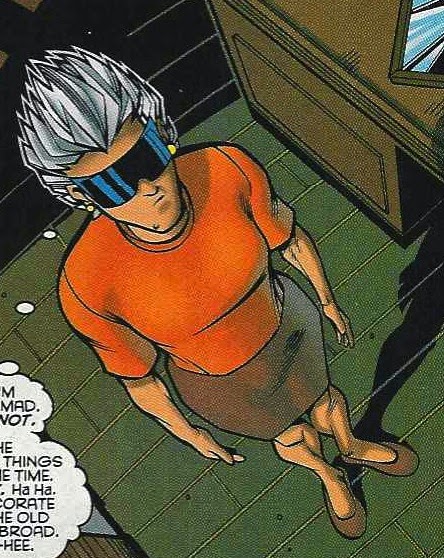
Her thing: Blind Al was Deadpool’s prisoner/roommate in San Francisco. Apparently Wade was supposed to kill her during a pre-DP mission in Zaire, but he didn’t. She looks like Aunt May with blue-blocker sunglasses and spiky hair, and in fact impersonates May in the aforementioned Deadpool #11 adventure. The two would prank and insult each other, and at times, Deadpool would put her in The Box, a dark torture chamber in Wade’s house. He eventually frees her.


T-Ray:

Created by: Joe Kelly and Ed McGuinness

1st appearance: Deadpool #1, 1997

His thing: T-Ray hates Deadpool. He’s a mercenary, like Wade, and his powers involve magic. He wears a bandage across his nose and looks like a character from a later iteration of Street Fighter. Oh, and he says his name is Wade Wilson and Deadpool stole his identity and killed his wife. So yeah, T-Ray’s a little bit of a continuity nightmare. But he looks cool.


Taskmaster:

Created by: George Perez and David Michelinie

1st appearance: Avengers #195, 1980

His thing: Tony Masters uses a photographic memory to replicate the moves of anyone he fights. As such, he wields a sword like the Black Knight, shoots arrows like Hawkeye and wields a shield like Captain America. Though he spent more than 15 years as a third-tier Avengers baddie, he found his calling as a regular frenemy of Deadpool, starting with trying to lure away Weasel. Over time, Wade and Tasky would work as members of a new Frightful Four, fight for the love of Sandi Brandenburg and just plain fight.


Sandi Brandenburg:

Created by: Udon Studios, Ken Siu-Chong and Alvin Lee

1st appearance: Taskmaster #1, 2002

Her thing: Sondra “Sandi” Brandenburg was a dancer-turned-office manager for mercenaries. She was romantically involved with Taskmaster and came to work for Deadpool and later Alex Haydn, aka Agent X, a character created in a mindswap of Deadpool and two other people. She had a habit of taking in strays and for a time was in an abusive relationship. Deadpool threatens the boyfriend, but Taskmaster straight-up kills him.


Bob, Agent of Hydra:

Created by: Fabian Nicieza and Reilly Brown

1st appearance: Cable & Deadpool #38, 2007

His thing: Bob is, as his name implies, a Hydra agent, whom Deadpool pestered into helping him on a mission to rescue Agent X. He becomes an honorary member of Agency X upon also helping rescue agency members Sandi and Outlaw. He also becomes Deadpool’s sidekick as Cable disappears from the Cable & Deadpool picture, having abandoned the buddy-comedy book among the events of Civil War and Messiah Complex.


Deadpool Corps:

Created by: Victor Gischler and Paco Medina

1st appearance: Prelude to Deadpool Corps #4, 2010

Their thing: Deadpool. Headpool. Dogpool. Kid Deadpool. Lady Deadpool. Together they traversed the multiverse righting wrongs and acting like a bunch of unhinged goons. If you think five Deadpools is too many, definitely don’t read Deadpool Kills Deadpool, Cullen Bunn and Salva Espin’s 2013 miniseries in which every Deadpool from every reality in the multiverse engages in epic battle.


SHIELD Agent Preston:

Created by: Gerry Duggan, Brian Posehn and Tony Moore

1st appearance: Deadpool Vol. 3 #1, 2013

Her thing: Emily Preston is a SHIELD agent who contracts Deadpool to deal with an invasion of dead presidents conjured by a necromancer and former agent. She is killed by the undead George Washington and ends up trapped in Wade’s psycho psyche, leaving Deadpool to figure out how to restore her. Her consciousness is eventually transferred to a Life Model Decoy. Her SHIELD partner is named after and looks exactly like actor Scott Adsit, who played Pete Hornberger on 30 Rock. If Adsit is cast in the Deadpool movie, I will scream like a 13-year-old girl watching the Beatles on Ed Sullivan in 1964.


Shiklah:

Created by: Gerry Duggan, Brian Posehn and Reilly Brown

1st appearance: Deadpool: The Gauntlet #3, 2014


Her thing: Shiklah is a demon succubus who marries Deadpool, spurning Dracula, who had hired Wade to bring her to him. Because sure, why not? If Deadpool can be romantically obsessed with Death, why can’t he marry a demon?


Dan Grote’s new novel, Magic Pier, is available however you get your books online. He has been writing for The Matt Signal since 2014. He and Matt have been friends since the days when making it to issue 25 guaranteed you a foil cover.