Monday, December 8, 2014

The Matt Signal Advent Calendar 2014 Day 8: Excalibur #86


Excalibur #86, December 1994

He’s rude, he smokes, he’ll martyr himself for his friends and he’s British. He’s Pete bloody Wisdom, and you better recognize.

Excalibur #86 marks the first appearance of Warren Ellis’ spy game-weary spy, who is attached to the British superhuman team via his employer, Black Air. After one issue of the new character, the book got hijacked for four months by the "Age of Apocalypse," but once it came back, Ellis quickly set about the task of making Wisdom my favorite character in any book I was reading at the time.

I loved his back-and-forth (both verbal and, soon enough, physical) with a maturing Kitty Pryde. I loved the way he came off like a boorish, boozing a-hole, only to find out he’d pulled all his spy friends’ fat out of the fire at one time or another because “Job needs doing.” And I loved how he had no reverence for the admittedly pretentious Xavier or his Scottish counterpart, Dr. Moira MacTaggert. (There’s a great panel in which Wisdom dons a shower cap, sits in a chair and presciently mocks the professor’s resemblance to Patrick Stewart).

Sadly, for whatever reason, not many writers have been able to nail Wisdom’s voice. Excalibur foundered after Ellis left with issue #103, and it wasn’t until Paul Cornell’s MAX series and, later, Captain Britain and MI13 that the character as I knew and loved him returned to the page. When a writer has one of your all-time favorite characters match strategic wits with Dracula and win, that’s a bingo. 


Extra credit: Read Matt’s original pieces on Ellis’ Excalibur run and the MI13 series.

Reviews of Comics from Wednesday 12/3


Detective Comics #37
Story & Art: Brian Buccellato & Francis Manapul

Regular creative team Brian Buccellato and Francis Manapul return to Detective Comics after a two part fill-in story to introduce Anarky to the New 52. I like Anarky as a character, always have, despite some overuse in the late 90s, and I think in a world where government gridlock and income inequality are in the news every night, a character who is against the wealthy and the government seems to fit a certain zeitgeist. Hints were dropped to Anarky in issue 34, and Harvey Bullock and his not-partner-but-sort-of-partner Detective Margaret Yip are looking into the mysterious A symbols. We get a nice scene with Bullock and Yip talking about how they view Christmas and the New Year, how one sees it as a chance to start fresh, and the other sees it as a year where every open case goes down as unsolved, and how Bullock sees his cases and the GCPD as his life; Buccellato and Manpul are writing a great Harvey Bullock, and I'm glad to see him getting a spotlight. This is shown in comparison to Batman and Alfred, with Alfred taking Bruce on a walk on the grounds of Wayne Manor with Titus, Damian's dog, and Alfred insisting Batman have some, "Bruce time," something Bruce doesn't like the phrasing of, since he feels it makes him sound like he has multiple personalities. The primary action of the book involves Anarky killing a crooked Wayne Enterprises employee (one who was introduced in the previous arc, making it look like the creators are playing a long game with lots on interconnected plots, which I like), and then hacking Wayne Enterprises and setting everything networked to the system to blow. Batman, Bullock, and Yip, with a hand from Lucius Fox, attempt to evacuate the building, seemingly to no avail. I was pleased to see the creators using Anarky's established hacking skills, and not just changing him to be some murderous thug with a chip on his shoulder. I also want to throw credit to Manapul for drawing the CREEPIEST Mad Hatter ever in a scene at the beginning of the issue where Batman fights ol' Jervis Tetch. When he reappeared in  Batman: The Dark Knight, Ethan Van Sciver drew him in grotesque detail to the point he felt a little too realistic for a character who is so outside the norm. Manapul's style captures that madness and the creepiness of the Hatter perfectly, with some very clear influence from the original John Tenniel illustrations in Through the Looking Glass. There are a lot of questions left with the return of Anarky, and I'm looking forward to seeing the answers from Buccellato and Manapul.


Fight Like a Girl #1
Story: David Pinckney
Art: Soo Lee

Action Lab Entertainment publishes one of the best all ages comics on the racks, Princeless, a book that tosses fairy tale tropes on their ear and has a heroine who is tougher than any Disney princess, and I accept the blasphemy of  saying anyone is better than a character from Frozen gladly. This week, Action Lab released a number one of  a new series, Fight Like a Girl, which looks to capture the same magic. And while Princeless is still in a league of its own, the first issue of Fight Like a Girl is a solid introduction to its protagonist and its world. Amarosa has a brother who is dying, and since no doctor can save him, she goes before a council of gods from a mixture of pantheons, and asks to take a series of nine trials, which if she succeeds, the gods will cure her brother. It's a classic conceit, and it's presented well. We see a little on Amarosa's life outside the mystical realm, but mostly this issue is letting us understand the stakes. We get to see the fairy that is Amarosa's gods' provided sidekick, and we do get to see the first trial, where Amarosa confronts a shapeshifter who attacks her in the form of a T-Rex. So girl with a bat versus T-Rex doesn't seem too fair, but when the bat turns into a chainsaw, I feel like we're entering Scott Pilgrim territory, with that blend of realism and fantasy, which is a sweet spot I'd be happy to live in. But what grabbed me, and elevated this to something I'd like to talk about is that fact that the shapeshifter isn't s ravening monster. When we first see her, she's a in the form of a young woman. And while she's clearly a monster (she has to absorb other living things to enable her shapeshifting), she doesn't just attack Amarosa; she gives her a chance to walk away, and only takes action when Amarosa makes it clear she isn't going anywhere. And in the end, the shapeshifter points out to Amarosa how proud her family must be of her for killing someone who was willing to just let things go. I hope that thread, that idea of how far you're willing to go to do what you feel you need to, and at what point do you become something worse than what you're trying to kill/stop, is explored further. It's heady stuff for an all ages comic, but I feel we don't give kids enough credit for deep thought. So if, like me, you're feeling some Princeless withdrawal, I'd snag Fight Like a Girl.


Nailbiter #8
Story: Joshua Williamson
Art: Mike Henderson

OK, I feel guilty. Nailbiter is one of the best horror comics on the racks, and I've only reviewed it once. Last month's issue featured a guest appearance by Brian Michael Bendis, and it was a great issue, but I skipped reviews that week, but I'm reviewing this week, and so I have to hit Nailbiter. This issue begins the second major arc in earnest (after two stellar one off issues), and we get to spend some time with each member of the cast. Disgraced NSA agent Nicholas Finch continues to follow the trail left by his friend, FBI Agent Carroll, to try to find out not only who kidnapped and beat Carroll into a coma, but the secret of Buckaroo, the town that spawns more serial killers than any other. And his investigation leads him to a small farm that keeps bees. I am not really phobic when it comes to bugs of any kind (rats, on the other hand...), but Mike Henderson has made this book atmospheric from page one, and watching what is going on with the bees, and the sing song of the man in the basement, might make me reconsider that, because even if the bees aren't creeping me out, everything around them is. Meanwhile, the town preacher is ranting against the sins of the town that have brought this curse upon them, and cost him the life of his son, the bully who was killed at the serial killer super store in the first arc. He confronts Sheriff Crane, who was the childhood sweetheart of Buckaroo's celebrity serial killer, Edward Warren aka The Nailbiter, and talks about how prayer is going to stop these horrors. While Finch is usually the center of the action, I think Crane, as well as high school outcast Alice (who also stands up to the preacher), are my favorite characters in the book, and I think the introduction of a local rival with the preacher is going to give Crane more time to shine. And of course, Warren, the titular Nailbiter, gets his moment to shine, in a scene with a reporter that would make The Joker nod in approval. Nailbiter is a study in character and atmosphere, with each issue pulling you deeper into the terrifying town of Buckaroo, and this second arc looks to give us some answers. Or maybe not; with horror, who knows if what you'll get is what you want. Oh, and as an aside, the third issue of Williamson's fantasy series, Birthright was released this week, another book that continues to twist genre and move at breakneck speed, so I'd check that out too, if you aren't.


Secret Six #1
Story: Gail Simone
Art: Ken Lashley

It's baaaaAAAAck! Yes, Gail Simone's team of supervillains make their triumphant New 52 debut in an issue that is different from the old series, but still has enough of the familiar that it's clear we're in for the same insane ride. Gail Simone's trademark mix of humor and violence is well on display in this issue, as we're introduced to the new members of the team that will become the Secret Six: two old members (Catman and Black Alice), two characters from Simone's run on Batgirl (Strix and the Ventriloquist), and two new characters (Porcelain and Big Shot). The point of view character for this issue is Catman, which shouldn't surprise anyone, as Simone clearly loved that character. Catman is a slightly different character in his new incarnation. He seems, if not quicker to anger, far less strategic; when fake law enforcement come to pick him up, he simply starts attacking them with not much of a plan. Still, he tough and a complete badass, which keeps the original Catman formula in place. It's also interesting to see him with some more cat-like behaviors; if you've ever seen a cat shut in a room, you can see that reflected when he's trapped. And that's where he meets the rest of the team, trapped in a room with a big monitor and a voice telling them one will be killed if they don't discover the secret. The dynamic between each member of the team is already starting to build, and each character is distinct: Strix is quiet and haunted, Black Alice is distant and damaged. Big Shot seems to be the one trying to make things work, Ventriloquist is completely insane, and Porcelain seems the most together, which means, if I know Gail Simone, she's the most screwed up of the bunch. Ken Lashley's art is good for the book, dark and violent. His fight scenes are great to watch, as the action is clear, and his Catman has a cocky look to him, although when he realizes he's trapped, the terror bleeds off the page. While I'm going to miss Bane and Scandal, and the bromance between Catman and Deadshot, Gail Simone has proven she can take a concept she has done before and breathe a very different life into it, so I'm excited to see where Secret Six goes.


Wolf Moon #1
Story: Cullen Bunn
Art: Jeremy Haun

I think I've said this before, but in case I haven't, I love werewolves. Whether it's the classic movie versions like Larry Talbot from The Wolfman, Joe Kelly's haunted one from Bad Dog, the terrifying one from An American Werewolf in London, or the cute ones like Patrick the Wolf Boy. So, I was interested to see what Cullen Bunn, a writer whose horror and weird tales have always appealed to me, would do with the werewolf myth for Vertigo. And Wolf Moon is a very interesting take. Dillon Chase is a man who is haunted by the wolf, and now he hunts it. His girlfriend is similarly damaged, and she doesn't want him to go, but he must find it and stop it. But what Bunn does that is different is that this is not a werewolf that is transmitted by bite, as is usually the way. No, this wolf possesses someone for the three nights of the full moon and then leaves them, and their life, in shambles. What this does is making hunting the beast all the harder, as Dillon realizes when he has the werewolf in his sights; the person the wolf is riding ill be free soon, and has done nothing wrong. That doesn't mean they don't know what's going on. We do see some of the wolf's previous hosts, and the horror of knowing what they did. "The wolf," says Dillon, "doesn't just reshape flesh and bone... it reshapes lives." This issue is a number one, and so it spends much of its time introducing concept and character, but we still get a brutal attack from the werewolf in a fast food restaurant, drawn by Jeremy Haun. I've been a fan of Haun since Battle Hymn, and while I enjoyed his recent run on Batwoman, I'm glad to see him on Wolf Moon. His wolf is huge, menacing, and looks like it could swallow you whole. There is more going on here, a mysterious someone else hunting, and Bunn has built enough of a mystery to add another layer to his horror. With The Sixth Gun, Bunn's weird Western, wrapping up in a few months, it's good to see he has some more supernatural stories lined up to keep his fans coming back for more.

Sunday, December 7, 2014

The Matt Signal Advent Calendar 2014 Day 7: Deadpool #1


Deadpool #1, Nov. 1996

My favorite genre is and has always been comedy. If you can make me laugh, you can make me loyal. And Joe Kelly earned my loyalty in spades with his 33-issue run on Deadpool.

Credit where it’s due to Fabian Nicieza and Rob Liefeld, who created the character in 1991, but prior to ’96, Wade Wilson was little more than the occasional comic relief in X-Force and related titles, plus two four-issue miniseries.

Kelly’s run was the first sustained attempt at turning Deadpool from character actor to unhinged leading man. He mined the pain in Wade’s Weapon X past, gave him supporting characters who showed him how to be a hero and, most of all, unleashed his brand of pop culture-heavy chaos on the wider Marvel Universe.

Case in point, in the very first issue, he fights Alpha Flight’s Sasquatch. Now, I’m not saying this is a big “get,” but at the time, the Fantastic Four and Avengers had disappeared into the “Heroes Reborn” pocket universe, so Captain America and Iron Man were unavailable (and also weren’t nearly as popular as they are today). Even so, if they had just thrown Wolverine into the book, there would have been nothing to make this anything more than another X-title. Later on that first year, he mixes it up with the Hulk, Daredevil, Typhoid Mary, the Great Lakes Avengers and even gets stuck in a 1960s issue of Spider-Man.

Kelly’s writing was helped along by Ed McGuinness’ art, which was bright, clean and perfect for a book that smiled even in the darkest of places.


For more on Kelly’s Deadpool run, read my original piece on it. Then read about Gail Simone’s run.

Saturday, December 6, 2014

The Matt Signal Advent Calendar 2014 Day 6: X-Men (Vol.2) #20


X-Men (Vol.2) #20, March 1993

Comics critics talk a lot about accessibility and the need for jumping-on points, but consider this: The first X-Men book I ever bought was about how there was a second Psylocke, claiming to be and looking like the original Betsy Braddock, and accusing the purple-bathing-suit-clad, Cyclops-seducing ninja of being an impostor. 

Now, prior to this, my only experience with the X-Men was the cartoon, which did not feature Psylocke, at least not yet, and the Marvel Universe trading cards, which started in 1990, after the whole Lady Mandarin thing. I knew Psylocke’s first American appearance was New Mutants Annual #2 in 1986, but I didn’t know she was created in the Marvel U.K. books, nor did I know she originally looked like a white woman with pinkish hair who wore a baggy jumper. So this all confused the hell out of me, but it didn’t stop me from buying the next issue, or the one after that, or the one after that. In fact, I read both Uncanny X-Men and Adjectiveless X-Men straight through till Alan Davis took over in 1999, then picked it up again when Chris Claremont came back, then dropped it again once Grant Morrison left New X-Men and Chuck Austen switched books.


My point is, I didn’t let a silly thing like a story bogged down in continuity stop me from reading. If anything, it encouraged me to keep reading to understand what was going on and to seek out back issues dating to X-Men #1/Uncanny #281.

Friday, December 5, 2014

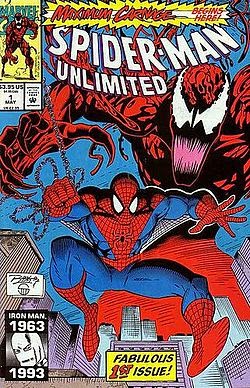
The Matt Signal Advent Calendar 2014 Day 5: Spider-Man: Maximum Carnage


Spider-Man: Maximum Carnage, May 1993

OK, so I swore I'd only write about good comics on here. This one stretches that definition a bit, but bear with me.

In seventh grade, I went on an overnight trip with school, and was put in a room with some guy I didn't know. Shockingly, I was a kind of awkward kid and barely liked the people I knew, let alone some stranger. But this stranger and I happened to both have brought comics with us, and the comic we both had was the current part of this Spider-Man crossover. I was trying out Spidey at the time, and had developed a lot of excitement for Venom and his evil spawn, Carnage. Now, I tell this story because this kid who I bonded with over Carnage and his exploits was Dan Grote, who over the years became my best friend, and whose work you're all reading here.

Maximum Carnage is the most 90s crossover to ever be 90sed in the 90s. Carnage, who is a cross between Venom and the Joker, escapes from the asylum and does his best Charles Manson impression, gathering a group of C-List villains around him, including newbie Shriek, Carrion ( an evil Jackal clone with extra powers), Demogoblin (the demon who for a while was bonded with then Hobgoblin Jason Macendale), and the Doppelganger (the Spider-Man Doppelganger from Infinity War who survived and became Demogoblin's buddy), to basically destroy as much property and kill as many people as he could. Spidey, meanwhile, teams up with Venom and they gather various 90s heroes, including Nightwatch, Deathlok, Morbius, and Firestar, along with Black Cat, Cloak & Dagger, and, out of left field, Captain America, to fight Carnage's family.

OK, let's be honest: Maximum Carnage is never going to be remembered as the highlight of Spider-Man storytelling. It's not Kraven's Last Hunt. But what it is, it does with gusto. It's wall to wall crazy, with as much over the top violence they could squeeze in while still staying within the Comics Code. It also does have some interesting stuff from a creative standpoint. Mark Bagely was really starting to find his stride on his monumental Amazing Spider-Man run around this point, and J.M. DeMatteis does some interesting stuff with Spidey struggling with the morality of letting a monster like Carnage live and whether he should let Venom just kill Carnage. But mostly, well, it's just a superhero slugfest.

It did, however, translate perfectly into a pretty awesome video game for Sega Genesis and SNES.


I wanted to tell the story of Dan and me meeting before he takes over for the next few entries. So stay tuned tomorrow for Dan Grote's comic memories, before I return the middle of next week with the breaking of the Bat.

Recommended Reading for 12/5: Cowboy Ninja Viking


A couple weeks ago, it was announced that Chris Pratt, this year's breakout star thanks to his work voicing Emmet in The Lego Movie and playing Star Lord in a little movie called Guardians of the Galaxy, would be starring in a film adaptation of a fairly obscure Image comic from 2009-2010, Cowboy Ninja Viking. I had that moment of comic fan hipster pride, as, "I read that comic when it was coming out." And I remembered enjoying the heck out of it, but it was some years ago, and memories can be fuzzy. Fortunately, I have ready access to more of my collection now that certain plans are coming together (that I will be writing about in the near future as they reach fruition), so I was able to find my copies, and as it turns out, it's actually even better than I remember.

The high concept on this book is brilliant in its madness and simplicity. A genius and arrogant psychologist and the US government worked together to use, "experimental past life regression therapies, (&) pioneering pharmacological enhancements" to take people with multiple personalities and let the prime personality channel the abilities of the others to make deadly assassins. As any reasonable person might imagine, this ends poorly. Six years later, when the series begins, though, it looks like these Triplets, thus named because each person has three alternate personalities with a specific set of skills, are back, and so the original doctor must find the one Triplet he knows he can trust and track down the others.

If you couldn't figure it out from that paragraph, the titles of the comic references that particular Triplet. Duncan was the success of the project, basically making him the most stable of a group of highly unstable psychopaths, which is like saying this one poison will kill you quicker than the others. Duncan himself is a fairly normal seeming guy, not threatening and not even very noticeable. But with his other personalities in his head, well he's not normal at all. And one of the charms of the way the book is written is that each of the Triplets' different personalities are really that: personalities. These aren't just different versions of the same guy, but are very distinct. Cowboy, for instance, pictures himself as a ladies man and is always on the hunt for, shall we say, companionship, and he has no issue with providing compensation for it. Viking is a pretty typical viking, who figures everything can be solved with his axe. And Ninja tends to spout platitudes and philosophy, which frustrates the hell out of the others. But they're all super deadly, and Duncan has no problem channeling them to fight evil. Or anyone that bugs him. So, yeah, crazy.


I will tell you flat out, Duncan won the Triplet lottery. As we see other Triplets, we see that the personalities aren't all quite as useful in combat as Duncan's three. Grear, for instance, Dunca's ex-wife, is Sniper Martial Artist Chef. That last one is kind of persnickety about people bashing her food, and wields a mean frying pan, but not optimal in combat. Or there's Yoshitiki Ammo, who is Pirate Gladiator Oceanographer. Steed Malbranque is Navy SEAL Hitman Roadie; not useful on that last one, but he has some great stories. And there are fourteen of these characters total! I won't sit here and list what they all can do, despite it being a ton of fun, because we never see exactly what all of them can do. But I will say Joan of Arc and Genghis Khan are in there, as are archers, a highlander, and a hairdresser.

There is a supporting cast in the comic that aren't Triplets too. Sara Nix is Duncan's partner and handler. She's almost heart breakingly normal, or at least desires to be on some level. She was working for Dr. Sebastian Ghislain,the man who designed the Triplet program and who we'll get to in a minute, and was about to move on to a bigger job in three days (which she never fails to point out when things get hairy, in the same way Dante in Clerks says he "isn't supposed to be here today.") when the Triplets resurfaced and she was sucked into Duncan's orbit. Nix is efficient, intelligent, and likes Duncan. And Duncan clearly develops feelings for her quickly, and although he won't tell her, his quiet love for her and desire to protect her is part of his motivation to keep going with all this insanity.

Dr. Sebastian Ghislain is my favorite character in the comic who isn't a Triplet. He is a wealthy,completely self-centered, arrogant, womanizing drunk, who also happens to be a brilliant psychologist; picture Tony Stark at the beginning of Iron Man if he was a shrink and not a weapons designer. When we first meet him, he is about to bed a model, and his penchant for the ladies and his inability to say anything but exactly what he thinks at that moment gets him, and by extension his team, into a few problems over the course of the series. But he does actually seem to care about the Triplets, and wants to do right by them, even if it's right only in the way he thinks is right. Which cannot be said for Johann Blaq, Ghislain's former assistant, who faked his own death and spent years secretly perfecting the Triplet process so he could release the Triplets, who had been locked up after the project failed, and turn them into a cabal of mercenaries under his command. Blaq is the series' principle antagonist, and you can tell he's evil by his facial hair. Dude has seriously evil mustache/pointy beard combo.


The plot of the series starts off with the Triplets resurfacing, and Ghislain recruiting Duncan and Nix to help him try to solve the problem, getting back involved with the US government, and confronting Blaq. And when the new Triplet program gets its first government mission, well things just get worse. The book is full of crazy action, great characterization, and some really funny bits. Duncan and his three personalities bickering is hilarious, and many of the other Triplets have some pretty funny personalities, especially Steed's roadie. Ghislain is also funny in that, "I'm going to say exactly what I think and damn the consequences," way. I will warn those who are squeamish, the violence is pretty graphic, with body parts flying; when you've got katanas and viking axes as principal weapons, limbs and heads tend to roll.

Riley Rossmo, on of my favorite artists in comics, provided the art for the entire series. This was early in his career, after Proof but before Green Wake and Bedlam. Rossmo does wonderful things that add to the feel of the book and helps makes what could be a somewhat confusing concept work. Panels shift from one personality to the next as they converse, making it easy to keep straight who is talking. While there are some splash pages mixed in, most of them have quite a few panels, which allows for some really crazy page layouts, as well as a great sense of action. The designs for all the Triplets different personalities are also clever; Rossmo makes it easy to figure out exactly what each Triplet can do from simple visual cues, since in most cases the personality is only seen from chest up.

But I would be remiss in not pointing out that Rossmo is aided in this by letterer Clayton Cowles. Cowles designed specific shaped word bubbles for each Triplet personality with a specific symbol or object attached to it or passing through it, something that represents exactly who that personality is. It's a great conceit, helping differentiate who is speaking when multiple personalities are conversing in the same panel, and shows exactly how much a good letterer can help make a book work.

A couple more notes on style and form. The comic is in color, but not full color as used in most comics. Each page has usually a one color tone over it, designed by Rossmo. It makes the book look very stylish and unique. It was also one of the books Image used it's "Golden Age Format" meaning it's slightly off size from what you usually get, being slightly longer and wider than a standard comic, and has very few to no ads per issue. It was a really nice format, and it was a shame it didn't catch on. I would have liked to see more off-the-beaten-path projects use it.

Sadly, only ten issues of Cowboy Ninja Viking were published. Not only that, but issue ten ends with a page that has at the top, "Twelve Issues Later," so it felt like the creators had plenty more lined up. Hopefully, if the movie does come around, we'll get a return for Duncan and the rest, and some answers to the mysteries that ending left dangling. But, hanging plot lines or not, if you enjoy fun action and whacky characters, you should track down Cowboy Ninja Viking.

The ten issues of Cowboy Ninja Viking were collected into two trades or one deluxe hardcover. While all are currently out of stock on Amazon, the second trade is still in print, as is the hardcover, and are orderable through Diamond, so if your comic shop doesn't have it on the shelf, they should be able to get it for you.


Thursday, December 4, 2014

The Matt Signal Advent Calendar 2014 Day 4: The Infinity Gauntlet #1


The Infinity Gauntlet #1, July 1991

Up until Infinity Gauntlet #1, I was a Batman reader pretty much exclusively. I would pick up comics guest starring Batman, and even an occasional something else, things like Real Ghostbusters or Trannsformers. And my little brother wanted to read comics like his big brother (probably the last time he tried to be like me), so I had read a couple issues of The Incredible Hulk he had bought and quickly discarded, written by some guy named Peter David.

But there was something about this cover, about the menacing head of Thanos looming, the Gauntlet itself, and all those strange characters who I was unfamiliar with, as well as that cover copy, "The End Begins Here!" that drew me in. And by the end of the opening scene, where this clearly bad guy named Thanos was talking with some guy who looked like the Devil about being God that I was hooked. By issue's end, Thanos had wished half the universe into non-existence, and the heroes were already playing catch up. Plus there were pages I didn't get about new souls taking over dead bodies and a cocoon that I knew meant something else big was coming.

Besides being my first real exposure to Marvel Comics, Infinity Gauntlet showed me another facet of comic collecting I was unfamiliar with: collecting for a creator. I had never put too much thought into the people who produced the comics I was reading, but there was something about the writing here that captured my attention. I looked at the name of the writer, Jim Starlin, and was looking at my trade of A Death in the Family, where Jason Todd died, and I saw it was the same writer. Well, from there I started looking for other stuff he'd written, other issues of Batman, the reprints of his Warlock run, and the stuff he'd written that led into Infinity Gauntlet. Pretty soon I was following Peter David too, and Denny O'Neil thanks to his work on Legends of the Dark Knight, which I talked about yesterday, and we were entering that wonderful six year period where all three core Batman titles had the same writers (Doug Moench, Chuck Dixon, and Alan Grant), so another nail was in my coffin, and I was hooked into another vein of comic book fandom.

If you're interested in learning more about The Infinity Gauntlet, check out the recommended reading I wrote for it.