Monday, October 29, 2012

Reviews of Comics from Wednesday 10/24


All Star Western #13
Story: Jimmy Palmiotti & Justin Gray
Art: Moritat/ Phil Winslade

Clowns and Gotham City do not mix. Well, they do if you enjoy homicide and chaos.As Haly's Circus arrives back in Gotham, Jonah Hex, Tallulah Black, and Amadeus Arkham are called to look into a gruesome murder, and all hints point them to the circus. There they find it's more than just a clown that have gone insane, and that it seems like this madness is tied in with what they have already been hired to look into, the missing formula of Dr. Henry Jekyll. It seems that Jekyll's formula is tied in with the black diamond, the source of Eclipso, that has been popping up all over the DC Universe. What's nice is that none of that matters to the story at hand. What we have here is a suspense and action story, with killer clowns, man eating tigers, and a formula that makes men evil. Which in all fairness is pretty much any Tuesday in Gotham, no matter what era the story takes place. This issue also sees the return of the Barbary Ghost, who was featured in the back-ups earlier in the series, now entering the main story. While she didn't really interact with Hex and crew this issue, I look forward to seeing her more in upcoming issues. Speaking of back-ups, a new serial begins this issue, featuring Tomahawk, although this is a different version of that character. Here, he is a brave fighting with Tecumseh against the US forces after the American Revolution. It's an intense story, not sugar coating in any way the way the US treated the Native Americans. Interestingly, the US general who will be leading the army against Tecumseh and Tomahawk is "Mad" Anthony Wayne, who's last name was given by Bob Kane to his greatest creation and has been established as an ancestor of Bruce. I'm curious to see if this will all tie into the Watyne family legacy, or if its just a nice little nod. We'll have to see.


Batman Incorporated #4
Story: Grant Morrison
Art: Chris Burnham

Batman Incorporated has its first major throw down with the forces of Leviathan, and while things seem to work out in Batman's favor, there's much more going on here. I like that Morrison can actually take an all action issue and use it for some excellent character development. We get a really good sense of many of the members of Batman Inc who aren't Gotham residents, specifically the adversarial relationship between The Hood and Gaucho due to the issues between their countries, and a nice scene with Batwing getting back at the ninja Man-Bats for his near death fight with them in the "Leviathan Strikes!" one-shot. Batman had been left in a pretty precarious place last issue, but as ever, he's Batman and had his escape plan set all along. Morrison crated Damian, and writes him as such a perfect little brat with a broken soul underneath. When the revelation of who has been wearing the Wingman costume finally happens, you can see that Damian is both hurt and confused, exactly as ten year old would be, no matter how mature he pretends to be. The revelation makes perfect sense, and fits with some of what has been going on in the New 52. I wonder if Morrison had this planned even before the transition. The ending, the last panels, is something I didn't see coming. Poor Damian has been pushed around like a chess piece for so long, I wonder if these events will finally push him over the edge. Only time, and Grant Morrison, will tell.


Fables #122
Story: Bill Willingham
Art: Gene Ha

Fables is the second longest running Vertigo series currently running, and every time I think Bill Willingham is getting ready to wind the series up, he comes up with a new angle to play with. This issue starts out some years in the future, with an adult Ambrose Wolf working on his history of Fables. The story he tells is one of the old days in the Homelands before the war with the Adversary, when his father, the Big Bad Wolf was still the most terrifying creature in all the forests.Bigby gets himself into some trouble when he tries to eat a witch, and finds his destiny is to die in two days time. As we all know, this doesn't happens, but we get to see how destiny works in the world of Fables. More than just a fun and interesting story, this issue features beautiful art by Gene Ha. Not only are his people always great to look at, but he draws beautiful forests. And most of all, his giant wolf is out of this world. I can't wait to see what happens in the second part of the arc.


OK, folks, I'm an east coast boy, so I'm scheduling this sucker to be posted tomorrow and finishing battening down the hatches for the monster storm about to hit us. Stay safe, everyone, and you'll hear more from me once I'm out the other side.

Friday, October 26, 2012

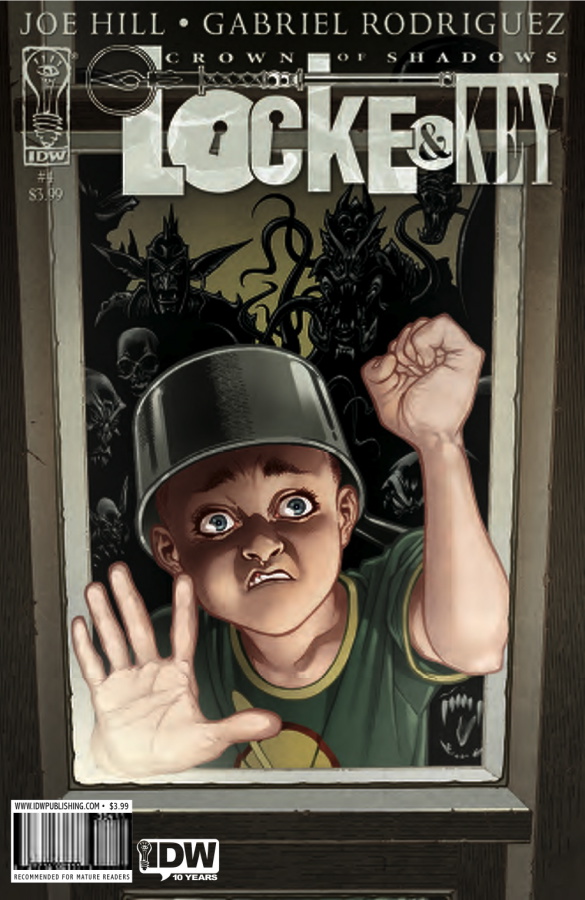
Recommended Reading for 10/26: Locke & Key


The end of a month of scary recommended readings had to go to my favorite horror comic currently on the stands, and one that I think will stand the test of time as one of the greatest horror comics ever. Locke & Key, from writer Joe Hill and artist Gabriel Rodriguez, is a horror comic in a grand sense; its not just about the monster under the bed, but the horror of loss, of growing up, of betrayal. It has aspects of a coming of age story, as most of the principal cast are kids and young adults, but the older characters still experience their own growth. And its those characters that keep you coming back; as good as the plots are, and they're very good, Hill has crafted some of the most memorable characters I've read in a long time, and your heart soars and breaks with them.

I first discovered Locke & Key because I had read Joe Hill's debut novel, Heart-Shaped Box, and was incredibly impressed. It was amazing to see such a perfectly crafted first novel, and one that was so damn scary. I read a lot of horror, in novel, short story, and comic form, and to read a book that actually gives me the heebie-jeebies is quite a feat. And to see that this guy was starting a horror comic was something I had to check out.

Locke & Key opens with the Locke family returning to their family's ancestral home, Keyhouse, in Lovecraft, Massachusetts (no, nothing foreboding in that name at all). The family is shaken by the recent murder of their father and husband, Rendell, at the hands of one of his students, Sam Lesser. Nina, Rendell's wife, has taken her three children, Tyler, Kinsey, and Bode to start fresh at Keyhouse, which is currently only inhabited by Rendell's younger brother, Duncan. Or so it seems, because Keyhouse has many occupants, and they're not entirely human.

The Locke kids are the central characters of Locke & Key, and the central story is really about them growing up while discovering the secrets of Keyhouse. When the reader first meets them, each of the kids is traumatized by the death of their father in different ways. Over the course of the series, each grow as people, and Ty and Kinsey, who are both high school students versus young Bode who is in grammar school, have to grow up, not just to face the normal challenges of life, but to face the challenges of Keyhouse.


Tyler Locke, using the Giant Key


The secret of Keyhouse is, not surprisingly, keys. But not just the kind of keys you have on your keychain. Each of the keys has a special power, given to them by their composition from something called Whispering Iron. The keys are a wonderful device, allowing Hill to solve problems or introduce new plot elements without resorting to anything outside the world of the series because this extraordinary element is already set. Keys include the Ghost Key, which allows you to leave your body and float as a ghost, the Anywhere Key, that's door opens to anywhere you need to go, the Head Key, which opens the head of the person it is used on and allows personality traits and memories to be added or removed, The Gender Key, that allows you to swap genders, and the Omega Key, which opens a very special, and very evil, door.

When it comes to writing about series that are horror and mystery based, it's hard to do without spoiling anything, something I have commented about before. With Locke & Key it is even harder to do, because the mythology of the series is so brilliantly and gradually pieced out that the reader doesn't get all the answers until the fifth volume, and even then I think there might be some surprises left for use in the sixth and final. But suffice it to say, the story is not limited to Lovecraft in the present. Stories flashback to the American Revolution, to Rendell Locke in his own teen years, and the two one shots, Guide to the Known Keys and Grindhouse, show different previous generations of Lockes.


Kinsey Locke


While I can't talk to much about plot, I can talk about characters, and that's where Hill shines. Each of the Locke kids are phenomenal, three dimensional characters. Tyler, the eldest son, is a boy at the end of his adolescence and preparing to see where life will take him. Haunted at the beginning of the series by an off hand, angry comment that he made to Sam Lesser he believes caused the young man to kill his father, Ty arrives in Lovecraft by far the most detached. But over the course of the series, he not only grows out of that shell and begins to connect with people, but he takes up the role of guardian of his family, supporting his mother who has sunk into alcoholism after the death of her husband, and protecting his siblings from the dark forces that seek the Omega Key.

Kinsey, the only girl in the family and a few years younger than Ty, starts out trying to live life as if nothing has happened. But with the realization of the magic in Keyhouse and the dark events of the end of the first mini-series and beginning of the second, Kinsey makes a decision to use the Head Key to get rid of the emotions that hurt. For much of the series, this is what defines Kinsey, who is a track runner, and who runs from facing her own emotions. Without fear, she is headstrong, and more free to sharing the knowledge of the keys with her friends. Kinsey's growth has a lot to do with realizing that the bad emotions, the fear, the tears, the anger, are as much a part of life as the good ones.

Bode, the youngest of the Lockes, is only six years old. His sense of wonderment at the discovery of all the magic that lives in Keyhouse is different from that of his older siblings. For Bode, it's all wonderment. Even though it comes with darkness, like mysterious voices in the Wellhouse or shadow demons, its still fun to use the Ghost Key and sail around the house, or to get a peak at someone's thoughts with the Head Key. His sense of wonderment is charming, and often the spot of light in an otherwise dark book. He still has to grown up, though, and events at the end of the series might have just placing Bode as the one who will save everyone.


Bode Locke


The cast around the Locke kids are all equally well developed characters. Ad the point of view shifts from character to character issue-to-issue, supporting characters get their moments to shine. Nina, the Locke's mother, is a strong woman who was broken by the death of her husband and the attack made on her, and is having a hard time putting the pieces back together. Duncan, Rendell's brother, is a gentle, quiet artist who loves his family and tries his best to support them while surrounded by tragedy. We also get to see various townsfolk in Lovecraft, including Ellie, one of the few surviving members of the Keepers of the Keys (Rendell's friends) and her son, Rufus, who is developmentally disabled but who has certain special knowledge that helps his new friend, Bode. And finally, there's Zack. Or Dodge, if you prefer. Or the Girl in the Wellhouse. Dodge is the villain of the piece, and I'll let you discover exactly what he's about yourself.

The suspense that builds its way through Locke & Key is done so slowly that you can start reading it and feel fine, but by the end of the issue you realize you've broken out in a cold sweat and gooseflesh. Watching the monsters come after the Lockes, whether they are Sam Lesser, Dodge, or shadow monsters, is part of it, and Hill is a master of the craft here. But it's not all monsters. While Hill and Rodriguez don't avoid violence and gore, and use them to great effect, it's the psychology of horror that makes something really scary. The slow build as Dodge's plan to find the Omega Key reaches fruition is a different kind of scary. Watching Dodge worm his way into the Locke family's life, watching him play with them, it's creepy. Monsters are what we make of them, after all, and sometimes to scariest ones are just people. Although I'm not saying Dodge is entirely human either. You'll have to read to find out.

Gabriel Rodriguez, artists on Locke & Key, is one of the most impressive artists I've seen in comics in recent years. Hi style is distinct and he falls into that category of artists that I love: he draws amazing expressive characters. Faces and body language are important in comics, and in horror comics even moreso, since what is not said is as important as what is said. Each of the Locke kids are made even more real by how perfectly captured they are in each panel by Rodriguez. And his talent for monsters, for shadow demons, for the things in the heads of people when the Head Key is used, is second to none. When we first see the Head Key used, and see into Bode's head, it's an amazing scene, and I don't know how much of what was in there was in Hill's original script and how much was crafted just by Rodriguez, but in the hands of a lesser artist, it could have been just cute or amusing; Rodriguez makes it jawdropping. Rodriguez also does an incredible job of altering his style to fit the story. The Grindhouse one-shot, a classic, gory gangster/revenge yarn, is grittier. And the first issue of the fourth volume, Keys to the Kingdom, is dedicated to Bill Watterson, and features panels drawn in the style of his classic comic strip Calvin and Hobbes, and as someone who loved that strip, the homage is perfect and loving. Every time I open an issue of Locke & Key I don't know what I'm going to get, but I just know it's going to be excellent.

With one final mini-series left chronicling this generation of the Locke family, you still have time to catch up with the series. There's something in this series for everyone, whether it's a well crafted family drama or a jump at a particularly scary moment. Come on, step into Keyhouse and see what's waiting for you.

There are five volumes of Locke & Key available in hardcover, and the first three have also been released in paperback. In order, they are Welcome to Lovecraft, Head Games, Crown of Shadows, Keys to the Kingdom, and Clockworks. The final mini-series, Omega, will begin coming out in single issue in November.

Monday, October 22, 2012

Reviews of Comics from Wednesday 10/17


Star Wars: Agent of the Empre- Hard Targets #1
Story: John Ostrander
Art: Davide Fabbri

John Ostrander returns to the Star Wars universe with another tale of Jahan Cross, Agent of the Empire. The first Agent of the Empire mini-series was a great spy romp, following Cross as he got involved in a plot to use droids across the galaxy to conquer civilization. This time, the story seems more personal, as he will be working in some backstage political intrigue that will make him cross paths with his estranged father. But that's in the future of the series. This issue was an action packed romp that got readers who might not know Cross up to speed on who he is: the Empire's answer to James Bond. Set prior to the events of A New Hope, Cross attends a party on Alderaan, where he meets movie characters like Bail Organa and Princess Leia, and classic EU characters like Leia's best friend, Winter. With the appearance of the current Count Dooku, the nephew of the Prequel Trilogy villain, intrigue kicks into high gear. By the end of the issue, an assassination has occurred, and Cross has returned to Coruscant, where conversations with Armand Isard, head of Imperial Intelligence, and his daughter (and major villain of the Rogue Squadron comics and novels) Ysanne, begin to shake some of Cross's confidence in the Empire's beneficence. I've always said that the noble Imperial is a favorite Star Wars archetype of mine, and I feel Jahan Cross is a good addition to the ranks. Oh, and did I forget to mention the opening scene is a flashforward of Cross fighting Boba Fett? Yeah, you know that's not going to end well for someone.


X-Factor #245
Story: Peter David
Art: Leonard Kirk

With the final chapter of "Breaking Points," long time X-Factor writer Peter David sets the book off on its new course. Now, what exactly the new course is, I'm not sure yet, but hey, Peter David hasn't steered me wrong yet. "Breaking Points" has seen the rather large cast of X-Factor paired down slightly, and some characters, both those left behind and those not on the scene, changed. This issue really focuses on Havok, and gets him from the point he has been at in this series, as the soemwhat flustered co-leader of the team, to the point where he is in joining the Uncanny Avengers team. Much of the issue is a conversation between first Havok and Madrox, and then Havok and Polaris. Havok is confronted with a lot of the baggage he carries, especially in regards to his brother, Cyclops, and all that has happened with Cyclops over the course of Avengers Vs. X-Men. There is a poignant scene, where Havok and Polaris finally come to terms with their somewhat strained relationship, and although Madrox is clearly one of Peter David's babies, and Havok is a character that he might not have the same attachment to, he gives him a great sendoff with some dignity. Of course, that dignity is then somewhat undermined with the comedy stylings of Pip the Troll and a going away... present from many of his teammates. Aside from Havok, there is a major change ins status quo for Madrox and Layla, a new costume for Polaris, and Madrox actually putting his foot down versus his usual indecisive personality. Character is where Peter David's writing has always shined, and this issue is another great example of why X-Factor is one of the best books on the racks.


Young Justice #21
Story: Greg Wesiman
Art: Christopher Jones

With the animated series unfortunately on hiatus, it seems that I'll have to get my Young Justice fix in the comics. And fortunately, the comic series is as good as the show, with the stories intertwined as untold tales, and written by showrunner, series writer, and Gargoyles creator Greg Wesiman. This is the second part of a six part arc, taking place mostly about a month before the beginning of the season two "Invasion" storyline, but flashing back to five years earlier, about a month before the end of season one. In the present, many heroes and villains have been teleported off Earth by Brainiac, making his Young Justice debut, while much of the team is divided on separate missions: Nightwing and Wonder Girl are recruiting Blue Beetle, while most of the rest of the team is protecting the new leader of Qurac from possible attacks from Queen Bee. The issue does a great job of juggling all the plotlines, and still allowing the characters room to breathe. This doesn't feel like a Superboy trapped in space comic with a Miss Martian subplot, or a Nightwing recruiting a hero with a Batgirl subplot; it feels like a comic featuring the whole team. If you're going through Young Justice withdrawal like I am, you should check out the comic. Hopefully it will get us through to January...

Friday, October 19, 2012

Recommended Reading for 10/19: The Barr & Davis Detective Comics


There are certain runs on Batman titles that are considered legendary: O'Neil/Adams, Englehart/Rogers, Miller/Mazzucchelli, Loeb/Sale. But there are some that slip through the cracks, no matter how good they are. A personal favorite of mine was the short, seven issue run on Detective Comics by Mike W. Barr and Alan Davis.I'll be focusing on the first six issues, since the final one was the first issue of a four part story that Davis did not complete (it was, in fact finished by a then new talent named Todd McFarlance). But trust me, there's enough material in those six issues.

These are some of the final pre-Crisis Batman stories, and although that doesn't hugely matter, it does mean they are some of the final stories not in the shadow of Frank Miller's legendary Batman: Year One. The Batman in these stories is a bit lighter, able to smile, and while still a dark knight, is not someone that the non-criminal element of Gotham would be terrified of. He is also a bit more of a father figure to Jason Todd than the more dire Batman of the post Year One era. More than that, this Jason Todd is still the sort of Dick Grayson redux he was before he was given his new origin and attitude. The stories aren't as hokey as some of the early Silver Age Batman stories, as a matter of fact they get very dark in places, but there's a sense of fun to them that has been lost in times since.


The first two issues of the run are a two part story that feels like house cleaning from the previous few years of Batman stories. Catwoman had pretty much reformed here, and had not only developed a serious on-again/off-again relationship with Batman, but knew his identity. In a move that hearkens to the current "Death of the Family," Joker decided Catwoman shouldn't be with Batman and is better as a villain, and hire mad scientist Doctor Moon, a character who hasn't appeared in some time but was an 80s and 90s mad science fixture in the Bat- and Super- titles, to use a CAT scan device to change her mind. By the end of the story, Catwoman is a villainess again and does not know Batman's identity. The Joker plays a dark game here, and he truly leaves a wounded Batman. Batman himself savagely beats the Joker, and comes close to taking the Clown Prince of Crime's life. Batman might smile at Robin and quip, but Barr's Batman is still a  force to be reckoned with.


The remaining four issues of the run are single issue stories, although the last two tie together. Issue 571 is probably my favorite Scarecrow story of all time, and arguably the best (it also allows me to stick to something a Halloween theme with this week's recommendation, since what villain is better for Halloween then Scarecrow?). In "Fear for Sale," the Scarecrow develops a drug that does the opposite of his usual fear toxin. Instead of making someone afraid, it strips away all their fear. When Batman is exposed, he begins to act reckless, and a nervous Jason attempts to stop him. The way Jason was written after his new origin, a reckless Batman would have been something he was all for, but here he does his best to stop Batman from rushing headlong into the Scarecrow's death trap. In the end, though, Batman has one fear that the Scarecrow's toxin isn't able to block, and it is using that fear that Batman overcomes to toxin and defeats Scarecrow. That fear? The death of Jason, something that plays more into the last couple issues of the run and is oddly prescient for Jason's well known fate. This story has also been adapted for the latter episodes of the classic animated Batman series under the title of, "Never Fear."


"The Doomsday Book," Detective Comics #572, was one of the first back issues I ever bought. That cover, with my two favorite detectives of literary history, was something that just grabbed me. And the story inside was something different from the comics I was used to reading. It was a double sized anniversary issue, and was a series of interconnected stories that all tied together in the end. It also featured two chapters featuring characters who were new to me, but had a history with the title; Slam Bradley, the PI who first appeared in Detective Comics #1, and the Elongated Man, who had a back up feature in the tile back in the 60s. The story features a "lost" Holmes story, the descendant of Professor Moriarty, and a last minute save by the great detective himself. Barr is a huge fan of mysteries, as evidenced by his Batman stories and his 80s play fair mystery series Maze Agency, whose issues I am still attempting to track down, and this issue is a love letter to many a great detective stories.


"The Mad Hatter Flips His Lid" is a strange little throwback to the classic Batman TV series of the 60s. The Hatter design here is that of the 60s and the TV show, the chubby, hat obsessed and gimmick using version, not the Lewis Carroll obsessed version who was first introduced and disappeared until the mid 80s. Here, after being released from Gotham State Prison, the not truly rehabilitated Hatter goes on a crime spree based on hats, and the issue contains some truly groan-worthy puns. When Bruce Wayne, "throws his hat into the ring," (I told you the puns were bad) for city council, Batman prepares his trap. But the Hatter has deadly razor brimmed hats that he unleashes by remote control, and while Batman is able to stop him, the Hatter shoots Robin. The boy falls, and Batman beats the Hatter senseless. This is the last appearance of this version of the Hatter, and Robin's shooting is a cliffhanger for the final issue of the run.


"My Beginning... and My Probable End," is probably the most significant issue of the Barr/Davis run from a historical point of view. It was released the same month as the final issue of Batman: Year One over in Batman, and tells the story of Bruce Wayne's childhood and youth. It doesn't contradict anything Miller writes. but serves as a compliment, giving details Miller doesn't focus on. What's more important is how these details are revealed. With Robin wounded, Batman rushes him to Leslie Thompkins clinic. Here, Bruce spends much of the issue talking to Leslie. While Leslie had been introduced as the kindly woman who was there for Bruce the night his parents were shot, this is, as far as I know and correct me if I'm wrong, the first appearance of Leslie as the tough doctor, the pacifist who serves as the voice of the opposition to Batman's more brutal methods. The issue has touching moments between Bruce and Leslie, and when Jason wakes up after his surgery, we see a Bruce who is caring in a way that he is not really allowed to be in issues after this.

As great as Barr's scripts are, a run is only elevated to legendary by the marriage of story and art. Alan Davis's art works beautifully with the stories. His touch is light, creating smooth looks to his characters and allowing for Batman to be menacing one page and smiling and joking with Robin the next. There's a reason Davis is considered a great, after all. His Scarecrow is excellent, all gangly limbs and contorting joints, and his Leslie is wiry and tough, but still maternal. The run also introduced Profile, an underworld information broker who hangs out at an underworld pup, Mcsurley's. Profile was never really used again, hut he had a great, unique look, a sort of modern fop look that stood out in the grimy bar, and I think Davis giving him that look is what has made him stick in my head all these years.

The final Barr/Davis issue was the beginning of Batman: Year Two, a strange story featuring Batman using the gun that killed his parents and teaming up with the mob and Joe Chill to stop the return of a Gotham vigilante called the Reaper, whose design is visually striking and about five years ahead of its time; he looks like something every Image creator wanted to draw, with a skull head, red body armor, and long scythes on both hands that ended in maces and had concealed guns built in. While the story was not as memorable as the previous six issues, I have to give Davis credit for his Reaper design.

This entire run has just been collected for the first time in a deluxe hardcover, Legends of the Dark Knight: Alan Davis. It contains all six of the issues discussed here, plus the first part of Batman: Year Two, the follow up Reaper story, "Full Circle," and a short Batman: Black and White tale, "Last Call at McSurley's." Unfortunately, the hardcover was misprinted and recalled. A new printing is due shortly, and I suggest you give it a try.

Wednesday, October 17, 2012

Three Advance Reviews of Comics You Should Check Out

One of the best things about going to a comic convention is the swag and the chance to get stuff you can't get anywhere else. This year, between the Diamond Retailer Breakfast pack and wandering Artist's Alley, I found three exclusive comics, previews and variants of comics that haven't been released yet that I want to get the word out for early. I'll remind my loyal audience of them when they get closer, but for now, here's a little sample of things to come.


Bedlam #1
Story: Nick Spencer
Art: Riley Rossmo

Bedlam is the new Image Comic from Nick Spencer (Morning Glories, Thief of Thieves, Ultimate Comics: X-Men) and Riley Rossmo (Proof, Cowboy Ninja Viking). It's the story of Madder Redd, a serial killer and master criminal very much in the Joker model. The first issue opens with Madder Redd slaughtering all the visitors at a museum before being confronted by The First, his heroic enemy. Flash forward and Madder Redd has been captured by the police and is being interrogated. But is it really Madder Redd? It seems that the man the police has is a fake, and the real Madder Redd is living as a fairly ordinary man named Fillmore, who is constantly at war with his previous, darker self. The story of Madder Redd's transformation is still being pieced out, although there are flashbacks that begin to explain it, and he has not lost all his cunning. It seems he now has a drive to help, and so he is looking to aid the police in taking down other killers. The series has Nick Spencer's trademark mysteries, giving the audience only as much information as they need to keep them coming back. This isn't a bad thing, and the series is a little more straightforward than his other current Image Series, Morning Glories. Riley Rossmo draws a great horror comic, and this is horror in the tradition of Silence of the Lambs. His design for Madder Redd is creepy, and his scenes of Redd in action are great. Bedlam #1 will be released in two weeks on Halloween.


G-Man: Coming Home #1
Story & Art: Chris Giarrusso

In all my posts talking about all-ages comics, I am ashamed that I forgot to mention G-Man. Created by Chris Giarrusso, who Marvel fans might remember for his Mini-Marvel strips, G-Man is exactly what the tagline of the series says, "The Superhero Adventure of a Kid and his Magic Cape." G-Man, along with his big brother Great Man and the rest of their friends, all young heroes, have action packed adventures that are at times real nail biters, but never leave the realm of something the whole family can enjoy. This isn't a full story, but the first chapter of the upcoming G-Man original graphic novel, Coming Home. The story picks up from the end of the last G-Man story, Cape Crisis, but does a great job of getting new and lapsed readers up to speed. The first chapter not only reintroduces G-Man and his friends, but expands the world by introducing the Thunderfriends, a team of grown up heroes.Giarrusso has built a whole world of new heroes and crazy situations that are fun, entertaining, and exciting. The first two volumes of G-Man are readily available, and while no release date is shown on the comic for the third volume, be sure that I will let you know.


Helheim #1
Story: Cullen Bunn
Art: Joelle Jones

While the The Sixth Gun, the current ongoing from Oni Press by writer Cullen Bunn, is a great example of a tried and true comic genre, the weird western, his new series, Helheim, comes from a much less tread path: the weird Viking story. A tribe of Vikings are at war with a witch and her undead servants. The series introduces its young protagonist, Rikard, the son of the leader of the Viking group, as he, his father, and some allies flee the creatures that serve the witch. They arrive back at camp, and after defeating the monsters, head into camp... as Night Creatures, the most evil servants of the witch, spring from the forms of the downed undead. In the ensuing battle, Rikard is killed, which seems like the end of the story for our hero. But he has been seeing visions of his older self looking sadly on, so there's more to it. And when Rikard's father goes to Brea, Rikard's lover and a witch in her own right who, according to him, is the reason their enemy keeps attacking, he gets a nasty surprise I don't want to spoil. It's a great set-up for the series, and I'm looking forward to where Bunn is taking it. If you've been enjoying The Sixth Gun, or liked Brian Wood's Vertigo viking opus Northlanders, you should check out Helheim when it launches in March.

Tuesday, October 16, 2012

A Busy Week for Comics on TV

So, this past week we saw the debut of two TV series (one a series premiere, one a season premiere).


I thought season two of The Walking Dead was not as strong as the first one. What should have been one arc in a season with multiple acts took up much of the season with very little payoff. And I think the series, and new showrunner Glen Mazzara, wanted to address that right off the bat. The teaser for the debut episode, "Seed" was silent, with the survivors making their way through a house, killing some walkers (although in all fairness since they're already dead, I don't know if there's a better term then killing), and digging for supplies. There's no excessive talking here, no hemming and hawing; it's all action. And I think the destroyed walker count in this one episode exceeds the entirety of last season.

Not to say that the whole episode is action. There's still the strife in the Grimes family, with Lori unsure about where she stands with her husband and son. Daryl continues to walk along the outskirts of the group, taking part in the action but not in the day to day life. Rick is acting like a leader, giving orders and holding the responsibility close to him. And, hey, even T-Dog is doing stuff. The episode felt balanced, giving something for all the members of the cast something to do.

The prison is an excellent place for the survivors to go, with its high walls and strong defenses, and has a creepy air that works well for a zombie story. As the survivors attempt to clear the prison of its dead inhabitants, the darkness and winding corridors add a level of claustrophobia and intensity that you didn't get in the more open expanses of the farm.

The highlight of the episode for me was the first full appearance by Michonne, the sword wielding zombie killer played by Danai Gurira. She only had a couple scenes, but her sword play and total badassery made me happy. Michonne has been a favorite of mine in the comic for a long time, and she has been translated to the screen perfectly. Her scenes with Andrea show her to be caring as well as a hardcore killer, and she walks around with chained zombies, so I couldn't ask for more.

As for where I feel the season is going, well I doubt I could be happier. The appearance of the prisoners makes me a little nervous about the expanding cast size, but we'll see where that goes. Seems like Herschel will be picking up some of the plotlines that were left in the void by the early death of Dale, and I like how tough Maggie is getting; it seems she might be picking up some of the tough female character quotient left by Andrea not being as tough as she is in the comic.  Michonne and Andrea are looking like they/re going to be running into the Governor and Woodbury first, so I'm curious to see where they go and how they meet up with the rest of the survivors again. This was a good episode with a lot of promise; I hope the series continues on this path.


I admit to going in to Arrow, the new series featuring Green Arrow, with a bit of trepidation. Superheroes and TV don't always translate. And while at times Smallville, the CW's previous DC Comics adaptation flew like Superman through the skies, there were times it moved much more slowly and felt like a show that would be on the same network as Gossip Girl and 90210; lots of angst and not a lot of superheroics. I also know Green Arrow can often be presented as Batman-lite, and frankly he was in his early days in comics; he had an Arrowcar and Arrowcave, for pete's sake!

Fortunately, the series premiere did a lot to alleviate those fears. The pilot if both full of action, good character beats, and some knowing winks to the comic reading audience. The pilot starts out with Oliver Queen, the man who will become Green Arrow, being saved from the island he has been stranded on for the past five years. He returns to Starling City, where he begins taking up his quest to right the wrongs of his corrupt mogul father by taking out a list of men who are equally corrupt. He's not the same bleeding heart liberal he is in the comics, but he is looking out for the little guy.

Stephen Amell does an excellent job as both Oliver Queen and his mysterious alter ego, who does not have a name in the series yet. He plays the cocky, arrogant rich guy one moment, and the intense vigilante the next. It's interesting that the series creators chose to give him a family, a mother and sister. This does a nice job of separating him from Batman. He is not an orphan, but has these connections that give him something else to fight for. Whoever Amell's stunt double is also does an impressive job. The way he moves and the way he fights aren't like you usually see among TV and movie superheroes. His movement over rooftop isn't acrobatic, but more like an animal stalking it's prey, moving on all fours, and his fighting style involves arms and legs, choking out his enemies instead of trying to knock them unconscious with fists.

The other members of the cast also do an impressive job. Oliver's mother and sister, played by Susanna Thompson and Willa Holland respectively, both have their rich affectations but are hiding secrets. Colin Donnell plays Tommy Merlyn, Ollie's ne'er do well best friend. He seems like a wastrel, and something of a slick operator, but comic fans will recognize his last name and know that he has a future in villainy. But the highlights of the supporting cast are the Lance family. Laurel Lance, Ollie's once and probably future girlfriend is played by Katie Cassidy, of Supernatural and Harper's Island fame. Here, she is a crusading attorney working for legal aid. She serves as a voice the down to earth and the common man in Ollie's world of privilege. She doesn't take any of Ollie's arrogance, and puts him in his place, even though she doesn't realize most of it is an act. Hopefully, we'll watch her transition into her own heroic identity before the series is over. Her father, Detective Quentin Lance, is a tough cop who seems to be a good cop in a corrupt town who also has his problems with the rich Queen family. He is played ably by Paul Blackthorne, a favorite actor of mine best known for playing Harry Dresden on the shirt lived television adaptation of The Dresden Files.

There were several clever references for the DC buff to pick up beyond Merlyn's appearance. On the island where Ollie is found, a mask that belongs to Deathstroke the Terminator is seen. The head of security of Ollie's target is Dracon, a villain created by Judd Winick during his run on the comic series. And two incidental characters are named Diggle and Grell after creators who have a history with Green Arrow in the comics.

I was interested to see that the creators of the show have no problem with having Ollie take the life of a villain. Ollie snaps the neck of a thug who discovers the new uncanny physical skills he picked up on the island, and he seems to have no problem slinging arrows that seem to put goons down for good. The comic Ollie isn't a killer, and the couple times he has killed have taken their toll on him. However, I accept that this works within the world of the show; the Oliver who came off that island is a predator hunting game that is deadly. He feels he needs to put them down before they do the same to him and others. How this will affect him, and his perception by the public and the police, is something I hope the series addresses.

All in all, I think Arrow has some promise. There are some mysteries laid out that I'm looking forward to seeing payoff, and the cast does a good job. We'll have to wait and see if the series winds up going on for years like Smallville, or folding like Birds of Prey did after a short time. Early signs point to a longer run, and I will be staying tuned for it.


On a final note, this past weekend, Cartoon Network decided to preempt it's DC Nation block of cartoons in favor of reruns of other cartoons. Until January. Young Justice, part of that block, is probably the best action cartoon on TV today, and the successor to the great Timmverse DC Comics cartoons of the 90s and early 00s. I would suggest if you are a fan, to tweet @cartoonnetwork with the hashtag #DCNation to let your voice be heard. I know, serious first world problem here, but still, you don't stand between a man and his cartoons.

Monday, October 15, 2012

Reviews of Comics from Wednesday 10/10


Batman #13
Story: Scott Snyder/ Scott Snyder & James Tynion IV
Art: Greg Capullo/ Jock

That was... Wow. It's been a year since the Joker last appeared, and had his face removed by the Dollmaker, and his return is everything I could expect from the beginning of a great Joker story. The Joker is a character as malleable as Batman, changing with the times and the need of the story, something Grant Morrison played to great effect in "The Clown at Midnight." But Snyder's Joker is not Morrison's changing man, nor is he Chuck Dixon's manic supervillain. No, Snyder's Joker is a figure of terror, the perfect compliment to the Dark Knight. The Joker spends the issue slowly moving the game pieces, Batman's ally, into position, so he can begin his campaign against them. Snyder pays homage to classic Joker stories, with nods to the first Joker story, but is telling a tale of his own. The use of Harley Quinn, both in the main story and in the back-up focusing on her, establishes her relationship with the Joker, which is very different than the frustration and seeming affection he showed her in the animated series. Harley is just a pawn to the Joker, someone to be used and disposed of, just like everyone else, in his campaign against Batman. The issue is filled with scenes that make the skin crawl, especially Joker's assault on Gotham Central. He murders the police officers around Jim Gordon while taunting him, leaving him frozen in fear. The art, both by series regular Greg Capullo and the backup by Jock, is stellar. The faceless Joker is both revolting and frightening, a shock despite the image being leaked, when under the pens of these two talented artists. "Death of the Family" begins with this issue, and I haven't been this excited for a Batman story in a long time, and that's saying something. Welcome back, Mr. J.


Frankenstein Agent of S.H.A.D.E. #13
Story: Matt Kindt
Art: Alberto Ponticelli

Frankenstein Agent of S.H.A.D.E. has been a fun, horror tinged book since its debut as part of the New 52, and has been loosely attached to the excellent Swamp Thing and Animal Man series, but now with "Rotworld" the book is tying more into the worlds of the Red, Green. and Rot, the forces that govern nature. The zero issue of Frankenstein established the relationship between the creature and his mad maker, Dr. Victor Frankenstein, but this issue sees Dr. Frankenstein's return, this time as a servant of the Rot. Frankenstein received a garbled message from S.H.A.D.E. as the Rot begins conquering the world, and then is contacted by the Red and sent to Metropolis to retrieve the Soul Grinder, Dr. Frankenstein's device thet created the monster. The issue is full of awesome action, of Frankenstein fighting horrible monsters, and I have seen very few artists who can draw a creature as creepy as series artists Alberto Ponticelli. If you haven't tried Frankenstein yet, this is a good jumping on point, and the perfect time of year to see a monster who is a hero fight even bigger monsters.


Halloween Eve
Story:Brandon Motclare
Art: Amy Reeder

I love Halloween comics; ok, in all fairness, I love everything Halloween. So I was curious to check out this Halloween themed one-shot from Image. The story is a simple enough one: Eve works at a costume shop, and she doesn't like Halloween. As a matter of fact, she doesn't seem to like much of anything or anyone. But when she's left alone at the shop after hours on the night before Halloween, she gets sucked into Halloween Land, where it's always Halloween. She comes back with a new perspective on life. It's pretty much The Wizard of Oz with a Halloween twist, which is intentional and made even more clear when Eve winds up dressed as Dorothy at the end of the story. The story lives on how it is told, not so much the story itself, and the creators hit a home run with that. Writer Brandon Montclare makes Eve tough without making her unlikable, and surrounds her with an oddball cast. But artist Amy Reeder is the star. Her style has grown from even her time on Madame Xanadu and her far too brief stint on Batwoman, mixing the ability to draw expressive faces and body language with beautiful and detailed backgrounds. It's a fun comic that sets a great tone for a good Halloween.


Point of Impact #1
Story: Jay Faerber
Art: Koray Kuranel

While I'm still missing Near Death, it's good to see Jay Faerber getting right back up on the metaphoric horse with this new crime mini-series from Image. Point of Impact looks to be a traditional murder mystery, with the story starting with the body of a woman being thrown off the top floor of a building. Over the course of the issue, we meet the people who filled her world: Mitchell Rafferty, her reporter husband; Patrick Boone, her lover; and Abby Warren, an acquaintance of hers who happens to be the detective in charge of the murder investigation. Mitch comes home to another mystery, as someone ransacks his house and steals his dead wife's laptop. The story is already laying out clues, and I'm hoping that by the end the mystery will have played fair, meaning you can see all the clues and actually figure out the mystery. Koray Kuranel does a great job with the art,with clean lines that work really well in the black and white of the series. On a side note, this was a great week for crime comics in general with the second issue of the new Stumptown series, which was just as excellent as the first issue.


So, that's the end of this week's reviews. But have no fear, ladies and gents, your loyal host has a surprise in store for you. I'm on vacation this week, and so I intend to update quite a bit; if all goes well once a day for the week. Stay tuned for talk about this past week's comics on TV, some advance reviews of previews I picked up at NYCC, the first of a new feature about uncollected or underrated series and runs, and your usual recommended reading on Friday. It's gonna be fun.