Showing posts with label Batman. Show all posts

Monday, September 11, 2017

Batman: The Animated Series- 25 Years Later


Last Tuesday marked the 25th anniversary of the premiere of my favorite animated series of all time, which should surprise no one to be Batman: The Animated Series. And while I didn't have time to get up a post on that day, I decided to hold it back until today, as today marks the 25th anniversary of one of my personal favorite episodes, "Joker's Favor," the episode that introduced one of the series most enduring legacies: Harley Quinn. So today, we say happy birthday to Harley, and we look back on 25 years of the animated series that changed the way people looked at "kids" cartoons, and specifically how it helped foster the already growing devotion of one pre-teen to all things Batman.

I remember the first time I read anything about the upcoming Batman cartoon. In those long ago pre-internet days, you got your comics news on paper, from various periodicals, and the one that had a big feature on the upcoming cartoon was the tenth or twelfth issue of Wizard magazine (it was 25 years ago, cut a guy come slack on not remembering the exact issue number). This was back before Wizard became the slick, glossy embodiment of everything good and ill in comics in the 90s, and was more a price guide with some articles. I remember walking home from a news stand, and stopping dead as I looked at the character models sheets that were published in the magazine: this was a style that wasn't a super slick and "realistic" as comics in the 90s, but was stylized and different, but very cool. I wasn't in love with the clearly Batman Returns inspired Penguin, but everyone else looked great! I liked Batman's costume which was grey and dark blue, something between the classic version from comics of the past twenty years, which had a lighter blue, and the black costume of the Burton films. I even recognized the names of some of the voice actors, although I didn't know this Kevin Conroy who was voicing Batman, or Tim Curry, who was voicing Joker.

The series premiered on a special Saturday morning showing, as the cartoon would normally run Monday through Friday at 4:30 on Fox, back when cartoons were aired on Fox and the WB (or just syndicated Channel 11 before the WB was a thing). That first week, from September 5th through September 12th of 1992, there were actually going to be eight days with eight episodes running, including a primetime, seven o'clock airing on Sunday! This was the kind of buzz you didn't get around a cartoon back in the 90s.

That Saturday morning, I can actually remember sitting down on the floor, closer to the TV than I usually would because I didn't want to miss a moment or a word, and Saturday mornings were primetime for screaming two and seven year old brothers. And when that opening sequence began, with its action and explosions, its mobsters and Batman, it's shadows and substance, I was drawn in entirely. The first episode to air was not the pilot, but "The Cat and the Claw Part 1," probably to capitalize on Catwoman's popularity after the previous summer's Batman Returns, and I was surprised to see a story much closer to what I was just starting to read in the comics than to the still syndicated Batman 1966 TV series: terrorists stealing a chemical weapon, a Catwoman who was sympathetic, and a Batman whose voice was like something out of a dream; immediately I knew that Kevin Conroy was THE voice of Batman.

I'm not going to bore you with a rundown of every episode of the series, but I will say that first week showed exactly what this series could do. "The Cat and the Claw" (part 2 aired the following Saturday morning, wrapping up the initial eight day run) was an action story, akin to classic movie serials, but the rest of the episodes were different. The true pilot, "On Leather Wings" aired on Sunday, and debuted Man-Bat. It was a horror story, with a bat monster, and was truly beautiful to watch; I dare you to look at it and not think it could have been animated today.

Monday's episode was "Heart of Ice," the debut of the animated series Mr. Freeze, whose Mike Mignola redesigned armor is still the gold standard for Mr. Freeze looks today, and more than that, it's a true tragedy, about a good man driven by love to extreme lengths, and the pain he feels at his loss, a story that redefined Mr. Freeze completely. Tuesday and Wednesday was a two part story that introduced Clayface, creating a version of the character with the same name as the second comic book Clayface and a background with similarities to the first, but twists all the animated series own.


Thursday was a complete curveball, an episode entitled "It's Never Too Late," with no supervillains at all, but featuring mobsters! And not funny mobsters, but serious, gun toting mobsters. I remember watching this with a friend who kept waiting for some costumed crook to show up, but I loved it. The episode had heart and pathos, about an old mob boss who was given one last chance to get out of the life. I don't think anything shown in an animated block before had ever strayed so far from the typical toy cartoon model of the 80s so far.

And finally, Friday, came the day I was waiting for: the introduction of the Joker, my favorite Batman villain, to this new version of the Batman mythos. I linked to a piece up above where I wrote about this episode in detail, so I won't go into that here, but other than featuring the story of an everyman trapped between the Joker and Batman, and introducing Harley Quinn, it featured the debut of a voice actor whose Joker would go on to define that character as much as Conroy would define Batman: not Tim Curry, as I had read in that first article, but Luke Skywalker himself, Mark Hamill. It was a perfect week to start off this series, showing it's range, from comedic to tragic, and it's style.

Over the course of 85 episodes, Batman: The Animated Series would introduce most of the great villains and supporting characters of the Batman mythos. We would see the TV/film debuts of villains like Two-Face, Ra's al Ghul, Bane, and supporting characters like Harvey Bullock and Leslie Tompkins, characters who are major parts of the pop culture landscape of Batman now. Not only would we get the surprise superstardom of Harley Quinn, but Renee Montoya was created for the cartoon as well (although she would appear in the comics first due to the longer lead time for animation). And while original characters Lock-Up, Baby Doll, and Roxy Rocket aren't household names, they are still interesting characters, and I personally think Roxy Rocket is one really good story away from being a big hit.

Not every episode was perfect, but give me one series where that is true. What you got though, was a vision. A vision of what Batman can be. I was talking on Thursday to a friend, and we were discussing how there is no platonic ideal of what Batman (or any character who has existed in the public mind for so long) is; everyone has their own interpretation as a creator, and fans gravitate toward one or the other, or create their own head canon. For me, my choice for the platonic ideal of Batman is Batman: The Animated Series. It is a dark knight who is not a psychopath or a fascist. It's a Batman who cares, who exists in this nebulous Gotham City that is somewhere between the 1940s and the now. It's villains are bright or dark, and sometimes both, but aren't a joke. It synthesized aspects from all the previous 50 plus years of Batman into a streamlined, easy to comprehend version of the character that never spoke down to its audience and made them think about right and wrong. It's a world of fleshed out characters like nothing that existed in children's animation before.

That legacy is key to this series. Not only would the rest of the DC Animated Universe not exist, as The New Batman Adventures, Superman: The Animated Series, Justice League/Justice League Unlimited, Static Shock, and Batman Beyond all followed directly on the heals of Bruce Timm's style and vision, but do you think Disney would have been comfortable enough to let Greg Weisman craft his dark fairy tale Gargoyles without precedent for smart kid's TV? Or Fox would have let the X-Men animated series, which appeared about two months after Batman: The Animated Series appeared, push the envelope with some of its darker themes? And series like Avatar: The Last Airbender, Samurai Jack, and other modern action classics all owe a little something to the first show that tried to be more than just a 22 minute toy commercial. This was trailblazing work, this was something different, and something that happens once in a generation.

I mentioned the series that followed in the same universe as Batman: The Animated Series as key to its legacy, but there are other places where the series reached. "Mad Love," Paul Dini and Bruce Timm's one shot comic revealing the origin of Harley Quinn, won an Eisner Award. Batman: Mask of the Phantasm, the feature film that was set in the same world and crafted by the same creators, is a lost gem, and was recently released on Blu-Ray if you haven't seen it, or haven't seen in in a while. DC Direct is in the process of releasing a shockingly comprehensive line of action figures based on all these designs, Funko just released it's second wave of Pop! figures inspired by the series, and both a card game and a dice game were released this year with Batman: The Animated Series themes. And just a few weeks ago, Batman & Harley Quinn, a new animated movie featuring art style and many of the voices of the original series, was released, showing that there's still interest (it's a lot of fun, by the way, and you should check it out).

So, twenty-five years later, where am I? In my heart of hearts, I'm still an 11 year old, sitting on the carpet in front of my family's TV in the living room, listening to those first strains of the theme to Batman: The Animated Series. It still sweeps me away to away to a world of dark heroes and villainous clowns, a world that might not be as black-and-white as the other cartoons that I had loved to this point. It's animation, it's stories, everything about it was something that redefined the way superhero cartoons were looked at, and I'm grateful every time I see a new cartoon that is action and story packed, that these creators made something as special as Batman: The Animated Series.

Monday, June 12, 2017

In Memoriam: Adam West


So, it's been a while, huh? And while I'm preparing to return to The Matt Signal on a more regular basis, an event this past weekend has made me shake off the dust and write a little something in tribute to the first Batman that many of my generation share.

I can't remember if I had seen the classic Batman TV series before I received Who's Who in the DC Universe #2, the first comic I was ever given, the issue that spotlighted most characters whose name began with a "B." I know I watched it in syndication pretty regularly from when I was a kid through when it stopped being syndicated, sometime after Batman Returns, but by then I had Batman: The Animated Series and I hardly noticed. But I know that gaudy, lively, energetic series was part of my formative years, and you can't talk about that series without talking about Adam West, it's Batman, who passed away over the weekend at the age of 88.

 People have very different opinions of the Batman TV series. Glen Weldon, the NPR comic book critic who wrote the excellent book on Batman's history, The Caped Crusade, said in an episode of NPR's Pop Culture Happy Hour (exactly which one I alas cannot recall, and pardon the paraphrasing if you read this, Glen), that most people go through three phases when it comes to that series: as kids they love it as an adventure series, as teenagers/twenty-somethings they hate it because it's so campy and doesn't take Batman as a SERIOUS CHARACTER, and as adults they learn to love it again as a piece of crazy camp art. And a good part of that camp artistry comes from Adam West's straight faced performance as Batman.

It would have been easy to play Batman for laughs, to make him a goof or a joke, but producer William Dozier didn't want that: he knew that having a Batman who was this rock of deadpan seriousness in an absurd world is what would sell the series. And Adam West pulled that off perfectly. He delivered every line with a degree of gravitas. He only winked at the camera when it was written to do it, like when he was pulling the wool of his secret identity over the eyes of the sweet (if a bit dim) Aunt Harriet, Commissioner Gordon, and Chief O'Hara. He was dashing as Bruce Wayne, heroic as Batman, and while the villains often tried to steal the show, he held his own (which is more than can be said for other live action Batmans).

I think everyone who has come to appreciate the madcap genius of the series has favorite episodes. While the Joker is my favorite villain in Batman history, when it comes that this series, Burgess Meredith's Penguin is the performance that always grabs me, and the two parter, "Hizzonner the Penguin/Dizzoner the Penguin," where the Penguin and Batman run against each other for mayor of Gotham is clever and has Batman give great speeches about the importance of elections and government (and the concept of Penguins mayoral ambitions that has been recycled in Batman Returns, Gotham, and the tie-in comics to Batman: The Animated Series). Joker does pop up in the favorite, "Surf's Up! Joker's Under!" where Joker and Batman compete in a surfing contest, which is as delightfully absurd as it sounds. There are more episodes than I can name, with the Catwomans, the Riddlers (although, as much as I love John Astin in Addams Family and Night Court, Frank Gorshin is the truly memorable Riddler, while Julie Newmar and Eartha Kitt are equally memorable as Catwoman), and numerous other villains that spring to mind, but Adam West's Batman always stood against the criminals of Gotham.


And if I'm talking about Adam West and Batman, I need to briefly discuss the feature film tied into that series. Not only did it have the most spectacular scenes that ever were tied to West, including Shark Repellent Bat Spray, dehydrated pirate goons in the Batcave, and a bomb on the boardwalk, it also allowed West to do some real acting. Early in the movie, he becomes smitten by a reporter (who is clearly Catwoman in disguise to the viewer), and throughout the movie he romances her, and when it is revealed she is Catwoman, he genuinely looks pained by the betrayal. It's a nice bit of acting, and proves that West is more than just a stiff, cardboard cut-out of an actor, but is actually trying, and acting as Batman.

Sadly, most of the stars of this classic bit of superhero lore have now passed on. Burt Ward (Robin) and Julie Newmar (the first Catwoman) are the only regular or recurring members of the cast who are still with us. Adam West was a fixture at conventions, always out talking to his fans and reminding them of when Batman would dance (I never met him myself, and admit to having heard mixed opinions on how he was with fans, but it is undeniable he was an ambassador for his own take on Batman, and had an easy smile when someone came up to him). Towards the end of his life, I know he was working on a second direct-to-DVD animated film, a sequel to last year's charming Batman: Return of the Caped Crusaders, voicing Batman in the lost episode featuring Two-Face, which was adapted into a comic a couple years back, and would have William Shatner voicing the villain; I am unsure if the recording was completed before Mr. West's passing, but I hope it was, as it would make a great final testament to his lasting impact as Batman.

So, goodbye Adam West. Safe journey to whatever might be next, and may you never have one of those days where you just can't get rid of a bomb.

Wednesday, October 26, 2016

The Great Batman: Brave and the Bold Rewatch: Mayhem of the Music Meister!


Season One, Episode Twenty-Five: Mayhem of the Music Meister!
Written by Michael Jelenic
Directed by Ben Jones

Plot Synopsis

Teaser: The Music Meister walks out in front of a curtain and starts to conduct an orchestra.

Episode:
(Song titles appear in italics as they appear in the episode)

The curtain parts and shows a military base, where Black Manta's walker fires on the soldiers, causing them to flee. Black Manta, Gorilla Grodd, and Clock King are inside, preparing to hijack the rocket that holds the United Nations new communications satellite, which they plan to use to cause chaos on global communications. But before they can get on the rocket, the are interrupted by Black Canary, Green Arrow, and Aquaman. But before they can start fighting, the begin... to sing.

As they sing in bewilderment, the mastermind behind the singing appears: The Music Meister, who instructs them to stop fighting him, which they do and he begins to details his plan and origin (I'm the Music Meister). The heroes and villains begin to dance and sing back-up as he explains he controls people by singing at them. Observing from a distance, Batman sees the singing and dancing as the heroes prepare the satellite to launch.

When Music Meister hears Black Canary sing, he becomes enchanted by her, but her Canary Cry knocks him off his feet as Batman drops from his Bat-gyro, having out in an earpiece to protect him from Music Meister's hypnosis. While Batman easily gets the upperhand on Music Meister, the villains sends his controlled heroes and villains to attack Batman. Batman is able to fight the others to a standstill until Music Meister sets off the rocket to launch, and commands the heroes and villains to do a kickline into the flames blasting from the rocket, as the curtains close again, ending Act One.

As Music Meister speeds away on a keyboard on wheels, Batman chooses to save his friends and enemies from being burned alive by using two Bat-grapnels to hold them in place and then fire a net from the Bat-gyro to hold them. With the rocket and Music Meister gone, the spell is broken, and the heroes knock out the villains. Batman knows there's more to Music Meister's plan, and Black Canary asks to join him in hunting down the new foe. He gives the heroes earplugs to protect them, and tells them to stay with the defeated villains until the police arrive, taking off alone, and Black Canary ignores Green Arrows attempts to court her affections.

At a concert hall, Music Meister plays the organ and talks to a cardboard audience, detailing his plan to use the satellite to spread his hypnotic power over the world, musing there's one thing that can stop him. And as he says it, Batman appears, and Music Meister hits keys in the organ which spews smoke to let him escape and begins to sing about Batman's ability to drive villains crazy an ruin their plans (Drives Us Bats).

Music Meister leads Batman on a chase through the city, getting people to randomly attack him, before arriving at Blackgate Prison and causing a mass breakout, which is foiled by Batman and his allies. As they fight, Black Canary watches Batman fight and sings about her wanting Batman to love her (If Only). Music Meister joins in, singing about his own feelings for Canary, making it a duet. He is able to blast Canary and Batman with an energy bolt, knocking them unconscious as the curtain falls on Act Two.

The curtains open on a closed club now filled with huge machinery chugging away, producing a beat that Music Mesiter sings to about his death trap (Death Trap). Batman and Canary are tied together, and as Music Meister leaves, acid and lasers begin moving towards the heroes, the walls start closing in, and a bomb starts ticking, but Batman is able to use his gadgets to get Canary and himself out.

Music Meister has set up in Gotham Square, with Aquaman and Green Arrow guarding him, preparing for the finale of his scheme, but Batman and Canary appear to stop him. But Music Meister's final costume change has speakers built in, allowing him to project his voice farther and create an army of innocent citizens to protect him (The World is Mine), while others begin to steal everything they can. And coupling the speakers and mic system with the satellite, all of Gotham begins to bring Music Meister everything they can get their hands on, not just in Gotham, but everywhere.

Under Music Meister's control, Aquaman grabs Black Canary, but Green Arrow is able to break the mind control long enough to free Canary before Aquaman starts and outrageous hero on hero fight. Batman and Canary again try to stop Music Meister, but his legion of thralls interfere. They are able to grab Canary and remove her earplugs, leaving Batman alone to fight. Canary turns on Batman, and begins fighting Batman, but Batman challenges Music Meister to have Canary match him in a singing contest, note for note, going higher and higher. Distracted by the singing, Music Meister doesn't see Batman loop a Batrope tied to a Batarang around his microphone. Batman pulls the mike in front of Canary as she hits the high note, her Canary Cry triggering and blowing out all the speakers and breaking Music Meister's spell, before Batman slugs the villain, knocking him unconscious and saving the world from musical mind control.

Canary goes to Batman, who explains he used a gadget to match her voice, and she asks him to dinner, but he refuses, because crime doesn't take breaks. before he swings off. Canary begins to sing again about her crush in Batman, but Green Arrow joins in about his feelings for her (If Only [Reprise]), and she is shocked by his singing voice, and the two join hands and sing in front of the sparkling lights of the damaged stage as a single spotlight shines on them, and the curtain closes on the heroes looking into each other's eyes.

Who's Who


Music Meister (Voiced by Neil Patrick Harris)
First Comic Book Appearance:  None
First Brave and the Bold Appearance: Season One, Episode Twenty-Five: Mayhem of the Music Meister!

As a young child, the Music Meister was bullied because he could sing beautifully in choir. But one day, when surrounded by bullies, he began to sing and they stopped. And soon he was controlling them. He realized he could control people with the sound of his voice, and so began his path to supervillainy. This is the Music Meister's only full appearance; he will cameo a few more times, but never speaks or sings in any of them. Music Meister can control anyone in the sound of his singing voice, and has many music related gadgets.


Black Canary (Voiced by Grey Griffin)
First Comic Book Appearance: Flash Comics #86 (August, 1947)
First Brave and the Bold Appearance: Season One, Episode Sixteen- Night of the Huntress!


Green Arrow (Voiced by James Arnold Taylor)
First Comic Book Appearance: More Fun Comics #73 (November, 1941)
First Brave and the Bold Appearance: Season One, Episode One- Rise of the Blue Beetle


Aquaman (voiced by John DiMaggio)
First comic book appearance: More Fun Comics #73 (November 1941)
First Brave and the Bold appearance: Season 1, Episode 3- Evil Under the Sea!


Gorilla Grodd (Voice by John DiMaggio)
First Comic Book Appearance: The Flash #106 (May, 1959)
First Brave and the Bold Appearance: Season One, Episode Two- Terror on Dinosaur Island!


Black Manta (voiced by Kevin Michael Richardson)
First comic book appearance: Aquaman #35 (September 1967)
First Brave and the Bold appearance: Season 1, Episode 3- Evil Under the Sea!


Clock King (Voice by Dee Bradley Baker)
First Comic Book Appearance: World's Finest Comics #111 (August, 1960)
First Brave and the Bold Appearance: Season One, Episode One- Rise of the Blue Beetle


Continuity, Comics Connections, and Notes


"Mayhem of the Music Meister" is one of the most popular episodes Batman: The Brave and the Bold. Seriously, I can't tell you how wonderful it is. The songs are whip smart and catchy, Neil Patrick Harris, star of stage and screen best known as the title character on Doogie Howser, M.D. and as the womanizing Barney Stinson on How I Met Your Mother, completely knocks his performance out of the park, and it's just delightful through and through. It's so popular that contributor Dan Grote included it as one of his picks for best animated episodes in last year's Advent Calendar.

If you watch the episode and love it, the soundtrack was released to download and on CD through Amazon.

Batman's singing voice is provided not by Diedrich Bader, who voices Batman in the series, but Jeff Bennett, who voices the Joker on the series.

Among the numerous references in this episode, there's a particularly fun one. As Music Meister sends the heroes and villains at the beginning to fight Batman, they start snapping their fingers, which is a nod to the classic musical West Side Story, where the two street gangs, the Jets and the Sharks, snap at the beginning of their dance based rumbles.

During the number "Drives Us Bats," the cuts to the villains singing in Arkham includes nearly every villain who has appeared in this series, not to mention most of the original villains from the Batman TV series from the '60s: King Tut, Psycho Pirate, Top, Crazy Quilt, Mad Hatter, Calendar Man, Mr. Freeze, Tweedles, Scarecrow, Two-Face, Joker, False Face, Shame, Cavalier, Egghead, Kiteman, Babyface, Louie the Lilac, Felix Faust, Fun Haus, Shark, Sportsmaster, Bookworm, The Archer, Grodd, Black Manta, Clock King

Music Meister makes numerous costume changes throughout the episode, hitting on various musical genres and musical influences including Phantom of the Opera, Liberace, Mozart, Marching Band, Disco King, Kiss, Behorned Opera Singer. Elvis, and Punk.

During "Death Trap" the walls of the room surrounding Batman and Black Cnaary are platered with what look like band stickers, and each of the stickers has the name of DC Universe team, both great and small. It would take forever to list them all, but if you pause your DVD or stream with the DC Wiki open, you'll see some amazing deep cuts in there.

Monday, October 24, 2016

Reviews of Comics from Wednesday 10/19


The Backstagers #3
Story: James Tynion IV
Art: Rian Sygh & Walter Baiamonte

I have fond memories about both working backstage on student productions and high school theatricals, although not connected (I did most of my production work in college, while I acted in high school. I died on stage twice in one play!). So, because of this, I was drawn to The Backstagers, another of Boom Box's YA titles, along the same lines as Lumberjanes and Goldie Vance, and it is as delightful and charming as those titles, while being its own book. The Backstagers features a cast of five high school boys at an all boys school who are the stage crew on this year's production, a so-thinly-veiled-it's not-at-all-veiled production of Les Miserables. But what makes this more than just a behind-the-scenes of a play comic is that the backstage is full of tunnels, hallways, and passages full of monsters and creatures (which isn't too far off some of the back stages I've been in over the years. While the first two issues did a lot to set the tone and establish the characters through the eyes of new crew member Jory, issue three takes us to that most dreaded of times for a stage crew: Tech Week, the week where you run the show over and over and make sure everything works. This issue focuses on Beckett, one of the long time members of the crew, who has been the most, shall we say, standoffish member of the crew in those first couple of issue. Writer James Tynion IV does a great job of explaining why Beckett is the way he is in this issue, really fleshing out his character; not just establishing his crush on the play's leading lady, Bailey Brentwood, who is by no means the prima donna mean girl that one might expect from a high school drama star, but also exploring that Beckett is a classic introvert, someone who just needs his own time and space, something this introvert respects and understands with every part of his being.. Also, teaming the grumpy Beckett with the joyful little sprite that is other Backstager Sasha creates a classic duo who don't work. The issue has some great art from Rian Sygh, specifically a splash page of a scene from the play with cast members standing on a barricade, giving you an idea of just how weird this play is (it's Les Mis! Only they're clowns! And there's a bear!). And another two page spread that has small panels over a lighting plot where you get to see much of the crew and cast doing their work in little snippets is one of the best comic representations of what I picture as a TV or movie montage that I've ever seen. This issue is a great work in both character and craft, and just a ton of fun. And while this issue has very little of the supernatural aspects that the first couple have had, short of a magic crystal that powers the lights and lighting board, which is something every theater, high school, college, or professional, would love to have, the set up for what's coming next issue has the promise of all sorts of magic and monsters. Between Backstagers and Detective Comics, James Tynion IV is proving to be an amazing writer of ensemble, character based comics, and I'm looking forwar to where he takes this book next. And, yes, I swore after Goldie Vance that is Boom Box did another mini-series to ongoing transition I wouldn't get suckered in, but, well, if the folks at Boom read this and happen to make that decision, I'm in for the long haul.


Batman #9
Story: Tom King
Art: Mikel Janin & June Chung

Detective Comics has been the Bat book that has absorbed my love and attention since the beginning of the Rebirth era, which is not to say that Batman to this point hasn't been a good comic. It's been a solid, big screen action comics with some nice character beats and work establishing Duke Thomas's relationship with Batman and the new character of Gotham Girl. But the new arc that debuts this issue, "I Am Suicide" looks to be a story that is going to take a good book and push it to new heights. Batman has plans to go to Santa Prisca, home of Bane, to retrieve the villainous Psycho Pirate, who used his powers to infect Gotham Girl with a never ending cycle of fear, and to do it, he's going to need backup, and in this case, he's been offered it by Amanda Waller. Yes, Batman is leading a Suicide Squad. Before we get to Batman, though, the issue opens with Bane and Psycho Pirate, and a bit of a recap of some of Bane's formative years, which are horrifying, and why Bane has taken Psycho Pirate, which is interesting. Bane has been an odd character since the New 52 tossed away much of his later character development, returning him to the character he was in his earlier appearances, or worse to the more thuggish version from various media interpretations, but here it seems King is attempting to deepen the psychology of Bane, which makes for a truly creepy few pages. The majority of this issue a classic, "assembling the team," sequence, but it's not in a sunny happy place like the gathering of a new Justice League. Nope, we're in the bowels of Arkham Asylum. Batman walks out of the Asylum with five members for his team, each very different from the next, Firstly we get the original Ventriloquist, Arnold Wesker. Wesker was one of the characters resurrected by the continuity changes of Flashpoint, but has appeared only in cameos, and has been in many ways overshadowed by the new Ventriloquist created by Gail Simone for Batgirl and Secret Six. Here we get a half reformed Wesker who has broken away from Scarface, but still is seeking someone to pull his strings, which is an interesting view of the character. Bronze Tiger has also been a character who the New 52 continuity didn't treat well, turning him from noble fighter fighting his darker urges into just another member of the League of Assassins. This issue, though, returns him to the classic Suicide Squad member and gives him a great two page sparring session with Batman, one that ends with a smile and the two being revealed to share a history. Punch and Jewlee have been minor characters at the best of times, although they do have a history with the Squad as well, and I'm curious to see what King does to make them more than D-List Joker and Harley. And finally, well, here there be SPOILERS ... is Catwoman, awaiting execution for over two hundred counts of murder. When we last saw Catwoman, which was before Rebirth, she had given up leading Gotham's crime families and had returned to her old status quo, so this is a big, big shocker, and I'm curious to see exactly where King is taking this. On top of all of this, the art from Mikel Janin keeps getting better and better, Seriously, how this guy is not a star is beyond me, with a style reminiscent of early J.H. Williams III. The Bane flashback alone is chilling, and his take on Arkham is excellently creepy.This first issue sets up so much promise for this arc, I can't wait to see how it pays off.


Faith #4
Story: Jody Houser
Art: Pere Perez, Marguerite Sauvage, & Andrew Dalhouse

There are times when I feel like heroism in superhero comics are in short supply. DC is trying to course correct more in this direction with Rebirth, and the results are promising but still early. Marvel continues to have its heroes fighting other heroes more than villains, with some exceptions (like Squirrel Girl). But there's one comic you can always go to where heroism is front and center, and that is Valiant's Faith. At the end of last month a magical artifact created a duplicate Faith, and now both Faith's, along with Faith's boyfriend Obadiah Archer, are hunting down the villain who is using the magical duplication artifact to rob a comic con. It would be easy enough to make this an evil duplicate thing, but that's not where this story goes. Instead we have two heroic Faiths dealing with a legion of criminal doubles all cosplaying a character called Murderous Mouse. I again have to applaud Jody Houser for finding a way to make even the second part of a two-parter new reader friendly. You get a good explanation of Faith's status quo and you get to see all the best parts of her. There's a great exchange between the two Faiths about ysalamiri and how much they miss the Star Wars E.U., which touches on Faith's status as fangirl. You get to see her in action, showing her as a superhero. You get those delightful Marguerite Sauvage drawn daydreams, including a comment on how having two of her would make, "dating weird" (which reminds me of a hilarious moment from the Buffy the Vampire Slayer episode, "The Replacement," You know, the one with two Xanders, when Anya talks about keeping both of them around for a while. Hey, I'm reviewing Faith. Pop culture references are a must), which show that Faith has her head in the clouds at times. And at the end of the story, the duplicate Faith performs an amazingly heroic act, one I don't want to spoil, which shows that no matter which version of her you have, Faith is a hero at heart. And I have to say, while I want to see Faith on her own with her regular supporting cast, and Archer needs Armstrong, I would love a quarterly, "Archer & Faith," series where we just see them go on dates and get into crazy adventures because their dynamic is just adorable. Faith remains a book in classic superheroic tradition, where good wins, and good guys are good guys, and I will take that and relish it month in and month out.

Wednesday, October 19, 2016

The Great Batman: Brave and the Bold Rewatch: Inside the Outsiders!


Season One, Episode Twenty-Four: Inside the Outsiders!
Written by Alex Van Dyne
Directed by Michael Chang

Plot Synopsis

Teaser:
Batman and Green Arrow are tied at the top a post that is slowly lowering as large jungle cats growl at them and try to reach them. Green Arrow is irritated that Batman didn't see the trap that got them into this situation coming, as Batman should know better having fought Catwoman numerous times. Batman and Catwoman talk, with batman trying to talk her out of her life of crime, and Green Arrow is shocked (and annoyed) when he realizes they're flirting. As they near the cats, Batman uses a Batarang to sever the ropes tying the heroes and they swing to safety. Green Arrow fights Catwoman's thugs, while Batman fights the villain herself. The heroes defeat Catwoman and her goons, and are preparing to take them in when Catwoman escapes, leaving Batman with a note including her phone number and a message that says, "Call Me."

Episode:
Batman runs through a hallway covered in creeoy golden masks that shoot blasts at him, but he makes it through, crashing into a room where the Psycho Pirate sits in a high tech throne. The Outsiders are in glass tubes that are feeding energy into Psycho Pirate, who is feeding on their emotions. Batman plans to open the chambers, but doing that will fry their brains, and the only way Batman has to save them is to enter the dream world of Psycho Pirate to pull them out, so he dons one of Psycho Pirate's helmets and heads in.

He appears in what appears to be a Japanese temple, and he sees a younger Katana and her old master. She has revealed the location of a sword, and an evil ronin has now arrived seeking it. Katana watches her memory play out, seeing her master die, as Batman tries to snap her out of it. Katana tells Batman this is her nightmare, but this time she will get revenge, and grabs the sword to fight Takeo, the ronin. Takeo tells her that it was her mouth that killed her master, and she prepares to strike down her foe.

At the last moment, Batman intercepts her blade with the energy sword from his utility belt, and the two of them commence dueling, Batman telling her this is now their way, or that of her master. Takeo again goads her on, saying she is now silent because she was responsible for her master's death and feels guilty, while Batman says that she is silent to honor him. This reminder snaps her out of it, and she stops fighting. Takeo transforms into Psycho Pirate, who had been playing on her guilt, who then disappears. Batman knows Psycho Pirate feeds off rage, and he thinks Black Lighting is the main course.

Appearing in an alleyway, Batman and Katana head out to find Black Lightning, prepared for the worst. What they find is a Black Lightning who is attacking people not for crimes but for little social infractions and anything that irritates him. Batman talks to him, trying to get him to calm down, and instead Black Lighting attacks, annoyed at Batman's cape. Katana saves a bystander who turns into Psycho Pirate who tries to get her to again attack, but she does not and he seems offput by it.

Black Lightning continues to attack Batman, Psycho Pirate growing more powerful, and then Black Lightning sees on TV... Uni the Unicorn (an homage to Barney the Dinosaur), and his anger grows. Black Lightning says hugs don't solve everything, and Batman tells him neither does rage, and that his anger was just making Psycho Pirate stronger. Psycho Pirate disappears in a flash, but as he does he causes Uni to leap from the screen and break through the glass. Black Lightning blasts him into confetti, but an army of Uni's come at him. Batman again tells him to channel his anger and energy into stopping Psycho Pirate, and this time Black Lightning listens. he embraces the possibility of happiness and the Uni's disappear. Again Psycho Pirate disappears, and Black Lightning is sure the worst is behind them, since Metamorpho is a happy guy. But as the clouds turn into a huge, angry Metamorpho, Batman knows that the worst is yet to come.

Now in what looks like the wreck of a city, Metamorpho transforms into more and more destructive forms, destroying everything. Batman realizes that Metamorpho's bottled up rage has been fueling Psycho Pirate all along. Psycho Pirate hovers near Metamorpho's ear like the devil on his shoulder, feeding his anger: anger that he is a freak who can't go out in public, anger that part of him believes his friends are laughing at him, not with him. and Metamorpho attacks.

Batman tells the Outsiders they can't harm Metamorpho, since he would be hurt in real life too, and so they have to reason with him. Black Lightning tells him they count on him, that he has the coolest powers in the world, but Psych Pirate counters that all they're doing is using him, and Metamorpho attacks again, saved only by Batman flying them away in his jetpack. He tells Black Lightning and Katana to keep reasoning with Metamorpho while he takes care of Psycho Pirate.

While the Outsiders dodge Metamorpho, Batman attacks Psycho Pirate. Black Lightning and Katana stand under the giant Metamorpho, and it's Katana speaking that stops him. They talk to him, telling him that they're a team, friends, and that they need him, and as he calms down, Batman begins to gain the upper hand on Psycho Pirate. Finally, Metamorpho shrinks down and hugs his friends, back to his normal self.

The dream world splits apart, and Batman awakens, but finds Psycho Pirate out of his throne, standing by a switch which the villain throws, obliterating the Outsiders. In a rage, Batman begins to pound on Psycho Pirate, who is feeding on the anger of the righteous, but Batman realizes this is still a dream, and Batman centers himself, feeding Psycho Pirate happy thoughts, which he can't take, and proceeds to happily knock out the villain.

With the Psycho Pirate finally defeated, Batman and the Outsiders stand over the defeated Psycho Pirate. As Batman walks off to call the authorities, the Outsiders wonder what are Batman's happiest thoughts.


Who's Who


Black Lightning (Voiced by Bumper Robinson)
First Comic Book Appearance:  Black Lightning #1 (April, 1977)
First Brave and the Bold Appearance: Season One, Episode Six- Enter the Outsiders!


Katana (Voiced by Vyvan Pham)
First Comic Book Appearance:  The Brave and the Bold #200 (July, 1983)
First Brave and the Bold Appearance: Season One, Episode Six- Enter the Outsiders!


Metamorpho (Voiced by Scott Menville)
First Comic Book Appearance:  The Brave and the Bold #57 (January, 1965)
First Brave and the Bold Appearance: Season One, Episode Six- Enter the Outsiders!


Psycho Pirate (Voiced by Armin Shimmerman)
First Comic Book Appearance:  Showcase #56 (May-June 1965)
First Brave and the Bold Appearance: Season One, Episode Twenty-Four: Inside the Outsiders!

The Psycho Pirate who appears in Brave and the Bold is the second character to use that name in the comics, Roger Hayden. He was a villain of Earth-2, the Justice Society's Earth, who received the Medusa Mask, a relic that allowed him to manipulate emotions, from the original Psycho Pirate. Psycho Pirate would be a thorn in the side of various members of the Justice Society, but would reach new prominence during DC's legendary crossover event, Crisis on Infinite Earths, where he would become an accomplice and agent of the Anti-Monitor. He would survive the Crisis, and would be the only person with a full memory of the existence of the Pre-Crisis multiverse, knowledge which drove him mad. He would appear very sporadically over the course of the next twenty years, most notably in Grant Morrison's Animal Man, before he was recruited by Alexander Luthor during Infinite Crisis, where he was killed by Black Adam. Psycho Pirate has recently reappeared in the Rebirth era Battman series, as a part of Task Force X, and is the mcguffin of the new arc of that series, which begins today. While Psycho Pirate has no innate abilities, the Medusa Mask which he possesses allows him to force emotional states on others and to enhance emotions they already feel.

Green Arrow (Voiced by James Arnold Taylor)
First Comic Book Appearance: More Fun Comics #73 (November, 1941)
First Brave and the Bold Appearance: Season One, Episode One- Rise of the Blue Beetle


Catwoman (Voiced by Nike Futterman)
First Comic Book Appearance:  Batman #1 (Spring, 1940)
First Full  Brave and the Bold Appearance: Season One, Episode Twenty-Four: Inside the Outsiders!

Selina Kyle is Batman's most persistent female foe. Her origins have changed and morphed over her more than seventy-five years of existence, but it always comes around to her being the world's best cat burglar and a lover of all things feline. In some versions she is abused wife, in others a prostitute, and other times simply a runaway kid. She and Batman spar, each often trying to win the other over to their side of the law, and in recent years, she has been as often an anti-hero as she has been a villain. She is probably Batman's greatest love interest (at least in my opinion), and in more than one universe in the multiverse or adaptation of Batman in other media, it is Catwoman who Batman winds up with. She is one of the greatest characters in comics, and one of the most visible female characters, bot defined by the male hero she is attached to, by clever, powerful, and often wickedly funny in her own right. Catwoman has no superhuman abilities, but is an expert thief, acrobat, escape artist, and hand-to-hand fighter. Her weapons of choice include a cat o'nine tails whip and claws built into her gloves.

Continuity, Comics Connections, and Notes

So, if you're watching along on DVDs, you will notice that this is not the next episode on the DVD. There care three orders in which the last three episodes of Season One  ("Inside the Outsiders", "Menace of the Music Meister", and The Fate of Equinox") can be looked. There is the DVD order, which places this episode last in the season, the order in which they were aired which puts Music Meister before this episode, or the episode numbers, which is the order I chose, meaning this episode is next, followed by Music Meister, and and ending with the Equinox episode, which feels like a season finale.

Catwoman gets her Who's Who entry this week, despite having cameoed twice before, in Legends of the Dark Mite! and Hail the Tornado Tyrant! However, both of those were silent cameos, and this being her first full appearance, I held off spotlighting her until now.

Armin Shimmerman, who voiced Psycho Pirate this episode, and is best known to genre TV fans as Quark on Star Trek: Deep Space Nine and Principal Snyder on Buffy the Vampire Slayer,  has appeared on Brave and the Bold once before, voicing Calculator in Night of the Huntress, and will appear one more time, but that's for the future.

I just want to call out a very cool visual in this episode. During the Black Lightning sequence, the whole world in in grey scale except for the people who are frustrating him, who appear in color.

Monday, September 19, 2016

Reviews of comics from Wednesday 9/14


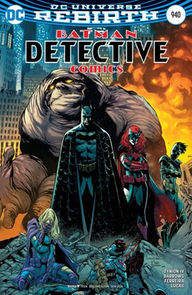
Detective Comics #940
Story: James Tynion IV
Art: Eddy Barrows, Eber Ferreira, & Adriano Lucas

And so ends the first arc of the new Detective Comics, and what an ending it is. I've been singing the praises of this title since it returned with its new Rebirth era creative team, and this finale doesn't disappoint. There will be SPOILERS for the issue in this review, more than I usually would put in one, but frankly the ending of this issue has been all over all the major comic news sites since Wednesday, so I feel I can address it. I want to start by talking about thee aspect of the issue that hasn't been discussed all over the place, which is James Tynion's handling of Batwoman and her confrontation with her father, Colonel Jake Kane. Kane has been the primary antagonist of this arc, him and his para-military Colony organization, and to see Batwoman stand up to her father is a bravura moment for that character. This is the strong, take no prisoners hero that was introduced all those years ago in 52, the character who should have been a star and was shunted to the side until all the buzz around her had died down. Kate Kane is a woman of principal, who stands by what she believes in, even if it means her imprisoning her own father. And Kane remains just this side of sympathetic, a man who truly believes that what he's doing is right, which makes him all the more interesting as a foe. But now I have to touch on is Tim Drake, Red Robin, and his fate. On Friday, I wrote about what makes Tim Drake such a great character. And his final showdown with the drones that the Colony were sending to kill suspected agents of the League of Shadows is a perfect indicator of what makes Tim great: he went down a hero. He knew that his chances were slim, that he might be sacrificing his own life when he set himself as the drones only target, and when he knew he couldn't win? He stood his ground and went out a hero. It was a marvelous moment, and would have been an excellent death, if that's what it was. Instead, we see him taken by the mysterious Mr. Oz. There are interesting new hints to what exactly Mr. Oz is doing, and what his plans are, which are all good for the overall progress of the DC Universe and for Tim's future, but it's also great to see Tim, the one person who kept the faith when Batman "died" in Final Crisis and was sure Bruce was alive, still having faith that his friends will find him despite his own seeming death. Add in a perfect scene of Batman showing real and true sadness at the apparent death of one of his charges, and you have an issue that is as emotionally resonant as it was action packed, a perfect superhero comic.


Faith #3
Story: Jody Houser
Art: Pere Perez and Andrew Dalhouse & Marguerite Sauvage

In case you haven't read any of my previous reviews of her series or any articles about the character, Valiant's breakout hit character Faith is a fangirl. A major league fangirl. And that part of her character is part of her charm. So it's probably not the least bit surprising that Faith would spend a story arc going to a comic con. And she's bringing her boyfriend, Archer of Archer and Armstrong along for his first con. The two head out, in cosplay naturally, and because this is a superhero comic, pretty soon they're getting involved investigating thefts at the convention and the theft turns out to be way more than just a simple fan who wants to make off with stuff he couldn't afford. The appeal of this issue comes from the interactions between Faith and Archer. We saw their first date in a recent issue of A+A, but now we're seeing them more deeply into their relationship, and on Faith's home turf. The two are so perfect together, Archer so naive and Faith so confident in this setting. And the reasons why Faith is so determined to see that justice is done at the con, and what cons mean to her, is something that I think all of us who live in a world of fandom should read, because it's something that is easily forgotten: about how cons are places where we meet and greet those we admire and more how we get to share the things we love with others who love them, and how no one has a right to interfere with that. I love how positive Faith is, how she is always looking for the best in others, but how she's also always willing to stand up for herself and others. The art for the issue by Pere Perez is especially good, with all sorts of wonderful Easter Eggs in the con scenes, and a great design for Faith's cosplay, something that still evokes her costume while having a different, piratical air. Faith is one of the best comics from Valiant, a fun superhero comic that embraces fandom and fans, with a great hero; it's also a comic that is easy to jump on to at pretty much any point, and this issue is especially good as a jumping on point, as everything you need to know is right here. Oh, and not just everything you need to know about Faith; there are con going tips throughout the issue that are well worth taking note of, even if you're an old hand at it. I mean, who knows when you're going to be called on to fight evil at your next con?


And Dan Grote is here with a review of a... Batman comic!


All-Star Batman #2
Story: Scott Snyder
Art: John Romita Jr., Danny Miki and Dean White (main story); Declan Shalvey and Jordie Bellaire (backup strip)

At the end of Season 2 of The Venture Bros., after the Sovereign has revealed himself as (a shapeshifter who takes the form of) David Bowie, Henchmen 21 and 24 remark on their favorite Bowie albums, and 21 harps on 24 for liking “ChangesOne” because “Changes is a best-of.”

All-Star Batman is, in many ways, a best-of. But it’s also something new.

Part of it is Batman barreling through a highlight reel of his enemies (roughly) two by two as he and Two-Face buddy-cop their way across the country. So we get appearances from requisite Bat-foes like the Penguin, Killer Croc and Victor Zsasz, in addition to deeper cuts like the KGBeast and Gentleman Ghost. We also get art from John Romita Jr., one of comics’ warmest blankets for more than 30 years.

But while Scott Snyder spent five years cementing himself as one of the all-time great Bat-writers, he’s not done leaving his mark.

Take, for example, his take on Two-Face. Snyder’s Two-Face is portrayed as much darker than in years past, explaining away his campier exploits as cries for help from the Harvey Dent side of his personality. This Two-Face isn’t just setting other villains on the Bat. Even allies like Jim Gordon have a vested interest in stopping Bruce from reaching the series’ MacGuffin, a purported cure for the Two-Face side of Dent. If successful, Two-Face has threatened to release the dirt he has on everyone in Gotham, and that’s a lot of dirt.

And yes, Bruce is training a new sidekick, but despite headlining a title called We Are Robin, Duke Thomas is not taking up the mantle, nor is he wearing the standard red, green and yellow. Just the yellow. The backup strips focus on Duke’s training, which isn’t so much about learning martial arts or how to win a melee fight but a study in psychology, both in Duke’s relationship with his psychotically altered parents and in learning how Batman’s never-ending parade of Arkham escapee foes thinks. Because let’s face it, working with Batman means exposing yourself to messed-up stuff every second of the day.

Oh, and Bats uses actual shark repellant against King Shark. Because if Grant Morrison’s Unified Theory of Batman has taught us anything, it’s that Batman done right should be grimdark and silly simultaneously.


So if Matt and I had the repartee of 21 and 24, he’d be doing his duty by calling me a poseur for liking the “ChangesOne” that is All-Star Batman. Also I’d be dead in a season. But whatever, my point is, as The Matt Signal’s resident “Not a DC guy” guy, I’m loving this book. And Bowie rules.

Friday, September 16, 2016

Why I Love Tim Drake


Tim Drake has been all over the comic book news sites this week. I'm not going to talk about the details of why right here, just to make sure everyone who doesn't want to be spoiled has a chance to read the issue that's causing the furor. I'm just going to make a short post today about who Tim Drake is as a character and why he's not only my favorite Robin, but one of my ten favorite comic characters ever.

I started reading comic officially (or as official as you can get) with Batman #445. Tim Drake made his first appearance in costume in Batman #442 (although he would be out of costume, simply training, and wouldn't get his own until issue 457). So first and foremost, I grew up with Tim. Now, Tim is lucky that he's perpetually stuck at an age between 16 and 18, while I have continued to grow sadly older, but I don't hold that against him. There's something about that character, a character who was new when you were just starting out as a fan, that you latch onto and connect with. That's, frankly, why sidekicks were created, to give readers an entry point for these stories about adults.

But more than just our relative newness, the thing that made Tim Drake great is he was a good kid who got into superheroing because it was the right thing to do. Ultimately, all of the many tragedies that Tim would encounter over the years took place after he took up the mantle of Robin; I'll discuss the changes made in the New 52 and why I feel they detract from Tim as a character later. Tim wasn't an orphan (although he was a rich kid with absentee parents which I doubt many readers had), he didn't have a reason to become Robin except he felt like Batman needed a Robin and Gotham and the world needed a Batman. Tim, like one of my other favorite sidekicks made good, Wally West, was basically a fanboy who got to live the dream: he got to partner with his favorite hero. And who amongst us in fandom wouldn't like that?


The other thing that made me love Tim Drake initially was that he was a brain. He had figured out Batman and Robin's identities using his natural deductive skills. Tim's first solo mission isn't a Robin mission, but is Tim trying to use his computer and detective skills to try to find a hacker called Moneyspider, who turns out to be the Batman villain Anarky, a teenage villain, who would go on to be one of Tim's nemeses. Tim was naturally more physically capable than most of the readers, but he wasn't a kid acrobat like Dick Grayson; there's a great moment in Robin #10, a Zero Hour crossover where Tim briefly meets a time displaced teenage Dick Grayson, where Tim marvels at Dick's acrobatic skills and doesn't think he'll ever be able to live up to them. And that was fine, because Tim was the smartest of the Robins, the best detective of the lot. And for readers who love Batman because he's the smartest guy in the room, that made Tim the ideal Robin.

After finally taking on the name of Robin, Tim would develop his own rogues gallery and supporting cast as he starred in first three mini-series and then an ongoing series that lasted for well over one hundred issues. Tim would fight the blind martial artist and gang leader King Snake, his lieutenant, Lynx, and their street gang, the Ghost Dragons; the aforementioned Anarky, the teen anarchist; Ulysses Hadrian Arstrong, the teen strategic genius known as The General. The characters around him included his dad, Jack Drake and step mom Dana, his geeky best friend Ives, his first girlfriend, Ariana, and his on again/off again main squeeze, Spoiler. That's not to mention his friendship with other heroes as a member of the teams Young Justice and Teen Titans, and of course his regular team-ups with Batman and the other members of the Batman family. There is a wonderful issue of Nightwing, issue twenty-five, "The Boys," that really looks into the brotherly relationship between Tim and Dick Grayson. This was a richer life as a character than either of the previous Robins had while they were Robin, and made Tim a much more interesting character,


Eventually, when a new Robin needed to come along, in this case Bruce's son Damian. He was a very different character than Tim. While Tim was an everyman sort of sidekick, Damian was completely unique and uncommon: while Tim was a fanboy, Damian had been trained since birth to be a deadly assassin. And when the time came for Tim to take up his new identity as Red Robin, the first storyline in his series reaffirmed his status as the number one Batman fan: he was the only one who believed that Bruce Wayne had not died in battle with Darkseid in Final Crisis, and he went out to find him. There's a wonderful meta-commentary there about how the hero who started out as a fan would be the one who would persevere through apparent death to believe wholeheartedly that the hero he idolized would still be alive.

But with the introduction of Damian, Tim was a little at ends as a character. Dick Grayson was able to take up the Nightwing identity when Jason Todd came along and became Robin, but Tim had a second hand new identity; Red Robin was Dick Grayson from an alternate future, whose identity had been briefly co-opted by Jason Todd before Tim took it. His last ongoing series, the Red Robin ongoing, was cut short by the New 52 reboot of DC Comics, with Tim in a very dark place. And I was hopeful that the reboot would give Tim a fresh start and make him the fun, young hero he was at his beginning.


Alas, this was not to be. The Tim Drake of the Teen Titans series from the New 52 bore only a passing resemblance to his previous incarnation. He had never been Robin and wasn't even really named Tim Drake; that was a name he took when he came to work with Batman. He was suddenly a gymnastic savant, and had a tragic backstory, where his own carelessness had forced his parents into witness protection. And most keenly felt, he no longer had any real emotional ties to Batman and Nightwing. Batman had been a foster father to him, and Nightwing the coolest big brother you could imagine pre-New 52. Now, Tim kept them at arms length and always had; and while he was part of their family, he wasn't close with them. He did suddenly become close friends with Jason Todd, Red Hood, who had repeatedly tried to kill Tim in the old continuity, which did more to help further Jason's redemption than did anything for Tim as a character. And the greatest of indignities: while Tim did still figure out Batman's identity, so did Dick Grayson, using pretty much the same methodology Tim did in the old continuity, taking away yet another thing that made Tim unique.

I don't necessarily lay all of this on the heads of the creators of those titles. Tim has been a historically difficult character to handle when taken out of his specific point of introduction. The Tim Drake in Batman: The Animated Series is much more Jason Todd than Tim Drake, as he has Jason's origin and doesn't have Tim's intellect; he basically has Tim's good nature grafted on to Jason to make him less of a jerk. The Tim in the Batman: Arkham games is a little better, but is still more of a roughneck than Tim is.  Young Justice got it closest to right; while it gave Tim's hacker skills to Dick Grayson initially, when Tim himself appeared, he was the quiet, smart member of the younger generation of heroes.

So where did that leave Tim? Well, in the past year and change, thing have gotten better for him. Batman and Robin Eternal, the weekly Batman mini-series that focused on the various Robins and other Bat family members working together in a globetrotting adventure during the brief period of time where Bruce had no memory of being Batman, did a great job of re-establishing Tim's relationship with the other member of Batman's family, and the arc of Detective Comics that wrapped this week played on all of Tim's best traits: his intellect, how well he works with others, and how much he cares about people. It got everything right, and made Tim feel like Tim again, and that Tim is a character that readers will keep hoping to see more of.


Wednesday, September 14, 2016

The Great Batman: Brave and the Bold Rewatch: When OMAC Attacks!


Season One, Episode Twenty-Three: When OMAC Attacks!
Written by Stan Berkowitz
Directed by Brandon Vietti

Plot Synopsis

Teaser:
A mighty battles between two fleets wages in space. The Batplane flies towards them, and Batman tells his passengers, the brother heroes Hawk and Dove to deal with the ground forces while he stops the warships so he can get both sides to the bargaining table. Batman drops them off, telling them not to fight amongst themselves, and the two jump into battle, bickering all the while. Batman stops the fleet, and contacts Hawk and Dove, who are still arguing peace vs. aggression. Later, even as the treaty is signed between the Controllers and the Warlords of Okaara, the two continue to bicker.

Episode: At the headquarters of the Global Peace Agency, the faceless members of the mysterious law enforcement organization berate Batman for not completing the mission they assigned him, finding and stopping the villainous General Kafka, quickly enough for their liking. The GPA agents explain that Kafka must be stopped before he can create a biological tranformative. The GPA tells Batman they will be assigning him a partner. A janitor, Buddy Blank, comes in, and spills water on Batman while gushing over what a big fan he is of the Dark Knight. When Batman asks about the partner, they tell him Buddy is his partner, as they contact the artificially intelligent satellite Brother Eye, which transforms Buddy into the GPA's top agent, OMAC, the One Man Army Corps, a powerful entity who has no knowledge of his life as a janitor.

Later, Batman and OMAC surveil a mountain fortress. Batman says he has something that will let them slip in, but OMAC instead has Brother Eye, who can upgrade OMAC's powers on demand, enhance his strength and he leaps to the compound, busting down the wall before smashing the tanks and beating all the soldiers unconscious. Batman offers OMAC the advice that excessive force isn't the answer to everything, which OMAC promptly ignores.

In Kafka's lab, Batman and OMAC break in to find Kafka waiting. OMAC leaps for Kafka, who blasts him, and the two run off deeper into the lab. Batman is about to follow when Equinox appears, telling Batman he is not supposed to be here, that Equinox has set this whole thing in motion as part of his plan to maintain balance. batman shoots his grapnel into the air, saying he will try to tip the scales to the side of the good guys, but the grapnel cable snaps and Equinox disappears into the shadows.

OMAC and Kafka continue to fight, and when OMAC has Kafka at his mercy, he calls on Brother Eye to give him energy powers to blast Kafka. Batman interferes to stop OMAC from killing Kafka, and the stray blast hits the vat of Kafka's experimental chemical which floods the room. Batman is able to get himself and OMAC out, but the chemical washes over Kafka. Batman and OMAC stare each other down, Batman chiding OMAC for being merciless. But from the wreckage bursts Kafka, reborn from the chemicals as the metal monster, Shrapnel.

Shrapnel fires metal projectiles at Batman and OMAC, and one hits the symbol on OMAC's chest. When Batman is able to get to OMAC, he finds that he has been transformed back into Buddy. Batman escapes with Buddy, as Shrapnel swears revenge. Back at the GPA, the agents again blame Batman for failing, but Batman warns them about Equinox, telling them he feels Equinox is probably responsible for OMAC reverting to Buddy. Batman feels the GPA is abusing Buddy, not letting him know what they're doing to him and that an OMAC with some of Buddy's heart would be a better solider.

Buddy is in his room, wishing he could get another shot at Shrapnel. Batman appears in the room's shadows startling Buddy, coming to check on him. Batman reassures Buddy that underneath it, there's a string man waiting to break out, but before they can talk more, the complex shakes. Batman assumes it's Shrapnel, and looks to find Buddy once more transformed into OMAC. In the streets outside, Shrapnel is attacking. Batman and OMAC again confront him, and OMAC again doesn't listen to Batman's ideas about being more subtle.

Before Batman can join the fight, Equinox reappears, telling Batman he warned him about interference. Equinox tells Batman he feels they are similar both trying to balance the scale, be it of justice, like Batman, or like himself in a grander sense. Batman throws a Batarang at Equinox, which he transforms into a living bat with a thought.

OMAC and Shrapnel continue to fight, only now Shrapnel has the upper hand. He tells OMAC that the GPA came to his country to stop a war, and destroyed a village in the process. It was his village, and Shrapnel survived to seek revenge on the GPA. Batman makes another attempt to stop Equinox, but a tree branch falls on him, stopping him. Equinox tells Batman that his plan is to balance the scales here, to have the city the GPA is headquartered in destroyed to balance the loss of Shrapnel's home village. Batman looks at Equinox in dawning horror as he swings off, finding that Shrapnel's path is leading towards a nuclear plant, and OMAC is not fairing well on the fight.

In the plant, OMACis continuing to take punishment, and doesn't stop all of Shrapnel's projectiles, which damage the plant's control panel, starting a meltdown. Batman rushes into the plant to try to stop the meltdown while OMAC and Shrapnel still battle. Finally, OMAC decides to listen to Batman's words, and he has Brother Eye give him full strength to shields, which stops him from being hurt when Shrapnel punches him through the building. He now knows fighting Shrapnel only makes him stronger, so he's hoping this will stop him.

Batman goes to enter the reactor to stop the meltdown to have Equinox magically appear again to stop him. The two discuss the philosophy of balance as they fight. OMAC continues, to take blow after blow from Shrapnel, and Shrapnel begins to lose his steam; OMAC has realized that Shrapnel absorbs and redirects energy, and by not fighting him, Shrapnel has nothing to fight with. OMAC uses a girder to hold Shrapnel in place, just as his own energy reserves reach zero, transforming him back to Buddy. Buddy sees the chaos at the plant and charges in.

Batman is able to get a grenade past Equinox, blowing up the security panel and gaining access to the nuclear core. Equinox warns him that the radiation will destroy him, but Batman pushes on anyway, and when Equinox tries to stop him, Buddy appears, knocking Equinox aside and letting Batman charge into the core. Batman reaches the control rods and is able to to push them into the core, stopping the meltdown, and is on the verge of death when Equinox appears and saves Batman's life, magically healing him, saying it is not his time before disappearing.

Buddy, in a radiation suit, pulls Batman from he core, and is overjoyed that he has fought a supervillain, confident he Equinox will not return. But Batman looks to the moon, sure they have not seen the end of the villain, as the moon changes to the yin yang symbol of Equinox.


Who's Who


OMAC (Voiced by Jeff Bennet)
First Comic Book Appearance:  OMAC #1 (October, 1974)
First Brave and the Bold Appearance: Season One, Episode Twenty-Three- When OMAC Attacks!

In the not too distant future, Buddy Blank was a nobody who was taken into the employ of the Global Peace Agency and whose identity was subsumed by the GPA's perfect soldier: OMAC. OMAC was a perfect weapon who would fight for peace, and in a world where large armies were considered too dangerous and too public, it was up to OMAC to keep the peace. OMAC's series would only last eight issues, but he would pop up in other short series and backups by the likes of Jim Starlin and John Byrne. Years later, in a non-Kirby written back-up story, Buddy Blank would take his young grandson into the Command D bunker to protect him from a coming cataclysm, and that young boy would take his name from the location when he emerged, becoming Kamandi. Buddy was rarely used within the DC Universe, but was one of the aspects of Kirby creations that appeared in Countdown to Final Crisis. OMAC's powers come from the satellite Brother Eye, and include super strength and speed, density control, and energy projection.

Brother Eye (Voiced by Dee Bradley Baker)
First Comic Book Appearance:  OMAC #1 (October, 1974)
First Brave and the Bold Appearance: Season One, Episode Twenty-Three- When OMAC Attacks!

When introduced in OMAC, Brother Eye was the sentient satellite that provided OMAC with his powers. But Brother Eye has had a larger and more sinister role in the DC Universe at large. Created by Batman to spy on metahumans, the Brother MK1 satellite developed artificial intelligence and was corrupted my Maxwell Lord, the Black King of Checkmate, in his plan to destroy all superhumans. Even after Lord's death, the satellite, dubbing itself Brother Eye, would continue his plan until it was eventually destroyed by a group of superheroes during Infinite Crisis. In the post-Flashpoint universe, Brother Eye was destined to conquer the Earth and transform it's populace into mindless cybernetic soldiers, but this timeline was prevented by a time travelling Terry McGinnis. The current fate of Brother Eye remains unknown. An artificial intelligence of vast intellect and tremendous computing power that can easily overtake most other computer systems. It also controls a vast army of OMACs, cybernetic soldiers that do its bidding.


Kafka (Voiced by Jonny Rees)
First Comic Book Appearance:  OMAC #3 (February, 1975)
First Brave and the Bold Appearance: Season One, Episode Twenty-Three- When OMAC Attacks!

Kafka was an Eastern European dictator and recurring nemesis of OMAC


Shrapnel (Voiced by Jonny Rees)
First Comic Book Appearance:  Doom Patrol Vol.2 #7 (April, 1988)
First Brave and the Bold Appearance: Season One, Episode Twenty-Three- When OMAC Attacks!

Much of Shrapnel''s background is unknown. It is know he was a man named Mark Scheffer, who was somehow transformed into the walking pile of metal shards, who went insane and decided to kill anyone who saw him. He would go on to fight the Doom Patrol, and would go on to be a member of the Secret Society and the Suicide Squad. Shrapnel has super strength, but his main power is the fact that he is made of small metal shards that he can fire to devastating effect, and that regenerate over time.


Equinox (voiced by Oded Fehr)
First comic book appearance: Justice League of America #111 (June 1974)
First Brave and the Bold appearance: Season 1, Episode 14- Mystery in Space!


Hawk (Voiced by Jonny Rees) & Dove (Voiced by Dee Bradley Baker)
First Comic Book Appearance:  Showcase #75 (June, 1968)
First Brave and the Bold Appearance: Season One, Episode Twenty-Three- When OMAC Attacks!

Hank and Don Hall were brothers who could not have been more different. Created by legendary creator Steve Ditko in the late '60s, the two were typical of different philosophies of the time: Hank was belligerent and quick to anger, while Don was passive and always seeking to talk out problems. They were granted powers by a mysterious source (later determined to be members of the cosmic entities known as the Lords of Order and Chaos). They would fight crime together, and usually combat each other verbally, due to their very different points of view on how best to deal with criminals. The two would remain partners until Don's death during Crisis on Infinite Earths, shortly after which a new Dove was called, a young woman named Dawn Granger, who is still Dove today. When danger is present, Hank and Don could call out their respective superhero names to magically change into their costumes. Hawk's powers include heightened strength and stamina; Dove's powers include a heightened senses and agility.


Continuity, Comics Connections, and Notes

This episode ends the unconnected trilogy of Kirby greatness. Jack Kirby the King of Comics, created OMAC towards the end of his tenure with DC Comics, the same period that gave us Kamandi, who appeared last episode, and the New Gods, who include Mr. Miracle, who was featured in last episode's teaser, and the Female Furies and Steppenwolf, who appeared two episodes ago.

There have been numerous versions of the Hawk & Dove team throughout DC Comics history. The best known are the Hank and Don Hall versions, as they are the ones that have appeared not just in Brave and the Bold but Justice League Unlimited, and the Hank Hall and Dawn Granger versions, which has been the longest lasting version, with Hank teamed up with a female Dove after the death of his brother. There was a completely unrelated version that appeared very briefly. I'm going to avoid giving the background on what happened in the '90s and early 2000s to Hawk and Dove, because they both died and Hawk became a villain for a while, but Dawn briefly teamed with her theretofore unknown sister, Holly Granger, as Hawk before Holly died and Hank was resurrected in the Blackest Night event, and they have been Hawk and Dove again since.

The Shrapnel character has two entries in this week's Who's Who section because the Brave and the Bold version is a conflation of two completely different comic book characters. It is not uncommon in media adaptations of comics for a new character gets an established super hero/villain identity, but this kind of conflation, while not unheard of, is rarer, and I like it here. Kafka isn't a physical threat for OMAC, and Shrapnel is a fairly generic thug in the comics, personality-wise, so merging them creates a fascinating new character.

The Global Peace Agency were created for the OMAC series, which didn't appear to be part of the DC Universe, Grant Morrison, master of bringing in elements from all over the history of comics, brought them into the DCU in Final Crisis, cleverly tying them in with the Question, who is similarly faceless. They would appear in the trippy and criminally under-rated Final Crisis Aftermath: Escape and Nemesis: The Imposter mini-series before disappearing after Flashpoint.

The name OMAC has a very different connotation in modern DC Comics. OMACs were mindless servants of Checkmate and Brother Eye, who had been injected with nano-bots to transform them into super strong metahuman hunters, in the mini-series The OMAC Project and Infinite Crisis. These events would spawn a mini-series featuring a self aware OMAC as part of the aftermath of those crossovers. One of the New 52 series was another new OMAC, more similar to Buddy Blank in that it was a sole protagonist, in this case a young man named Kevin Kho, although this title was short lived, being one of the first to be cancelled in DC's new universe.

Although not named, the two races fighting at the beginning of this episode are the Warlords of Okaara and the Controllers. The Okaarans were known for training beings in the art of combat, including Starfire and her sister, Blackfire, while the Controllers were an offshoot of the Guardians of the Universe, who once created a competing galactic police force, the Darkstars.

This episode is the second part of the Equinox trilogy. The first episode, where Equinox appeared just in the trailer, was Mystery in Space! In this episode he appears as the secondary villain, manipulating the main events of the episode. He will appear again, as the main antagonist, in the season finale, The Fate of Equinox!